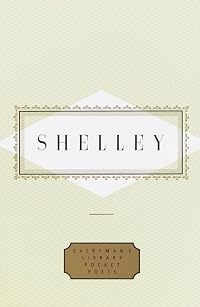
Shelley: Poems (Everyman's Library Pocket Poets)
by Percy Bysshe Shelley
On This Page
Description
A pocket-sized anthology of poems by Romantic-era poet Percy Bysshe Shelley.Tags
Recommendations


Member Reviews
Imagine this scene: Somewhere in the awesome surroundings of the French Alps, incessant summer rains covering the valleys with a moist, foggy veil. Inside a cottage, Lord Byron, Percy Bysshe Shelley and his wife, Mary, are discussing life, principle and the mysterious fears of human nature, which strangely comes alive with thrilling horrors. Mischievous Lord Byron, always ready to experiment, suggests a ghost story competition. The three set to work.
This is the original seed that will grow to become Mary Shelley's most powerful tale, Frankenstein, making her hero-villain and his unnamed Creation more famous than herself, and therefore, than her husband Percy.
Sceptreless, free, uncircumscribed, but man
Equal, unclassed, tribeless, and show more nationless
Exempt from awe, worship, degree. Prometheus Unbound.
I had always linked "Shelley" with “Frankenstein”, oblivious of what else might be found in that surname.
Reading this selection of poems has allowed me to see that there is indeed much of Shelley in “Frankenstein”, but his influence in that novel is far from being his only contribution to the literary world. A new universe of beautiful emotional intensity; throbbing with intelligent, unsettled, offbeat pulse has opened up to me with Shelley’s verse.
His alluring heroes (as with Lord Byron's) are often hardly distinguishable from their creator, they are gripped by the idea that the "principle of life" is somehow to be found in probing into the mysteries of death and decay, never in religion, and his ideas about the necessity of atheism and his doubts regarding the real significance of good and evil were enough to label him as a radical and gained him no popularity at the time.
But apart from the brooding despair of some of his poems, Shelley also exemplifies the purest Romanticist form with his joyous ecstasy when describing interchange with nature, the power of the visionary imagination, the pursuit of ideal love or the untamed spirit ever in search of freedom.
In this sense, I found Shelley speaking directly to me, his voice echoing as mine, treading the path of insurgency alongside him. Hymn to Intellectual Beauty and Montblanc, two of his finest poems, are clear examples of his defiant nature:
No voice from some sublimer world hath eve
To sage or poet these responses given:
Therefore the names of Demon, Ghost, and Heaven,
Remain the records of their vain endeavour:
Frail spells whose utter'd charm might not avail to sever,
From all we hear and all we see,
Doubt, chance and mutability.
Thy light alone like mist o'er mountains driven,
Or music by the night-wind sent
Through strings of some still instrument,
Or moonlight on a midnight stream,
Gives grace and truth to life's unquiet dream. Hymn to intellectual beauty.
In these poems one can also notice Wordsworth's essence in Shelley, as he suggests how his imagination and poetic sensitivity were formed by nature.
But somehow, I sense in Shelley a more enigmatic power than in Wordsworth, skepticism and doubt oozing from his verses:
And what were thou, and earth, and stars, and sea,
If to the human mind’s imaginings
Silence and solitude were vacancy? Montblanc.
The enigmatic mountain leaves the speaker with no assurance that the imagination may endow with meaning the awful blankness of nature, and challenges the reader to enter into a philosophical discussion similar to Kant's ideal of intellectual autonomy versus the conservative belief based on testimony or unquestioned religious tradition.
And although Shelley was aware that his uncommon approaches would never be popular, he persisted in filling his poems with symbolism and imagery, giving voice to his rebellious heroes, such as the like of Prometheus, who represented the mind or soul of a man in its highest potential.
His name forever linked with those of Byron and Keats, Shelley has come to symbolize the free and soaring spirit of humankind, and having entered his universe I am overjoyed to have discovered yet another restless mind, always aspiring to ever-loftier ideals of perfecting the self, and above all, with a confident voice filled with never faltering hope.
Shelley's works will never be read by the masses, although his wish in Ode to the West Wind is perhaps closer to coming true today than he would have dared imagine:
by the incantation of this verse,
Scatter, as from an unextinguished hearth
Ashes and sparks, my words among mankind!.
Shelley’s ideas, embodied in his verse, remain as a challenge to the currently subservient acceptance of authority and also as a remainder that it is our duty to never cease to aspire to higher goals for ourselves and to, as Kant said, Sapere aude, Dare to be Wise. show less
This is the original seed that will grow to become Mary Shelley's most powerful tale, Frankenstein, making her hero-villain and his unnamed Creation more famous than herself, and therefore, than her husband Percy.
Sceptreless, free, uncircumscribed, but man
Equal, unclassed, tribeless, and show more nationless
Exempt from awe, worship, degree. Prometheus Unbound.
I had always linked "Shelley" with “Frankenstein”, oblivious of what else might be found in that surname.
Reading this selection of poems has allowed me to see that there is indeed much of Shelley in “Frankenstein”, but his influence in that novel is far from being his only contribution to the literary world. A new universe of beautiful emotional intensity; throbbing with intelligent, unsettled, offbeat pulse has opened up to me with Shelley’s verse.
His alluring heroes (as with Lord Byron's) are often hardly distinguishable from their creator, they are gripped by the idea that the "principle of life" is somehow to be found in probing into the mysteries of death and decay, never in religion, and his ideas about the necessity of atheism and his doubts regarding the real significance of good and evil were enough to label him as a radical and gained him no popularity at the time.
But apart from the brooding despair of some of his poems, Shelley also exemplifies the purest Romanticist form with his joyous ecstasy when describing interchange with nature, the power of the visionary imagination, the pursuit of ideal love or the untamed spirit ever in search of freedom.
In this sense, I found Shelley speaking directly to me, his voice echoing as mine, treading the path of insurgency alongside him. Hymn to Intellectual Beauty and Montblanc, two of his finest poems, are clear examples of his defiant nature:
No voice from some sublimer world hath eve
To sage or poet these responses given:
Therefore the names of Demon, Ghost, and Heaven,
Remain the records of their vain endeavour:
Frail spells whose utter'd charm might not avail to sever,
From all we hear and all we see,
Doubt, chance and mutability.
Thy light alone like mist o'er mountains driven,
Or music by the night-wind sent
Through strings of some still instrument,
Or moonlight on a midnight stream,
Gives grace and truth to life's unquiet dream. Hymn to intellectual beauty.
In these poems one can also notice Wordsworth's essence in Shelley, as he suggests how his imagination and poetic sensitivity were formed by nature.
But somehow, I sense in Shelley a more enigmatic power than in Wordsworth, skepticism and doubt oozing from his verses:
And what were thou, and earth, and stars, and sea,
If to the human mind’s imaginings
Silence and solitude were vacancy? Montblanc.
The enigmatic mountain leaves the speaker with no assurance that the imagination may endow with meaning the awful blankness of nature, and challenges the reader to enter into a philosophical discussion similar to Kant's ideal of intellectual autonomy versus the conservative belief based on testimony or unquestioned religious tradition.
And although Shelley was aware that his uncommon approaches would never be popular, he persisted in filling his poems with symbolism and imagery, giving voice to his rebellious heroes, such as the like of Prometheus, who represented the mind or soul of a man in its highest potential.
His name forever linked with those of Byron and Keats, Shelley has come to symbolize the free and soaring spirit of humankind, and having entered his universe I am overjoyed to have discovered yet another restless mind, always aspiring to ever-loftier ideals of perfecting the self, and above all, with a confident voice filled with never faltering hope.
Shelley's works will never be read by the masses, although his wish in Ode to the West Wind is perhaps closer to coming true today than he would have dared imagine:
by the incantation of this verse,
Scatter, as from an unextinguished hearth
Ashes and sparks, my words among mankind!.
Shelley’s ideas, embodied in his verse, remain as a challenge to the currently subservient acceptance of authority and also as a remainder that it is our duty to never cease to aspire to higher goals for ourselves and to, as Kant said, Sapere aude, Dare to be Wise. show less
One of the great Romantic lyric poets of the English language. Too bad he wasn't successful during his life except among his close circle of friends. Today he is considered brilliant. I concur. This short book of examples of his poetry, entices the reader to pick up other volumes of his work.
Shelley nails it with his lyrical poems
Ratings
Members
- Recently Added By
Lists

The Road to Freedom (Will Durant's 100 Best Books for an Education)
100 works; 8 members
Author Information

532+ Works 8,030 Members
Born in Field Place, near Horsham in Sussex, Shelley was educated at Syon House Academy and Eton, where he acquired the sobriquet "Mad Shelley" for his independent spirit. While at Eton he published Zastrozzi (1810), a Gothic novel. Expelled from Oxford because he refused to retract his atheistic beliefs, Shelley quarreled with his wealthy father show more and was banished from home. Shelley married impulsively and then abandoned his young wife to run off to Italy with the 16-year-old Mary Wollstonecraft Godwin (the daughter of the radical feminist and the anarchist philosopher, who was eventually to write Frankenstein). While in Italy, Shelley became close friends with Byron, and the two became objects of endless, notorious rumor. Shelley's personal character was revered by almost everyone who knew him. Extremely generous toward others, frugal with himself, he strove tirelessly for the betterment of humanity. Prometheus Unbound (1820), a lyrical drama in four acts, calls for the regeneration of society through love and for the destruction of all repressive institutions. The Cenci (1819), a verse drama based on real events, is one of the few plays from the romantic period still produced. Shelley's lyrics are marvelously varied and rich in sound and rhythm. Wordsworth regarded him as the best artist among living poets.Adonais (1821), written to honor the memory of John Keats, is one of the supreme elegies in English.The Triumph of Life, which was left incomplete at his death, has been hailed by T. S. Eliot as the nearest approach in English to Dante (see Vol. 2). The "Ode to the West Wind" and "To a Skylark" are anthologized everywhere. Shelley's early death by drowning ended his career just as it was coming into full flower. A revolutionary in his art and life, Shelley is considered by many to be an inspired polemicist and poetic genius. As one of his contemporaries wrote in Etonian (1821), "He is one of the many whom we cannot read without wonder, or without pain. . . ." (Bowker Author Biography) show less
Series
Belongs to Publisher Series
Common Knowledge
- Disambiguation notice
- This is the selection for "Everyman's Library Pocket Poets". Please do not combine with other selections unless you can confirm that the contents are the same.
Classifications
Statistics
- Members
- 248
- Popularity
- 131,237
- Reviews
- 3
- Rating
- (4.18)
- Languages
- English
- Media
- Paper, Ebook
- ISBNs
- 4
- ASINs
- 1