
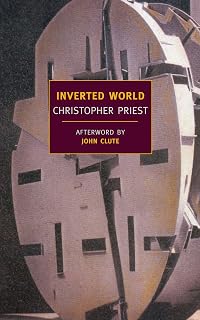
Inverted World
by Christopher Priest
On This Page
Description
The city is winched along tracks through a devastated land full of hostile tribes. Rails must be freshly laid ahead of the city and carefully removed in its wake. Rivers and mountains present nearly insurmountable challenges to the ingenuity of the city's engineers. But if the city does not move, it will fall farther and farther behind the "optimum" into the crushing gravitational field that has transformed life on Earth. The only alternative to progress is death. The secret directorate that show more governs the city makes sure that its inhabitants know nothing of this. Raised in common in crèches, nurtured on synthetic food, prevented above all from venturing outside the closed circuit of the city, they are carefully sheltered from the dire necessities that have come to define human existence. And yet the city is in crisis. The people are growing restive, the population is dwindling, and the rulers know that, for all their efforts, slowly but surely the city is slipping ever farther behind the optimum. Helward Mann is a member of the city's elite. Better than anyone, he knows how tenuous is the city's continued existence. But the world--he is about to discover--is infinitely stranger than the strange world he believes he knows so well. show lessTags
Recommendations
















Member Reviews
A group of Earthlings living precariously on an impossible world must go to great lengths in order to survive, until they discover just how impossible their world actually is... I didn't realize a book could still take me by surprise but despite a slow first half describing the mundane day-to-day workings of an enclosed mobile city, Christopher Priest ends his novel with a one-two punch of physics and psychology that had me rereading paragraphs just to fully appreciate the twists. A sci-fi mystery that also serves as a timely allegory in this age of social polarization and conspiracy theories.
This is a strangely compelling science fiction novel about belief and perception. A city must move (on rails) ever northward to stay alive. Saying more would be to spoil the discoveries the reader makes through the eyes of the story's protagonist, Helward, who passes through the various Guilds that run the city and keep its secrets.
It is questionable whether the book truly delivers on its premise, and the ending is rather abrupt, but it does leave the reader with a lot of food for thought, and the story is told in a compelling manner that maintains interest. At its best, it reminds me of why I used to devour so much science fiction when I was younger.
It is questionable whether the book truly delivers on its premise, and the ending is rather abrupt, but it does leave the reader with a lot of food for thought, and the story is told in a compelling manner that maintains interest. At its best, it reminds me of why I used to devour so much science fiction when I was younger.
What a wonderfully executed book! The structure of the book, its pace, how it negotiates between first-person, third-person, and a more distanced narrator in one section, are all handled superbly and lend a cadence to the episodes in the novel as well.
I did almost give up halfway through Part 1, and I assume many readers might find the detailed pages—and pages and pages—of track-laying laborious. But, just as it is laborious for Helward, so, too, must it be for the reader; this is the crux of the "inverted world" and having this background allows what happens to make sense... as well as nonsense.
What I really found interesting here was how Priest handles gender and class in this seemingly organized world of the city. The social show more commentary here, aimed right back at late-1960s and early-1970s Britain, is unabrasive but it is also unrelenting, proving that speculative fiction can speak to social and cultural issues "on the ground," as it were.
Having not really read around much in the genre of speculative and/or science fiction apart from Atwood and some of the more canonical titles, I will say that Priest's ease at handling this material—and his talent at making it resonate and be of such immense interest—has me very eager to explore this genre in some more depth. show less
I did almost give up halfway through Part 1, and I assume many readers might find the detailed pages—and pages and pages—of track-laying laborious. But, just as it is laborious for Helward, so, too, must it be for the reader; this is the crux of the "inverted world" and having this background allows what happens to make sense... as well as nonsense.
What I really found interesting here was how Priest handles gender and class in this seemingly organized world of the city. The social show more commentary here, aimed right back at late-1960s and early-1970s Britain, is unabrasive but it is also unrelenting, proving that speculative fiction can speak to social and cultural issues "on the ground," as it were.
Having not really read around much in the genre of speculative and/or science fiction apart from Atwood and some of the more canonical titles, I will say that Priest's ease at handling this material—and his talent at making it resonate and be of such immense interest—has me very eager to explore this genre in some more depth. show less
Well, this novel slowly snuck up on me, slowly but unstoppably. The first 70 pages or so seem fairly straight-forward future dystopia - not with all questions answered, but still. And then we get into the meat of the plot and it becomes something else entirely. Sure, you can (and possibly should) find all sorts of common vibrations here; of how we don't all live in the same (perceived) world, of how the constant hunt for the future ravages the present, of how we're always prepared to do horrible things rather than reshape our reality. But honestly, the one thing that kind of bugs me about the book is that we get it spelled out in the end. (If you believe it. It's all relative.) It's in the sheer panicked movement forward that the novel show more lives. Like a shark. On land. Without fins. It's in the impossibility of knowing what someone else sees. In the vertigo of passing through.
Train kept a-rolling all night long
Train kept a-rolling all night long
With a heave, and a ho
But I just couldn't let her go show less
Train kept a-rolling all night long
Train kept a-rolling all night long
With a heave, and a ho
But I just couldn't let her go show less
This is a beguiling read. We're presented with so much in the way of supportive material, detailed 'facts' about what is happening, about what we're supposed to be witnessing, and yet we are left doubting everything. Like the notional protagonist of the tale we are left -- literally and figuratively -- all at sea; and though it's indicated at the end that the protagonist intends to return to shore, the reader is still left floundering.
The opening seems to suggest we're on solid ground. Helward Mann lives in a city called Earth. It's towed forward on rails towards and beyond what is declared an optimum point but cannot ever keep still; only apprentices in the various guilds that keep the city mobile are ever put in a position to show more understand why it's imperative that the city moves and then they dare not ever contemplate any alternative. Much of the novel is told from Helward's point of view, meaning that we are bound to accept his perception of what the truth of the matter is; but little by little, when our attention is shifted from Mann's autobiography to a third-person narrative and to a outsider's perspective, we realise that all is not as it seems.
I shall follow convention and not reveal the 'twist' that occurs towards the end, though to be honest it didn't take much to fathom what the 'reality' of this future world was well before the final sections.
The central concept of a city moving forward on four sets of tracks is so arresting that it carried this reader through most of the book till it was stopped, quite literally in its tracks, by a barrier no land-based transport can cross: the sea. Other writers have taken this, or a similar concept of a community on rails, and run with it, notably Philip Reeve's Mortal Engines (2001) and China Miéville's Railsea (2012) and Iron Council (2004), but here the solid ground I mentioned earlier is not as reliable as we at first thought: it's moving, and the city has to move inexorably forward or be doomed to extinction.
This novel at first appears to be in the so-called hard SF genre. There's discussion of hyperbolas, of infinite worlds bound within a finite universe and a mysterious energy that distorts time and space. To the distress of true scientific geeks none of it stacks up, however much it appears acceptably convincing to the innocent reader in terms of pushing the narrative on.
What Inverted World really boils down to, however, is perception: not just physical perception -- through our eyes, our sense of touch and so on -- but what our minds have been conditioned to believe is reality. This is Helward Mann's problem: the mental paradigm he has inherited and accepted through personal experience is challenged by outsiders who function according to different paradigms. Interestingly, Helward's challenges come from two strong independently-minded women who upset the status quo of this male-dominated urban society in ways that fundamentally question the parameters under which it has existed for two centuries.
I see this as a philosophical novel, one which looks askance at our beliefs in progress (towards what? an illusion?), our devastation of the earth (this was a novel written in the shadow of the Cold War) and blind acceptance of self-perpetuating political systems. Its successful attempts to disorientate us are underpinned by shifts in points of view and authorial voice and by its matter-of-fact prose stripped of any poetry or passion.
Whatever its failings -- and there are a few, such as a cast of characters with rather cold personalities whom it's hard to empathise with -- it's still a haunting read; and maybe those 'failings' are deliberate, attempts at opacity and distancing to serve as a warning of the kind of bleak future mankind is heading towards. Towards Hell, perhaps.
https://wp.me/s2oNj1-inverted show less
The opening seems to suggest we're on solid ground. Helward Mann lives in a city called Earth. It's towed forward on rails towards and beyond what is declared an optimum point but cannot ever keep still; only apprentices in the various guilds that keep the city mobile are ever put in a position to show more understand why it's imperative that the city moves and then they dare not ever contemplate any alternative. Much of the novel is told from Helward's point of view, meaning that we are bound to accept his perception of what the truth of the matter is; but little by little, when our attention is shifted from Mann's autobiography to a third-person narrative and to a outsider's perspective, we realise that all is not as it seems.
I shall follow convention and not reveal the 'twist' that occurs towards the end, though to be honest it didn't take much to fathom what the 'reality' of this future world was well before the final sections.
The central concept of a city moving forward on four sets of tracks is so arresting that it carried this reader through most of the book till it was stopped, quite literally in its tracks, by a barrier no land-based transport can cross: the sea. Other writers have taken this, or a similar concept of a community on rails, and run with it, notably Philip Reeve's Mortal Engines (2001) and China Miéville's Railsea (2012) and Iron Council (2004), but here the solid ground I mentioned earlier is not as reliable as we at first thought: it's moving, and the city has to move inexorably forward or be doomed to extinction.
This novel at first appears to be in the so-called hard SF genre. There's discussion of hyperbolas, of infinite worlds bound within a finite universe and a mysterious energy that distorts time and space. To the distress of true scientific geeks none of it stacks up, however much it appears acceptably convincing to the innocent reader in terms of pushing the narrative on.
What Inverted World really boils down to, however, is perception: not just physical perception -- through our eyes, our sense of touch and so on -- but what our minds have been conditioned to believe is reality. This is Helward Mann's problem: the mental paradigm he has inherited and accepted through personal experience is challenged by outsiders who function according to different paradigms. Interestingly, Helward's challenges come from two strong independently-minded women who upset the status quo of this male-dominated urban society in ways that fundamentally question the parameters under which it has existed for two centuries.
I see this as a philosophical novel, one which looks askance at our beliefs in progress (towards what? an illusion?), our devastation of the earth (this was a novel written in the shadow of the Cold War) and blind acceptance of self-perpetuating political systems. Its successful attempts to disorientate us are underpinned by shifts in points of view and authorial voice and by its matter-of-fact prose stripped of any poetry or passion.
Whatever its failings -- and there are a few, such as a cast of characters with rather cold personalities whom it's hard to empathise with -- it's still a haunting read; and maybe those 'failings' are deliberate, attempts at opacity and distancing to serve as a warning of the kind of bleak future mankind is heading towards. Towards Hell, perhaps.
https://wp.me/s2oNj1-inverted show less
This novel made quite a stir when it was first published in 1974. It has a striking opening: "I had reached the age of six hundred and fifty miles." The novel tells the story of Helward Mann, a guild apprentice of the City of Earth, which for its own survival and that of everyone in it has to keep moving forward, or some disaster will befall.
It soon becomes clear that there is something odd about this world, or at least Helward Mann's perception of it. Sent on missions outside the City, Mann experiences variations in time and spatial dimensions; something he has in common with all the other apprentices and guildsmen who venture any distance away from the City. Exploring the perception of the world, and how that varies for different show more people is the theme of the novel.
Varying perceptions was to be a major theme of Christopher Priest's novels for the rest of his career. This novel was nominated for science fiction's Hugo Award, and it won the British Science Fiction Association's top award for 1974; it probably represents the high-water mark of Priest's overtly science fictional writing career. For whilst Priest would return to the themes in this book quite frequently, in future work - especially his Dream Archipelago stories - he would not again attempt to put a mechanistic, science-fictional rationale behind the events and situations he describes.
The novel is written in a fairly austere style, especially where Helward Mann is relating his own experiences. He has been raised in the City, by the City, and so is a somewhat institutionalised individual, and some readers have found his character cold and impersonal. As other characters are introduced, specifically Liz Khan, a woman from outside the City, Priest injects more feeling into the narrative. The world Liz Khan comes from, whilst directly intersecting with that of the City, nonetheless represents an alternate reality to Mann's. At the end of the story, we are left wondering how Helward Mann will interpret that reality.
Liz Khan's world centres at first on a Mediterranean village, with a prologue that seems straight out of the travel writing of the era. I have a personal theory that Chris Priest was influenced in part by the travel writing of the British adventurer Patrick Leigh Fermor, and the prologue certainly supports that view. Attitudes towards women are those of the 1970s, although Priest has his female characters - Liz Khan and Victoria (a City woman who is briefly married to Mann) - challenge the accepted views of the time.
This is certainly a novel of its time. yet its strangeness makes it hard to forget. Before China Miéville showed us Railsea, or Philip Reeve the cities of Mortal Engines, the City of Earth was winching itself across the landscape, inviting us to see the world through Helward Mann's eyes.
My 1975 New English Library paperback has illustrations by the late Andrew Stephenson which encapsulate some of the off-kilter strangeness of Mann's world. More recently, Gollancz have reprinted the novel in their SF Masterworks series. show less
It soon becomes clear that there is something odd about this world, or at least Helward Mann's perception of it. Sent on missions outside the City, Mann experiences variations in time and spatial dimensions; something he has in common with all the other apprentices and guildsmen who venture any distance away from the City. Exploring the perception of the world, and how that varies for different show more people is the theme of the novel.
Varying perceptions was to be a major theme of Christopher Priest's novels for the rest of his career. This novel was nominated for science fiction's Hugo Award, and it won the British Science Fiction Association's top award for 1974; it probably represents the high-water mark of Priest's overtly science fictional writing career. For whilst Priest would return to the themes in this book quite frequently, in future work - especially his Dream Archipelago stories - he would not again attempt to put a mechanistic, science-fictional rationale behind the events and situations he describes.
The novel is written in a fairly austere style, especially where Helward Mann is relating his own experiences. He has been raised in the City, by the City, and so is a somewhat institutionalised individual, and some readers have found his character cold and impersonal. As other characters are introduced, specifically Liz Khan, a woman from outside the City, Priest injects more feeling into the narrative. The world Liz Khan comes from, whilst directly intersecting with that of the City, nonetheless represents an alternate reality to Mann's. At the end of the story, we are left wondering how Helward Mann will interpret that reality.
Liz Khan's world centres at first on a Mediterranean village, with a prologue that seems straight out of the travel writing of the era. I have a personal theory that Chris Priest was influenced in part by the travel writing of the British adventurer Patrick Leigh Fermor, and the prologue certainly supports that view. Attitudes towards women are those of the 1970s, although Priest has his female characters - Liz Khan and Victoria (a City woman who is briefly married to Mann) - challenge the accepted views of the time.
This is certainly a novel of its time. yet its strangeness makes it hard to forget. Before China Miéville showed us Railsea, or Philip Reeve the cities of Mortal Engines, the City of Earth was winching itself across the landscape, inviting us to see the world through Helward Mann's eyes.
My 1975 New English Library paperback has illustrations by the late Andrew Stephenson which encapsulate some of the off-kilter strangeness of Mann's world. More recently, Gollancz have reprinted the novel in their SF Masterworks series. show less
This novel is actually all kinds of amazing when it comes to the exploration of a few core ideas and more than very decent when it comes to exploring humanity, perception, and irreconcilable differences.
The story is ostensibly a coming of age story, an acceptance of one's world, and then, eventually a deep dissent without a true solution, but it comes across so easily, so effortlessly, that I'm truly unsurprised that this was nominated for the Hugo in '75 and won the British SF award in the same. So the characters are good, the story is very solid... then what, exactly, makes this novel stand out?
The concept. An intersection of our Earth with these people's Earth. Not original enough? No problem. How about an infinite space of earth show more along a fluid time? The city is on rails, a direct concept that is carried over to [b:Railsea|12392681|Railsea|China Miéville|https://d.gr-assets.com/books/1321409808s/12392681.jpg|17373771], travelling slowly into the future and away from the past, which doesn't sound so surprising except when you realize that if the inhabitants actually walk in one direction or another, they actually explore the real past or the future. Infinite space along a traversable time, the inverse of the Earth we actually live in.
But this is where the story gets interesting. There's guilds and explorers and the crossing over along very predefined instants where the two Earths meet, and then we start asking questions about perception.
It's truly much more than this, but it gives you a nice taste and it's truly a grand exploration of ideas across many points. :)
Truly a great recommendation for any SF lover. :) show less
The story is ostensibly a coming of age story, an acceptance of one's world, and then, eventually a deep dissent without a true solution, but it comes across so easily, so effortlessly, that I'm truly unsurprised that this was nominated for the Hugo in '75 and won the British SF award in the same. So the characters are good, the story is very solid... then what, exactly, makes this novel stand out?
The concept. An intersection of our Earth with these people's Earth. Not original enough? No problem. How about an infinite space of earth show more along a fluid time? The city is on rails, a direct concept that is carried over to [b:Railsea|12392681|Railsea|China Miéville|https://d.gr-assets.com/books/1321409808s/12392681.jpg|17373771], travelling slowly into the future and away from the past, which doesn't sound so surprising except when you realize that if the inhabitants actually walk in one direction or another, they actually explore the real past or the future. Infinite space along a traversable time, the inverse of the Earth we actually live in.
But this is where the story gets interesting. There's guilds and explorers and the crossing over along very predefined instants where the two Earths meet, and then we start asking questions about perception.
It's truly much more than this, but it gives you a nice taste and it's truly a grand exploration of ideas across many points. :)
Truly a great recommendation for any SF lover. :) show less
Members
- Recently Added By
Published Reviews
ThingScore 25
"... it is certainly one of the strangest SF novels of all time. Unfortunately the ending lets you down almost as badly as the traditional dream in Nineteenth Century stories."
added by RBeffa
Lists

Best Dystopias
280 works; 276 members
501 Must-Read Books
529 works; 71 members

Bibliography for Among Others
159 works; 15 members

Survey of Classic Dystopias
29 works; 4 members

S.F. Masterworks (Complete)
229 works; 15 members

David Pringle's Science Fiction: The 100 Best Novels
101 works; 9 members

SF Masterworks
193 works; 8 members
One Book, Many Authors
441 works; 40 members

Top Five Books of 2015
811 works; 241 members

Books Read in 2024
4,623 works; 126 members

La Bibliothèque idéale de la SF (Éditions Albin Michel, 1988)
52 works; 1 member
Talk Discussions
Past Discussions
Inverted World by Christopher Priest -- Spoiler Thread in Science Fiction Fans (September 2008)
Author Information

63+ Works 11,856 Members
Some Editions
Awards and Honors
Series
Belongs to Publisher Series
Work Relationships
Is contained in
Is an expanded version of
Common Knowledge
- Canonical title
- Inverted World
- Original title
- Inverted World
- Alternate titles*
- Der steile Horizont; Inversion
- Original publication date
- 1974
- People/Characters
- Helward Mann; Victoria Delrouex; Elizabeth Khan; Future Denton; Track Malchuskin; Future Clausewitz (show all 13); Barter Collins; Bridge-Builder Lerouex; Gelman Jase; Future Blayne; Rafael; Navigator McMahon; Dorita
- Important places
- Portugal
- Important events
- Coordinated Attack by the Tooks
- Epigraph
- Whereso'er I turn my view,
All is strange, yet nothing new;
Endless labour all along,
Endless labour to be wrong
— Samuel Johnson - Dedication
- To my mother and father
- First words
- Elizabeth Khan closed the door of the surgery, and locked it. (From Prologue)
I had reached the age of six hundred and fifty miles. (From Chapter 1 of Part 1) - Last words
- (Click to show. Warning: May contain spoilers.)As darkness fell I swam back through the surf to the beach.
- Original language*
- Englisch
*Some information comes from Common Knowledge in other languages. Click "Edit" for more information.
Classifications
Statistics
- Members
- 2,069
- Popularity
- 9,994
- Reviews
- 70
- Rating
- (3.89)
- Languages
- 11 — Czech, English, Finnish, French, German, Italian, Lithuanian, Polish, Romanian, Spanish, Swedish
- Media
- Paper, Audiobook, Ebook
- ISBNs
- 39
- ASINs
- 25
