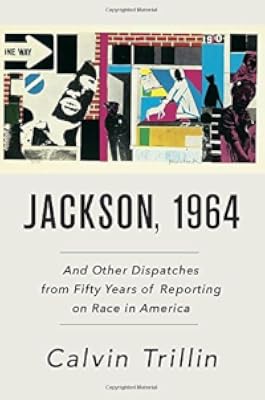
Jackson, 1964: And Other Dispatches from Fifty Years of Reporting on Race in America
by Calvin Trillin
On This Page
Description
An anthology of previously uncollected essays, originally published in "The New Yorker," reflects the work of the eminent journalist's early career and traces his witness to the fledgling years of desegregation in Georgia.Tags
Recommendations












Member Reviews
16 articles from The New Yorker - the oldest one is from 1964, the newest from 2008; each of them with a note at the end about what happened after the article.
Trillin starts his book with a quick note explaining that the article had been shortened occasionally and some repetitions had been removed (as I read the magazine, I know what he is talking about) but they had not been edited otherwise for content or language. And that is important because when you read through the book, you see the language evolve and change. I would have hated it if those articles from the 60s and the 70s were changed so they do not sound offensive today.
But before the articles, he also writes an introduction - the story of 50+ years in a few sentences. Of show more course it is about race and about memories and it sets the tone of the book.
The articles are in almost chronological order - actually the first 14 are in order and the last two are reversed - the 1996 one is last and the 2008 is before it. When I was the contents, I wondered if I want to read them in their chronological order but decided to trust the author. And that is the correct way to read it. Because that last story pairs with the very first and shows the difference brought to the state of Mississippi in a little over 30 years.
Why would a book about race relations start in the state that is notorious for its issues in that area especially in the 60s? I expected to read a story of suffering and awfulness... and it turned out that there was actually a voting registration movement in the summer of 1964 in Jackson and the area and that despite politics and everything, something had been happening there. And from there, we start moving through the country and the decades - in New Orleans for the Zulu parade, in Wilmington, Delaware with the National Guards Patrols of 1968, to Oshkosh, Wisconsin for a university that does not really like integration in 1969, to the Mormons and their believes in Utah in 1970, to Alabama, Texas, South Carolina, New Jersey, Seattle and Boston in the 70s. And the topics and the language shifts - from Negros, voting rights and just the right to exist to blacks, the right to enter a discotheque, not being killed for being black and on the street and build where you want. It is the story of a turbulent couple of decades in 12 articles - not connected in any way and still painting a nuanced picture.
The last 4 are a bit different - partially because of the times and partially because of the topics - a hearing about an appointment that allows Trillin to muse on the topic of "the people that were behind the scenes" in 1977 leads these. That one resonated with me. The country I was born in, Bulgaria, was a communist country until 1989. After the change, everyone claimed that they were dissidents - people that had opposed the regime, most of them behind the scenes. As you can imagine, most of them were just trying to win something in a bad situation so I loved the sentence that Trillin reported to have heard from a black lawyer in New Orleans: "It must be getting mighty crowded back there, behind the scenes".
The last 3 cover 3 decades - a story about race designations in Louisiana in the 80s (which allows an exploration of race and identity), the death of a young man in the new century (a white boy killed by a black home-owner) and the last story - the opening of the archives of the race commission in Mississippi in the 90s. But despite being just one per decade, they still show that the problems are still with us - even half a century after the turbulent 60s.
There is a meeting with Martin Luther King, Jr. in one of the articles of course as is some local and national politics and bashing at public figures. And there is a lot of local feeling in each of them - people who I had never heard of became live in the pages.
And what scares me is that more than once through the book, I had to check again what year that piece was from - because if you changed the language a bit, it could have been published last week... or next week.
It's not an easy book to read in places but it is worth it and I would recommend it to anyone - 50 years apparently were not enough to change things. show less
Trillin starts his book with a quick note explaining that the article had been shortened occasionally and some repetitions had been removed (as I read the magazine, I know what he is talking about) but they had not been edited otherwise for content or language. And that is important because when you read through the book, you see the language evolve and change. I would have hated it if those articles from the 60s and the 70s were changed so they do not sound offensive today.
But before the articles, he also writes an introduction - the story of 50+ years in a few sentences. Of show more course it is about race and about memories and it sets the tone of the book.
The articles are in almost chronological order - actually the first 14 are in order and the last two are reversed - the 1996 one is last and the 2008 is before it. When I was the contents, I wondered if I want to read them in their chronological order but decided to trust the author. And that is the correct way to read it. Because that last story pairs with the very first and shows the difference brought to the state of Mississippi in a little over 30 years.
Why would a book about race relations start in the state that is notorious for its issues in that area especially in the 60s? I expected to read a story of suffering and awfulness... and it turned out that there was actually a voting registration movement in the summer of 1964 in Jackson and the area and that despite politics and everything, something had been happening there. And from there, we start moving through the country and the decades - in New Orleans for the Zulu parade, in Wilmington, Delaware with the National Guards Patrols of 1968, to Oshkosh, Wisconsin for a university that does not really like integration in 1969, to the Mormons and their believes in Utah in 1970, to Alabama, Texas, South Carolina, New Jersey, Seattle and Boston in the 70s. And the topics and the language shifts - from Negros, voting rights and just the right to exist to blacks, the right to enter a discotheque, not being killed for being black and on the street and build where you want. It is the story of a turbulent couple of decades in 12 articles - not connected in any way and still painting a nuanced picture.
The last 4 are a bit different - partially because of the times and partially because of the topics - a hearing about an appointment that allows Trillin to muse on the topic of "the people that were behind the scenes" in 1977 leads these. That one resonated with me. The country I was born in, Bulgaria, was a communist country until 1989. After the change, everyone claimed that they were dissidents - people that had opposed the regime, most of them behind the scenes. As you can imagine, most of them were just trying to win something in a bad situation so I loved the sentence that Trillin reported to have heard from a black lawyer in New Orleans: "It must be getting mighty crowded back there, behind the scenes".
The last 3 cover 3 decades - a story about race designations in Louisiana in the 80s (which allows an exploration of race and identity), the death of a young man in the new century (a white boy killed by a black home-owner) and the last story - the opening of the archives of the race commission in Mississippi in the 90s. But despite being just one per decade, they still show that the problems are still with us - even half a century after the turbulent 60s.
There is a meeting with Martin Luther King, Jr. in one of the articles of course as is some local and national politics and bashing at public figures. And there is a lot of local feeling in each of them - people who I had never heard of became live in the pages.
And what scares me is that more than once through the book, I had to check again what year that piece was from - because if you changed the language a bit, it could have been published last week... or next week.
It's not an easy book to read in places but it is worth it and I would recommend it to anyone - 50 years apparently were not enough to change things. show less
I am always sad to hear someone doesn't know about Calvin Trillin. He is just wonderful, whether writing about food, his wife or politics, he is charming, smart and insightful. In this collection of his essays on race, written over the course of 50 years, he's given us a trail of the evolution of the Civil Rights era that shows us how we got to where we are today and the price that African-Americans paid to get us here. He shows, without commenting much, which assumptions we've managed to change in the last half century, and where we still have a way to go. Entertaining and thoughtful.
This collection of essay, starting in Mississippi in 1964, stretching to 2008 and over various parts of the country, and ending in Mississippi in 1995, are important if you (and you should be ) are interested in the story of race in this country. Portraying the quiet but pervasive racism in Mississippi in contrast to the loud and violent racism in Alabama, discussing complex business issues that are covered and distorted through the lens of racism in New Orleans and New Jersey, exploring deaths on both sides as symptoms of racism in Seattle and Long Island makes this a must- read. And then you get to the ridiculous racism of checking newborns, of breaking up romances, of birth certificate revisions, and to all those moderate white folks show more "who say they have been working behind the scenes...it must be getting mighty crowded back there, behind the scenes" (192). show less
Accurate, surprisingly funny (yes, I know it's Calvin Trillin) and all too timely
Calvin Trillin is a delight to read. He writes well and the topic in this case is so germane, considering the current Black Lives Matter movement. If you have any interest at all i Civil Rights issues and history this is a great window on the past 50 years, focusing mostly on the 60s and 70s. Even though I have read relatively widely on Civil Rights history, Trillin still surprised me with tidbits I had either forgotten or had never heard before. Just a great book.
It's always welcome to have Calvin Trillin's take on people and events.
Ratings
Members
- Recently Added By
Lists

Bitter Southerner Summer Reading Roundup
198 works; 8 members

Youth: BLM
265 works; 1 member
Author Information

40+ Works 6,609 Members
Calvin Trillin attended public schools in Kansas City and went on to Yale University and graduated in 1957; he later served as a Fellow of the University. He was born on December 5, 1935. He worked as a reporter for Time magazine before joining the staff of The New Yorker in 1963. His reporting for The New Yorker on the racial integration of the show more University of Georgia was published in his first book, An Education in Georgia. Family, travel and food are also themes in Trillin's work. Three of his books American Fried; Alice, Let's Eat; and Third Helpings; were individually published and are also collected in the 1994 compendium The Tummy Trilogy. He has also written a collection of short stories Barnett Frummer Is An Unbloomed Flower (1969) and three comic novels, Runestruck (1977), Floater (1980), and Tepper Isn't Going Out (2001). Among his recent work, is Dogfight: The 2012 Presidential Campaign in Verse. He was awarded the Thurber Prize for American Humor for Quite Enough of Calvin Trillin: Forty Years of Funny Stuff, in 2012. (Bowker Author Biography) show less
Awards and Honors
Notable Lists
Classifications
- Genres
- Nonfiction, Anthropology, History, General Nonfiction, Politics and Government, Biography & Memoir
- DDC/MDS
- 305.80097309 — Society, government, & culture Social sciences, sociology & anthropology Social group - Age, Gender, Ethnicity Ethnic and national groups standard subdivisions / Ethnic and national groups with ethnic origins from more than one continent, of European descent standard subdivisions Biography And History North America United States
- LCC
- E185.615 .T76 — History of the United States United States
- BISAC
Statistics
- Members
- 127
- Popularity
- 257,082
- Reviews
- 6
- Rating
- (4.39)
- Languages
- English
- Media
- Paper, Audiobook, Ebook
- ISBNs
- 5
- ASINs
- 1