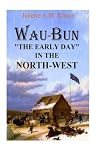
Wau-Bun: The "Early Day" in the Northwest
by Mrs. John H. Kinzie
On This Page
Description
Originally published in 1856, and then edited (with notes and introduction) by Louise Phelps Kellogg and republished in 1930, there is no better description of early Chicago and the famous Fort Dearborn Massacre to be found anywhere than that contained in Wau-bun, The Early Day in the Northwest.Among the familiar characters who come into the story are Governor James D. Doty, Jefferson Davis, John Lowe, Col. Wm. S. Hamilton, son of Alexander Hamilton, Eleazar Williams, Augustin Grignon, show more Jacques Porlier, Chief Four Legs, and many others.The garrison life at Forts Howard and Winnebago, the dangerous passage of the rapids of the Fox River in the Mackinac boats, and the customs of the Wisconsin Indians of the period are all vividly told in this classic.Unmissable American historical literature."e;Mrs. Kinzie's account of the early day in Wisconsin is delightful; it sparkles with humor and with the pleasure of youth in new and strange adventures. The spirit of happiness pervades it and the author's affectionate sympathy for her husband's Indian 'children' shines on every page. Her description of travel and its vicissitudes in Wisconsin of the early day is full of fun and jollity. She was what we would call today a 'good sport,' taking everything with philosophy and good will. The feast of good things is spread for the reader; all that remains is enjoyment of the narration."e;-Louise Phelps Kellogg, Introduction show lessTags
Recommendations






















Member Reviews
Mrs. Kinzie (Juliette) was the wife of an Indian Agent to the Winnebagos in the early 1830s. She was a meticulous observer of frontier life in the upper mid-west. Providing great detail about the as yet undeveloped land, the natives and frontiersmen, their clothing, behavior and attire--she paints an excellent portrait of life and the perils of overland travel. Not entirely an unbiased observer, the introduction to this edition spells out that she left out, altered or lied about events that would have been considered indelicate or which might have damaged her family name. She presents herself as the finest thing in shoe leather on that side of the Mississippi. Her commentary is rife with all the arrogance and prejudices of the age to show more which she was completely oblivious. She was absolutely convinced of her own and her husband's superiority and that they were doing what was best for the Indians and the country. I would have like to have picked her up and shaken her for all the good it would have done. Her description, based on the remembrances of family and friends of the massacre at Ft. Dearborn in 1812, was particularly harrowing. show less
Where I got the book: free on Kindle.
This is the real deal; a woman who lived on what was then the Western frontier telling it how it was. And making it all sound perfectly normal. Hostile tribes, swarms of mosquitos, dangerous journeys, injury and illness? No prob. Husband away for months? Near starvation? We can hack it.
Reading this short book really made me appreciate the spirit that built America. This was back when Chicago was a collection of huts (she describes, at one point, how they invited all five single men in Chicago to a party) and includes Mrs. Kinzie's transcription of an eyewitness account of the Fort Dearborn massacre.
I don't know whether to be surprised at how much sympathy Mrs. Kinzie has for the Native Americans. She show more understands precisely why they have reason not to love the white men, and sees that their land and traditions are being stolen away from them. At the same time, she has a paternalistic attitude toward them, seeing them as "our children" and thus evidently not capable of managing by themselves. I suspect this dual attitude was typical of the settlers of the time.
I would heartily recommend this book to anyone interested in the early history of America outside its original colonies. Fascinating. show less
This is the real deal; a woman who lived on what was then the Western frontier telling it how it was. And making it all sound perfectly normal. Hostile tribes, swarms of mosquitos, dangerous journeys, injury and illness? No prob. Husband away for months? Near starvation? We can hack it.
Reading this short book really made me appreciate the spirit that built America. This was back when Chicago was a collection of huts (she describes, at one point, how they invited all five single men in Chicago to a party) and includes Mrs. Kinzie's transcription of an eyewitness account of the Fort Dearborn massacre.
I don't know whether to be surprised at how much sympathy Mrs. Kinzie has for the Native Americans. She show more understands precisely why they have reason not to love the white men, and sees that their land and traditions are being stolen away from them. At the same time, she has a paternalistic attitude toward them, seeing them as "our children" and thus evidently not capable of managing by themselves. I suspect this dual attitude was typical of the settlers of the time.
I would heartily recommend this book to anyone interested in the early history of America outside its original colonies. Fascinating. show less
Originally published in 1851, WAU-BUN opens with Juliette Kenzie's lovely hand-drawn maps.
WAU-BUN translates in Ojibwa to "the dawn - the break of day"
and is a definite metaphor for the lives of Juliette and her husband, the newly appointed agent
for The Old Indian Agency House in Portage, Wisconsin.
There was no way to anticipate the changes and dangerous challenges that dominated their new existence
during the years 1830-1833 at Fort Winnebago. Juliette's evocative landscape drawings illuminate their historical passage.
Though the Kenzies express honest and almost total understanding of the horror of all the Indian land being forever stolen,
they are also, in their Christian way, condescending and superior to the Indians. Slavery is not a show more major concern.
Readers may hope that her husband finally has the courage to simply not join Juliette's latest travel caprices and guides her
to listen to more experienced and wiser travelers.
Her account of the Massacre at Chicago was horrifying and unexpected. show less
WAU-BUN translates in Ojibwa to "the dawn - the break of day"
and is a definite metaphor for the lives of Juliette and her husband, the newly appointed agent
for The Old Indian Agency House in Portage, Wisconsin.
There was no way to anticipate the changes and dangerous challenges that dominated their new existence
during the years 1830-1833 at Fort Winnebago. Juliette's evocative landscape drawings illuminate their historical passage.
Though the Kenzies express honest and almost total understanding of the horror of all the Indian land being forever stolen,
they are also, in their Christian way, condescending and superior to the Indians. Slavery is not a show more major concern.
Readers may hope that her husband finally has the courage to simply not join Juliette's latest travel caprices and guides her
to listen to more experienced and wiser travelers.
Her account of the Massacre at Chicago was horrifying and unexpected. show less
Ratings
Members
- Recently Added By
Author Information

3 Works 78 Members
Some Editions
Series
Belongs to Publisher Series
Common Knowledge
- Canonical title
- Wau-Bun: The "Early Day" in the Northwest
- Alternate titles
- Wau-Bun: The "Early Day" in the North-West
- Original publication date
- 1856
Classifications
- Genres
- History, Nonfiction, General Nonfiction, Biography & Memoir, Travel
- DDC/MDS
- 977.02 — History & geography History of North America North central United States
- LCC
- F484.3 .K572 — Local History of the United States, Canada and Latin America United States local history Old Northwest. Northwest Territory
- BISAC
Statistics
- Members
- 74
- Popularity
- 427,009
- Reviews
- 3
- Rating
- (3.78)
- Languages
- English
- Media
- Paper, Ebook
- ISBNs
- 16
- ASINs
- 7