On This Page
Description
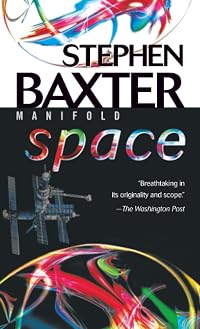
This thrilling sequel to "Manifold" finds Reid Malenfant, fueled by curiosity, venturing to the far edge of the solar system. There, he discovers a strange alien artifact; a gateway allowing instantaneous travel through interstellar space. What lies beyond the other side of the gateway will push Malenfant beyond terror, sanity, and humanity itself.Tags
Recommendations











Member Recommendations
Aarontay Another attempt to explain the Femi's Paradox.
Member Reviews
This side-quel to Manifold:Time did not work for me at all. The same main character, Reid Malenfant, is the core of the book, but in this parallel universe, his life has worked out very differently. To orient readers, at least those familiar with SF, one of the primary characters from the first book, his wife, is almost immediately revealed to have died of cancer, a tumor triggered by a random accident of cosmic rays. But more than local history has changed. While the mysterious interstellar gates still exist, now Fermi's Paradox is the primary theme. At first, it's where are they, but it quickly becomes "they're here, and more are coming, and it's not a good thing." The primary idea Baxter wants to play with is that in a universe this show more large, no matter how large it is, sooner or later, something will survive to wipe everything else out. But there's more layers to that idea than that. As Reid and several women (who dominate most of this arcs in this book) travel the light years by gate, there's no escaping the time differential. Hundreds and thousands of years pass in the history of our solar system, in Stapledonian fashion. Unfortunately, several things work against the book. The theme means that for the most part everyone is a helpless observer of solar and galactic events beyond anyone's control. The small "cast" means that despite a temporal and spatial canvas that boggles the imagination, people still run into each other more easily than I can find friends in small town. The book ends with two events, both of which seemed at odds with the "universe really doesn't care about Earth and humans, you know" theme that was the crux of the preceding 500 pages. show less
Although this book starts out with a premise - and characters - already encountered in 'Time; Manifold 1', very quickly we head off in a different direction. Whilst the first book focused on Reid Malenfant and his companions travelling backwards and forwards in time, this book sees a different Reid Malenfant, with a slightly different history, becoming involved with our first contact with aliens.
In a way, this book is a return to the big, wide-screen Baxter of his early years; there is a larger cast of characters, and some of them are less well-drawn. But the scale and events of the story more than make up for that. Baxter's concern here is the Fermi Paradox - if more advanced alien races exist in the galaxy, why have we never seen any show more firm evidence of their existence? - and he suggests a very plausible reason why not.
There is a large element of old-fashioned "gosh-wowery" in this book; instead of staying effectively on a near-Earth asteroid, as in the first book in the trilogy, the action here skips from star to star, as far as the galactic core; and there are plenty of strange lifeforms, asteroid impacts with planets and exploding moons to keep anyone happy: all done in the best possible scientific taste and accuracy. (No, seriously.) The transcendant fate of the main character reveals the true nature of the artificial aliens and offers the possibility of the survival of life by the end of the book which draws hope from nearly universal destruction. show less
In a way, this book is a return to the big, wide-screen Baxter of his early years; there is a larger cast of characters, and some of them are less well-drawn. But the scale and events of the story more than make up for that. Baxter's concern here is the Fermi Paradox - if more advanced alien races exist in the galaxy, why have we never seen any show more firm evidence of their existence? - and he suggests a very plausible reason why not.
There is a large element of old-fashioned "gosh-wowery" in this book; instead of staying effectively on a near-Earth asteroid, as in the first book in the trilogy, the action here skips from star to star, as far as the galactic core; and there are plenty of strange lifeforms, asteroid impacts with planets and exploding moons to keep anyone happy: all done in the best possible scientific taste and accuracy. (No, seriously.) The transcendant fate of the main character reveals the true nature of the artificial aliens and offers the possibility of the survival of life by the end of the book which draws hope from nearly universal destruction. show less
Really quite stunning. I liked Manifold: Time but found it occasionally uneven and that it didn't entirely fit together. But this book was a lot better (and I recommend starting with it, there's no sense in which this is a sequel).
Manifold: Space is an exploration of the Fermi Paradox -- why we don't see life elsewhere in the universe. And the answers it gives are quite chilling but ultimately hopeful. It is as much about evolution as physics as it explores the adaptations of humans living everywhere from Mercury to Triton -- not to mention the other non-carbon based life forms the star travellers find throughout the universe, in many cases dead or dying from violent expansionary cultures and ultimately recurrent physical phenomenon show more themselves. show less
Manifold: Space is an exploration of the Fermi Paradox -- why we don't see life elsewhere in the universe. And the answers it gives are quite chilling but ultimately hopeful. It is as much about evolution as physics as it explores the adaptations of humans living everywhere from Mercury to Triton -- not to mention the other non-carbon based life forms the star travellers find throughout the universe, in many cases dead or dying from violent expansionary cultures and ultimately recurrent physical phenomenon show more themselves. show less
Really quite stunning. I liked Manifold: Time but found it occasionally uneven and that it didn't entirely fit together. But this book was a lot better (and I recommend starting with it, there's no sense in which this is a sequel).
Manifold: Space is an exploration of the Fermi Paradox -- why we don't see life elsewhere in the universe. And the answers it gives are quite chilling but ultimately hopeful. It is as much about evolution as physics as it explores the adaptations of humans living everywhere from Mercury to Triton -- not to mention the other non-carbon based life forms the star travellers find throughout the universe, in many cases dead or dying from violent expansionary cultures and ultimately recurrent physical phenomenon show more themselves. show less
Manifold: Space is an exploration of the Fermi Paradox -- why we don't see life elsewhere in the universe. And the answers it gives are quite chilling but ultimately hopeful. It is as much about evolution as physics as it explores the adaptations of humans living everywhere from Mercury to Triton -- not to mention the other non-carbon based life forms the star travellers find throughout the universe, in many cases dead or dying from violent expansionary cultures and ultimately recurrent physical phenomenon show more themselves. show less
Book 2. In my opinion, the three books should be read in order.
The three books in the Manifold Trilogy will take you on a mind stretching journey. While the characters are somewhat one-dimensional, they keep you grounded enough to enjoy the science which is presented on an immense scale. Why isn't there any evidence of other sentient life in the universe? What is the purpose of intelligent life at the end of billions of years of evolution. What would the "old ones" do to change things "downstream", to make life more meaningful? Baxter's characters search for the answers to these questions in unique and fascinating ways.
Stimulating, entertaining, and ultimately satisfying.
The three books in the Manifold Trilogy will take you on a mind stretching journey. While the characters are somewhat one-dimensional, they keep you grounded enough to enjoy the science which is presented on an immense scale. Why isn't there any evidence of other sentient life in the universe? What is the purpose of intelligent life at the end of billions of years of evolution. What would the "old ones" do to change things "downstream", to make life more meaningful? Baxter's characters search for the answers to these questions in unique and fascinating ways.
Stimulating, entertaining, and ultimately satisfying.
It didn't go where I was expecting this book. After the first few pages I was unimpressed, the middle sections I found very gripping in parts, and then it veered off into the fantastical quite a bot towards the end.
It is a story of first contact set in the near future, and tackles head on the question of why the aliens aren't here. It raises some interesting questions about the life-expectancy of a space faring species (or any species). We tend to assume resource scarcity is limited to Earth - maybe not so much if you think about it logically...
Not bad at all if you like hard science fiction, but I didn't find the characters particularly engaging. The bibliographic data here suggests it is part of a series - I wasn't aware of that show more reading it, and I can't really imagine how... show less
It is a story of first contact set in the near future, and tackles head on the question of why the aliens aren't here. It raises some interesting questions about the life-expectancy of a space faring species (or any species). We tend to assume resource scarcity is limited to Earth - maybe not so much if you think about it logically...
Not bad at all if you like hard science fiction, but I didn't find the characters particularly engaging. The bibliographic data here suggests it is part of a series - I wasn't aware of that show more reading it, and I can't really imagine how... show less
Odd book, a kind of strange jingoistic US-centricism (for a British author!)
Interesting ideas, but the characters were mainly ciphers.
Interesting ideas, but the characters were mainly ciphers.
Members
- Recently Added By
Author Information

260+ Works 43,820 Members
Some Editions
Awards and Honors
Distinctions
Notable Lists
Series

Belongs to Publisher Series
Common Knowledge
- Original title
- Space
- Original publication date
- 2000-08
- People/Characters
- Reid Malenfant; Frank Paulis; Xenia Makarova; Cassiopeia; Madeleine Meacher; Nemoto (show all 10); Dorothy Chaum; Maura Della; Carole Lerner; Sally Brind
- Important places
- The Moon; Edo Lunar Base, Moon; Kennedy Space Center, Florida, USA; Milky Way, Alpha Centauri
- Epigraph
- Innumerable suns exist; innumerable earths revolve around these suns in a manner similar to the way the seven planets revolve around our sun. Living beings inhabit these worlds...
- Giordano Bruno (1548-1600)
If they existed, they would be here.
- Enrico Fermi (1901-1954) - Dedication
- To my nephew, Thomas Baxter, and Simon Bradshaw and Eric Brown
- First words
- My name is Reid Malenfant. You know me. And you know I'm an incorrigible space cadet.
- Last words
- (Click to show. Warning: May contain spoilers.)She turned away, and went in search of Reid Malenfant.
Classifications
Statistics
- Members
- 1,491
- Popularity
- 15,606
- Reviews
- 12
- Rating
- (3.59)
- Languages
- Bulgarian, English, French, German
- Media
- Paper, Ebook
- ISBNs
- 14
- ASINs
- 8