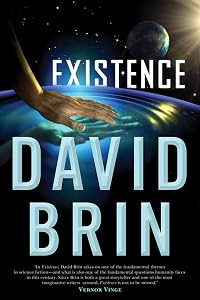
Existence
by David Brin 
On This Page
Description
In a future world dominated by a neural-link web where people can tune into live events and revolutions can be instantly sparked, an active alien communication device is discovered in orbit around the Earth, triggering an international upheaval of fear, hope and violence.Tags
Recommendations


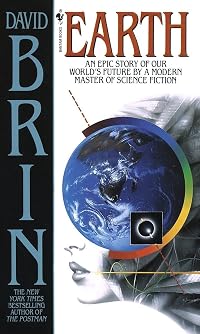


Member Recommendations
Member Reviews
Beware of spoilers!
This book is, with more than 800 pages (at least that's what my e-reader says) a pretty hefty brick. But it's also a book about ideas, and Brin is very thorough in his exploration of these ideas, even if it happens at the expense of cohesive plot and character arcs.
What's it about? He gives his very own answer to the Fermi paradox, the question why no alien lifeform has made contact in any form when it's reasonable to assume that Earth is not particularly special and there's life basically everywhere.
However, the main topic is not so much his answer to this specific question - that countless alien civilisations swarm the galaxy like viruses with the sole purpose to replicate themselves and to push their victims into show more inevitable self-destruction - but the reaction of humanity to these discoveries.
"Humanity" is by no means a unified entity, though; 10 billions live on a planet ravaged by ecological disasters and exploitation, in a global society which is highly technologised and dependent on AI on one side and highly fragmented and hierarchical on the other. There are several degrees of technology sceptics, there are the technology believers and supporters who want advancement at all costs, there are the super-rich oligarchs with their own agenda, there are autistics who fight for their recognition not as an abnormality, but as a different development strand. There are AIs and enhanced animals, formerly extinct lifeforms and ancient alien spaceships - and all of these have a voice and an opinion, fears and hopes.
It's a cacophony, and it reads like one - as complex as chaotic. Some of these voices get a lot of page-time, and those are the ones that remain. I loved Tor Povlov, journalist gone hero gone cyborg-explorer-in-space. Gerald Livingston, the pragmatic trash collector in orbit who sets the whole thing in motion, and Hamish Brookeman, the former bestseller author too busy with propaganda to listen to the voices in his head. But there are also too many characters who get no development, who are discarded after they served their function to illustrate a certain idea or side-topic. Did we really need the POV of a psychic octopus? A lot of redundancies and wasted potential here.
And then there's the inserts, little interludes that interrupt the main narrative. An essay about all the ways how humanity - and any developed civilisation - could have (and perhaps should have) destroyed itself. The poetic but barely intelligible thoughts of an autistic person. The challenges to aliens that may or may not hide somewhere in the solar system and refuse to make contact.
And still, in the end this whole cacophony makes sense. Because, what remains? It's the fact that our diversity is our greatest strength. Our diversity, our flexibility, our ability to emphasise, to accept and - most important of all - to adapt. It's what saves us, in the end, and it's an overall optimistic, hopeful view on mankind and its future that Brin presents here. show less
This book is, with more than 800 pages (at least that's what my e-reader says) a pretty hefty brick. But it's also a book about ideas, and Brin is very thorough in his exploration of these ideas, even if it happens at the expense of cohesive plot and character arcs.
What's it about? He gives his very own answer to the Fermi paradox, the question why no alien lifeform has made contact in any form when it's reasonable to assume that Earth is not particularly special and there's life basically everywhere.
However, the main topic is not so much his answer to this specific question - that countless alien civilisations swarm the galaxy like viruses with the sole purpose to replicate themselves and to push their victims into show more inevitable self-destruction - but the reaction of humanity to these discoveries.
"Humanity" is by no means a unified entity, though; 10 billions live on a planet ravaged by ecological disasters and exploitation, in a global society which is highly technologised and dependent on AI on one side and highly fragmented and hierarchical on the other. There are several degrees of technology sceptics, there are the technology believers and supporters who want advancement at all costs, there are the super-rich oligarchs with their own agenda, there are autistics who fight for their recognition not as an abnormality, but as a different development strand. There are AIs and enhanced animals, formerly extinct lifeforms and ancient alien spaceships - and all of these have a voice and an opinion, fears and hopes.
It's a cacophony, and it reads like one - as complex as chaotic. Some of these voices get a lot of page-time, and those are the ones that remain. I loved Tor Povlov, journalist gone hero gone cyborg-explorer-in-space. Gerald Livingston, the pragmatic trash collector in orbit who sets the whole thing in motion, and Hamish Brookeman, the former bestseller author too busy with propaganda to listen to the voices in his head. But there are also too many characters who get no development, who are discarded after they served their function to illustrate a certain idea or side-topic. Did we really need the POV of a psychic octopus? A lot of redundancies and wasted potential here.
And then there's the inserts, little interludes that interrupt the main narrative. An essay about all the ways how humanity - and any developed civilisation - could have (and perhaps should have) destroyed itself. The poetic but barely intelligible thoughts of an autistic person. The challenges to aliens that may or may not hide somewhere in the solar system and refuse to make contact.
And still, in the end this whole cacophony makes sense. Because, what remains? It's the fact that our diversity is our greatest strength. Our diversity, our flexibility, our ability to emphasise, to accept and - most important of all - to adapt. It's what saves us, in the end, and it's an overall optimistic, hopeful view on mankind and its future that Brin presents here. show less
David Brin is an icon in science fiction, and for good reasons. Brin's imagination gave us works like the Kiln People, the Postman, and of course, the seminal Uplift War saga in all of its glory. In his latest novel, Existence, Brin takes us to the near future, a world where mankind has continued to make mistakes, but has also made attempts at progress. We start by meeting Gerald Livingston, an orbital garbage collector. For a hundred years, people have abandoned things in space, and someone has to clean it up. But there’s something spinning a little bit higher than he expects, something that isn’t on the decades’ old orbital maps. An hour after he grabs it and brings it in, rumors fill Earth’s infomesh about an “alien show more artifact.”
Thrown into the maelstrom of worldwide shared experience, the Artifact is a game-changer. A message in a bottle; an alien capsule that wants to communicate. The world reacts as humans always do: with fear and hope and selfishness and love and violence. And insatiable curiosity. (end blurb)
The difficulty I have with describing or even assessing this book is that it felt to me like it was written in three different mindsets. The first 25% of the book falls into that class of science fiction that deals with world crisis - you may recognize the formula. The setting - near future. The cast - someone in power, someone outside of the corridors of power, and a reporter of some kind. Additional cast optional. The crisis - something outside of our control threatens the way of life globally - flood, solar flares, alien incursion, etc.. The artifact is uncovered, ripples reach out, and we see how these dozen or so lives of our cast are affected, in some ways interacting.
Then the book takes a shift.
I'm glossing over, because I'm trying to avoid any spoilers, but the next chunk of the book (@50%) left me growing impatient for something to actually happen. That isn't to say that there isn't action or progress, but the middle seemed to stretch on and on without any satisfaction of resolution. Towards the end of this chunck we get a lot of tantalyzing clues and suggestions about our place in the universe, answers to the Fermi paradox, etc.. I would classify this portion of the book as less sci-fi disaster novel and back down into the near future thriller genre.
Then came the last 25%. Neither crisis novel nor thriller, this part of the book was pure speculative space opera, which if we're talking science fiction, is known to be my preference. It'll be no suprise that I wish the writing in the last 25% of the book had actually been more like 75%.
Brin is very much in touch with modern technology, and it shows in this book. Our near future citizens aren't that displaced from today. The gadgets are shinier and smaller, but the concepts are the same, or at least taken to their next few logical steps. Its only after reading the Afterword, where Brin explains himself and the novel a little more, that we learn that a lof of that first 25% of the book was previously written material that was worked in. Although I enjoyed those bits - especially the homage to uplift - I didn't feel like they were satisfactorily given a conclusion. The same happened later in the book, where we were led along certain paths and then never saw the characters involved again, leaving those subplots just dangling.
Don't be discouraged. Existence was still a good read by a great author, just be prepared to do a little work to get there.
Thanks to NetGalley and Tor/Forge for an advance copy of the novel. show less
Thrown into the maelstrom of worldwide shared experience, the Artifact is a game-changer. A message in a bottle; an alien capsule that wants to communicate. The world reacts as humans always do: with fear and hope and selfishness and love and violence. And insatiable curiosity. (end blurb)
The difficulty I have with describing or even assessing this book is that it felt to me like it was written in three different mindsets. The first 25% of the book falls into that class of science fiction that deals with world crisis - you may recognize the formula. The setting - near future. The cast - someone in power, someone outside of the corridors of power, and a reporter of some kind. Additional cast optional. The crisis - something outside of our control threatens the way of life globally - flood, solar flares, alien incursion, etc.. The artifact is uncovered, ripples reach out, and we see how these dozen or so lives of our cast are affected, in some ways interacting.
Then the book takes a shift.
I'm glossing over, because I'm trying to avoid any spoilers, but the next chunk of the book (@50%) left me growing impatient for something to actually happen. That isn't to say that there isn't action or progress, but the middle seemed to stretch on and on without any satisfaction of resolution. Towards the end of this chunck we get a lot of tantalyzing clues and suggestions about our place in the universe, answers to the Fermi paradox, etc.. I would classify this portion of the book as less sci-fi disaster novel and back down into the near future thriller genre.
Then came the last 25%. Neither crisis novel nor thriller, this part of the book was pure speculative space opera, which if we're talking science fiction, is known to be my preference. It'll be no suprise that I wish the writing in the last 25% of the book had actually been more like 75%.
Brin is very much in touch with modern technology, and it shows in this book. Our near future citizens aren't that displaced from today. The gadgets are shinier and smaller, but the concepts are the same, or at least taken to their next few logical steps. Its only after reading the Afterword, where Brin explains himself and the novel a little more, that we learn that a lof of that first 25% of the book was previously written material that was worked in. Although I enjoyed those bits - especially the homage to uplift - I didn't feel like they were satisfactorily given a conclusion. The same happened later in the book, where we were led along certain paths and then never saw the characters involved again, leaving those subplots just dangling.
Don't be discouraged. Existence was still a good read by a great author, just be prepared to do a little work to get there.
Thanks to NetGalley and Tor/Forge for an advance copy of the novel. show less
I found this a very disappointing book after all the hype from the transhumanist community about Brin and the constant appearance of the book on my social media.
There is some interesting and innovative thinking here (although perhaps less so to anyone who has actually 'worked' Second Life'). Brin can also write well about character in short bursts.
This is overwhelmed by the standard faults of contemporary scifi - too many ideas not taken to a conclusion, an inability to take a stand that is not ultimately sentimental and neologism to excess.
The real problem here seems to be the triumph of marketing over classic editorial engagement - not an uncommon problem nowadays.
Three quarters of the book is a slow moving mix of alternating show more adventure (the best parts), didacticism (all rather basic preaching) and experimental writing that just does not work all that well.
Then, just as one is settling into this near-glacial flow, and taking an interest in the fate of at least one or two of the characters, the book suddenly stops and jumps into a final fifth of space opera.
Was this deliberate? Or was Brin simply finding that this massive tome would meander on forever into multiple volumes and needed to be 'concluded' for the bookshelves and the kindles.
The whole things smacks of editorial indulgence. The book could have been so much better with an editing down of 30% of ideas and text, an improved bridge between the sections and greater balance betwen them.
Brin can be very good at adventure and at character, though his characters are still mostly symbols rather than people while his aliens seem more real on occasions than his humans.
But some of the personae are just plain irritating - I would willinglly have shot Profesor Noozone out into the furthest reaches of the galazy - while whole story lines are suddenly abandoned.
Whatever happened with the Chinese mother and her autistic supporters in the Disney Park? Who was behind the machinations over the stones? and is that all with the snotty rich kid and the dolphins?
We have critiqued the messiness and indulgent populism of modern science fiction before (see http://www.goodreads.com/book/show/8391123-the-mammoth-book-of-apocalyptic-sf ) Those criticisms hold for 'Existence' to a large extent. It seems to be a crisis in the genre.
Truly great science fiction takes one or a relatively few ideas and works it or them to the limits without equivocation. The thinking takes place in the mind of the reader and not all on the page.
'Menu' science fiction - throwing idea after idea without development so that the reader can pick what he or she likes according to taste and mental wallet - is what you get in a market-driven culture.
Here, nothing is properly developed because it is a novel of alternatives from a primer on human fates and destinies - it is a list of possibilities that end up becoming sillily absurd by the end.
So there we have it. You might be entertained by it but I could not take it seriously ... it reflected a flibertigibbet frightened culture of readers rather than directed us to new horizons. show less
There is some interesting and innovative thinking here (although perhaps less so to anyone who has actually 'worked' Second Life'). Brin can also write well about character in short bursts.
This is overwhelmed by the standard faults of contemporary scifi - too many ideas not taken to a conclusion, an inability to take a stand that is not ultimately sentimental and neologism to excess.
The real problem here seems to be the triumph of marketing over classic editorial engagement - not an uncommon problem nowadays.
Three quarters of the book is a slow moving mix of alternating show more adventure (the best parts), didacticism (all rather basic preaching) and experimental writing that just does not work all that well.
Then, just as one is settling into this near-glacial flow, and taking an interest in the fate of at least one or two of the characters, the book suddenly stops and jumps into a final fifth of space opera.
Was this deliberate? Or was Brin simply finding that this massive tome would meander on forever into multiple volumes and needed to be 'concluded' for the bookshelves and the kindles.
The whole things smacks of editorial indulgence. The book could have been so much better with an editing down of 30% of ideas and text, an improved bridge between the sections and greater balance betwen them.
Brin can be very good at adventure and at character, though his characters are still mostly symbols rather than people while his aliens seem more real on occasions than his humans.
But some of the personae are just plain irritating - I would willinglly have shot Profesor Noozone out into the furthest reaches of the galazy - while whole story lines are suddenly abandoned.
Whatever happened with the Chinese mother and her autistic supporters in the Disney Park? Who was behind the machinations over the stones? and is that all with the snotty rich kid and the dolphins?
We have critiqued the messiness and indulgent populism of modern science fiction before (see http://www.goodreads.com/book/show/8391123-the-mammoth-book-of-apocalyptic-sf ) Those criticisms hold for 'Existence' to a large extent. It seems to be a crisis in the genre.
Truly great science fiction takes one or a relatively few ideas and works it or them to the limits without equivocation. The thinking takes place in the mind of the reader and not all on the page.
'Menu' science fiction - throwing idea after idea without development so that the reader can pick what he or she likes according to taste and mental wallet - is what you get in a market-driven culture.
Here, nothing is properly developed because it is a novel of alternatives from a primer on human fates and destinies - it is a list of possibilities that end up becoming sillily absurd by the end.
So there we have it. You might be entertained by it but I could not take it seriously ... it reflected a flibertigibbet frightened culture of readers rather than directed us to new horizons. show less
I missed Brin, it turns out! This is century-spanning space opera (though largely set on Earth), with big time-jumps, multiple species of humanity (including Neandertals, “auties,” and AIs along with dolphins), and attack memes from outer space. As with much big idea sf, it’s about our present problems: climate change, the apparently unstoppable power of wealthy elites, and more generally whether we will make it as a technological species over the medium term. The people are recognizable but outsize, and they hold different viewpoints; each is the hero of their own narrative. In short, it’s fun and a little bit thought-provoking (did I mention the attack memes from outer space?).
So far...hardcore sci-fi in the best way possible...tons to feast your mind on, so much complexity (and tiny print) that at times you just have to stop and sit for awhile to take it all in. Not the kind of book, though, you can afford to read if you don't have some time to commit to it. There are points in the novel when I'm tempted to put a stop it all, but there's something about Existence that just won't let go...
It took me a long time to read this book - partially because I wanted to saviour its brilliance and partially because it is so dense that I had to take long breaks from it. That's a contradictory statement, because Existence is a contradictory book and has spawned a complimentary review. This could either be a very long review where I recount every aspect of the novel (and there are many) and how they affected me, or a short review where I don't tell you much about the story, but let you know what impressed me most about it. I'm opting for the latter.
Singularly, each aspect of the novel is superb, but brought together in a 550 page plus manuscript, they languish. Existence explores humanity's First Contact with an intelligent species in show more the context of a world gone to hell. An Earth where humanity tethers on the brink of (self-inflicted) destruction and turns eagerly to the salvation offered by advanced beings. And humanity's natural reaction - equal parts fear and curiosity - bring out the best, and worst in all of us. Within this grand experience are several smaller, but no less epic, subplots - the long awaited emergence of Artificial Intelligence and the slow decline of personal privacy at the expense of "security". Survival on a planet plagued with natural disasters, growing deserts and limited tracts of agriculturally viable land. The abandonment of space programs and astronomy in general due to centuries of Galactic silence and growing evidence that the Fermi Paradox is real: we are truly alone. Somewhere along the way I started feeling like the author had just taken on too much - that an exploration of all that, and more, even in a large novel such as this, is simply too ambitious.
But David brin pulls it off. The first quarter or so of the book introduces us to a myriad of interesting characters and to a bizarre world that I can see glimpses of our future in, but cannot fathom. The discovery by Gerald Livingstone of an alien artefacts gets things rolling and before long all of humanity is waiting to see what it has to reveal to us. What follows is an increasingly philosophical look at human nature, punctuated with a little action, and everything is examined from at least three differing perspectives. Not that this part of the book is boring - there's a zeppelin explosion, seismic shifts all over the world, a Chinese conspiracy and, to top it all off, we learn the aliens aren't being entirely truthful. But it feels lacking. The last 100 or so pages of the book are different again, written almost on a completely different style to the rest of the novel as humans take a few steps towards unravelling the mystery of their place in the universe. And the conclusion, while absolutely not what I had expected, brings a sense of closure intermingled with sheepish irony.
So, should you read Existence? If you need action, clear-cut stories and cannot abide philosophical debate, then this is not the book for you. But if you are interested in a comprehensive discourse on human nature at its most fundamental levels in the context of our First Contact with intelligent life, then I believe you will enjoy Existence. While the over-reaching plot elements fade very quickly from ones mind, the wonder and adventure David Brin brings to his book linger.
You can read more of my reviews at Speculating on SpecFic. show less
Singularly, each aspect of the novel is superb, but brought together in a 550 page plus manuscript, they languish. Existence explores humanity's First Contact with an intelligent species in show more the context of a world gone to hell. An Earth where humanity tethers on the brink of (self-inflicted) destruction and turns eagerly to the salvation offered by advanced beings. And humanity's natural reaction - equal parts fear and curiosity - bring out the best, and worst in all of us. Within this grand experience are several smaller, but no less epic, subplots - the long awaited emergence of Artificial Intelligence and the slow decline of personal privacy at the expense of "security". Survival on a planet plagued with natural disasters, growing deserts and limited tracts of agriculturally viable land. The abandonment of space programs and astronomy in general due to centuries of Galactic silence and growing evidence that the Fermi Paradox is real: we are truly alone. Somewhere along the way I started feeling like the author had just taken on too much - that an exploration of all that, and more, even in a large novel such as this, is simply too ambitious.
But David brin pulls it off. The first quarter or so of the book introduces us to a myriad of interesting characters and to a bizarre world that I can see glimpses of our future in, but cannot fathom. The discovery by Gerald Livingstone of an alien artefacts gets things rolling and before long all of humanity is waiting to see what it has to reveal to us. What follows is an increasingly philosophical look at human nature, punctuated with a little action, and everything is examined from at least three differing perspectives. Not that this part of the book is boring - there's a zeppelin explosion, seismic shifts all over the world, a Chinese conspiracy and, to top it all off, we learn the aliens aren't being entirely truthful. But it feels lacking. The last 100 or so pages of the book are different again, written almost on a completely different style to the rest of the novel as humans take a few steps towards unravelling the mystery of their place in the universe. And the conclusion, while absolutely not what I had expected, brings a sense of closure intermingled with sheepish irony.
So, should you read Existence? If you need action, clear-cut stories and cannot abide philosophical debate, then this is not the book for you. But if you are interested in a comprehensive discourse on human nature at its most fundamental levels in the context of our First Contact with intelligent life, then I believe you will enjoy Existence. While the over-reaching plot elements fade very quickly from ones mind, the wonder and adventure David Brin brings to his book linger.
You can read more of my reviews at Speculating on SpecFic. show less
This is a story with Big Ideas to cover, and it covers them pretty well. Bu-u-u-u-ut, that doesn't necessarily make it a well-told story. It frequently felt to me as if the Ideas were getting in the way of the narrative. And perhaps Mr. Brin deliberately made the choice, feeling that the Ideas were what was important. But I found [b:Existence|13039884|Existence|David Brin|https://d202m5krfqbpi5.cloudfront.net/books/1326053679s/13039884.jpg|18203750] harder to get through than other books by Brin that I have read.
Members
- Recently Added By
Lists

Most-anticipated future releases
40 works; 25 members

Jean's Sci Fi/Fantasy Reading list
189 works; 12 members

Books Read in 2024
4,727 works; 128 members
Author Information

153+ Works 40,468 Members
David Brin is a scientist, writer, and public speaker. He was born in Pasadena, California, on October 9, 1950. Brin attended the California Institute of Technology (Caltech) and later earned a doctorate at the University of California. He accepted a position as an engineer at Hughes Aircraft Company. Brin is a former fellow at the California show more Space Institute and serves on several government and nongovernment advisory committees dealing with issues involved with technological growth. Brin has lectured all over the world on such topics as space flight, ecology, and the search for extraterrestrial life. Brin deals with global warming, the destruction of the ozone layer, and pollution of Earth. His 1987 novel, The Uplift War, received the Hugo Award and the Locus Award. His novels have been translated into 20 languages. (Bowker Author Biography) show less
David Brin is a LibraryThing Author, an author who lists their personal library on LibraryThing.
Awards and Honors
Series
Belongs to Publisher Series
Science Fiction Book Club (1362259)
Work Relationships
Common Knowledge
- Original publication date
- 2012-06-21
- Epigraph
- Those who ignore the mistakes of the future are bound to make them.
- Joseph Miller - Dedication
- To "Tether Joe" Carroll, who spins real space lariats . . .
and
"Doc" Sheldon Brown, who teaches time travelers . . .
. . . and Ralph Vicinanza,
who helped many dreams and dreamers to thrive. - First words
- what matters? do i? or ai? + the question spins
I.
I, AMPHORUM
The universe had two great halves. - Last words
- (Click to show. Warning: May contain spoilers.)"Silly," she chides. "Don't you know by now?
"Everything changes."
THE END . . .
. . . of Existence . . .
The question that will decide our destiny is not whether we shall expand into space. It is: shall we be one species or a million? A million species will not exhaust the ecological niches that are awaiting the arrival of intelligence.
- Freeman Dyson - Blurbers
- Baxter, Stephen; Disch, Thomas M.; Grandin, Temple
- Disambiguation notice
- Although this novel has some elements in common with the Uplift books, it is not part of that series.
Classifications
Statistics
- Members
- 1,061
- Popularity
- 24,357
- Reviews
- 56
- Rating
- (3.45)
- Languages
- Czech, English, French, German
- Media
- Paper, Audiobook, Ebook
- ISBNs
- 13
- ASINs
- 12