Wolf And Iron
by Gordon R. Dickson
On This Page
Description
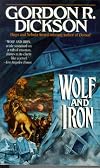
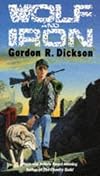
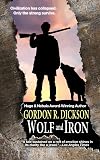
After the collapse of civilization, when the social fabric of America has come apart in bloody rags, when every man's hand is raised against another, and only the strong survive. "Jeebee" Walther was a scientist, a student of human behavior, who saw the Collapse of the world economy coming, but could do nothing to stop it. Now he must make his way across a violent and lawless America, in search of a refuge where he can keep the spark of knowledge alive in the coming Dark Age. He could never show more make it on his own, but he has found a companion who can teach him how to survive on instinct and will. Jeebee has been adopted by a great Gray Wolf.. show less
Tags
Recommendations



















Member Reviews
A young man in a post-apocalyptic world sets out to find his brother's ranch, befriending a wolf on the way. I felt this was in a book in which research overpowered and finally buried the story. It's clear Dickson wanted to get the details about the wolf right, he even has his main character reading the same books about wolves that he did. There are entire chapters that are little more than rehashing this information. Aside from two encounters with a bear, there's really no action in the story. Other events occur, but they are either viewed from a safe distance or related in the past tense long after they're over. The story arc that's left is boy meets girl, boy loses girl, boy gets girl back. Nothing else happens. The main character show more spends a lot of time trying to understand his wolf friend, and a lot of time trying to understand other things. Eventually almost 500 pages pass, without any kind of drama or conflict or activity, and even the main character's goal is eventually discarded. The post-apocalypse setting of the book is itself irrelevant--it could have been set in the old West, or even in a remote wilderness area. I read a lot of these books, and this one, by a respected science fiction author, was a colossal bust. show less
A terrific men's adventure story which takes place in a post apocalyptic setting. The novel seems to set itself almost antithetically to A Boy and His Dog. Where that novel is about rejecting the socializing process of marriage and the associated procreative sex, as emasculating and leading to zombification, Dickson views it as a necessary part of what's involved in becoming a man. You could say another title for this book could be A Man and His Wolf.
Dickson is less interested in telling a story about the collapse of society, and more about one man, and the wolf who befriends him, and in so doing, tunes him into the essentials of survival in this new world. There are painstaking descriptions of building simple weapons and shelters, and show more how much ingenuity might be required to survive something like injury in a wild environment. There's a rather extensive descriptive passage about a birth that's fairly impressive in it's completeness. It seems that Dickson wants to make a point about how much life would slow down in such a circumstance. He lingers long on simple and small things, and he has the descriptive talent to do it effectively.
In that sense it reminded me of classic mountain man books like the one about Liver Eating Johnson (the title escapes me, but it is the basis for the movie Jeremiah Johnson), or perhaps the more compelling parts of Knut Hamsen's novel of farm life,The Growth of the Soil.
And then there is the extensive research about wolves that has been pulled into the book to make the wolf character more credible.The wolf sort of functions as a familiar or animus, as the the central character who was a mathematics academic before the collapse, gradually comes to terms with the darker aspects of what it means to be both wolf and man, in order to survive.
Probably too slow and not prurient or violent enough for teens and under 25 to bother reading, but definitely great for older readers.
I found it a very satisfying, thoughtful and emotionally involving read.
****Four stars show less
Dickson is less interested in telling a story about the collapse of society, and more about one man, and the wolf who befriends him, and in so doing, tunes him into the essentials of survival in this new world. There are painstaking descriptions of building simple weapons and shelters, and show more how much ingenuity might be required to survive something like injury in a wild environment. There's a rather extensive descriptive passage about a birth that's fairly impressive in it's completeness. It seems that Dickson wants to make a point about how much life would slow down in such a circumstance. He lingers long on simple and small things, and he has the descriptive talent to do it effectively.
In that sense it reminded me of classic mountain man books like the one about Liver Eating Johnson (the title escapes me, but it is the basis for the movie Jeremiah Johnson), or perhaps the more compelling parts of Knut Hamsen's novel of farm life,The Growth of the Soil.
And then there is the extensive research about wolves that has been pulled into the book to make the wolf character more credible.The wolf sort of functions as a familiar or animus, as the the central character who was a mathematics academic before the collapse, gradually comes to terms with the darker aspects of what it means to be both wolf and man, in order to survive.
Probably too slow and not prurient or violent enough for teens and under 25 to bother reading, but definitely great for older readers.
I found it a very satisfying, thoughtful and emotionally involving read.
****Four stars show less
A post-apocalyptic survival. Jeebee Walther, a scientist, navigates a collapsed America to reach his brother’s Montana ranch. Accompanied by a wolf, Walther learns survival skills, faces dangerous gangs, and attempts to preserve knowledge for a new dark age.
Perhaps the most human of the dystopian genre, Dickson never explains the cause of the collapse of modern society, but instead focuses on the aftermath through an unlikely protagonist.
This book was not for me and I'm not sure why I kept reading. If you are a survivalist you might like it since this is a post-apocalyptic world and the majority of the book describes how the main character builds a shelter, makes a forge, makes weapons, etc. Very little in the way of character development. Very little plot.
The section where Jeebee traveled with the peddler wagon was the most interesting to me and I wish Dickson would have continued with that storyline. The peddler and his helpers had a route they used to trade with farms. Paul envisioned eventually setting up trading posts. It was a vision of civilization starting up again. I would have liked to see how they managed to do that. Those characters were interesting.
I'm show more sorry I didn't stop reading when I got to page 24. But I skimmed a lot of the book and spent some of my reading time doing other things instead. show less
The section where Jeebee traveled with the peddler wagon was the most interesting to me and I wish Dickson would have continued with that storyline. The peddler and his helpers had a route they used to trade with farms. Paul envisioned eventually setting up trading posts. It was a vision of civilization starting up again. I would have liked to see how they managed to do that. Those characters were interesting.
I'm show more sorry I didn't stop reading when I got to page 24. But I skimmed a lot of the book and spent some of my reading time doing other things instead. show less
[Wolf and Iron] by [Gordan R. Dickson] tells of survival after a socio-economic collapse. The characters are strongly developed and Jeebee's relationship with wolf drives the story as her learns to survive using his instincts. It follows the format of post apocalyptic stories so it is fairly predictable but the characters and relationships are what really drive the plot.
I thought this book might become one of my favorites when I started reading. Basically, this is my favorite genre, and Gordon R. Dickson started his story well enough with a comparatively plausible socio-economic collapse of the whole society. The book held its own right upto the halfway mark. But then it started to become monotonous and nothing major happened even at the end.
But nonetheless, if you are a fan of post-apocalyptic fiction, this is not that bad piece of work to have a shot at.
But nonetheless, if you are a fan of post-apocalyptic fiction, this is not that bad piece of work to have a shot at.
Members
- Recently Added By
Author Information

293+ Works 33,444 Members
A naturalized American who was born in Canada on November 1, 1923, Gordon Rupert Dickson is a popular science fiction writer. Dickson graduated from the University of Minnesota in 1948 and made his home in Minneapolis. Among his many novels, especially notable is Soldier, Ask Not, which won the Hugo Award in 1965. For many years, Dickson's most show more engrossing project was his Childe Cycle, a series of novels about humanity's evolutionary potential, which included a group of futuristic books that are popularly known as the Dorsai Cycle. Dickson also wrote hundreds of short stories and novelettes including Call Him Lord, for which he received a Nebula Award in 1966. (Bowker Author Biography) show less
Some Editions
Awards and Honors
Awards
Common Knowledge
- Original title
- Wolf and Iron
- Original publication date
- 1990
- People/Characters
- Jeebee Walther; Merry; Paul; Wolf
- Important places
- Midwest, USA
Classifications
Statistics
- Members
- 613
- Popularity
- 47,809
- Reviews
- 12
- Rating
- (3.80)
- Languages
- English, German, Russian
- Media
- Paper, Audiobook, Ebook
- ISBNs
- 10
- ASINs
- 9