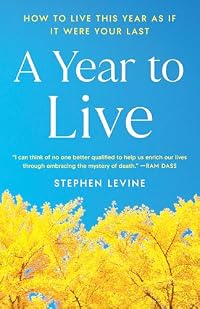
A Year to Live: How to Live This Year as If It Were Your Last
by Stephen Levine
On This Page
Description
ontemporary spiritual teacher Sogyal Rinpoche's The Tibetan Book of Living and Dying dealt with how to use the consciousness of our mortality to live a better life. Now the author of the perennial bestseller Who Dies? tells us how to live mindfully each moment, each hour, each day as if it were all that was left.Tags
Recommendations








Member Reviews
I dearly love the concept that propels this book. Stephen Levine and his wife spent decades providing grief counseling to concentration camp survivors, war veterans, hospice patients, and many others. He brings that experience and unique perspective to "A Year to Live", in which he proposes a revolutionary act: to practice living the next year of one's life as if it were your final 365 days.
It's an exercise in gratitude, awareness, facing fear, and deciding what matters most in one's life. He guides readers through exercises and opportunities to practice, while taking us on his own journey with his wife through their "Year to Live."
The book can get a bit new-agey, even for a Dharma-lovin', yoga-practicing guy like me. But I can't find show more too much fault with a man who sat side-by-side with so many transitioning from life to the next stage. The experiences, along with his own Buddhist training, opened him up to a brave spiritual journey, and one that I am compelled to take myself.
This is a quick read, a brief book that invites a deep look at the lives we lead and how we might adapt our approach to treat each day and moment with the preciousness they deserve. show less
It's an exercise in gratitude, awareness, facing fear, and deciding what matters most in one's life. He guides readers through exercises and opportunities to practice, while taking us on his own journey with his wife through their "Year to Live."
The book can get a bit new-agey, even for a Dharma-lovin', yoga-practicing guy like me. But I can't find show more too much fault with a man who sat side-by-side with so many transitioning from life to the next stage. The experiences, along with his own Buddhist training, opened him up to a brave spiritual journey, and one that I am compelled to take myself.
This is a quick read, a brief book that invites a deep look at the lives we lead and how we might adapt our approach to treat each day and moment with the preciousness they deserve. show less
I usually like Levine's work so I was disappointed with this rather weak offering. Composed more of exhortations and pronouncements about the qualities and meaning he ascribes to dying (but states as reality) than of activities and practices for a "one year to live" exploration, it lacked the intellectual rigor and logic that the Buddhist texts demonstrate. It was disorganized, and though at times I found it interesting, I primarily found it annoying. I do not believe in the continued existence of consciousness or a soul after death, so many of Levine's comments were jarring, especially as he referenced atheism fairly positively. What I take from Levine is that I am incorrect or somehow not ready for death (though Levine's version of show more getting ready seems to be less about learning to be in the here and now rather than living in fear, and more about being ready for a post-death journey of transformation). It is certainly his prerogative to hold whatever view he holds, but sermonizing about the character of the afterlife is not convincing when supported by neither logic nor evidence. Many Buddhist writers manage this elegantly.
In the audiobook version, Levine pauses ponderously (even when playback is sped up) in a manner that took me out of contemplation rather than into it. show less
In the audiobook version, Levine pauses ponderously (even when playback is sped up) in a manner that took me out of contemplation rather than into it. show less
Reading this book is an experiment and the question arises,
can I wake up to what's important in my life, so that I'm not taking it for granted? Am I able to see this day, this moment as it is?
Am I able to drop the loyalty to the stories that I've been sticking to,
am I able to forgive myself for the unskillful reactions to things people say and unfortunate events that
have held me captive for so long? 'The healing we took birth for', as
Stephen and Ondrea refer to it. This is the healing I'm going for in this
re-reading of, A Year to Live, How to Live This Year as if It Were Your Last.
can I wake up to what's important in my life, so that I'm not taking it for granted? Am I able to see this day, this moment as it is?
Am I able to drop the loyalty to the stories that I've been sticking to,
am I able to forgive myself for the unskillful reactions to things people say and unfortunate events that
have held me captive for so long? 'The healing we took birth for', as
Stephen and Ondrea refer to it. This is the healing I'm going for in this
re-reading of, A Year to Live, How to Live This Year as if It Were Your Last.
I thought it'll be a flurry of real life stories about how people really awoke and changed their lives. I expected it to be a truly motivational read for many of us stuck in their jobs or relationships that don't fulfill. I wanted practical examples stemming from all those pronouncements and mantras on mindfulness. Alas, I got only soothing incantations. They may be what some people need, but I really counted on something more brimming over with life than another book of compassionate deliberations.
Kind of trippy that the author died as I was reading his book (erm, not to make it all about me). RIP. A few ideas that will definitely stay with me, hit or miss overall, but glad I read it.
'For over twenty years Stephen Levine has worked creatively to help thousands of people approach their own deaths with equanimity, truth, and an open heart. I can think of no one better qualified to help us enrich our lives through embracing the mystery of death.'-Ram Dass
In his new book, Stephen Leivine, author of the perennial bestseller Who Dies?, teaches us how to live each moment, each hour, each day mindfully-as if it were all that was left. On his deathbed, Socrates exhorted his followers to practice dying as the highest form of wisdom. Levine decided to live this way himself for a whole year, and now he shares with us how such immediacy radically changes our view of the world and forces us to examinine our priorities. Most of us show more go to extraoridinary lengths to ignore, laugh off, or deny the fact that we are going to die, but preparing for death is one of the most rational and rewarding acts of a lifetime. It is an exercise that gives us the opportunity to deal with unfinished business and enter into a new and vibrant relatinship with life. Levine provides us with a year-long program of intensely practical strategies and powerful guided meditations to help with this work, so that whenever the ultimate moment does arrive for each of us, we will not feel that it has come too soon.
Contents
Introduction
1 Catching up with your life
2 Practice dying
3 Preparing to die
4 Dying from the common cold
5 Renewing evolution
6 Famous last words
7 Fear of fear
8 Noticing
9 A commitment to life
10 Fear of Dying
11 Fear of death
12 The moment of death
13 The act of dying
14 Dying contemplation
15 Jennifer
16 Life review
17 Forgiveness
18 Gratitude
19 Keeping a journal
20 Altaring your life
21 Living in the body
22 With death just over my shoulder
23 Letting go of control
24 July
25 Tom
26 Who dies?
27 Original face
28 After-death experiences
29 Beyond the house of death
30 Return appearances
31 Reincarnation
32 Peter and Tim
33 Disposing of the corpse
34 Finding the lotus before winter
35 Armando and the floating world
36 A good day to die
37 Name that tune
38 Aging
39 December
Epilogue
Appendix: Group practice show less
In his new book, Stephen Leivine, author of the perennial bestseller Who Dies?, teaches us how to live each moment, each hour, each day mindfully-as if it were all that was left. On his deathbed, Socrates exhorted his followers to practice dying as the highest form of wisdom. Levine decided to live this way himself for a whole year, and now he shares with us how such immediacy radically changes our view of the world and forces us to examinine our priorities. Most of us show more go to extraoridinary lengths to ignore, laugh off, or deny the fact that we are going to die, but preparing for death is one of the most rational and rewarding acts of a lifetime. It is an exercise that gives us the opportunity to deal with unfinished business and enter into a new and vibrant relatinship with life. Levine provides us with a year-long program of intensely practical strategies and powerful guided meditations to help with this work, so that whenever the ultimate moment does arrive for each of us, we will not feel that it has come too soon.
Contents
Introduction
1 Catching up with your life
2 Practice dying
3 Preparing to die
4 Dying from the common cold
5 Renewing evolution
6 Famous last words
7 Fear of fear
8 Noticing
9 A commitment to life
10 Fear of Dying
11 Fear of death
12 The moment of death
13 The act of dying
14 Dying contemplation
15 Jennifer
16 Life review
17 Forgiveness
18 Gratitude
19 Keeping a journal
20 Altaring your life
21 Living in the body
22 With death just over my shoulder
23 Letting go of control
24 July
25 Tom
26 Who dies?
27 Original face
28 After-death experiences
29 Beyond the house of death
30 Return appearances
31 Reincarnation
32 Peter and Tim
33 Disposing of the corpse
34 Finding the lotus before winter
35 Armando and the floating world
36 A good day to die
37 Name that tune
38 Aging
39 December
Epilogue
Appendix: Group practice show less
My sister recommended this book to me when she found it at her local library. She was suffering from systemic lupus at the time. For her, it was her "last year". For me, I learned how to live for today. It was the last thing we genuinely shared together.
Members
- Recently Added By
Author Information

31 Works 2,514 Members
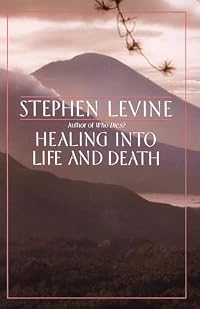
Stephen Levine was born in Albany, New York on July 17, 1937. He attended the University of Miami. After working as an editor and writer in New York City, he was one of the founders of the San Francisco Oracle in 1966. He was a poet, author, and teacher of guided meditation and healing techniques. He and his wife Ondrea counseled the dying and show more their loved ones for more than 30 years. He was the author of several books including A Gradual Awakening, Meetings at the Edge, Healing into Life and Death, A Year to Live: How to Live This Year as If It Were Your Last, and Becoming Kuan Yin: The Evolution of Compassion. He and his wife wrote Embracing the Beloved: Relationships as a Path of Awakening, To Love and Be Loved, and Who Dies?: An Investigation of Conscious Living and Conscious Dying. He died on January 17, 2016 after a long illness at the age of 78. (Bowker Author Biography) show less
Classifications
Statistics
- Members
- 549
- Popularity
- 53,828
- Reviews
- 9
- Rating
- (3.78)
- Languages
- 5 — Chinese, Dutch, English, German, Polish
- Media
- Paper, Audiobook, Ebook
- ISBNs
- 15
- UPCs
- 1
- ASINs
- 4