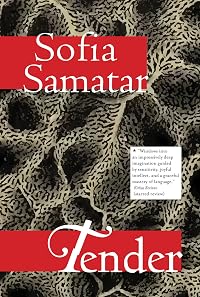
Tender: Stories
by Sofia Samatar
On This Page
Description
Divided into "Tender Bodies" and "Tender Landscapes," the stories collected here in this first collection of short fiction from a rising star travel from the commonplace to the edges of reality. Some of Samatar's weird and compassionate fabulations spring from her life and literary studies; some spring from the world, some from the void. Tender explores the fragility of bodies, emotions, and landscapes, in settings that range from medieval Egypt to colonial Kenya to the stars, and the voices show more of those who question: children, students, servants, researchers, writers" -- ?c Amazon.com. show lessTags
Recommendations
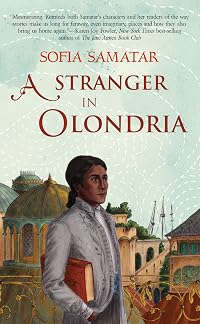
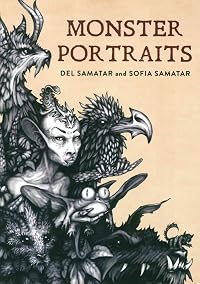



Member Reviews
When I start reading a Samatar story I'm never quite sure where I am or why I'm there... And then something turns, or a heart opens, or a scar (more often something worse, like a cyborg implant or a synthetic sky) is revealed, and nothing matters more than being right there, right now, until I get to the last page.
Plus there are often moments like the one below, appealing especially to acolytes of the written word. I'm smitten, give me up for lost.
"This is not the first time I have written something I intend to submit for preservation. I have submitted a number of works, more than I care to remember. All have been rejected. I have submitted dreams, fantastical stories, novels of Old Earth, children's tales, even hymns. At this point, show more merely to pass by the archives gives me a queasy feeling. For this reason, I rarely go into town, and if I need something unavailable in Housing, I pick it up from Sister Bundle's little stand, rather than visiting the stores. It is a terrible feeling to have your work pulped. Brother Chalk at the archives--whom I call Ezera, since I knew him at school--tries to comfort me by telling me that pulped paper makes fresh paper possible, that destruction and renewal is the cycle of Life. His remaining hair clumped at the back of his head, his chubby jowls fringed with beard, he is a good man, a father, sympathetic, and one of my best friends. The last time I spoke with him, I thanked God that I had no pencil with me, for I might have succumbed to the temptation to drive it into his hand."
From "Fallow" show less
Plus there are often moments like the one below, appealing especially to acolytes of the written word. I'm smitten, give me up for lost.
"This is not the first time I have written something I intend to submit for preservation. I have submitted a number of works, more than I care to remember. All have been rejected. I have submitted dreams, fantastical stories, novels of Old Earth, children's tales, even hymns. At this point, show more merely to pass by the archives gives me a queasy feeling. For this reason, I rarely go into town, and if I need something unavailable in Housing, I pick it up from Sister Bundle's little stand, rather than visiting the stores. It is a terrible feeling to have your work pulped. Brother Chalk at the archives--whom I call Ezera, since I knew him at school--tries to comfort me by telling me that pulped paper makes fresh paper possible, that destruction and renewal is the cycle of Life. His remaining hair clumped at the back of his head, his chubby jowls fringed with beard, he is a good man, a father, sympathetic, and one of my best friends. The last time I spoke with him, I thanked God that I had no pencil with me, for I might have succumbed to the temptation to drive it into his hand."
From "Fallow" show less
This is a beautiful collection. Samatar navigates her own imagination with distinctive voices and structures that make each of the twenty stories a fresh revelation. Her style is mythic: she tells the story she wants without making concessions for the demanding tendencies of the reader. This results in a crystalline sense of timing, as revelations often delayed or incomplete deepen her characters rather than merely pushing the plot along. Her prose varies from conversational to poetic, well-fitted to the different modes of her stories. I adore these stories, and would recommend them to anyone. Samatar does not transcend genre; she makes it unnecessary.
This story collection is very literary genre fiction: lovely language and more ambiguity than plot in most of these stories. I was happy to let the wonderful prose wash over me even when I didn't know what I was reading about anymore, as was the case with a few of the most fragmented pieces. (I wasn't quite interested enough in those stories to page back and see if I could figure it out.) There's an impressively wide range of settings and narrators and styles and moods. Even when Samatar works within established subgenres, she really has something fresh to say, and original ways to say it. I especially appreciate her timely (and timeless) message that (post-)apocalyptic settings aren't just fantasies and warnings for privileged show more societies, they are also some real people's real lives. show less
 This review was written for LibraryThing Early Reviewers.
Often, collections by a single author are a mixed bag; sometimes they're great, more often they're meh. How I sort the greats from the mehs is if, when I look at the table of contents, I can recall a story's details and how that story made me feel and think, and there are more "Ah! Yes, that one; I loved that one!" than "I don't remember this story at all," then I know the collection as a whole was successful for me as a reader. The thing is, with this collection, even the stories I was meh about, I can still picture in vivid detail. They're memorable despite my personal reaction to them. That's quite a storyteller!
"An Account of the Land of Witches," a new never-before-published story, was my favorite of the collection. All of show more Samatar's writing feels grounded in truth even when she's deep in fantasy. I appreciate that sense of reality amidst the make believe.
4 stars
(The first time I read Samatar was her story in The Starlit Wood: New Fairy Tales. And I will be reading A Stranger in Olondria very soon.) show less
"An Account of the Land of Witches," a new never-before-published story, was my favorite of the collection. All of show more Samatar's writing feels grounded in truth even when she's deep in fantasy. I appreciate that sense of reality amidst the make believe.
4 stars
(The first time I read Samatar was her story in The Starlit Wood: New Fairy Tales. And I will be reading A Stranger in Olondria very soon.) show less
This review was written for LibraryThing Early Reviewers.A collection of strange, delicately written stories which use elements of fantasy, science fiction, or fable to reflect on painful real-world issues, such as racism, injustice, and the migration of refugees. Although these are technically prose, reading them feels much more like reading poetry, including the feeling that most of the significance in them lies somewhere between the lines on the page. Some of them I thought were simply brilliant. Others struck me as only partially successful literary experiments, ones whose messages and meanings were a little too obvious or (more often) a little too obscure. But even those were beautifully written and interesting.
This review was written for LibraryThing Early Reviewers.Sofia Samatar's collection of stories reveals human (or not-so-human) tenderness as the aching of a wound, or the gentle kindness from another, or the vulnerability of the young. It's a stunning collection of powerful stories with beautiful writing and many with creative ways of expressing the tale (essay format, journal entries, letters) that provides a unique depth and texture.
I love "Selkie Stories Are for Losers," a story in which a young woman comes to terms with her anger at the loss of her mother, sharing the stories with the reader, she keeps hidden within herself. The phrases "I don't tell" and "I won't tell" are repeated throughout, highlighting the need for new stories free of the pain and mistakes of the past.
On the show more flip-side of the relationship between mother and daughter is "Honey Bear," an affecting story of a woman and her husband driving to the ocean with their daughter. The story sings with love and compassion. The woman is ill, the husband frustrated and over protective. She holds to her daughter with such affection in a world that is slipping away, dying. The ending of this story — which I will not spoil — shattered me. Love is so powerful. So is hope, however small.
Another deeply moving story is "Walkdog," which is presented as an class essay about knowing one's environment. The author chooses to write about walkdogs, creatures said to steal people away, forcing them to walk behind them for years and years. The use of footnotes here are critical to the way the story unfolds, gaps of the personal slipping under the seemingly academic, building into a story about a bullied boy and the girl who loved him, but not enough to protect him — all culminating in a heartbreaking conclusion.
Power structures are often explored in these stories. "Ogres of East Africa" — which I've read three times now and the story grows with each readingfor — shares the story of Alibhai a servant to a white hunter looking to track and hunt an ogre. As he records stories of ogres for hig master, he records his own history in the margins, his story slowly moving to the forefront of the text.
In a similar fashion, "An Account of the Land of Witches" presents the story of a slave finding freedom in a strange land in which boundaries are meaningless. Later a woman in our modern world goes looking for the history of this land, basing her dissertation on the slave's letter and her master's refutation, only to have her efforts stopped when the borders are closed by war.
There are so many more lovely stories in this collection — both "Dawn and the Maiden" and "Cities of Emerald, Deserts of Gold" stand out for me in terms of their beauty of language. Take for example, this passage"
One could go one-by-one in an attempt to honor each story in its turn. But I'm afraid I don't have time, so I'll just say this is a gorgeous book, worth every penny in the cost of acquiring it. show less
I love "Selkie Stories Are for Losers," a story in which a young woman comes to terms with her anger at the loss of her mother, sharing the stories with the reader, she keeps hidden within herself. The phrases "I don't tell" and "I won't tell" are repeated throughout, highlighting the need for new stories free of the pain and mistakes of the past.
On the show more flip-side of the relationship between mother and daughter is "Honey Bear," an affecting story of a woman and her husband driving to the ocean with their daughter. The story sings with love and compassion. The woman is ill, the husband frustrated and over protective. She holds to her daughter with such affection in a world that is slipping away, dying. The ending of this story — which I will not spoil — shattered me. Love is so powerful. So is hope, however small.
Another deeply moving story is "Walkdog," which is presented as an class essay about knowing one's environment. The author chooses to write about walkdogs, creatures said to steal people away, forcing them to walk behind them for years and years. The use of footnotes here are critical to the way the story unfolds, gaps of the personal slipping under the seemingly academic, building into a story about a bullied boy and the girl who loved him, but not enough to protect him — all culminating in a heartbreaking conclusion.
Power structures are often explored in these stories. "Ogres of East Africa" — which I've read three times now and the story grows with each readingfor — shares the story of Alibhai a servant to a white hunter looking to track and hunt an ogre. As he records stories of ogres for hig master, he records his own history in the margins, his story slowly moving to the forefront of the text.
In a similar fashion, "An Account of the Land of Witches" presents the story of a slave finding freedom in a strange land in which boundaries are meaningless. Later a woman in our modern world goes looking for the history of this land, basing her dissertation on the slave's letter and her master's refutation, only to have her efforts stopped when the borders are closed by war.
There are so many more lovely stories in this collection — both "Dawn and the Maiden" and "Cities of Emerald, Deserts of Gold" stand out for me in terms of their beauty of language. Take for example, this passage"
My love is a river. My love is a brink. My love is the bring of an underground river. My love's arms ripple like rivers in the moonlight when he unlocks the garden gate. — from "Dawn and the Maiden"
One could go one-by-one in an attempt to honor each story in its turn. But I'm afraid I don't have time, so I'll just say this is a gorgeous book, worth every penny in the cost of acquiring it. show less
Tender is a marvelous collection of short stories. I read them slowly, one at a time over many weeks, to better savor Samatar's beautiful language and wide-ranging imagination. I loved her first novel, A Stranger in Olondria, but I think I love this collection even more. While all of these stories are wonderful, my favorites are "Selkie Stories Are for Losers," "Walkdog," "Honey Bear," "How to Get Back to the Forest," "An Account of the Land of Witches" (which is simply one of the best short stories I've read in a long time), and the haunting novella "Fallow." Samatar's stories are elegiac and melancholy, struck through with beauty and hope in the face of loss.
I received this book for free as part of Library Thing's Early Reviewers show more program. show less
I received this book for free as part of Library Thing's Early Reviewers show more program. show less
This review was written for LibraryThing Early Reviewers.Members
- Recently Added By
Lists

Kirkus Starred Fiction Reviews of Books Published in 2017
412 works; 7 members
Author Information

21+ Works 1,992 Members
Awards and Honors
Awards
Distinctions
Work Relationships
Common Knowledge
- Original publication date
- 2017
- Dedication
- For Isabel and Nico
- First words
- I hate selkie stories.
- Last words
- (Click to show. Warning: May contain spoilers.)I got your message.
- Blurbers
- brown, adrienne maree; Beukes, Lauren; Dutton, Danielle; LaValle, Victor; Loory, Ben; Nahm, David Connerley
Classifications
Statistics
- Members
- 205
- Popularity
- 160,208
- Reviews
- 18
- Rating
- (4.23)
- Languages
- English
- Media
- Paper, Ebook
- ISBNs
- 3
- ASINs
- 1