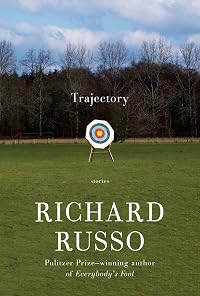
Trajectory: Stories
by Richard Russo
On This Page
Description
"In this pair of novellas and two stories, Russo's characters bear little similarity to the blue-collar citizens we're familiar with from most of his novels. In "Horseman," a tenured professor confronts a young plagiarist as well as her own weaknesses as the Thanksgiving holiday approaches--"And after that, who knew?" In "Intervention," a realtor facing an ominous medical prognosis finds himself in his father's shadow while he presses forward, or not. In "Voice," a semi-retired English show more professor is conned by his increasingly estranged brother into coming along on a group tour of the Biennale, fleeing a mortifying incident with a traumatized student back in Massachusetts but encountering further complications en route. And in "Milton and Marcus," a lapsed novelist is struggling with his wife's illness and trying to rekindle his screenwriting career, only to be stymied by the pratfalls of that trade when he's called to an aging, iconic star's mountaintop in Wyoming"-- show lessTags
Recommendations

Member Reviews
Four stories: three hits and a miss. Much of Russo's other short stories and novels deal with academics or working class heroes, and Trajectory continues his track record of brilliance, humor, and insight. The first story is the only one told from a female perspective and it's very grim and full of male characters who are much more intriguing than the narrator. The second and third stories both involve pairs of brothers, in varied situations and settings, who drive each other crazy with obtuseness, jealousy, and misunderstandings. The last and most amusing tale is that of a Hollywood screenwriter who, though beloved by a Paul Newman type actor (and Russo and Newman had a very strong relationship through Nobody's Fool and Empire Falls), show more is challenged by a Robert Redford-ish older leading man to re-activate a long dead screenplay for him after the Newman figure has died.
Russo is a humor writer above all. Quotes:
"The general impression she conveys is of a woman who once upon a time cared about how she presented herself to me, but woke up one morning, said fuck it and was immediately happier."
"Nate has belatedly come to understand life is, seemingly by design, a botched job."
"I always thought I was special." It was an odd, in some ways startling, admission. There were any number of people who clearly felt like this, but the sentiment was seldom given voice."
"People cling to folly as if it were their most prized possession, defending it, sometimes with violence, against the possibility of wisdom."
"I was afraid to engage again, even at a distance, with a heart and mind so compatible with my own."
"Put simply, I'd wanted more happiness than I had coming. Wasn't its pursuit my inalienable right? But of course that's just another way of asking, Why shouldn't we have whatever we want?" show less
Russo is a humor writer above all. Quotes:
"The general impression she conveys is of a woman who once upon a time cared about how she presented herself to me, but woke up one morning, said fuck it and was immediately happier."
"Nate has belatedly come to understand life is, seemingly by design, a botched job."
"I always thought I was special." It was an odd, in some ways startling, admission. There were any number of people who clearly felt like this, but the sentiment was seldom given voice."
"People cling to folly as if it were their most prized possession, defending it, sometimes with violence, against the possibility of wisdom."
"I was afraid to engage again, even at a distance, with a heart and mind so compatible with my own."
"Put simply, I'd wanted more happiness than I had coming. Wasn't its pursuit my inalienable right? But of course that's just another way of asking, Why shouldn't we have whatever we want?" show less
A long time fan of Russo's stories, this collection is by far his best work in my humble opinion. It's refreshing he takes a breather from the small town ecosystem from his other works, delving into relationships or all sorts, along with new locations. "Voices" is extraordinary as is "Horseman" and "Intervention" but they're all really top notch. Short story development is a real skill, and Richard has proven here that he's not only proficient at it, but excels. Bravo Mr. Russo and thank you for sharing these wonderful characters, places and ideas.
Trajectories is comprised of four long short stories of varying length. A quick note—if you have read the separately published “Nate in Venice”, then you have read the second story, entitled Voice in this collection. No idea why the titles changed.
I have read quite a bit of Russo’s work and to me his shorter works are often darker than his novels, which have rich vein of quiet humor even when the story lines get serious or the subject matter is more disturbing. I think I like the novels better, but everything he writes is good, just different.
We fall down the Rabbit hole in three out of four of these stories. Twice into the world of academia (Voice and Horseman) and once into the world of the Hollywood writer (Milton and show more Marcus). I felt like a fly on the wall in these stories, especially in Milton and Marcus since I have never even met anyone with ties to Hollywood. I found Horseman to be particularly interesting because my experience with stories about academics who find themselves in tight situations are almost always told from the male perspective. Horseman was interesting to me because it dealt with what is most likely a common existential crisis for academics and considering it from a woman’s perspective showed that some experiences can be universal and individual at the same time.
In Intervention we have a story of a struggling real estate developer who is suffering a perfect storm of financial decline, a serious health issue, and faltering confidence. In other words, an aging Everyman. My favorite story in the collection, I found the main character to be sympathetic and quietly inspirational and the supporting cast was interesting and compelling. This cast of characters would support a longer novel form very nicely.
As with many literary writers, especially the few that are of this caliber, I feel that at least for me a first read is just an introduction to the basic plot and characters (to use a Hemingway analogy--the top 10% of the iceberg) and subsequent readings of each of these stories will provide further rewards as deeper meanings are revealed. show less
I have read quite a bit of Russo’s work and to me his shorter works are often darker than his novels, which have rich vein of quiet humor even when the story lines get serious or the subject matter is more disturbing. I think I like the novels better, but everything he writes is good, just different.
We fall down the Rabbit hole in three out of four of these stories. Twice into the world of academia (Voice and Horseman) and once into the world of the Hollywood writer (Milton and show more Marcus). I felt like a fly on the wall in these stories, especially in Milton and Marcus since I have never even met anyone with ties to Hollywood. I found Horseman to be particularly interesting because my experience with stories about academics who find themselves in tight situations are almost always told from the male perspective. Horseman was interesting to me because it dealt with what is most likely a common existential crisis for academics and considering it from a woman’s perspective showed that some experiences can be universal and individual at the same time.
In Intervention we have a story of a struggling real estate developer who is suffering a perfect storm of financial decline, a serious health issue, and faltering confidence. In other words, an aging Everyman. My favorite story in the collection, I found the main character to be sympathetic and quietly inspirational and the supporting cast was interesting and compelling. This cast of characters would support a longer novel form very nicely.
As with many literary writers, especially the few that are of this caliber, I feel that at least for me a first read is just an introduction to the basic plot and characters (to use a Hemingway analogy--the top 10% of the iceberg) and subsequent readings of each of these stories will provide further rewards as deeper meanings are revealed. show less
Trajectory, Richard Russo, author; "Horseman" read by Amanda Carlin, "Voice" read by Arthur Morey, "Intervention" read by Fred Sanders, "Milton and Marcus" read by Mark Bramhall
In this book of short stories, Russo has chosen characters who are faced with a life choice of going forward or remaining in the past, of having hope or of sinking into the lap of despair. Stories that could have been depressing are uplifting in the end, as all of the main characters choose what life has to offer them, rather than what life has given them, oftentimes, with disappointing consequences.
In “Horseman”, a college professor matures through the errors of her student’s ways. The student’s poor behavior causes her to review her own life choices. show more She comes to terms with her own social issues and chooses to broaden her horizons, to break free and make the necessary changes to improve her life rather than stay stuck in a protected environment that she has created for herself, rather than remain in the place she always thought would keep her safe!
In “Voice”, the main character is insecure. He has to come to terms with his past, has to learn to forgive himself as well as others, and then he has to go forward optimistically instead of dwelling on despair and his previous mistakes of judgment. He has to decide whether or not he is a good person, or whether he has to stay in the shadow of others as he always has done before, believing they are right and he is wrong.
In “Intervention, the economy has hit a recent downturn, and the real estate market has hit the realtors and the sellers strapped for cash. As the main character becomes more empathetic toward his clients feelings, he also becomes more introspective about himself and rediscovers his own will to live hopefully, rather than be stuck in the patterns of his family in the past, a pattern that apathetically accepted fate as if it could not be influenced by outside forces and as if it was predetermined.
In “Milton and Marcus”, a screenwriter is in a difficult position. He has to find a path forward with a wife who is seriously ill and a successful career that is in decline. It is, therefore, a story within a story. One part is his own story and the other is about Milton and Marcus, two estranged friends, a screenplay he has written. It is the screenplay that provides the impetus for him to go forward and be the man he wants to be, and perhaps, not exactly the kind of man he has been.
In each story, the main character is faced with what sometimes seems an insurmountable problem. The issue becomes the catalyst that propels the main character’s road forward, and determines how he/she comes to terms with how to proceed with living. All of the stories involve the character’s examination of his past behavior which acts as their guiding light to the way ahead. In some cases, a weakened, lesser character is the impetus for improvement. In each story, there is desperation, but the writing style and insertion of humor brings each one to a hopeful conclusion, one not steeped in pessimism, but rather in optimism, as each character finds a way to accept themselves, warts and all, and to accept that life might still present them with opportunity rather than defeat as they march into their futures. Each of the characters chooses to challenge themselves, to fly rather than remain tethered to the ground. show less
In this book of short stories, Russo has chosen characters who are faced with a life choice of going forward or remaining in the past, of having hope or of sinking into the lap of despair. Stories that could have been depressing are uplifting in the end, as all of the main characters choose what life has to offer them, rather than what life has given them, oftentimes, with disappointing consequences.
In “Horseman”, a college professor matures through the errors of her student’s ways. The student’s poor behavior causes her to review her own life choices. show more She comes to terms with her own social issues and chooses to broaden her horizons, to break free and make the necessary changes to improve her life rather than stay stuck in a protected environment that she has created for herself, rather than remain in the place she always thought would keep her safe!
In “Voice”, the main character is insecure. He has to come to terms with his past, has to learn to forgive himself as well as others, and then he has to go forward optimistically instead of dwelling on despair and his previous mistakes of judgment. He has to decide whether or not he is a good person, or whether he has to stay in the shadow of others as he always has done before, believing they are right and he is wrong.
In “Intervention, the economy has hit a recent downturn, and the real estate market has hit the realtors and the sellers strapped for cash. As the main character becomes more empathetic toward his clients feelings, he also becomes more introspective about himself and rediscovers his own will to live hopefully, rather than be stuck in the patterns of his family in the past, a pattern that apathetically accepted fate as if it could not be influenced by outside forces and as if it was predetermined.
In “Milton and Marcus”, a screenwriter is in a difficult position. He has to find a path forward with a wife who is seriously ill and a successful career that is in decline. It is, therefore, a story within a story. One part is his own story and the other is about Milton and Marcus, two estranged friends, a screenplay he has written. It is the screenplay that provides the impetus for him to go forward and be the man he wants to be, and perhaps, not exactly the kind of man he has been.
In each story, the main character is faced with what sometimes seems an insurmountable problem. The issue becomes the catalyst that propels the main character’s road forward, and determines how he/she comes to terms with how to proceed with living. All of the stories involve the character’s examination of his past behavior which acts as their guiding light to the way ahead. In some cases, a weakened, lesser character is the impetus for improvement. In each story, there is desperation, but the writing style and insertion of humor brings each one to a hopeful conclusion, one not steeped in pessimism, but rather in optimism, as each character finds a way to accept themselves, warts and all, and to accept that life might still present them with opportunity rather than defeat as they march into their futures. Each of the characters chooses to challenge themselves, to fly rather than remain tethered to the ground. show less
I was disappointed to find this collection of 4 stories is mainly made up of one novella, "Voice", that I’ve read before. I’ve no problem with authors publishing a novella on its own and then re-publishing it as part of a collection, but I’m frustrated that he renamed it, (originally “Nate in Venice”). The rest of the book includes a story of a college professor who suspects plagiarism, a writer who gets sucked into the glamour of Hollywood screenwriting by a famous star (allegedly inspired by his friendship with Paul Newman), and an older man dealing with a bad health diagnosis while trying to help a hoarder sell her home. None of the stories were too memorable, but I still love Russo's descriptions. For me, his best work show more comes from novels that give him a chance to develop the characters a bit more.
“He and Paula have been married for close to 30 years, thanks in large part to a mutual willingness to let an arched eyebrow do the heavy lifting of soliloquy.” show less
“He and Paula have been married for close to 30 years, thanks in large part to a mutual willingness to let an arched eyebrow do the heavy lifting of soliloquy.” show less
Every time I had to set this aside to take care of all the practical responsibilities of life, I looked forward to returning to these stories and finding out what happened to these people. That being said, these aren't the sorts of stories where a whole lot happens (in the exterior). But the interior lives (when Russo is at his best) are often captured beautifully. This book also reminds me of the unique power of stories (they are not just "short novels").
I have only read one other book by this author, don't remember which one but remember I didn't like it all that much. Now, after reading these, I think I may have to try another because I enjoyed these stories and his writing. Four stories, though one is so long it could be considered novella length. People looking back on something that happened in the past, and now middle aged they reconsider how they act in the present and future, seems to be the common theme.
The first two stories were my favorites and both concern Professors, though one is now retired. In the Horsemen, a woman professor, with an autistic child, reconsiders something a professor once told her in her college days, advice at that time that she dismissed. Now show more reconsidering in the light of her marriage and disconnection she has to her child. Very well done and his writing made this soul searching dilemma quite realistic and poignant.
In the Voice, a retired professor on a trip to Venice, with a brother he never really got along with due to past circumstances within the family, attempts to make sense of the estrangement, as well as his brothers actions on the trip. A bad experience with a student in his class also figures in his musings. He meets new people on the trip, and in light of a possible new relationship he comes to decisions about his past and how he will handle the future.
Russo seems like a natural born storyteller, his writing flows, with often insightful comments mixed with humorous antidotes. His dialogue is fantastic, natural sounding and realistic within the circumstances these characters find themselves. I really enjoyed these stories, just good solid writing and plotting.
ARC from publisher. show less
The first two stories were my favorites and both concern Professors, though one is now retired. In the Horsemen, a woman professor, with an autistic child, reconsiders something a professor once told her in her college days, advice at that time that she dismissed. Now show more reconsidering in the light of her marriage and disconnection she has to her child. Very well done and his writing made this soul searching dilemma quite realistic and poignant.
In the Voice, a retired professor on a trip to Venice, with a brother he never really got along with due to past circumstances within the family, attempts to make sense of the estrangement, as well as his brothers actions on the trip. A bad experience with a student in his class also figures in his musings. He meets new people on the trip, and in light of a possible new relationship he comes to decisions about his past and how he will handle the future.
Russo seems like a natural born storyteller, his writing flows, with often insightful comments mixed with humorous antidotes. His dialogue is fantastic, natural sounding and realistic within the circumstances these characters find themselves. I really enjoyed these stories, just good solid writing and plotting.
ARC from publisher. show less
Members
- Recently Added By
Lists

Top Five Books of 2017
757 works; 230 members

Books Read in 2017
4,249 works; 130 members

To Read
617 works; 7 members

Kirkus Starred Fiction Reviews of Books Published in 2017
412 works; 7 members
Author Information

37+ Works 29,113 Members
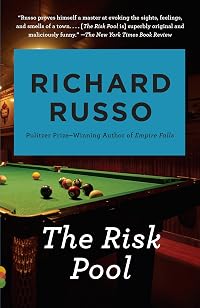
Richard Russo was born in Johnstown, New York on July 15, 1949. He received a Bachelor's degree, a Master of Fine Arts degree, and a Doctor of Philosophy degree from the University of Arizona. He taught at numerous colleges including Southern Illinois University Carbondale and Colby College. He has written numerous books including Mokawk, The Risk show more Pool, Straight Man, Bridge of Sighs, and That Old Cape Magic, as well as a short story collection, The Whore's Child. His novel Empire Falls won the 2002 Pulitzer Prize for Fiction and Nobody's Fool was made into a movie starring Paul Newman, Bruce Willis and Melanie Griffith. His memoir was entitled Elsewhere. He also co-wrote the 1998 film Twilight with director Robert Benton and the teleplay for the HBO adaptation of Empire Falls. (Bowker Author Biography) Richard Russo lives in coastal Maine with his wife & two daughters. (Publisher Fact Sheets) show less
Some Editions
Work Relationships
Common Knowledge
- Original publication date
- 2017
- Disambiguation notice
- Contains:
- Horseman
- Voice
- Intervention
- Milton and Marcus
Classifications
Statistics
- Members
- 347
- Popularity
- 90,854
- Reviews
- 15
- Rating
- (3.64)
- Languages
- English, French, German, Korean
- Media
- Paper, Audiobook, Ebook
- ISBNs
- 18
- ASINs
- 4