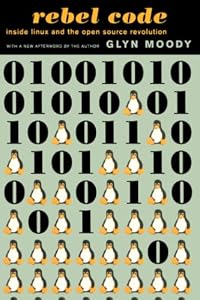
Rebel Code: Linux and the Open Source Revolution
by Glyn Moody
On This Page
Description
A high-velocity chronicle of the open source movement-and its impact on computing, business, and cultureTags
Recommendations















Member Recommendations
Member Reviews
I can't give this a star rating. It began excellently, and ended in irrelevant trivia, and farce.
I read this book very much from a personal historical perspective, since I lived the history it recounts and know many of the people in it, either personally or by reputation. (I also happened to be frequently corresponding with one of the people most quoted in it, for unrelated reasons, as I read it.)
So, really I enjoyed the first 100 or so pages of the book, which covered years before I got very involved in this stuff. I'd heard that history before, but this stuck me as a more complete version, taken from closer to the source. That first section kept me reading too late for a few nights.
Then it went downhill, with endless details about show more company's shenanigans during the dotcom bubble. Was there, don't want to hear it again. The latter half of the book is a snapshot of a particularly deranged moment in time, which has perhaps of historical value, but not personal historical value. In the end I plowed though it only because Goodreads
told me I'd been reading this book for a month.
I will leave you with ... the farce! (From the last page of the book)
«Stallman says despairingly. "I'm going to keep working on the free software movement because I don't see who's going to replace me."
Nevertheless, a worthy successor who has the rare mix of qualities neccessary may already be emerging in the person of Miguel de Icaza.« show less
I read this book very much from a personal historical perspective, since I lived the history it recounts and know many of the people in it, either personally or by reputation. (I also happened to be frequently corresponding with one of the people most quoted in it, for unrelated reasons, as I read it.)
So, really I enjoyed the first 100 or so pages of the book, which covered years before I got very involved in this stuff. I'd heard that history before, but this stuck me as a more complete version, taken from closer to the source. That first section kept me reading too late for a few nights.
Then it went downhill, with endless details about show more company's shenanigans during the dotcom bubble. Was there, don't want to hear it again. The latter half of the book is a snapshot of a particularly deranged moment in time, which has perhaps of historical value, but not personal historical value. In the end I plowed though it only because Goodreads
told me I'd been reading this book for a month.
I will leave you with ... the farce! (From the last page of the book)
«Stallman says despairingly. "I'm going to keep working on the free software movement because I don't see who's going to replace me."
Nevertheless, a worthy successor who has the rare mix of qualities neccessary may already be emerging in the person of Miguel de Icaza.« show less
Rebel Code is the compelling account of how a band of mavericks took on big business and revolutionized the computer world.
In 1991 a young student, Linus Torvalds, bought a PC and began writing a new software program. It started as a hobby, but in a few years he and a global alliance of hackers, linked by the Net, had developed an operating system that now threatens Microsoft. GNU/Linux is used by millions, and most troubling of all for the corporate giants, it is free.
In this definitive account, Glyn Moody tells the astonishing David-and-Goliath story of Linux, placing it in the broader history of the free software movement, and shows what can be achieved when creativity and co-operation rise above the profit motive.
In 1991 a young student, Linus Torvalds, bought a PC and began writing a new software program. It started as a hobby, but in a few years he and a global alliance of hackers, linked by the Net, had developed an operating system that now threatens Microsoft. GNU/Linux is used by millions, and most troubling of all for the corporate giants, it is free.
In this definitive account, Glyn Moody tells the astonishing David-and-Goliath story of Linux, placing it in the broader history of the free software movement, and shows what can be achieved when creativity and co-operation rise above the profit motive.
Good, but not great. The author's political bias was readily apparent.
Using the example of Linux as the prototypical case, the book describes the history of the open source movement.
Using the example of Linux as the prototypical case, the book describes the history of the open source movement.
A rather better than average book about Open Source.
Not just the basics were covered (GNU, Linux) but most of the various necessary extras (Mozilla, XFree86, Apache, Samba, KDE, GNOME and so on).
I'd have liked a slightly stronger technology slant, and I think databases and file systems were slighted, but overall a very good read.
Not just the basics were covered (GNU, Linux) but most of the various necessary extras (Mozilla, XFree86, Apache, Samba, KDE, GNOME and so on).
I'd have liked a slightly stronger technology slant, and I think databases and file systems were slighted, but overall a very good read.
Entertaining and interesting account of the history of open source software development and the people that drove it.
Nice book about the history and background to the development of linux os.
Ratings
Members
- Recently Added By
Author Information

3 Works 453 Members
Glyn Moody's writings have appeared in numerous publications including Wired magazine, The Economist, New Scientist, Financial Times, The Guardian, and The Daily Telegraph
Common Knowledge
- Canonical title*
- Codice ribelle: la vera storia di Linux e della rivoluzione open source
- Original title
- Rebel Code: Linux and the Open Source Revolution
- Original publication date
- 2001
- People/Characters
- Richard M. Stallman; RMS; Linus Torvalds
*Some information comes from Common Knowledge in other languages. Click "Edit" for more information.
Classifications
- Genres
- Technology, Nonfiction, General Nonfiction, History
- DDC/MDS
- 650 — Applied Science & Technology Management & public relations Business Skills & Management
- LCC
- QA76.76 .O63 .M645 — Science Mathematics Mathematics Instruments and machines Calculating machines Electronic computers. Computer science Computer software
- BISAC
Statistics
- Members
- 402
- Popularity
- 77,220
- Reviews
- 6
- Rating
- (3.51)
- Languages
- 5 — Catalan, English, Finnish, German, Italian
- Media
- Paper, Ebook
- ISBNs
- 9
- ASINs
- 1