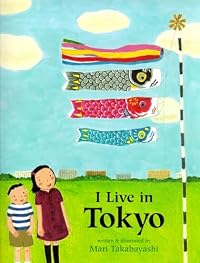
I Live in Tokyo
by Mari Takabayashi
On This Page
Description
A little girl describes the city of Tokyo in which she lives by the passage of the months and seasons of the year.Tags
Recommendations





Member Reviews
I greatly enjoyed reading Mari Takabayashi's "I Live in Tokyo." One aspect I liked about the book is that it was informational, providing the reader with knowledge about Japanese culture and traditions, but it still felt like I was reading a story. The book is divided into twelve sections, one for each month of the year, and in each section the narrator gives information about what she does in that month. In March, she celebrates "Hinamatsuri," the doll's festival, and in May she celebrates "Tango no Sekka," the boy's festival. It seems as if the narrator is simply telling the reader about her life, but in actuality the book provides a great deal of information about Japanese culture and lifestyle. The book provides information about show more traditions, holidays, and festivals, and it also provides the reader with many Japanese vocabulary words. I liked the small, colorful images defining and describing Japanese words related to each month's tradition or celebration. These terms include items that are incorporated into Japanese celebrations, like "otoshidama," New Year's gift money given to children. Other terms defined beneath the small pictures are everyday items and foods, like "yakizakana," a grilled fish dish. I also liked that the narration itself provided a great deal of vocabulary in a way that felt natural and conversational. For instance, when talking about visiting her grandmother, the narrator says, "my grandmother is a master of sado, the tea ceremony," and when describing the first day of the school year, the narrator explains that "kanji are Chinese characters, based on pictures, that are used in Japanese writing." One thing that I especially liked about the inclusion of the Japanese vocabulary was that not all of the terms are defined outright. Rather, the meaning of the words is revealed through context. When the narrator is talking about her kimono and says "I can't run, and the obi around my belly starts to itch," I assumed that she is referring to a belt or a sash. I liked that the narration was not interrupted to explain the terms whose meaning could be inferred, because it made the writing flow nicely. I loved the book's beautiful, brightly-colored watercolor artwork, and I think it gives the book a happy, cheerful feel. I think the "big idea" of the book is simply to convey information about Japanese culture to readers and to show readers that Japan has many exciting cultural traditions. I would give this book five stars. show less
This book is just precious. You can see the wonderful memories the author has from growing up in Japan. She depicts the blending of old traditions and modern life in Japan in a whimsical, childlike manner. Often, when we do discuss Japanese culture, many of the holidays and festivals are overlooked. This book goes form month to month, talking about holidays in each month, many that would surprise people to learn about. I love the voice that is used, it really feels like a young girl telling me about these things. This book is a great jumping off point for learning more about different festivals and traditions in Japan.
I love that this book was illustrated by the author. It keeps the same feeling between the text and pictures, making show more this book feel very whole. show less
I love that this book was illustrated by the author. It keeps the same feeling between the text and pictures, making show more this book feel very whole. show less
I really enjoyed I Live in Tokyo. I enjoyed how the Mimiko walked through every aspect of her life. While this may seem tedious at first, there are tremendous culture differences between Japanese and American people. I enjoyed how Mimiko explained little things like how the homes in her neighborhood were close together and small because there are so many people living in Tokyo, the neighborhoods had to be that way to accommodate all of the people living there. I also enjoyed seeing the differences in dinner customs. The colors and illustrations are a great asset to this book because you do not have to use your imagination trying to figure out what Tokyo looks like. The vibrant colors and patterns are a great added feature. The big idea show more of the book was just letting the readers know about day to day life in Tokyo. While the book was realistic fiction, it could also be categorized as informational. It was a good, easy to understand book that I would enjoy reading again. show less
I picked this book out because I love Japanese culture and I know some of the language. I thought that I had known everything there is about Japan but after reading this book I can tell you that I was wrong. This book is very informative, as it does not really have a “normal” story. It follows a Japanese family in everyday life and goes through each month explaining traditions and customs of that the country. The point of this book is to introduce Japanese culture and language to its reader in a way that is entertaining and fun. I personally really enjoyed it because I plan to go to (maybe even live in) Japan at some point. I especially liked the words written in Japanese throughout. For example, on each page the month that was show more being talked about was written in Japanese. Also in the back of the book there was a page with Japanese to English translations on how to introduce yourself. This book is great for anyone wanting to learn more about different cultures. show less
I live in Tokyo by Mari Takabayashi was an interesting, yet enjoyable book to read for many reasons. I like that each page has a month listed on the side, with a holiday chosen to discuss the young girls family traditions during that holiday. It gives the reader an insight on this family’s tradition, which readers may either be able to relate to, or will learn something new about this particular culture. Another reason that I liked this book is because it not only has English words throughout it, but also Japanese words with their pronunciations as well. This allowed me to better understand how to pronounce the Japanese word and connect it to its English translation. The main idea of this book is to inform readers of the Japanese show more culture and its unique traditions. show less
The book is divided into twelve sections, one for each month of the year, and in each section the narrator gives information about what she does in that month. In March, she celebrates "Hinamatsuri," the doll's festival, and in May she celebrates "Tango no Sekka," the boy's festival. The book provides information about traditions, holidays, and festivals, and it also provides the reader with many Japanese vocabulary words. I liked the small, colorful images defining and describing Japanese words related to each month's tradition or celebration. These terms include items that are incorporated into Japanese celebrations, like "otoshidama," New Year's gift money given to children. I also liked that the narration itself provided a great show more deal of vocabulary in a way that felt natural and conversational. For instance, when talking about visiting her grandmother, the narrator says, "my grandmother is a master of sado, the tea ceremony," and when describing the first day of the school year, the narrator explains that "kanji are Chinese characters, based on pictures, that are used in Japanese writing." One thing that I especially liked about the inclusion of the Japanese vocabulary was that not all of the terms are defined outright. Rather, the meaning of the words is revealed through context. When the narrator is talking about her kimono and says "I can't run, and the obi around my belly starts to itch," I assumed that she is referring to a belt or a sash. I liked that the narration was not interrupted to explain the terms whose meaning could be inferred, because it made the writing flow nicely. I also really liked at the end of the book how there was a glossary of all the Japanese words I just read about throughout the book all in one place. I loved the book's beautiful, brightly-colored watercolor artwork, and I think it gives the book a happy, cheerful feel. I think the "big idea" of the book is simply to convey information about Japanese culture to readers and to show readers that Japan has many exciting cultural traditions. show less
I read the story, I Live In Tokyo, and thought it was enjoyable. I like it because of the illustrations throughout the story. Each page includes a month with a particular Holiday during that month. An example is on page 1 that includes the month of January with the holiday being the New Year. The page also includes background information with pictures like the Japanese zodiac and different food they eat called pzoni. The book ends with the last page being December and the holiday being the first day of winter called Toji. I also like the language because the book integrates Japanese words throughout the text. An example is saying, “Kimono” meaning wedding dress, “Shinkansen” meaning bullet train, and finally “Undokai” which show more translates to field day. I believe the big idea of the book is to teach others about Tokyo culture and to provide a glimpse of what it would be like to live there throughout the year. The book travels though each month, showing the different weather, food, and culture, so the reader develops an understanding of the entire year, rather than a specific time or event. This would be an excellent book for elementary school students, particularly third to fifth grade. show less
Members
- Recently Added By
Lists

A Child's Book Tour of Japan
58 works; 4 members
Author Information
3+ Works 275 Members
Awards and Honors
Classifications
Statistics
- Members
- 215
- Popularity
- 151,348
- Reviews
- 20
- Rating
- (3.93)
- Languages
- English
- Media
- Paper, Ebook
- ISBNs
- 3
- UPCs
- 2
- ASINs
- 1