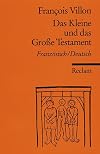
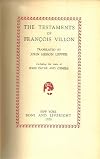
Le Grand Testament
by François Villon
On This Page
Description
L'œuvre principale de François Villon. Digressions sur l'injustice, la fuite du temps, la mort, la sagesse… Villon n'a pas uniquement renouvelé la forme de la poésie de son époque mais aussi la façon de traiter les thèmes poétiques hérités de la culture médiévale qu'il anime de sa propre personnalité. Il prend ainsi à contre-pied l'idéal courtois, renverse les valeurs admises en célébrant les gueux promis au gibet. Rencontre entre deux rockers passionnés de la langue show more française, jongleurs de mots et conteurs d'histoires populaires. show lessTags
Recommendations










Member Reviews
Da vida deste grande poeta não sabemos muito. As únicas fontes são a sua obra literária muito autobiográfica e um punhado de documentos legais relativos ao seu julgamento. Este "bad boy" do século XV, cantado por Georges Brassens, foi um personagem singular que levou uma vida tumultuada e, sem dúvida, chateou os outros no seu tempo. "O Testamento" é sem dúvida uma das obrs máximas da poesia narrativa.
One of the greatest poetry of late Middle Ages. Quotation: "Hanging outstretched on an elm tree, I feel at the neck the burden of my ass."
Like, totally cool, man.
Ratings
Members
- Recently Added By
Lists

Favourite Books
1,819 works; 316 members

Favourite Poems
34 works; 1 member

100 Books to Read in a Lifetime (That Are Older Than 200 Years)
415 works; 175 members

Books Read in 2018
4,360 works; 110 members

Greatest Books, allegedly
484 works; 9 members
Author Information

206+ Works 1,972 Members
Villon is one of the first great French lyric poets and one of the greatest French poets of any age. His "testaments" are mock wills, written in a racy blend of French and underworld slang. Scattered here and there among the ironic items of bequest are exquisite ballads and lyrics, some crystallizing classic themes of medieval literature. Villon's show more poetry uses traditional forms to create a powerful poetic personality during a period in which poetic individualism was rare. Indeed, his exquisite "Ballad of the Hanged Men" ("Ballade des Pendus") (1489) offers one of the most immediate depictions of death in Western poetry. Moreover, his dissolute life, lived among thieves and prostitutes, makes him a prototype of later decadent or bohemian poets. He was at various times arrested, imprisoned, tortured, and nearly put to death; his final sentence was commuted to exile by King Louis XI on accession to the throne, when he declared amnesties of all sorts, according to the usual practice of the time. It is not known how Villon spent his last years, after his release from prison. Villon's poetry has been translated by Rossetti (see Vol. 1), Synge (see Vol. 1), and Swinburne (see Vol. 1). (Bowker Author Biography) show less
Some Editions
Awards and Honors
Work Relationships
Is contained in
Common Knowledge
- Canonical title
- The Testaments of François Villon; Le Grand Testament
- Original title
- Le Testament
- Original publication date
- 1456; 1461
- Important places*
- Parijs, Île-de-France, Frankrijk; Parijs, Île-de-France, Frankrijk
- Original language
- French
*Some information comes from Common Knowledge in other languages. Click "Edit" for more information.
Classifications
- Genres
- Poetry, Fiction and Literature
- DDC/MDS
- 840 — Literature & rhetoric French Literature French literature and literatures of related Romance languages
- LCC
- PQ1590 .E5 .L4 — Language and Literature French, Italian, Spanish and Portuguese literatures French literature Old French literature (14th-) 15th century (to ca. 1525)
Statistics
- Members
- 166
- Popularity
- 197,403
- Reviews
- 3
- Rating
- (4.18)
- Languages
- 14 — Czech, Dutch, English, Estonian, Finnish, French, German, Hungarian, Norwegian (Nynorsk), Norwegian (Bokmål), Polish, Portuguese (Portugal), Slovak, Swedish
- Media
- Paper, Ebook
- ISBNs
- 22
- ASINs
- 15