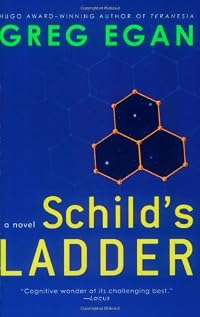
Schild's Ladder
by Greg Egan
On This Page
Description
In the deep future mankind is barely distinguishable from machine intelligences, rarely embodied outside of virtual environments. It is time, using the very building blocks of time and space, to engineer the universe itself. Time to enter a new quantum realm of marvels and terrors. The new novel from one of the worlds most respected and acclaimed writers marks a dramatic move into a new arena ¿ that of the wide screen SF epic ala Baxter, Banks, Hamilton and Macleod. Novels such as this have show more proved to be the engine house for both the major sales and the best ideas of modern SF. That the genre¿s primary ideas man and one of its finest prose stylists should direct his energies to this sort of canvas promises much. This will be Greg Egan¿s breakout book. show lessTags
Recommendations
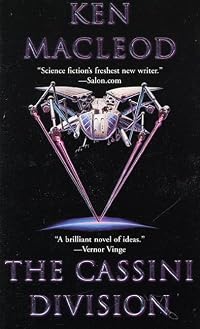
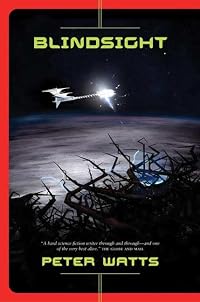
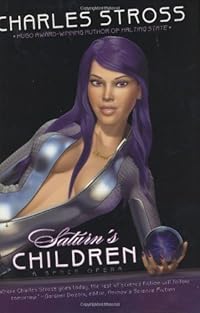
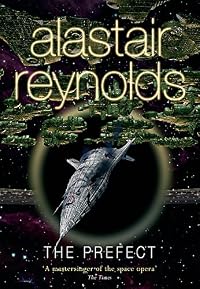
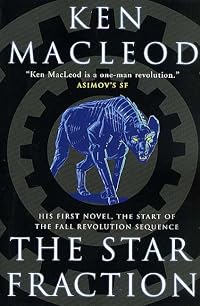
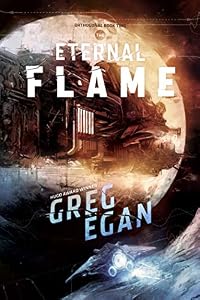
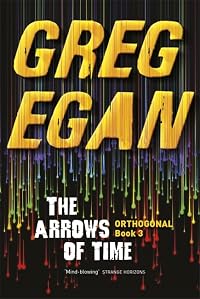
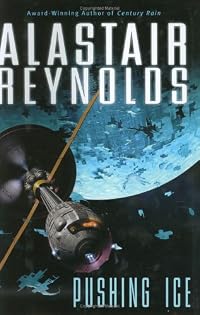
Member Recommendations
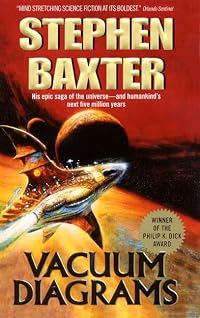
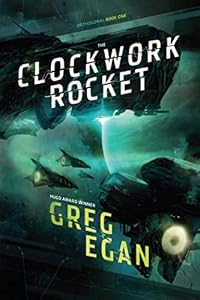
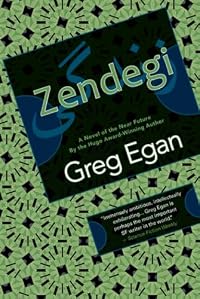
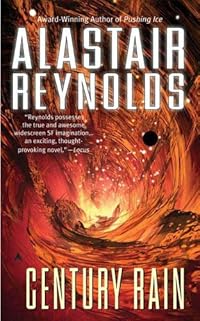
AndrewL Similar far-future story device
Member Reviews
Greg Egan’s hard SF is so steeped in mathematics, it needs its own sub-genre; Theorem Thriller? MathPunk? This story sets up the dilemma of an ongoing environmental disaster (caused by mathematics) that can only be confronted by the galaxy’s bravest mathematicians, because math. Even so, it’s wildly engrossing, because the stakes are so high, and because the society described has such compelling issues that arrive naturally due to their methods of interstellar transport. Fascinating scenarios arise from digitization of mind and body, then the return to analog flesh. In many other genre pieces, this is portrayed as a consequence-free vehicle for speeding plot advancements. Here, it cleaves societies into ‘travelers’ (those who show more undergo digitization for the sake of making interstellar journeys) and the planet-bound who stay behind, experiencing the long centuries that the travelers skip. When a child expresses his fear of losing himself and being replaced by some other ‘him’ during a journey, it’s hard to miss the metaphor for conventional estrangement. One doesn’t need light years of distance to make our divergent experiences separate us from those we love- you can’t step in the same stream twice.
The future society Egan paints is a bit too homogeneously enlightened for me, and while there is conflict, it is of a very academic type. All people seem to respect the same wide definition of personhood, and have evacuated entire worlds found to possess native life, no matter how single-celled or primitive. There seems to be no currency or economics, as humanity has entered a post-scarcity era, but the slow-motion drama unfolding with the expanding environmental disaster (The ‘Mimosa’ incident) begins to test this universal civility.
As in other Egan stories, the pace and scale really accelerate in the final chapters, forcing the reader to give up trying to follow the science and just go with the action. The reward is high, however, and the epic scales to these final settings really do amaze. Here, we are taken not to cosmic distances and epochs, but in the exact opposite direction, down to the briefest and tiniest Planck-length vistas. Throughout, I was identifying strongly with the protagonist, Tchicaya, although very little of his thoughts or life is revealed outside of the Mimosa problem at hand. Even considering, I found it difficult to put down, and will look forward to reflecting on Egan’s vision. show less
The future society Egan paints is a bit too homogeneously enlightened for me, and while there is conflict, it is of a very academic type. All people seem to respect the same wide definition of personhood, and have evacuated entire worlds found to possess native life, no matter how single-celled or primitive. There seems to be no currency or economics, as humanity has entered a post-scarcity era, but the slow-motion drama unfolding with the expanding environmental disaster (The ‘Mimosa’ incident) begins to test this universal civility.
As in other Egan stories, the pace and scale really accelerate in the final chapters, forcing the reader to give up trying to follow the science and just go with the action. The reward is high, however, and the epic scales to these final settings really do amaze. Here, we are taken not to cosmic distances and epochs, but in the exact opposite direction, down to the briefest and tiniest Planck-length vistas. Throughout, I was identifying strongly with the protagonist, Tchicaya, although very little of his thoughts or life is revealed outside of the Mimosa problem at hand. Even considering, I found it difficult to put down, and will look forward to reflecting on Egan’s vision. show less
After they finish Schild's Ladder, I think most people will remember two main things about it: first, the characters are all really weird and don't react to things quite like normal people do. Second, it's full of math, to the point where it's almost unreadable in parts. So, another Greg Egan book! Point 1 was more interesting for me: a big challenge for books that are set tens of thousands of years in the future is that they're often really hard to relate to. We already live in exponential times, with dramatic changes to our lifestyle that would be unimaginable to people mere hundreds of years ago, so extrapolating what life would be like for people twenty thousand years from now is not only tough to do convincingly, but also show more absolutely certain to look laughably naive in just a few years. Even Leonardo da Vinci couldn't have written about what the Internet would do to society, and to extend that out by a factor of dozens is mind boggling.
Nevertheless, it's always possible to give even the nerdiest science fiction (like the kind Greg Egan writes) some emotional hooks to present-day readers just by focusing on urges and issues that will always be resonant: sex, love, death, curiosity, and conflict. Schild's Ladder is set mainly of the aftermath of an accident at the future equivalent of the Large Hadron Collider. A false vacuum has been expanding throughout the universe at half the speed of light, wiping out ever-increasing numbers of the scattered human colonies. Tchicaya, the protagonist, is part of a research team divided into two groups: the Preservationists studying the false vacuum as one would study a serendipitous lab creation, and the Yielders dedicated to either halting or reversing the vacuum's expansion. Yet again Egan has peopled his book with nearly autistic computationally-augmented post-humans that don't care about the slow-motion destruction of the normal universe, since their future technology lets them float above the sphere of destruction to run experiments essentially forever.
The funny thing is that I honestly can't think of a way to improve Egan's handling of this slow-motion catastrophe; the world he's created is almost above criticism in terms of how its inhabitants would likely react. How would you write dialogue for millennia-old computer programs? So Tchicaya gets homesick, he spends most of the book thinking about an old girlfriend who showed up to the research station, gets involved in the factionalism on the station, even goes on a quest of sorts at the end, and it all seemed natural and relatable. It certainly made the hideous math easier to swallow, which gets progressively more ridiculous until the final section, where Tchicaya and his lady friend travel into the false vacuum world using physics magic. Egan himself has "only" a BS in Maths, but the book feels like a PhD thesis with walk-on characters at times. You will be really impressed that such abstruse material is presented as well as it is (you try writing a novel about quantum graph theory some time) which means you'll not only have a new respect for Egan, but also for the scientists who actually deal with this stuff in their research. Hopefully the team at the LHC is a little more careful than the team in this book though. show less
Nevertheless, it's always possible to give even the nerdiest science fiction (like the kind Greg Egan writes) some emotional hooks to present-day readers just by focusing on urges and issues that will always be resonant: sex, love, death, curiosity, and conflict. Schild's Ladder is set mainly of the aftermath of an accident at the future equivalent of the Large Hadron Collider. A false vacuum has been expanding throughout the universe at half the speed of light, wiping out ever-increasing numbers of the scattered human colonies. Tchicaya, the protagonist, is part of a research team divided into two groups: the Preservationists studying the false vacuum as one would study a serendipitous lab creation, and the Yielders dedicated to either halting or reversing the vacuum's expansion. Yet again Egan has peopled his book with nearly autistic computationally-augmented post-humans that don't care about the slow-motion destruction of the normal universe, since their future technology lets them float above the sphere of destruction to run experiments essentially forever.
The funny thing is that I honestly can't think of a way to improve Egan's handling of this slow-motion catastrophe; the world he's created is almost above criticism in terms of how its inhabitants would likely react. How would you write dialogue for millennia-old computer programs? So Tchicaya gets homesick, he spends most of the book thinking about an old girlfriend who showed up to the research station, gets involved in the factionalism on the station, even goes on a quest of sorts at the end, and it all seemed natural and relatable. It certainly made the hideous math easier to swallow, which gets progressively more ridiculous until the final section, where Tchicaya and his lady friend travel into the false vacuum world using physics magic. Egan himself has "only" a BS in Maths, but the book feels like a PhD thesis with walk-on characters at times. You will be really impressed that such abstruse material is presented as well as it is (you try writing a novel about quantum graph theory some time) which means you'll not only have a new respect for Egan, but also for the scientists who actually deal with this stuff in their research. Hopefully the team at the LHC is a little more careful than the team in this book though. show less
Sometimes, an SF novel will hit you in the gut and speak a little math at you and then scamper away, tittering at its cleverness.
Other times, an SF novel will not only hit you in the gut but hit you in the pride and nads and stand over you, asking you if you want some more. Maybe it'll call you Susan regardless of your sex.
After reading Schild's Ladder, I have to say this is one of those Other times.
I feel like I just read a hardcore Stephen Baxter novel that just had a massive overhaul on the math and the editor not only said, "there may be just a tad too much scalable extra-dimensional geometry, pre-assumptive quantum physics, and thoroughly alien human cultures" just before he (or she) threw up his (or her) hands and said... "Screw show more it. I'll check for grammar. The rest is all for a team of postdocs devoted to theoretical physics."
Does this mean I hated it?
MUAHAHAHAHAHAHA hell no. I loved it. Every single mind-blowing second of it. Just because some of it went over my head didn't mean I didn't LOVE the imagery, the bleeding-edge creativity of having our characters LIVE in this nearly incomprehensible post-and-re-physical humanity.
Examples: whole societies based on checksumming yourself because you're all software. Interchangeability between getting a body and going back in the software. 20 thousand years of murderless living and whole societies giving into their darker natures by telling fibs to cryogenic travelers about just how the world has changed, unwilling to let them know that we've all moved on because we think it's funny. Or how so many of us have tailored truly exotic sex organs (either software or physical) to be compatible with our partners... literally ONLY compatible to our partners. :)
Fascinating? Yeah, but not half as fascinating as the actual plot-driver. Expanding space and life living at a hugely accelerated rate and at a VERY small quantum level. Is it out to destroy us? Should we destroy it? Preserve it? Study it? It's out to eat our populated centers, but WE MADE IT. Accidental life... and perhaps intelligent. :)
Very good stuff here. Definitely designed to draw out only your A-Game. No punches are thrown and no one is talked down to. You will either sink or swim. :)
What a pleasure! show less
Other times, an SF novel will not only hit you in the gut but hit you in the pride and nads and stand over you, asking you if you want some more. Maybe it'll call you Susan regardless of your sex.
After reading Schild's Ladder, I have to say this is one of those Other times.
I feel like I just read a hardcore Stephen Baxter novel that just had a massive overhaul on the math and the editor not only said, "there may be just a tad too much scalable extra-dimensional geometry, pre-assumptive quantum physics, and thoroughly alien human cultures" just before he (or she) threw up his (or her) hands and said... "Screw show more it. I'll check for grammar. The rest is all for a team of postdocs devoted to theoretical physics."
Does this mean I hated it?
MUAHAHAHAHAHAHA hell no. I loved it. Every single mind-blowing second of it. Just because some of it went over my head didn't mean I didn't LOVE the imagery, the bleeding-edge creativity of having our characters LIVE in this nearly incomprehensible post-and-re-physical humanity.
Examples: whole societies based on checksumming yourself because you're all software. Interchangeability between getting a body and going back in the software. 20 thousand years of murderless living and whole societies giving into their darker natures by telling fibs to cryogenic travelers about just how the world has changed, unwilling to let them know that we've all moved on because we think it's funny. Or how so many of us have tailored truly exotic sex organs (either software or physical) to be compatible with our partners... literally ONLY compatible to our partners. :)
Fascinating? Yeah, but not half as fascinating as the actual plot-driver. Expanding space and life living at a hugely accelerated rate and at a VERY small quantum level. Is it out to destroy us? Should we destroy it? Preserve it? Study it? It's out to eat our populated centers, but WE MADE IT. Accidental life... and perhaps intelligent. :)
Very good stuff here. Definitely designed to draw out only your A-Game. No punches are thrown and no one is talked down to. You will either sink or swim. :)
What a pleasure! show less
As usual with Greg Egan, he uses some of the most powerful and elegant structures of modern physical and mathematical theories to create a dramatic backdrop for some of the most fundamental of life's questions. The use of Schild's ladder, in particular, was beautifully done.
In regards to the audience, it really is escapism for anyone who is already into mathematical physics, as Egan does not spend any time explaining fundamental principles of modern mechanics (ie., he assumes the reader is already familiar with Noether's theorem, so he doesn't it nor how a lack of space translation symmetry should correlate with the lack of conservation of momentum. It is cases like this where, in later novels, he uses a proxy character to ask the show more appropriate clarifying questions for the reader), so this is not exactly pop science fare.
However, if you've been trudging through any amount of modern physics/mathematics and need a break of speculative fiction that excites similar regions without over-tasking them, this makes for a wonderful diversion. Unfortunately, unless one is really up-to-date on their quantum field theory, some parts of the book will become almost unreadable as dramatic at all, which can be problematic to keeping one interested in the characters or their problems. There are many futurism gems here and there, though, that make the novel as a whole worth the read.
Spoilery: As an aside, the gender politics in the novel were refreshing, presenting the norm as gender fluid and pansexual. show less
In regards to the audience, it really is escapism for anyone who is already into mathematical physics, as Egan does not spend any time explaining fundamental principles of modern mechanics (ie., he assumes the reader is already familiar with Noether's theorem, so he doesn't it nor how a lack of space translation symmetry should correlate with the lack of conservation of momentum. It is cases like this where, in later novels, he uses a proxy character to ask the show more appropriate clarifying questions for the reader), so this is not exactly pop science fare.
However, if you've been trudging through any amount of modern physics/mathematics and need a break of speculative fiction that excites similar regions without over-tasking them, this makes for a wonderful diversion. Unfortunately, unless one is really up-to-date on their quantum field theory, some parts of the book will become almost unreadable as dramatic at all, which can be problematic to keeping one interested in the characters or their problems. There are many futurism gems here and there, though, that make the novel as a whole worth the read.
Spoilery: As an aside, the gender politics in the novel were refreshing, presenting the norm as gender fluid and pansexual. show less
I love Greg Egan books, but spent the first half of this one wondering if I'd gone wrong. It was a pretty boring description of a world and problem in quantum mechanics and some fictional extension of the theory developed in the future ("quantum graph theory") which unified quantum theory and relativity. The characters in the first half of the book were at best boring, too. However, (spoiler) there's a major change partway through the book, with new characters, a new reality, and new problems to solve; still based on physics, and not my favorite of his books, but still pretty solid. I wish an editor would have compressed the first half of the book to something shorter -- while it's nice to be able to call back to it later in detail, I show more suspect a lot of readers just abandon the book at the beginning, as I would have had I not already been a fan of Egan (as well as driving 80mph through a snowstorm in Idaho, and unable to easily switch audiobooks.) show less
Science fiction (is that what you kids still call it these days?) has a tough time keeping itself out there ahead of where real science is already treading. I suppose that is why fantasy fiction so dominates the market.
Egan posits a far future galaxy where Earth is the sole source of evolved life and where the pace of discovery and knowledge has not slackened one jot from the 20th century. Our knowledge of quantum particles, effects and theory has moved on in a, well, quantum leap. Faced with a cataclysmic quantum event that is slowly swallowing the known universe humanity has split into two factions, big-endian/little-endian style if you ask me, bent on destroying the phenomenon or forcing mankind to adapt and thus re-energize a show more stagnating culture.
Most of this book was incomprehensible to me, dealing with technical arcana I could not possibly follow and social intercourseI was not sure if I was supposed to gasp at or accept as just another cultural evolution. Perhaps this was the point - putting the reader into a world so advanced that much of what passes as normal is incomprehensible to us.
The characters and their inner worlds are there to guide us through this strange land, but in this case I found none of them attractive, none of them really worthy of support and none of them that I cared about at all, let alone enough.
Maybe this book is for the hard-core genre reader rather than the casual dipper like me, but I found myself glad not to live in that universe and have to read books like this about it. show less
Egan posits a far future galaxy where Earth is the sole source of evolved life and where the pace of discovery and knowledge has not slackened one jot from the 20th century. Our knowledge of quantum particles, effects and theory has moved on in a, well, quantum leap. Faced with a cataclysmic quantum event that is slowly swallowing the known universe humanity has split into two factions, big-endian/little-endian style if you ask me, bent on destroying the phenomenon or forcing mankind to adapt and thus re-energize a show more stagnating culture.
Most of this book was incomprehensible to me, dealing with technical arcana I could not possibly follow and social intercourseI was not sure if I was supposed to gasp at or accept as just another cultural evolution. Perhaps this was the point - putting the reader into a world so advanced that much of what passes as normal is incomprehensible to us.
The characters and their inner worlds are there to guide us through this strange land, but in this case I found none of them attractive, none of them really worthy of support and none of them that I cared about at all, let alone enough.
Maybe this book is for the hard-core genre reader rather than the casual dipper like me, but I found myself glad not to live in that universe and have to read books like this about it. show less
This was a pretty fun book! I think you'd want a slight background in quantum physics (a very basic understanding) because even though the author does try to describe a lot of things, he doesn't go into enough detail that I feel someone with zero exposure to some of the more strange concepts would be completely able to follow along.
He takes plenty of liberties with the science itself and even invents / expands some new models for understanding them that lead to the main journeys in this book.
Altogether, I found the characters to be decently well developed, the story fun to read and keeping me interested, some new concepts brought up and new ideas thrown around, and a whole new world / universe to explore with the author. I'd love to show more see sequels set in this universe. show less
He takes plenty of liberties with the science itself and even invents / expands some new models for understanding them that lead to the main journeys in this book.
Altogether, I found the characters to be decently well developed, the story fun to read and keeping me interested, some new concepts brought up and new ideas thrown around, and a whole new world / universe to explore with the author. I'd love to show more see sequels set in this universe. show less
Members
- Recently Added By
Lists


Author Information
129+ Works 13,869 Members
Awards and Honors
Awards
Distinctions
Series
Belongs to Publisher Series
Common Knowledge
- Canonical title
- Schild's Ladder
- Original title
- Schild's Ladder
- Original publication date
- 2001
- First words
- "In the beginning was a graph, more like diamond than graphite."
- Last words
- (Click to show. Warning: May contain spoilers.)"I think I'm ready to go home."
- Original language*
- Inglese
*Some information comes from Common Knowledge in other languages. Click "Edit" for more information.
Classifications
Statistics
- Members
- 1,065
- Popularity
- 23,921
- Reviews
- 27
- Rating
- (3.69)
- Languages
- English, German, Italian, Romanian
- Media
- Paper, Audiobook, Ebook
- ISBNs
- 18
- ASINs
- 9
