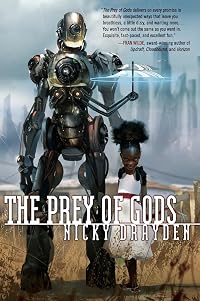
The Prey of Gods
by Nicky Drayden
On This Page
Description
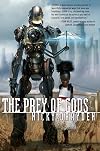
In South Africa, personal robots are making life easier for the working class; the government is harnessing renewable energy to provide infrastructure for the poor; and in the coastal town of Port Elizabeth, the economy is booming thanks to the genetic engineering industry which has found a welcome home there. Yes, the days to come are looking very good for South Africans. That is, if they can survive the present challenges: A new hallucinogenic drug sweeping the country. An emerging AI show more uprising. And an ancient demigoddess hellbent on regaining her former status by preying on the blood and sweat of every human she encounters. It's up to a young Zulu girl powerful enough to destroy her entire township, a queer teen plagued with the ability to control minds, a pop diva with serious daddy issues, and a politician with even more serious mommy issues to band together to ensure there's a future left to worry about. show lessTags
Recommendations





Member Reviews
I loved this so freaking much. This is the utterly weird, genre-bending, diverse, mind-blowing story that I want more of. In a future South Africa, there's an old has-been demigoddess hellbent on reclaiming her former glory with lots of murder and mayhem. Standing in her way? A girl with some truly terrible power, a pop diva, a politician who would rather put on a dress and sing on stage than run for premiere, a queer teen, and a robot.
I read half of this in print, and then bought the audiobook to finish it on a roadtrip because I needed to know what happens next. This was amazing.
I'm a bit torn if I want a sequel or not. On the one hand, the ending did leave some open-ended bits that I would love to see some resolution to. On the other show more hand, the book seemed perfect. And that ending was wild. show less
I read half of this in print, and then bought the audiobook to finish it on a roadtrip because I needed to know what happens next. This was amazing.
I'm a bit torn if I want a sequel or not. On the one hand, the ending did leave some open-ended bits that I would love to see some resolution to. On the other show more hand, the book seemed perfect. And that ending was wild. show less
Nicky Drayden’s debut novel is one of those stories that reminds you why you love to read. One can easily see Ms. Drayden thoroughly enjoying herself while writing it because the novel gives off an air of pure pleasure. The characters are diverse in age, appearance, gender identity, and sexual preference, promoting tolerance and encouraging insight into other’s experiences. The action does border on gory, but it is in keeping with the characters and therefore is not quite as gruesome as one might think. The overall story is charming; there is a lightness to it in spite of some of the more darker elements of the story. Simply stated, The Prey of Gods is fun with its fantasy and science fiction crossover appeal.
The story also gives show more off a Neil Gaiman vibe with its gods passing as humans but hoping to regain believers and therefore power. Considering Neil Gaiman is one of my favorite authors, the comparison is a positive one. Ms. Drayden deftly weaves mythology, whether real or not, into the story. She takes it one step further by layering upon the fantasy the idea of artificial intelligence becoming sentient. In a fantastic blend of the two genres, she then calls into question the idea of belief and gods and whether only humans can worship such ideas. Hefty ideas but she does it all in a manner that is welcoming and engrossing.
Another fantastic quirk of the story is how positive it is. Most novels set in the future are dreary and bleak. Between natural catastrophes, autocratic governments, or both, the future is not usually bright. In Ms. Drayden’s world however, the future is not a bad place. The biggest issue facing the government is an environmental one in which there are too many of one species that they need to be culled. The villages have water and food. People have jobs. While there are still different economic spheres, the tension that usually accompanies such dichotomies of wealth does not exist. Instead, there is an air of acceptance and love permeating the entire story and cascading down into the very fibers of society that usually cause the most strain.
The Prey of Gods is not the type of novel that evokes long and thoughtful philosophical discussions among readers, but its feel-good presentation does more to promote understanding and acceptance than any discussion ever could. It does so by showing everything in as matter-of-fact a manner as possible, neither asking for forgiveness nor seeking acceptance. Ms. Drayden assumes her readers will love her characters no matter who they are or who they love, making all of it a non-issue from the very beginning. If only it were that easy in real life.
While not a showy novel that will garner a mass following, The Prey of Gods is a well-written and engaging novel. Demigods may try to regain their power through fear and blood, but it is hope and love which win the day and the novel. It makes for a refreshing change from the doom and gloom of normal futuristic novels and a fantastic break from our current tension-filled reality. show less
The story also gives show more off a Neil Gaiman vibe with its gods passing as humans but hoping to regain believers and therefore power. Considering Neil Gaiman is one of my favorite authors, the comparison is a positive one. Ms. Drayden deftly weaves mythology, whether real or not, into the story. She takes it one step further by layering upon the fantasy the idea of artificial intelligence becoming sentient. In a fantastic blend of the two genres, she then calls into question the idea of belief and gods and whether only humans can worship such ideas. Hefty ideas but she does it all in a manner that is welcoming and engrossing.
Another fantastic quirk of the story is how positive it is. Most novels set in the future are dreary and bleak. Between natural catastrophes, autocratic governments, or both, the future is not usually bright. In Ms. Drayden’s world however, the future is not a bad place. The biggest issue facing the government is an environmental one in which there are too many of one species that they need to be culled. The villages have water and food. People have jobs. While there are still different economic spheres, the tension that usually accompanies such dichotomies of wealth does not exist. Instead, there is an air of acceptance and love permeating the entire story and cascading down into the very fibers of society that usually cause the most strain.
The Prey of Gods is not the type of novel that evokes long and thoughtful philosophical discussions among readers, but its feel-good presentation does more to promote understanding and acceptance than any discussion ever could. It does so by showing everything in as matter-of-fact a manner as possible, neither asking for forgiveness nor seeking acceptance. Ms. Drayden assumes her readers will love her characters no matter who they are or who they love, making all of it a non-issue from the very beginning. If only it were that easy in real life.
While not a showy novel that will garner a mass following, The Prey of Gods is a well-written and engaging novel. Demigods may try to regain their power through fear and blood, but it is hope and love which win the day and the novel. It makes for a refreshing change from the doom and gloom of normal futuristic novels and a fantastic break from our current tension-filled reality. show less
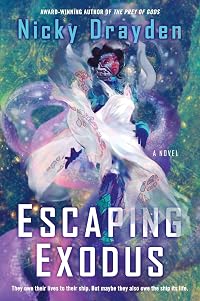
I enjoyed Escaping Exodus so much that I knew I had to read more from Nicky Drayden, and seriously this cover is just beyond captivating, so here I am!
A lot of what I loved about Exodus I also loved here — the joyously, spectacularly weird world building, the blend of fantasy and science fiction elements, the ties to traditions unfamiliar to me but that feel grounded and weighty. PlusExodus — certain scenes almost feel like you're watching them unfold on the big screen.
Some of the characters I did not particularly enjoy spending time with — there is real evil in this book. But it never got to a deal-breaking point for me, and I was definitely always invested in where it was going.
More people should be talking about Nicky Drayden.
A lot of what I loved about Exodus I also loved here — the joyously, spectacularly weird world building, the blend of fantasy and science fiction elements, the ties to traditions unfamiliar to me but that feel grounded and weighty. PlusExodus — certain scenes almost feel like you're watching them unfold on the big screen.
Some of the characters I did not particularly enjoy spending time with — there is real evil in this book. But it never got to a deal-breaking point for me, and I was definitely always invested in where it was going.
More people should be talking about Nicky Drayden.
This was a complex sci-fi that had notes reminiscent of other authors/works, and yet is fully its own.
I originally said "Its American Gods in a cyberpunk Africa" but that's an over-simplification. It reminded me of a lot of different things - American Gods, Gunnerkrigg Court, Oryx and Crake, Parasite Eve, Ghost in the Shell, Perdido Street Station, Magic: the Gathering, Impossible Creatures... the list goes on. Its easy to see that list and go "So its just a derivative pile of tropes, huh?"
No, its not. That's the thing. It takes these common, common tropes you find in sci-fi/fantasy, breaks them down, and then rebuilds them. There were some surface similarities in a few cases, sure, but most of the resemblance was emotional resonance. show more The cast is incredibly diverse. I appreciated the representation, but also just the unique variety of their voices and perspectives, making for a genuinely more interesting story. The story moves quickly and builds up naturally. The mythology is original and the magic system was explained enough without being overly mechanical or ambiguous. The ending is satisfying.
This was just a great damn book and I recommend it highly. show less
I originally said "Its American Gods in a cyberpunk Africa" but that's an over-simplification. It reminded me of a lot of different things - American Gods, Gunnerkrigg Court, Oryx and Crake, Parasite Eve, Ghost in the Shell, Perdido Street Station, Magic: the Gathering, Impossible Creatures... the list goes on. Its easy to see that list and go "So its just a derivative pile of tropes, huh?"
No, its not. That's the thing. It takes these common, common tropes you find in sci-fi/fantasy, breaks them down, and then rebuilds them. There were some surface similarities in a few cases, sure, but most of the resemblance was emotional resonance. show more The cast is incredibly diverse. I appreciated the representation, but also just the unique variety of their voices and perspectives, making for a genuinely more interesting story. The story moves quickly and builds up naturally. The mythology is original and the magic system was explained enough without being overly mechanical or ambiguous. The ending is satisfying.
This was just a great damn book and I recommend it highly. show less
I had never even heard of this book until it arrived as a selection for my postal book club, and I will admit that when I first saw it, I was skeptical. There is so much going on here: future South Africa, personal robots, genetic engineering, ancient gods and awakening demigods... seriously, it's bonkers, but also unputdownable and so fun. 3 1/2 stars
There's a lot I liked about this book, but there are a few things that rubbed me the wrong way. In particular, there are a few characters who engage in some truly heinous behavior and seem to be forgiven by POV characters without much ceremony. To be clear, just about every character in the story commits or will commit at least one really nasty action, but while some are given a chance to redeem themselves or to at least show remorse, others just are just suddenly treated like "good guys" despite years of utterly despicable behavior.
Also (and this could just be me), the love interest of one of the main characters comes across as a bit of a douche, and I don't think the book does a good enough job of showing us *why* the protagonist show more likes them. They just do. Eventually, we get to see them in a more endearing light, but that's not until well into the story.
Lastly (and again, this could be particular to the way I think about things), I often found myself thinking about the deeper implications of the technology or the magic that appears in the story, and then being disappointed in how it was handled. (Minor spoiler for the first couple chapters:) For example, there are robots that achieve sentience, but the story pays no attention to how this happens or to what sentience actually is, or in how the sentience of a being changes or should change how we deal with them. On a similar note, there's at least one powerful magical ability that appears in the story and then is never used again. This wouldn't be so bad if it weren't for the fact that the *existence* of the power causes trouble throughout the climax of the story, so it's supposedly still around, but the power itself never gets used or discussed.
Anyway, despite the above complaints, I still thought it was a pretty good story. It's nice to read stories not set in the US that feature queer and trans characters. And Nicky Drayden handles such characters fairly well*. Often in science fiction, we see a future where society's prejudices are basically exactly the same as they are now. (Occasionally, you'll get a far future where such prejudices have been basically wiped out, which is great, but not really appropriate for near-future stories like this.) So it's nice to see a future world that is markedly better in its treatment of queer folk, but not perfect.
*Subject to my above complaint about some characters engaging in really awful behavior and not properly having to deal with the consequences of those actions.
And there's some fun mixing of sci-fi and fantasy tropes in ways that I haven't really seen before, which I enjoyed. show less
Also (and this could just be me), the love interest of one of the main characters comes across as a bit of a douche, and I don't think the book does a good enough job of showing us *why* the protagonist show more likes them. They just do. Eventually, we get to see them in a more endearing light, but that's not until well into the story.
Lastly (and again, this could be particular to the way I think about things), I often found myself thinking about the deeper implications of the technology or the magic that appears in the story, and then being disappointed in how it was handled. (Minor spoiler for the first couple chapters:) For example, there are robots that achieve sentience, but the story pays no attention to how this happens or to what sentience actually is, or in how the sentience of a being changes or should change how we deal with them. On a similar note, there's at least one powerful magical ability that appears in the story and then is never used again. This wouldn't be so bad if it weren't for the fact that the *existence* of the power causes trouble throughout the climax of the story, so it's supposedly still around, but the power itself never gets used or discussed.
Anyway, despite the above complaints, I still thought it was a pretty good story. It's nice to read stories not set in the US that feature queer and trans characters. And Nicky Drayden handles such characters fairly well*. Often in science fiction, we see a future where society's prejudices are basically exactly the same as they are now. (Occasionally, you'll get a far future where such prejudices have been basically wiped out, which is great, but not really appropriate for near-future stories like this.) So it's nice to see a future world that is markedly better in its treatment of queer folk, but not perfect.
*Subject to my above complaint about some characters engaging in really awful behavior and not properly having to deal with the consequences of those actions.
And there's some fun mixing of sci-fi and fantasy tropes in ways that I haven't really seen before, which I enjoyed. show less
This novel, set in South Africa, blends together science fiction and fantasy into something that's just... nuts. There's demigods, superpowers, weird mythology, drugs, pop music, genetic engineering, and robots achieving sentience. There's also a lot of darkness, too: the main villain is disturbingly violent, and even the notionally good guys do some pretty horrible things.
It's a pretty cool kind of nuts, though, overall, with lots of energy and imagination. I'll admit, I did lose the momentum of the story for a bit before it got to the (entertainingly over-the-top) climax, but I think that was my fault, really, not the novel's, as I've been annoyingly distractable lately. So I'm no going to hold that against it.
It's a pretty cool kind of nuts, though, overall, with lots of energy and imagination. I'll admit, I did lose the momentum of the story for a bit before it got to the (entertainingly over-the-top) climax, but I think that was my fault, really, not the novel's, as I've been annoyingly distractable lately. So I'm no going to hold that against it.
Members
- Recently Added By
Lists

Science Fiction by female authors
43 works; 4 members

LGBTQ+ Speculative Fiction
821 works; 51 members

2017 Science Fiction and Fantasy I'm Looking Forward To
46 works; 6 members

2018 Hugo Eligible Novels
170 works; 16 members

Books Read in 2017
4,249 works; 129 members

Top Five Books of 2017
757 works; 231 members
Author Information

23+ Works 1,308 Members
Some Editions
Awards and Honors
Awards
Distinctions
Common Knowledge
- Original publication date
- 2017
- Important places
- South Africa
- Dedication
- To my wonderful parents, Bill and Pat, for giving me a loving space to stretch my wings and fly
- First words
- His birth certificate reads Muzikayise McCarthy, but nobody calls him that except his grandfather and anyone looking for a busted lip.
- Last words
- (Click to show. Warning: May contain spoilers.)I think therefore I am (translated from binary)
- Blurbers
- Wilde, Fran; Rambo, Cat; Wells, Martha
- Original language
- English
Classifications
Statistics
- Members
- 548
- Popularity
- 54,452
- Reviews
- 22
- Rating
- (3.74)
- Languages
- English
- Media
- Paper, Audiobook, Ebook
- ISBNs
- 7
- ASINs
- 2