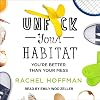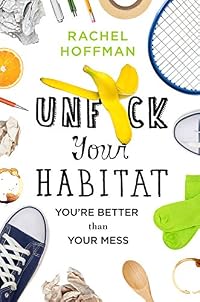
Unf*ck Your Habitat: You're Better Than Your Mess
by Rachel Hoffman
On This Page
Description
Finally, a housekeeping and organizational system developed for those of us who'd describe our current living situation as a "f**king mess" that we "really need to get around to fixing one day." Unf**k Your Habitat is for anyone who has been left behind by traditional aspirational systems-the ones that ignore single people with full-time jobs, people without kids but living with roommates, and people with mental illnesses or physical limitations. Most organizational books are aimed at show more stay-at-home moms and people who seem to have unimaginable amounts of free time. They assume we all iron our sheets, have linen napkins to match our table runners, and can keep plants alive for longer than a week. Basically, they ignore most of us living here in the real world. Interspersed with lists and challenges, this practical, no-nonsense guide helps you develop lifelong habits. It motivates you to embrace a new lifestyle in manageable sections so you can start applying the tactics as you progress. This philosophy is more realistic than aspirational, but the goal is the same: not everyone will have a showcase of a home, but whatever your habitat, you deserve for it to bring you happiness, not stress. show lessTags
Recommendations










Member Reviews
I'm not usually drawn to self-help books. This doesn't mean that I don't need plenty of help; but books of "simple tips" delivered in a confidently chatty tone by somebody who obviously doesn't feel challenged by things that baffle or overwhelm me just don't do much for me except help me postpone the inevitable: I'm reading about it--isn't that enough for now?
When I saw this title mentioned in another thread, though, the subtitle grabbed me. Yes, I do think I'm better than my mess. So I downloaded the Kindle version. And read it. (Giving myself a bonus point for not thinking that downloading was enough of a first step and I could do the rest later.)
This book is a straight-talking, BS-foiling pep talk and practical guide for dealing with show more household mess and clutter, both ordinary and extraordinary. Its lively, conversational style and I-see-you candor contribute to breaking down resistance.
Getting started is the hard part, so the author puts a lot of emphasis there. She doesn't waste much time arguing why do it (if we're reading this book, we probably don't need much help with the "why" part) but concentrates on what and how. It all involves effort and motivation, and she delivers a kind, forgiving, but firm and matter-of-fact push.
Sure, who doesn't know that the way to tackle a big task is to break it down into small parts? and even give ourselves rewards and rest pauses along the way?
Hoffman is specific about what small parts to break it down into, and how many. No ducking, no excuses: she lays it out. Take five things off that flat surface. Just five.
And still, if you can't do five, you haven't failed. Do four. Do one. She allows you plenty of leeway to shape your plan into something that you can actually achieve. And she stresses that once you've made a little progress, your success will build on and feed itself.
I'm happy to note that I'm not her worst case. I don't have dirty dishes scattered around. I don't have laundry lying on the floor. I don't have groceries stacked around in bags with food going bad. But I do have piles of books and papers and miscellaneous clutter in many areas of the house, with a high concentration in one or two spots, and I do find it hard to dig into them.
Hoffman is like a skilled goalkeeper who anticipates moves and feints and evasions and fends them all off. She sets out a model that a person like me, who always has something she'd rather do, can follow.
And when it comes to white vinegar, behold, she's made a believer of me. That alone was worth the time and price.
----
P.S. Yup, I did take five things off that corner table. And yes, it felt good. Now to do it again. show less
When I saw this title mentioned in another thread, though, the subtitle grabbed me. Yes, I do think I'm better than my mess. So I downloaded the Kindle version. And read it. (Giving myself a bonus point for not thinking that downloading was enough of a first step and I could do the rest later.)
This book is a straight-talking, BS-foiling pep talk and practical guide for dealing with show more household mess and clutter, both ordinary and extraordinary. Its lively, conversational style and I-see-you candor contribute to breaking down resistance.
Getting started is the hard part, so the author puts a lot of emphasis there. She doesn't waste much time arguing why do it (if we're reading this book, we probably don't need much help with the "why" part) but concentrates on what and how. It all involves effort and motivation, and she delivers a kind, forgiving, but firm and matter-of-fact push.
Sure, who doesn't know that the way to tackle a big task is to break it down into small parts? and even give ourselves rewards and rest pauses along the way?
Hoffman is specific about what small parts to break it down into, and how many. No ducking, no excuses: she lays it out. Take five things off that flat surface. Just five.
And still, if you can't do five, you haven't failed. Do four. Do one. She allows you plenty of leeway to shape your plan into something that you can actually achieve. And she stresses that once you've made a little progress, your success will build on and feed itself.
I'm happy to note that I'm not her worst case. I don't have dirty dishes scattered around. I don't have laundry lying on the floor. I don't have groceries stacked around in bags with food going bad. But I do have piles of books and papers and miscellaneous clutter in many areas of the house, with a high concentration in one or two spots, and I do find it hard to dig into them.
Hoffman is like a skilled goalkeeper who anticipates moves and feints and evasions and fends them all off. She sets out a model that a person like me, who always has something she'd rather do, can follow.
And when it comes to white vinegar, behold, she's made a believer of me. That alone was worth the time and price.
----
P.S. Yup, I did take five things off that corner table. And yes, it felt good. Now to do it again. show less
A very useful book. I've been using the app, and following Rachel on Twitter, for quite a while; the book allows her to expand on the _why_ of the challenges she gives us, to get and keep things clean. There are several not-quite-explicit references to Marie Kondo, whose book I also read recently; Rachel's resonates with me a lot better. Marie is very much into minimalism, and the vague "spark joy"; Rachel is very much into "have what you need, no more and no less", and judging things by their utility - though she does say that if something makes you happy - if _having_ something makes you happy - that makes it useful. So the book presents both the philosophy behind UFYH, and some quite detailed plans for dealing with the mess in show more real-world situations. Several chapters on the process of getting stuff clean/organized/reduced to a reasonable amount, including specific mention that doing a little bit now and taking a break is a much better idea than doing a marathon clean and wearing yourself out. She also specifically points out that this is a job that's never completely done, so building short stints of cleaning (her recommendation is 20 minutes of work and a 10-minute break) into your life is much more efficient on several levels than letting things pile up until you can't stand it and clean _everything_. She also explicitly mentions that if you can't do a 20/10 - if you're physically or mentally unable to muster up the energy for 20 minutes of work - then do what you can, and take a break. Everyone's different; some people may work better with 45/15s, and some may manage 5 minutes in a day. Every bit done is a step in the right direction. Then there's a long chapter on what to do if Person-of-importance (from mother-in-law, through handyman, to landlord) is coming over, how to get the mess under control in minimum time - what to focus on, what to ignore, and what _not_ to get lost in (like reorganizing your bookcase!).
Kondo's book struck me strongly as based on her experience and situation, and a pattern that wouldn't work for a _lot_ of other people (including most Americans); Rachel's pattern is looser, and therefore fits better (though part of that may be that my experience is probably closer to hers). For me, who is quite familiar with UFYH, the book is a worthwhile addition to the tools. I think it would also be a good introduction to the system, for someone who'd never run across UFYH before. Worth reading and rereading (also quite amusing, in parts!). I got this book from the publisher, through NetGalley. show less
Kondo's book struck me strongly as based on her experience and situation, and a pattern that wouldn't work for a _lot_ of other people (including most Americans); Rachel's pattern is looser, and therefore fits better (though part of that may be that my experience is probably closer to hers). For me, who is quite familiar with UFYH, the book is a worthwhile addition to the tools. I think it would also be a good introduction to the system, for someone who'd never run across UFYH before. Worth reading and rereading (also quite amusing, in parts!). I got this book from the publisher, through NetGalley. show less
This was a quick read, and since I desperately need to unf*uck my habitat, chosen based solely on the title. I think there is good strategy presented in a real way, unlike some self-help books, this one assumes you’re a real person and works within limitations of life. I like that this book gives permission to be Imperfect and celebrate even the littlest improvements. I have already tried to adopt the 20/10 method, cleaning for 20 min and breaking for 10. I am also repeating the 3-step mantra for dishes and laundry: wash, dry, put it away goddammit! There are also downloadable checklists on her website I can use when I return this one to the library. 🤞Crossing my fingers I can actually implement some of these strategies and make my show more house a little less disaster zone. 4/5 stars show less
This is an interesting take on how to get started cleaning up. I definitely see this as an overview. It would need to dig deeper than it does, be longer, perhaps, to do more. The nice thing is it acknowledges that this isn't the old way of doing things and that everyone is responsible. It also acknowledges that not everyone can do the cleaning magazine style look.
The lighthearted feel of the book, the playful way it's written, makes this an easy read. The narrator does well to stick with that light and playful feel as she reads.
I learned quite a bit. And now that I've used the ten minutes on writing book reviews, now back to 20 minutes of cleaning.
The lighthearted feel of the book, the playful way it's written, makes this an easy read. The narrator does well to stick with that light and playful feel as she reads.
I learned quite a bit. And now that I've used the ten minutes on writing book reviews, now back to 20 minutes of cleaning.
Not for people easily offended by swearing. The section on learned helplessness would be perfect for my husband if I could get him to read it. This is a person who isn't interesting in perfect, they just want non-nasty. Clean without being fussy and also decent living conditions for the average person. It's sensible and doable and I started a minor thing recently where I got two baskets for stuff. Now my husband can't complain that he is afraid of throwing something away that's important to me, if in doubt put it in the basket, if basket remains full for a few days, remind me to deal. Little does he know, this is going to be enforced on him too.
I liked how it's practical and is about being a non-house-worker and is all about doing show more little and often rather than impractical. Now I have to work with it a bit to see how it goes. It also deals with how not to beat yourself up if you're ill or in pain.
A lot of this was stuff I needed to hear. A lot of this is stuff that many late teens/early 20s/messy people need to hear. I found it practical and sensible and less gendered and annoying than many other books of it's type, yes a lot of it is common sense, but sometimes you need to hear it from someone else to reinforce your ideas. Yes there's not a lot of actual how to clean specific things but it is more about motivation than technique. show less
I liked how it's practical and is about being a non-house-worker and is all about doing show more little and often rather than impractical. Now I have to work with it a bit to see how it goes. It also deals with how not to beat yourself up if you're ill or in pain.
A lot of this was stuff I needed to hear. A lot of this is stuff that many late teens/early 20s/messy people need to hear. I found it practical and sensible and less gendered and annoying than many other books of it's type, yes a lot of it is common sense, but sometimes you need to hear it from someone else to reinforce your ideas. Yes there's not a lot of actual how to clean specific things but it is more about motivation than technique. show less
1) If you haven't already, check out the tumblr: http://unfuckyourhabitat.tumblr.com/
2) If you are not into swearing, then you may not like this writing style. The book's title should be a hint, y'all.
3) Unfuck Your Habitat (UYH) is a realistic approach to cleaning. I find it to be a nice complement to the Mari Kondo method which helps me declutter by letting go of items that do not "spark joy", whereas UYH is helping me form habits to clean as I go. I find that UYH's 20/10 method makes cleaning more approachable; sometimes just getting started is my biggest hurdle but this specific time frame shows me that I can accomplish quite a bit in a short amount of time. UYH is also big on documenting the Before and the After (see the tumblr show more for those example pics) to celebrate progress. Perfection is not the goal. Progress is.
4) What I most appreciate about UYH is the kindness the author offers to those living with mental illnesses, chronic pain, etc. My own depression can affect my ability or motivation to clean, and this book offers encouragement to cut myself some slack and to do what I can--however little at a time. show less
2) If you are not into swearing, then you may not like this writing style. The book's title should be a hint, y'all.
3) Unfuck Your Habitat (UYH) is a realistic approach to cleaning. I find it to be a nice complement to the Mari Kondo method which helps me declutter by letting go of items that do not "spark joy", whereas UYH is helping me form habits to clean as I go. I find that UYH's 20/10 method makes cleaning more approachable; sometimes just getting started is my biggest hurdle but this specific time frame shows me that I can accomplish quite a bit in a short amount of time. UYH is also big on documenting the Before and the After (see the tumblr show more for those example pics) to celebrate progress. Perfection is not the goal. Progress is.
4) What I most appreciate about UYH is the kindness the author offers to those living with mental illnesses, chronic pain, etc. My own depression can affect my ability or motivation to clean, and this book offers encouragement to cut myself some slack and to do what I can--however little at a time. show less
I’ve never been good a cleaning or keeping my room/dorm/apartment particularly tidy. I love to organize, but I’m not always so good at maintaining said organizational systems. I struggle with anxiety and I often will retreat into bed rather than clean. So needless to say, I could use some help, some real help, not my mother-in-law wanting to throw everything away.
I started listening to Unf*ck Your Habitat one Sunday afternoon while my husband and I were cleaning and I spent all of my allotted cleaning time doing the dishes. One should not have to spend and hour doing dishes. And that is when I finally admitted I had a problem.
I appreciate Rachel’s approach of adopting small changes over a period of time and not expecting yourself show more to develop a whole new cleaning mentality overnight. Her dissuasion from marathon cleaning also makes a great deal of sense. The chapters are laid out sensibly and also include ways to handle organizing your space for a variety of different living situations.
Additionally helpful is the chapter on emergency cleaning (which I find myself doing before my MIL comes over) as well the chapter on how to set up fresh cleaning habits when moving – and given that we have just put an offer in on our first house, it is incredibly helpful. So if you’ve watched Tidying Up with Marie Kondo on Netflix and feeling overwhelmed, give Rachel’s Unf*ck Your Habitat a try. And even if you don’t want to dive right into the book, I found her website tremendously helpful as well. show less
I started listening to Unf*ck Your Habitat one Sunday afternoon while my husband and I were cleaning and I spent all of my allotted cleaning time doing the dishes. One should not have to spend and hour doing dishes. And that is when I finally admitted I had a problem.
I appreciate Rachel’s approach of adopting small changes over a period of time and not expecting yourself show more to develop a whole new cleaning mentality overnight. Her dissuasion from marathon cleaning also makes a great deal of sense. The chapters are laid out sensibly and also include ways to handle organizing your space for a variety of different living situations.
Additionally helpful is the chapter on emergency cleaning (which I find myself doing before my MIL comes over) as well the chapter on how to set up fresh cleaning habits when moving – and given that we have just put an offer in on our first house, it is incredibly helpful. So if you’ve watched Tidying Up with Marie Kondo on Netflix and feeling overwhelmed, give Rachel’s Unf*ck Your Habitat a try. And even if you don’t want to dive right into the book, I found her website tremendously helpful as well. show less
Members
- Recently Added By
Author Information
6 Works 568 Members
Common Knowledge
- Original language
- English
Classifications
Statistics
- Members
- 479
- Popularity
- 63,148
- Reviews
- 21
- Rating
- (3.94)
- Languages
- English
- Media
- Paper, Audiobook, Ebook
- ISBNs
- 10
- ASINs
- 3