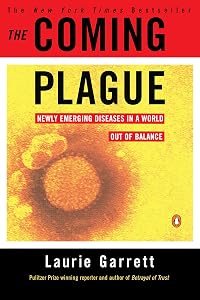
The Coming Plague: Newly Emerging Diseases in a World Out of Balance
by Laurie Garrett
On This Page
Description
Unpurified drinking water, improper use of antibiotics, local warfare, massive refugee migration have contributed to changing social and environmental conditions around the world. These have fostered the spread of new and potentially devastating viruses and diseases : HIV, Lassa, Ebola, and others. The author takes the reader on a fifty year journey through the world's battles with microbes and examines the worldwide conditions that have culminated in recurrent outbreaks of newly discovered show more diseases, epidemics of diseases migrating to new areas, and mutated old diseases that are no longer curable. show lessTags
Recommendations





Member Reviews
A compelling, phenomenal book that explains the history and evolution of infectious diseases and mankind's attempts to adapt and defeat them. Garrett explains disease mechanisms in a frightening yet lucid way, in layman's language. The ordinary reader - one with no background in epidemiology - walks away understanding how viruses and bacteria spread, how the immune system fights them, how various drug therapies work, and how viruses and bacteria evolve to beat both immune systems and drug treatments. Garrett explains the urgency of a truly world-wide public health policy, and backs every single statement up with the clearest distillation of facts and research.
It will terrify you, if you have a lick of sense ... and it will make you want show more to start taking action, start writing your politicians, start asking your doctor questions. You may not fear contracting Mad Cow disease from your food, but you certainly will want to ensure all your vaccinations are up-to-date. show less
It will terrify you, if you have a lick of sense ... and it will make you want show more to start taking action, start writing your politicians, start asking your doctor questions. You may not fear contracting Mad Cow disease from your food, but you certainly will want to ensure all your vaccinations are up-to-date. show less
I've been working on this doorstopper for the better part of a year, I think. But totally worth the ride.
In successive chapters, Garrett describes in sometimes novelistic detail the various fights humans and microbes have been fighting, mainly in the second half of the 20th century. Starting with an outbreak of hemorragic fever in Bolivia in 1962, tracking our struggles through Marburg virus, yellow fever, meningitis, Legionaire's disease, Lassa fever and then Ebola - in 1976! - (and that only gets us to page 100), she meticulously details the personalities, difficulties, and outcomes of wave after wave of new or newly virulent disease in our time. Inevitably, the story gets out of Africa and South America and the Third world in show more general, and leads back to North America, hanta virus and AIDS.
But more than just report on this destruction, she tracks origins, causes, how our own hand works against our own survival. As we travel more, destroy more, warm our planet more, build antibiotic resistance more, mix genetic material more either deliberately or accidentally, the microscopic enemies of our lives get smarter, stronger, almost more knowing, and get under our defenses again and again.
I love reading about medicine, but after the heroic tales petered out and the science of mutations became the story, this book made me extremely uneasy. Talk of vectors and reservoirs doesn't disguise the fact that the world is getting ever more dangerous as we change it.
The 'trade paperback' clocks in at 622 pages before the index and the 100 pages of footnotes and references. Fascinating, scary, and now 20 years old - and still happening. show less
In successive chapters, Garrett describes in sometimes novelistic detail the various fights humans and microbes have been fighting, mainly in the second half of the 20th century. Starting with an outbreak of hemorragic fever in Bolivia in 1962, tracking our struggles through Marburg virus, yellow fever, meningitis, Legionaire's disease, Lassa fever and then Ebola - in 1976! - (and that only gets us to page 100), she meticulously details the personalities, difficulties, and outcomes of wave after wave of new or newly virulent disease in our time. Inevitably, the story gets out of Africa and South America and the Third world in show more general, and leads back to North America, hanta virus and AIDS.
But more than just report on this destruction, she tracks origins, causes, how our own hand works against our own survival. As we travel more, destroy more, warm our planet more, build antibiotic resistance more, mix genetic material more either deliberately or accidentally, the microscopic enemies of our lives get smarter, stronger, almost more knowing, and get under our defenses again and again.
I love reading about medicine, but after the heroic tales petered out and the science of mutations became the story, this book made me extremely uneasy. Talk of vectors and reservoirs doesn't disguise the fact that the world is getting ever more dangerous as we change it.
The 'trade paperback' clocks in at 622 pages before the index and the 100 pages of footnotes and references. Fascinating, scary, and now 20 years old - and still happening. show less
This book is easily the most terrifying book I have ever read. Garrett is a great storyteller and makes a subject that could be very dry into a suspenseful journey through the history of epidemics and disease in America and the World.
While the initial chapters, documenting the fight against various virulent diseases around the world are gripping, later chapters detailing politics, bureaucracy, and policy decisions are a little dry in comparison. However, this information is important and worth reading. Garrett does an excellent job of explaining how under funded public health, agricultural practices, failed world health initiatives, politics and bureaucracy, poor ecological practices and scientific arrogance have lead to epidemics, show more disease resistant bacteria, and a world where there is essentially no planned response to the next virulent epidemic.
Overall the book is a crash course in epidemiology and public health. If you ever thought that public health, poverty, third world countries, and global health initiatives weren't something to concern yourself with, this book will make you think twice and, if you're smart, devise a personal plan should the next pandemic arrive in your town. show less
While the initial chapters, documenting the fight against various virulent diseases around the world are gripping, later chapters detailing politics, bureaucracy, and policy decisions are a little dry in comparison. However, this information is important and worth reading. Garrett does an excellent job of explaining how under funded public health, agricultural practices, failed world health initiatives, politics and bureaucracy, poor ecological practices and scientific arrogance have lead to epidemics, show more disease resistant bacteria, and a world where there is essentially no planned response to the next virulent epidemic.
Overall the book is a crash course in epidemiology and public health. If you ever thought that public health, poverty, third world countries, and global health initiatives weren't something to concern yourself with, this book will make you think twice and, if you're smart, devise a personal plan should the next pandemic arrive in your town. show less
I really enjoyed this book. It was ridiculously huge for a nonfiction, but I enjoyed (almost) every page of it. The book covers 3 aspects of disease: The recent history of deadly disease outbreaks such as Lassa Fever, Marburg/Ebola, and Yellow Fever; Current (as of 1994) outbreaks such as AIDS, Toxic Shock Syndrome, and Hantavirus; and the potential future of infectious diseases. The future is definitely the scariest. You would think that as technology advances the microbes would become less and less of a problem, but the book argues that with every technological advance we make, we wind up unleashing the microbes on ourselves. Blood transfusions, megacities, water treatment...heck, even antibiotics have actually strengthened the show more microbes as they become resistant to the drugs, rendering once benign illnesses untreatable. Laurie Garrett has definitely opened my eyes to the power of the microbes. Suddenly I don't feel so confident in humanities dominance of the planet.
Don't think that the book is all paranoid doomsaying though. While the predictions for the future of disease control can be disheartening, her chapters on humanities scientific advances can instill at least some confidence. The chapters on things like genetic engineering and WHO's attempts at world-wide microbe surveillance help make you think that not all is lost!
Overall, I found this book to be both compelling and very informative. The size might put some people off, but I would highly recommend it to anyone interested in the topic. show less
Don't think that the book is all paranoid doomsaying though. While the predictions for the future of disease control can be disheartening, her chapters on humanities scientific advances can instill at least some confidence. The chapters on things like genetic engineering and WHO's attempts at world-wide microbe surveillance help make you think that not all is lost!
Overall, I found this book to be both compelling and very informative. The size might put some people off, but I would highly recommend it to anyone interested in the topic. show less
This is one of those books that is daunting and fascinating all at once. THE COMING PLAGUE contains over 600 pages of fine-print material about the major diseases that emerged in the 20th century, how they were investigated, and what worked to resolve the issue (if anything). The level of detail Garrett employed is quite exhausting; the notes section is about 100 pages, and the books totals 750-pages in all. I read this for novel research, and it took me a month to do it as I read other books at the same time. Yes, I skimmed, but it was a slow skim as I jotted notes on sticky tabs throughout.
The sections that intrigued me the most were machupo (which I hadn't even heard of before), ebola, and hantavirus. The book also contains several show more hundreds pages on HIV/AIDS and the "Thirdworldization" issues of the 1980s and early '90s. It was interesting to see this book, published in 1994, cite how dangerous it was for cows and other farm animals to be given excessive hormones and antibiotic treatments, and lo and behold in the past few years those issues are finally being addressed. The slowness of medical responses is what really appalled me. In many ways, the United States was more ready in the 1950s due to Cold War vigilance and the use of "cowboy" epidemiologists who were willing to muck through the jungles in Africa or Central America to search for scat. As THE COMING PLAGUE points out in the end, the World Health Organization didn't recognize the threat of AIDS until it had already spread to four continents. That's just plain scary.
It all made for a fascinating read, but I am quite thankful to be done with this book! show less
The sections that intrigued me the most were machupo (which I hadn't even heard of before), ebola, and hantavirus. The book also contains several show more hundreds pages on HIV/AIDS and the "Thirdworldization" issues of the 1980s and early '90s. It was interesting to see this book, published in 1994, cite how dangerous it was for cows and other farm animals to be given excessive hormones and antibiotic treatments, and lo and behold in the past few years those issues are finally being addressed. The slowness of medical responses is what really appalled me. In many ways, the United States was more ready in the 1950s due to Cold War vigilance and the use of "cowboy" epidemiologists who were willing to muck through the jungles in Africa or Central America to search for scat. As THE COMING PLAGUE points out in the end, the World Health Organization didn't recognize the threat of AIDS until it had already spread to four continents. That's just plain scary.
It all made for a fascinating read, but I am quite thankful to be done with this book! show less
A very long book which deserves a slow careful read. I had had it on my shelves for a long time and finally took it down to read during the current pandemic. And it is all there in these pages: the warnings from 1994 of emerging diseases due to (then in early stages) climate change, misapplied efforts to clear up certain organisms (allowing worse ones to take over in no longer balanced ecosystems), increasing infringement on wild places bringing humans in contact with animals that carry diseases, often harmless to the animals but deadly to humans, inadequately funded health care systems, not just in the developing world but also in countries such as Russia and Romania, leading to multiple use of hospital syringes and hence direct show more bloodborne infection - for a lot of diseases often far more lethal than ordinary person-to-person transmission - infection of blood banks due to lack of any sterilisation procedures or screening of donors (many of whom were needle-using drug addicts who were paid to donate blood), and overuse of antibiotics in both agricultural and hospital settings allowing mass resistance to the same on the behalf of multiple disease causing organisms including some previously thought to be brought under control such as tuberculosis. All described through chapters which focus on particular diseases such as Lassa, Ebola, HIV and so on.
Particularly scary was the information that bacteria and other microbes freely exchange pieces of DNA and also take onboard freefloating fragments in their environment which confer on them such handy attributes as antibiotic-resistence and increased virulence. One of these fragments bestow on the receiving microbe the ability to form a pump which pushes back out of its cell wall anything that might harm it - such as antibiotics or even, in the case of micro-organisms contaminating water supplies, chemicals such as chlorine, rendering them impervious to the effects of such chemicals. Even cancer cells use the same mechanism. And all these things are swapping around DNA to improve their ability to infect and survive any attempt by humans to control them.
To summarise: this is a very informative book. The only reason I haven't given it 5 stars is not because it would need to be brought up to date to reflect how the situation has worsened since, but because the author has a tendency to try to tell the 'stories' of some of the doctors or victims of disease and jump back and forth in the timeline so that when they reappear pages later you can't always remember them. There are also a lot of people to remember anyway given the huge numbers of microbiologists, virologists and others involved in the history of these diseases. But a solid and very sobering 4-star read show less
Particularly scary was the information that bacteria and other microbes freely exchange pieces of DNA and also take onboard freefloating fragments in their environment which confer on them such handy attributes as antibiotic-resistence and increased virulence. One of these fragments bestow on the receiving microbe the ability to form a pump which pushes back out of its cell wall anything that might harm it - such as antibiotics or even, in the case of micro-organisms contaminating water supplies, chemicals such as chlorine, rendering them impervious to the effects of such chemicals. Even cancer cells use the same mechanism. And all these things are swapping around DNA to improve their ability to infect and survive any attempt by humans to control them.
To summarise: this is a very informative book. The only reason I haven't given it 5 stars is not because it would need to be brought up to date to reflect how the situation has worsened since, but because the author has a tendency to try to tell the 'stories' of some of the doctors or victims of disease and jump back and forth in the timeline so that when they reappear pages later you can't always remember them. There are also a lot of people to remember anyway given the huge numbers of microbiologists, virologists and others involved in the history of these diseases. But a solid and very sobering 4-star read show less
I finished! Started in April, finished in December.
This book is from 1993 so there is no SARS, MERS, or Covid-19. But this is a great overview of historic emerging diseases (Machupo, Ebola, Toxic SHock Syndrome, new flus, Hantavirus, and many more) and the scientific and cooperative work that has gone into learning about vectors, contagion, treatments, and so on. She discusses the political problems of getting funding and recognition for AIDS around the world. Near the end Garrett does begin to address the ranpant budget-cutting that had started in the US, and what it might mean for the future.
This took me so long to read because I got bogged down a few times. The chapter on the 1976 flu was slow because nothing happens--which is the show more point. What happens to public health trust and funding if the scientists models are incorrect?
Several of the later chapters are science-heavy (though my microbiologist friend disagrees LOL), as they discuss how viruses mutate. There are also a lot of numbers--costs, risks and percentages, absolute numbers, rates per place or population, etc.
All in all, this is an excellent book. A little hard to understand in places, and obviously not up-to-date. I would love to see an updated edition or part 2. show less
This book is from 1993 so there is no SARS, MERS, or Covid-19. But this is a great overview of historic emerging diseases (Machupo, Ebola, Toxic SHock Syndrome, new flus, Hantavirus, and many more) and the scientific and cooperative work that has gone into learning about vectors, contagion, treatments, and so on. She discusses the political problems of getting funding and recognition for AIDS around the world. Near the end Garrett does begin to address the ranpant budget-cutting that had started in the US, and what it might mean for the future.
This took me so long to read because I got bogged down a few times. The chapter on the 1976 flu was slow because nothing happens--which is the show more point. What happens to public health trust and funding if the scientists models are incorrect?
Several of the later chapters are science-heavy (though my microbiologist friend disagrees LOL), as they discuss how viruses mutate. There are also a lot of numbers--costs, risks and percentages, absolute numbers, rates per place or population, etc.
All in all, this is an excellent book. A little hard to understand in places, and obviously not up-to-date. I would love to see an updated edition or part 2. show less
Members
- Recently Added By
Published Reviews
It might seem churlish to complain about a book's thoroughness (especially a 750-page tome that was composed in longhand because the author, as she tells us in her acknowledgments, suffers from an occupational injury that prevents the use of a keyboard). Still, "The Coming Plague" covers an awful lot of ground, way too much for the casual reader. The obsession with detail -- dozens of bugs, show more hundreds of scientists and, by my count, 1,348 footnotes -- is as huge as Ms. Garrett's energy and enterprise. Her journalistic instincts are excellent. She cites the key articles, talks to the right researchers, focuses on the crucial scientific issues. Unfortunately, the book's flaws are huge, too. show less
added by jlelliott
Lists

Best Science Books for Non-Scientists
113 works; 57 members

Best Medical Nonfiction
79 works; 29 members

Best Books About Plagues and Epidemics
99 works; 17 members

Best History Books about Epidemics
27 works; 24 members

Non-Fiction Worth Reading
1,015 works; 261 members

Top Five Books of 2021
604 works; 181 members

Ten Books That Have Stayed With Me
160 works; 30 members
Books That Changed Our Perspective
423 works; 168 members
Author Information

10+ Works 2,421 Members
Laurie Garrett is a Pulitzer Prize -- winning reporter who has been a health and science writer for Newsday since 1988, and a contributor to such publications as Vanity Fair, Esquire, The Los Angeles Times, and Foreign Affairs
Awards and Honors
Awards
Notable Lists
Common Knowledge
- Canonical title
- The Coming Plague: Newly Emerging Diseases in a World Out of Balance
- Alternate titles
- The Coming Plague
- Original publication date
- 1994
- Important places
- Africa; Europe; France; Germany; USA
- Dedication
- To the people of Bukoba, Lasaka, Dar es Salaam, and dozens of other African locales who so generously over the years have shared their lives and wisdom with an inquiring white Western woman. Consider this a down payment on a... (show all)n enormous debt.
Africa: Asante sana, Mwalimu. - First words
- By the time my Uncle Bernard started his medical studies at the University of Chicago in 1932 he had already witnessed the great influenza pandemic of 1918-19.
- Last words
- (Click to show. Warning: May contain spoilers.)It's either that or we brace ourselves for the coming plague.
- Blurbers
- Baltimore, David
- Canonical DDC/MDS
- 614.4
- Canonical LCC
- RA651
Classifications
- Genres
- Science & Nature, Nonfiction, General Nonfiction, History
- DDC/MDS
- 614.4 — Applied science & technology Medicine & health Epidemics, Poisons, Alternative Medicine Incidence of and public measures to prevent disease
- LCC
- RA651 — Medicine Public aspects of medicine Public aspects of medicine Public health. Hygiene. Preventive medicine Epidemics. Epidemiology. Quarantine. Disinfection
- BISAC
Statistics
- Members
- 1,900
- Popularity
- 11,272
- Reviews
- 28
- Rating
- (4.16)
- Languages
- English, German, Portuguese
- Media
- Paper, Audiobook, Ebook
- ISBNs
- 14
- UPCs
- 1
- ASINs
- 11