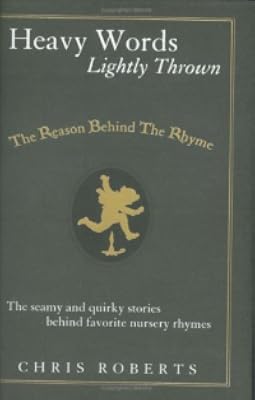
Heavy Words Lightly Thrown
by Chris Roberts, Catriona Andrews (Illustrator), Anne-Marie-Ross-Jennins (Illustrator), Vicky Bodycote (Illustrator), Jamie Bridson (Illustrator), Celia Briscoe (Illustrator), Tanya Bulycheva (Illustrator), Liesa Dewsnap (Illustrator), Mark Dickens (Illustrator), Victoria Fitzwilliams (Illustrator), Mushtaq Hussein (Illustrator), Karen MacAllister (Illustrator), Tania Martin (Illustrator), Paul Mellor (Illustrator), Jaya Miceli (Cover designer), Daniel Morgenstern (Illustrator), Sian Penn (Illustrator), Rebecca Pozzan (Illustrator), Redegan (Illustrator), Karolyn Reese (Illustrator), Will Sternberg (Illustrator), Ian Stevenson (Illustrator)
On This Page
Description
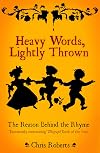
Nursery rhymes are rarely as innocent as they seem--there is a wealth of concealed meaning in our familiar childhood verse. More than a century after Queen Victoria decided that children were better off without the full story, London librarian Roberts brings the truth to light. He traces the origins of the subtle phrases and antiquated references, revealing religious hatred, political subversion, and sexual innuendo. A history lesson that makes astonishing connections to contemporary popular show more culture, this book is for Anglophiles, parents, history buffs, and anyone who has ever wondered about the origins of rhymes. The book features a glossary of slang and historical terms, and silhouettes of Mother Goose characters to accompany the rhymes.--From publisher description. show lessTags
Recommendations




Member Reviews
Heavy Words Lightly Thrown: The Reason Behind the Rhyme features an enjoyably British overview of popular nursery rhymes and their possible origins. Roberts does a thorough, humorous job of bringing history to life--I mean really, he quotes Eddie Izzard's "Tea or cakes or death" line in summarizing the Church of England. The majority of the rhymes were familiar to me, a California-raised American.
I was surprised by how old many of the nursery rhymes were. "London Bridge" is thought to celebrate the alliance of Aethelred the Unready and King Olav of Norway. Olav attached his ships to the bridge and at high tide floated the structure away. However, many of the rhymes date to the period of Henry VIII and shortly thereafter when religious show more tensions were high and often bloody.
I have to say, I feel odd reading my son's current favorite book, Mother Goose in California since finding out that "Goosey goosey gander" is about prostitutes and the whole Jack and Jill climbing a hill is really a euphemism for sex. It's like when I was a teenager and realized that the skunk Pepe le Pew was trying to rape a cat in all of those old cartoons.
I'm definitely keeping this book in my reference collection... though I think I'll hide it from my son for the next decade. Oh, sweet innocence! show less
I was surprised by how old many of the nursery rhymes were. "London Bridge" is thought to celebrate the alliance of Aethelred the Unready and King Olav of Norway. Olav attached his ships to the bridge and at high tide floated the structure away. However, many of the rhymes date to the period of Henry VIII and shortly thereafter when religious show more tensions were high and often bloody.
I have to say, I feel odd reading my son's current favorite book, Mother Goose in California since finding out that "Goosey goosey gander" is about prostitutes and the whole Jack and Jill climbing a hill is really a euphemism for sex. It's like when I was a teenager and realized that the skunk Pepe le Pew was trying to rape a cat in all of those old cartoons.
I'm definitely keeping this book in my reference collection... though I think I'll hide it from my son for the next decade. Oh, sweet innocence! show less
In this book, author Chris Roberts considers English language nursery rhymes in terms of their original, historical meanings. He traces some of these rhymes to the Middle Ages, but many others to the Tudor and Stuart monarchies of the 1500s through the early 1700s. In his account, these innocent- seeming rhymes reveal “religious hatred, political subversion, and sexual innuendo.” Thus, Humpty Dumpty is said to have been a cannon placed on the wall of a Colchester church. “Georgy Porgy” allegedly refers to the unpopular and portly George IV, and “Baa Baa Black Sheep” was originally a complaint against taxes. “Sing a Song of Sixpence” might refer to Henry VIII, and his first two wives. or maybe not -- and that raises a show more problem.
For many of the rhymes discussed, the author presents multiple, conflicting interpretations, each of which he supports with conjecture and speculation. This practice calls into question the legitimacy and accuracy of the book.
For example, consider “Mary, Mary Quite Contrary.” One possibility is that it is a jibe at Mary, Queen of Scots -- “the pretty maids all in a row” being a reference to the rampant promiscuity at court. Alternatively, the “garden” of the rhyme may be a cemetery full of Protestant martyrs, and the “silver bells and cockle shells” instruments of torture – in which case the Mary actually may be England’s Mary Tudor (aka “Bloody Mary”). Or perhaps the “Mary” is the mother of Jesus, and the “cockle shells” were badges worn by religious pilgrims. When a single simple rhyme gives rise to so many discrepant interpretations, clearly the reader can have no confidence in any one of them. Roberts sidesteps the contradictions by proposing that the rhyme “has come to represent either Mary, depending on how it is interpreted.” What can he possibly mean by this statement? The rhyme had an origin and a history, regardless of whether we can reconstruct what they were. Most of the rhymes discussed are of this sort – ones with multiple possible interpretations which are not able to be distinguished. Thus, this book becomes an exercise in imaginative speculation, not historical reconstruction.
In an afterword, the author gives the game away: ”Heavy Words was never meant to be a particularly scholarly exercise…. there are many alternative theories for several of the rhymes featured here, but this book has gone for the most interesting and plausible… “ The most interesting!? And so: entertainment was the goal. For anything like historical accuracy, readers will have to look elsewhere. show less
For many of the rhymes discussed, the author presents multiple, conflicting interpretations, each of which he supports with conjecture and speculation. This practice calls into question the legitimacy and accuracy of the book.
For example, consider “Mary, Mary Quite Contrary.” One possibility is that it is a jibe at Mary, Queen of Scots -- “the pretty maids all in a row” being a reference to the rampant promiscuity at court. Alternatively, the “garden” of the rhyme may be a cemetery full of Protestant martyrs, and the “silver bells and cockle shells” instruments of torture – in which case the Mary actually may be England’s Mary Tudor (aka “Bloody Mary”). Or perhaps the “Mary” is the mother of Jesus, and the “cockle shells” were badges worn by religious pilgrims. When a single simple rhyme gives rise to so many discrepant interpretations, clearly the reader can have no confidence in any one of them. Roberts sidesteps the contradictions by proposing that the rhyme “has come to represent either Mary, depending on how it is interpreted.” What can he possibly mean by this statement? The rhyme had an origin and a history, regardless of whether we can reconstruct what they were. Most of the rhymes discussed are of this sort – ones with multiple possible interpretations which are not able to be distinguished. Thus, this book becomes an exercise in imaginative speculation, not historical reconstruction.
In an afterword, the author gives the game away: ”Heavy Words was never meant to be a particularly scholarly exercise…. there are many alternative theories for several of the rhymes featured here, but this book has gone for the most interesting and plausible… “ The most interesting!? And so: entertainment was the goal. For anything like historical accuracy, readers will have to look elsewhere. show less
First Line: It should come as no surprise that nursery rhymes are full of sex, death, and cruelty.
Chris Roberts often leads walking tours of London. Having his tour guide patter constantly besieged with questions gave him the idea for this book. Roberts' preface to the US edition talks a bit about the metamorphosis this book has taken, and he thanks Gotham Books for the idea of including a glossary for those Americans who, unlike me, don't have an in-house interpreter for Cockney rhyming slang and the like. (Fortunately I didn't have to avail myself of my interpreter while reading Heavy Words Lightly Thrown.)
Roberts took me on a journey through many of the familiar nursery rhymes of my childhood: Little Jack Horner, Old King Cole, Pop show more Goes the Weasel.... I knew the origins of some and was quite enlightened by others. To say that I'll never think of goosebumps the same way again would be an understatement! I quite enjoyed Roberts' humorous style and think anyone interested in literary history would as well. show less
Chris Roberts often leads walking tours of London. Having his tour guide patter constantly besieged with questions gave him the idea for this book. Roberts' preface to the US edition talks a bit about the metamorphosis this book has taken, and he thanks Gotham Books for the idea of including a glossary for those Americans who, unlike me, don't have an in-house interpreter for Cockney rhyming slang and the like. (Fortunately I didn't have to avail myself of my interpreter while reading Heavy Words Lightly Thrown.)
Roberts took me on a journey through many of the familiar nursery rhymes of my childhood: Little Jack Horner, Old King Cole, Pop show more Goes the Weasel.... I knew the origins of some and was quite enlightened by others. To say that I'll never think of goosebumps the same way again would be an understatement! I quite enjoyed Roberts' humorous style and think anyone interested in literary history would as well. show less
I bought this because I saw a friend's post on it and it sounded interesting. Plus I'm a sucker for a good title.
Unfortunately, it doesn't really live up. And the subtitle is way off. Rather than "The Reason Behind the Rhyme," it should be "Apocryphal Stories and Historical Gossip Tangentially Related to Nursery Rhymes." But I suppose that lacks a certain . . . clichéness. (Wow. How's that for getting my snark on?)
But I sound a lot more disappointed than I actually am. I didn't have any real reason for high expectations; it's not like my friend was saying it was the book of the year or anything. And the title was, of course, stolen from a Smiths song. So I wasn't terribly let down or anything. I had hoped for him to stay a bit more show more focused, though. Often it seemed like he was taking every opportunity to go off on some barely related tangent. I'm not much a fan of that kind of rhetoric, so I usually found that annoying. If you are a fan of it—and plenty of people are, it's nothing to be ashamed of—then you'll probably love the book.
It did seem like he kept telling the same stories over and over, but I suspect that's due to (a) my lack of knowledge/interest concerning British royals and (2) the fact that said royals keep getting into the same kinds of scandals over and over, generation after generation. show less
Unfortunately, it doesn't really live up. And the subtitle is way off. Rather than "The Reason Behind the Rhyme," it should be "Apocryphal Stories and Historical Gossip Tangentially Related to Nursery Rhymes." But I suppose that lacks a certain . . . clichéness. (Wow. How's that for getting my snark on?)
But I sound a lot more disappointed than I actually am. I didn't have any real reason for high expectations; it's not like my friend was saying it was the book of the year or anything. And the title was, of course, stolen from a Smiths song. So I wasn't terribly let down or anything. I had hoped for him to stay a bit more show more focused, though. Often it seemed like he was taking every opportunity to go off on some barely related tangent. I'm not much a fan of that kind of rhetoric, so I usually found that annoying. If you are a fan of it—and plenty of people are, it's nothing to be ashamed of—then you'll probably love the book.
It did seem like he kept telling the same stories over and over, but I suspect that's due to (a) my lack of knowledge/interest concerning British royals and (2) the fact that said royals keep getting into the same kinds of scandals over and over, generation after generation. show less
This was a delightfully informative and humorously written little book that fleshes out the nursery rhymes that most of us grew up with. There are several rhymes in here that I was unfamiliar with and they are most likely more popular in England than they are here. It's a fascinating history lesson that draws several connections to many more contemporary political events. Some of this I already knew, but many of the explanations for nursery ditties and nonsense poems were real eye openers for me. I've been reading this book in bits and pieces for a while, it being one I carried in my handbag and read in odd moments. It's a good book for that sort of reading, since the reader can start and stop as needed. I enjoyed it a great deal.
This is an anthology of old nursery rhymes which purports to explain the origin of the rhymes.....many of which have political implications. Of course, there are also a huge number of variants of the rhymes that have been used or developed over the years as well. This complicated the interpretation of the rhymes. I have somewhat mixed feeling about the book. I don't think it's especially scholarly. For example, with the rhyme: "Goosey goosey gander.......
There I met an old man who wouldn't say his prayers
So I took him by the left leg and threw him down the stairs"
Roberts simply interprets this as having sexual meanings with the idea that "goose" refers to a "prostitute"....whereas other commentators draw attention to the fact that it is show more probably related to Catholic priests ..who if found in priest holes etc were likely to be thrown down the stairs......or to the actual case of Cardinal Beaton who would not submit to the covenanter's demands and was thrown down the stairs.
So interesting, not especially reliable or scholarly, and Roberts throws in some of his own amusing writing touches for good measure. (Some work...some don't....at least for me).
I rate it as three stars. Easy reading. But I don't think I'll keep it. show less
There I met an old man who wouldn't say his prayers
So I took him by the left leg and threw him down the stairs"
Roberts simply interprets this as having sexual meanings with the idea that "goose" refers to a "prostitute"....whereas other commentators draw attention to the fact that it is show more probably related to Catholic priests ..who if found in priest holes etc were likely to be thrown down the stairs......or to the actual case of Cardinal Beaton who would not submit to the covenanter's demands and was thrown down the stairs.
So interesting, not especially reliable or scholarly, and Roberts throws in some of his own amusing writing touches for good measure. (Some work...some don't....at least for me).
I rate it as three stars. Easy reading. But I don't think I'll keep it. show less
Many nursery rhymes (and a lullaby) that I knew from childhood, but who thinks about why it was written and if you even knew the right words!
Of note for me: London Bridge seems to have it origins as a Norwegian poems & apparently the pesky Norwegians towed one rendition of the bridge away. And the bridge now resides in Arizona.
Baa Baa Black Sheep is likely a commentary on taxes, and no one is sure who the Mary is referencing in Mary, Mary Quite Contrary.
I'm glad GoryDetails rescued this book from her LFL and sent it along in a bookbox. I'll likely release this in the Bio of Things bookbox.
Of note for me: London Bridge seems to have it origins as a Norwegian poems & apparently the pesky Norwegians towed one rendition of the bridge away. And the bridge now resides in Arizona.
Baa Baa Black Sheep is likely a commentary on taxes, and no one is sure who the Mary is referencing in Mary, Mary Quite Contrary.
I'm glad GoryDetails rescued this book from her LFL and sent it along in a bookbox. I'll likely release this in the Bio of Things bookbox.
Members
- Recently Added By
Author Information

11 Works 739 Members
Chris Roberts is a librarian and the proprietor of F and M Walking Tours in London.
All Editions
Common Knowledge
- Canonical title
- Heavy Words Lightly Thrown
- Original publication date
- 2003
- First words
- (Preface to the US Edition) I've often taken small groups of Americans on walking tours around London.
(Introduction) It should come as no surprise that nursery rhymes are full of sex, death, and cruelty.
(Chapter 1) Little "Jack" Horner was actually Thomas Horner, steward to the Abbot of Glastonbury during the reign of King Henry VIII. - Last words
- (Click to show. Warning: May contain spoilers.)Unless it's something we pick up in childhood through cheery rhymes ...
Classifications
Statistics
- Members
- 644
- Popularity
- 44,714
- Reviews
- 27
- Rating
- (3.36)
- Languages
- English
- Media
- Paper, Ebook
- ISBNs
- 9
- ASINs
- 4