On This Page
Description
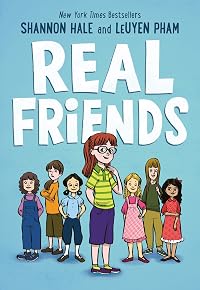
When her best friend Adrienne starts hanging out with the most popular girl in class, Shannon questions with whether she and Adrienne will stay friends, and if she is part of the clique.Tags
Recommendations

Member Reviews
Real Friends will be highly relatable to many. This is a nonfiction, graphic-novel account of author Shannon Hale's elementary years up to 5th grade, specifically, her upsetting experiences with friendship. Going only by the title and cover art, I thought this would be a mostly feel-good story about friendships that grow into the solid kind that last a lifetime. It's the opposite. Hale struggled with a selfish clique of popular girls who included her in their group sometimes but simply tolerated her when she was in, then outright shunned her.
Real Friends's story line definitely isn't unique, but Hale effectively captured the painful, and sometimes scary, dynamics of cliques, especially the all-consuming loneliness the shunned feel. I show more related to the story, as I became the shunned in 6th grade, my worst school year, with memories that remain some of my most vivid and pain that's somehow still very sharp. I also witnessed others get mocked and shunned, usually for superficial reasons, such as one nice girl the grade above me who was shunned because of her raging acne. Children have a breath-taking lack of, or very little, empathy, and Hale's account is powerful in its highlighting of how absolutely essential empathy is.
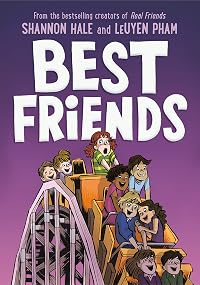
I recommend this for children and adults, though children probably will get more out of it. Hale's sequel is [b:Best Friends|42346392|Best Friends|Shannon Hale|https://i.gr-assets.com/images/S/compressed.photo.goodreads.com/books/1539635296l/42346392._SX50_.jpg|65992712], which I'll read next. show less
Real Friends's story line definitely isn't unique, but Hale effectively captured the painful, and sometimes scary, dynamics of cliques, especially the all-consuming loneliness the shunned feel. I show more related to the story, as I became the shunned in 6th grade, my worst school year, with memories that remain some of my most vivid and pain that's somehow still very sharp. I also witnessed others get mocked and shunned, usually for superficial reasons, such as one nice girl the grade above me who was shunned because of her raging acne. Children have a breath-taking lack of, or very little, empathy, and Hale's account is powerful in its highlighting of how absolutely essential empathy is.
I recommend this for children and adults, though children probably will get more out of it. Hale's sequel is [b:Best Friends|42346392|Best Friends|Shannon Hale|https://i.gr-assets.com/images/S/compressed.photo.goodreads.com/books/1539635296l/42346392._SX50_.jpg|65992712], which I'll read next. show less
Really wonderful. Almost painful to read in its authenticity. I remember being phased out of the cool group when I was in 3rd grade, and having to figure what to do now that none of the friends I had had wanted to spend time with me. But you know what else? It was so engaging. I opened the book, and bam I was hooked. I sat and read the entire thing then and there. Hale deftly maneuvers through this story, and while the central focus is friendship (particularly female), she manages to touch on other complex subjects like anxiety, sister relationships, and identity. A must read for fans of Raina Telgemeier. But I may have liked this one even more. And I should also mention the excellent illustrations by LeYuen Pham that bring the story to show more full-color life. She's brilliant here, as she always is. show less
It doesn't look like a sad book, but this book was pretty painful to read at times. Young Shannon faces bullying from Jenny, one of the girls in her circle of friends who seems to want to make Shannon miserable out of some unhealthy competitiveness (Jenny's insecure and cruel and targets Shannon because she's sensitive and nerdy). Then at home, Shannon is bullied and hit by her older sister Wendy who takes out her anger and frustration on Shannon because she's jealous that their parents are always praising Shannon's goodness. Wendy is sometimes drawn as a ferocious, menacing bear.
Yeah, it's pretty rough. But there are good times too. Between bouts of anxiety and obsessive counting and tapping, Shannon nurtures her imagination by show more playing all kinds of make-believe games. And then she finally finds the titular "real friends" she's deserved all along. And there's a very satisfying ending in which Jenny and Wendy both get what's coming to them, but in different ways.
The moral is: If people make you feel like shit, they're not really your friends, are they? Funny how hard it is for so many of us to learn this lesson. I suppose it seems like the alternative to dumping mean "friends" is being alone. But there are always other possible friends you just haven't noticed yet.
This is a fictionalized version of beloved author Shannon Hale's own childhood, so it's set in the late 1970s and early 80s, and the plot isn't constructed neatly like you would expect from pure fiction. Important characters appear and then disappear, which felt a bit ragged to me. (I'm thinking mainly of Adrienne's abrupt departure, Tammy's brief interlude, and Kayla who is never given a backstory -- in the Author's Note Hale calls her the "hiding-behind-the-shrub companion" and says her "situation" was hard, but still no specifics, even though they got to know each other better in high school. I was left wondering if Kayla was facing racist bullying because she's black, but race is never addressed in this book.) I suppose we can chalk this up to real life being messy and not being able to fit another subplot.
The Hales were churchgoers and young Shannon imagines at times that Jesus is her only real friend. I don't think it was intended to be funny, but it gave me a chuckle. show less
Yeah, it's pretty rough. But there are good times too. Between bouts of anxiety and obsessive counting and tapping, Shannon nurtures her imagination by show more playing all kinds of make-believe games. And then she finally finds the titular "real friends" she's deserved all along. And there's a very satisfying ending in which Jenny and Wendy both get what's coming to them, but in different ways.
The moral is: If people make you feel like shit, they're not really your friends, are they? Funny how hard it is for so many of us to learn this lesson. I suppose it seems like the alternative to dumping mean "friends" is being alone. But there are always other possible friends you just haven't noticed yet.
This is a fictionalized version of beloved author Shannon Hale's own childhood, so it's set in the late 1970s and early 80s, and the plot isn't constructed neatly like you would expect from pure fiction. Important characters appear and then disappear, which felt a bit ragged to me. (I'm thinking mainly of Adrienne's abrupt departure, Tammy's brief interlude, and Kayla who is never given a backstory -- in the Author's Note Hale calls her the "hiding-behind-the-shrub companion" and says her "situation" was hard, but still no specifics, even though they got to know each other better in high school. I was left wondering if Kayla was facing racist bullying because she's black, but race is never addressed in this book.) I suppose we can chalk this up to real life being messy and not being able to fit another subplot.
The Hales were churchgoers and young Shannon imagines at times that Jesus is her only real friend. I don't think it was intended to be funny, but it gave me a chuckle. show less
An unfortunately relatable story, Real Friends is an unflinching look at how groups of girls, especially, bully each other for no real reason. Everyone has some kind of story like this (well, I'm not sure about boys, but as a girl I've been on both sides growing up), but we don't really discuss it. It's taboo to admit that kids can be outright mean sometimes, to people that they like. Or that they will allow others to be mean, because they don't like you and don't know how else to express it (such as Adrienne allowing all this to happen to Shannon when she was clearly suffering). It does get better, once people mature out of their petty impulses, but all you can do is wait, and it helps to know that you're not the only one experiencing show more it.
4 stars because, while the fact that Shannon's OCD isn't treated during the story, it's not presented as too much of an issue, but Wendy's behavior is clearly out of line and overlooked. It's mentioned at the end that she had some undiagnosed problems as well, but the fact that Shannon's parents and sisters ignored her pleas for help and the fact that Wendy basically abused her is not OK. I had an older sister, and we fought (pretty nastily at times), but nothing like this. When Wendy followed Shannon into her room and shouted at her that all her friends hated her and her parents found her annoying is when it really crossed the line, and while Wendy was clearly also suffering, her behaviors were ignored. show less
4 stars because, while the fact that Shannon's OCD isn't treated during the story, it's not presented as too much of an issue, but Wendy's behavior is clearly out of line and overlooked. It's mentioned at the end that she had some undiagnosed problems as well, but the fact that Shannon's parents and sisters ignored her pleas for help and the fact that Wendy basically abused her is not OK. I had an older sister, and we fought (pretty nastily at times), but nothing like this. When Wendy followed Shannon into her room and shouted at her that all her friends hated her and her parents found her annoying is when it really crossed the line, and while Wendy was clearly also suffering, her behaviors were ignored. show less
Real Friends is a semi-autobiographical offering by Shannon Hale. It is aptly titled, because I think everyone encounters some level of the friend problems that are the focus of this book. It definitely feels like she took a peek into the lives of many of us when she shares her experiences. My only criticism of this book is that not all of the story bits were resolved at the end of the book; however, she acknowledges in the end matter that several of the relationships in her life that were portrayed in the book were not resolved, and therefore were not resolved in the storyline. All in all, I think it is a highly relatable book that many of my middle grade readers will identify with and enjoy.
Throughout elementary school, Shannon has one best friend, Adrienne - but Adrienne has other friends, one of whom is Jen, queen of the popular girls and leader of The Group. Through Adrienne, Shannon gains membership into the group, but it's precarious, and finally, she declares she is leaving for good. In a different classroom from the rest of the group in fifth grade - Shannon is in a 5th/6th split - she meets sixth-graders Zara and Veronica, who model a different brand of friendship: they're nice to everyone.
Shannon gets little support at home. She's stuck in the middle, with two older siblings (one of whom, Wendy, is often depicted as a terrifying bear) and two younger ones; her parents are not unkind but don't have the bandwidth show more to really help her through her difficulties with her sister and at school. She has a developed imaginative world and is always coming up with stories to pretend in with her friends; sometimes they're enthusiastic, other times she's on her own.
Quotes
"I think she's mean."
"But she's nice to me." (Shannon and Adrienne re: Jen, 76)
It felt like living in a house...
...with a wild bear.
"Isn't anyone else worried about that bear?"
"The bear never bothered me."
"But...the bear?"
...
"Who's our babysitter?"
"I think the bear is old enough now..."
"But...but..." (77-80)
The boys never rating-called us. I guess they didn't care what we thought about them. (88)
I wasn't sure leaving the group was the right choice. At least I'd had friends. Now sometimes I was so sad I could barely breathe. (137)
From the Author's Note:
Some have said that memories are the stories we tell ourselves about our past. Real Friends is the story I've been telling myself about my elementary school years. If you were to ask the other people portrayed in this book how it happened, surely the story they've been telling themselves would be different from mine.
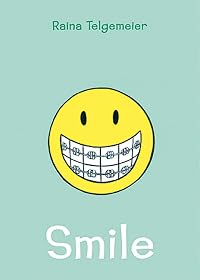
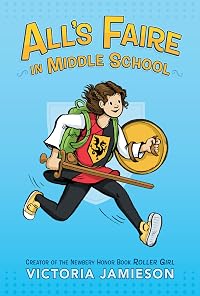
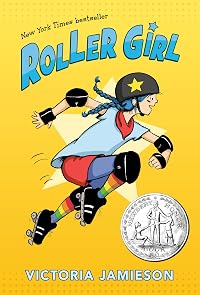
See also: Roller Girl and All's Faire in Middle School by Victoria Jamieson, Sisters and Smile by Raina Telgemeier show less
Shannon gets little support at home. She's stuck in the middle, with two older siblings (one of whom, Wendy, is often depicted as a terrifying bear) and two younger ones; her parents are not unkind but don't have the bandwidth show more to really help her through her difficulties with her sister and at school. She has a developed imaginative world and is always coming up with stories to pretend in with her friends; sometimes they're enthusiastic, other times she's on her own.
Quotes
"I think she's mean."
"But she's nice to me." (Shannon and Adrienne re: Jen, 76)
It felt like living in a house...
...with a wild bear.
"Isn't anyone else worried about that bear?"
"The bear never bothered me."
"But...the bear?"
...
"Who's our babysitter?"
"I think the bear is old enough now..."
"But...but..." (77-80)
The boys never rating-called us. I guess they didn't care what we thought about them. (88)
I wasn't sure leaving the group was the right choice. At least I'd had friends. Now sometimes I was so sad I could barely breathe. (137)
From the Author's Note:
Some have said that memories are the stories we tell ourselves about our past. Real Friends is the story I've been telling myself about my elementary school years. If you were to ask the other people portrayed in this book how it happened, surely the story they've been telling themselves would be different from mine.
See also: Roller Girl and All's Faire in Middle School by Victoria Jamieson, Sisters and Smile by Raina Telgemeier show less
That Hale managed to make the friendship travails of elementary school girls even marginally interesting to an old guy like me probably speaks highly to her skill as a writer.
But I would have preferred to see the book focus more heavily on the relationship with her sister or even be about the sister. The bear metaphor used in those sections was clever and visually arresting.
But I would have preferred to see the book focus more heavily on the relationship with her sister or even be about the sister. The bear metaphor used in those sections was clever and visually arresting.
Members
- Recently Added By
Lists

Graphic Novels with Female Positive Representation
107 works; 5 members

Books Read in 2017
4,249 works; 129 members

Sex Positive Sex-Ed books
35 works; 1 member

AR Level 2 in cloudLibrary
206 works; 1 member
Author Information

94+ Works 47,859 Members
Shannon Hale was born in Salt Lake City, Utah on January 26, 1974. She received a bachelor's degree in English from the University of Utah and a master's degree in creative writing from the University of Montana. Her first book, The Goose Girl, was published in 2003. She writes for both adults and young adults. Her adult books include Austenland, show more Midnight in Austenland, and The Actor and the Housewife. Her young adult books include Book of a Thousand Days, Princess Academy, Palace of Stone, and the Ever after High series. She co-wrote the graphic novels Rapunzel's Revenge and Calamity Jack with husband Dean Hale. (Bowker Author Biography) show less

Awards and Honors
Awards
Distinctions
Notable Lists
Series

Work Relationships
Common Knowledge
- Original publication date
- 2017
- First words
- When I was little, I didn't worry about friends.
- Last words
- (Click to show. Warning: May contain spoilers.)After all, no one's destiny is to be alone.
Classifications
- Genres
- Tween, Kids, Graphic Novels & Comics
- DDC/MDS
- 741.5 — Arts & recreation Drawing & decorative arts Drawing Comic books, graphic novels, fotonovelas, cartoons, caricatures, comic strips
- LCC
- PZ7.7 .H35 .R — Language and Literature Fiction and juvenile belles lettres Fiction and juvenile belles lettres Juvenile belles lettres
- BISAC
Statistics
- Members
- 1,496
- Popularity
- 15,511
- Reviews
- 74
- Rating
- (4.14)
- Languages
- English, Hungarian, Italian
- Media
- Paper, Ebook
- ISBNs
- 16
- ASINs
- 1