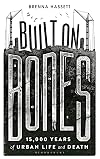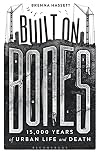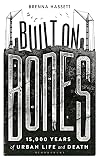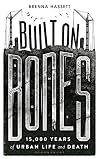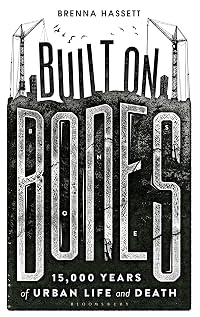
Built on Bones: 15,000 Years of Urban Life and Death
by Brenna Hassett
On This Page
Description
Imagine you are a hunter-gatherer some 15,000 years ago. You 've got a choice carry on foraging, or plant a few seeds and move to one of those new-fangled settlements down the valley. What you won 't know is that urban life is short and riddled with dozens of new diseases; your children will be shorter and sicklier than you are, they 'll be plagued with gum disease, and stand a decent chance of a violent death at the point of a spear. Why would anyone choose this' This is one of the many show more intriguing questions tackled by Brenna Hassett in Built on Bones. Using research on skeletal remains from around the world, this book explores the history of humanity 's experiment with the metropolis, and looks at why our ancestors chose city life, and why they have largely stuck to it. It explains the diseases, the deaths and the many other misadventures that we have unwittingly unleashed upon ourselves throughout the metropolitan past, and as the world becomes increasingly urbanised, what we can look forward to in the future. Telling the tale of shifts in human growth and health that have occurred as we transitioned from a mobile to a largely settled species. Built on Bones offers an accessible insight into a critical but relatively unheralded aspect of the human story- our recent evolution. show lessTags
Recommendations





Member Reviews
I've always had an interest in archaeology. I don't mean fossils and dinosaurs, but the remnants of recent civilisations and those long buried and forgotten. When a new plague pit is discovered on a construction site or the long lost remains of Richard III were located in a supermarket carpark, I'm going to be there to read about it.
As the title suggests, Built on Bones by Brenna Hassett takes a look at 15,000 Years of Urban Life and Death. As an archaeologist she specialises in the human skeleton to look at whether the move towards an urban lifestyle results in an earlier death than the foragers and nomads of history. Hassett looks at the changes in skeletons - and teeth in particular - which provide plenty of interesting tidbits and show more conclusions.
A highlight for me was on Page 49, where Hassett explains that with the move to agriculture and 'slurpable foods,' there was less work for our jaws, therefore less muscle, and as a consequence our jaws and faces have shrunk in size. This explains a great deal of the dental crowding and associated problems we see today.
I enjoyed learning more about the history and symptoms of urban diseases including syphilis, smallpox, leprosy and TB and Hassett also piqued my interest on Page 153 when she wrote about the practice of burying criminals in embarrassing positions.
Ultimately though, Built on Bones was a whole lot more academic than I was expecting. For a complete novice it was tough going at times and quite scientific. What made this somewhat harder were the infuriating footnotes on every other page. The majority of the footnotes were jokes and comic asides which kept drawing me away from the text and disrupting my rhythm. Well, why didn't you just ignore them I can hear you ask. Well, I couldn't ignore them because occasionally there would be an absolute gem I didn't want to miss, so I had to persevere.
Built on Bones by Brenna Hassett is recommended for armchair archaeologists, scientists, doctors, medical professionals, historians and devotees of Darwinism.
* Copy courtesy of Bloomsbury * show less
As the title suggests, Built on Bones by Brenna Hassett takes a look at 15,000 Years of Urban Life and Death. As an archaeologist she specialises in the human skeleton to look at whether the move towards an urban lifestyle results in an earlier death than the foragers and nomads of history. Hassett looks at the changes in skeletons - and teeth in particular - which provide plenty of interesting tidbits and show more conclusions.
A highlight for me was on Page 49, where Hassett explains that with the move to agriculture and 'slurpable foods,' there was less work for our jaws, therefore less muscle, and as a consequence our jaws and faces have shrunk in size. This explains a great deal of the dental crowding and associated problems we see today.
I enjoyed learning more about the history and symptoms of urban diseases including syphilis, smallpox, leprosy and TB and Hassett also piqued my interest on Page 153 when she wrote about the practice of burying criminals in embarrassing positions.
Ultimately though, Built on Bones was a whole lot more academic than I was expecting. For a complete novice it was tough going at times and quite scientific. What made this somewhat harder were the infuriating footnotes on every other page. The majority of the footnotes were jokes and comic asides which kept drawing me away from the text and disrupting my rhythm. Well, why didn't you just ignore them I can hear you ask. Well, I couldn't ignore them because occasionally there would be an absolute gem I didn't want to miss, so I had to persevere.
Built on Bones by Brenna Hassett is recommended for armchair archaeologists, scientists, doctors, medical professionals, historians and devotees of Darwinism.
* Copy courtesy of Bloomsbury * show less
Book received from NetGalley.
I ended up really enjoying this book, but after the first chapter, I had to not consider it as a history book but a sociology one. While it does go into some history of our living in what eventually became cities, it focuses more on why people did it, how living in a city changed our life spans, what discovering agriculture meant to the early ancestors and how it made city living possible while occasionally poking fun at the "paleo" culture we have today. I did learn a few things about how cities evolved and the people who lived in them and want a copy for my own research shelves. I'm not sure this book is for everyone.
I ended up really enjoying this book, but after the first chapter, I had to not consider it as a history book but a sociology one. While it does go into some history of our living in what eventually became cities, it focuses more on why people did it, how living in a city changed our life spans, what discovering agriculture meant to the early ancestors and how it made city living possible while occasionally poking fun at the "paleo" culture we have today. I did learn a few things about how cities evolved and the people who lived in them and want a copy for my own research shelves. I'm not sure this book is for everyone.
This was a very interesting and informative read about trying to understand the present human condition by studying how society structures have changed over time. The author goes into great detail about each phase of evolution and how scientist gathered the information that inferences were made from. I never realized there were so many areas of scientific study that would pertain to this topic. The author does a great job of providing all the information in a way that even a non scientist,like myself, could understand. Although this text could be used in a college level class, the author's footnotes help to lighten the read.
Ratings
Members
- Recently Added By
Lists

Review 1
30 works; 1 member
Author Information
2 Works 121 Members
Series
Belongs to Publisher Series
Bloomsbury Sigma (20)
Common Knowledge
- Canonical title
- Built on Bones: 15,000 Years of Urban Life and Death
- Original publication date
- 2017
- Dedication
- This book is dedicated to all those perfect leaves of grass, who have already gone to the dirt to grow.
- First words
- The amount of time humans have spent living in cities is an infinitesimal speck in the scope of hominid evolution.
- Last words
- (Click to show. Warning: May contain spoilers.)So it seems that, however much it has warped our bones, rotted our teeth and inflamed our sinuses – the city is right.
- Original language
- English
Classifications
- Genres
- Anthropology, Sociology, Nonfiction, History, General Nonfiction, Science & Nature
- DDC/MDS
- 307.7609 — Society, government, & culture Social sciences, sociology & anthropology Communities Specific kinds of communities Urban communities Biography And History
- LCC
- HT111 .H38 — Social sciences Communities. Classes. Races Communities. Classes. Races Urban groups. The city. Urban sociology
- BISAC
Statistics
- Members
- 93
- Popularity
- 346,900
- Reviews
- 3
- Rating
- (3.80)
- Languages
- English, German
- Media
- Paper, Audiobook, Ebook
- ISBNs
- 5
- ASINs
- 2