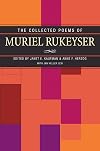
The Collected Poems of Muriel Rukeyser
by Muriel Rukeyer
On This Page
Description
Muriel Rukeyser held a visionary belief in the human capacity to create social change through language. She earned an international reputation as a powerful voice against enforced silences of all kind, against the violence of war, poverty, and racism. Her eloquent poetry of witness-of the Scottsboro Nine, the Spanish Civil War, the poisoning of the Gauley Bridge laborers-split the darkness covering a shameful world. In addition to the complete texts of her twelve previously published books, show more this volume also features new poems discovered by the editors; Rukeyser's translations, including the first English translations of Octavio Paz's work; early work by Rukeyser not previously published in book form; and the controversial book-length poem Wake Island. An introduction by the editors traces Rukeyser's life and literary reputation and complements discerning annotations and textual notes to the poems. - Publisher. show lessTags
Recommendations





































Member Reviews
http://www.newsreview.com/sacramento/Content?oid=oid%3A38974
My review of THE COLLECTED POEMS OF MURIEL RUKEYSER:
It’s both a scandal and a shame that The Collected Poems of Muriel Rukeyser has been out of print for almost three decades. Rukeyser, both widely admired and criticized during her lifetime, has slipped into obscurity in recent years.
That’s a scandal; not only did her poems provide the titles of a pair of the most famous anthologies of feminist poetry (No More Masks! and The World Split Open both are still widely read), but also her work made reality of the phrase “the personal is political.” And it’s a shame; Rukeyser’s poems are proof that it’s possible to produce powerfully aesthetic poems outside the rarified show more atmosphere of the academy.
Rukeyser, who died in 1980, thought a collection of all her poems was “a very curious idea.” Curious or not, it’s positively brilliant. Edited by Janet E. Kaufman and Anne F. Herzog, with assistance from Jan Heller Levi (Rukeyser’s last assistant and editor of A Muriel Rukeyser Reader), this new edition contains the texts of all 12 of Rukeyser’s books, as well as some new poems discovered by the editors. The notes are extremely helpful, providing context for the poems without being intrusive.
In poems that vary in subject matter from the trumped-up rape trial of nine African-American men in Scottsboro, Ala., to breastfeeding an infant in the middle of the night, and from the Spanish Civil War to recovering from a stroke, Rukeyser wrote across a wide page in bold strokes. Although her later poems are shorter--and some readers might find them more accessible--her real art lies in the long poem.
For example, in “The Lynchings of Jesus,” she approaches political executions from every angle. Where Emily Dickinson used the long dash to slide from meaning, Rukeyser uses caesuras, semicolons and colons to stop the reader short. We simply must contemplate, as she does, the many faces of injustice: “Let us be introduced to our superiors, the voting men, / they are tired ; they are hungry ; from deciding all day / around the committee table.”
Rukeyser had one of those lives that seems to be made for a biographer (though no one has attempted it yet). In 1936, she went to Gauley Bridge, West Virginia; her poems about the silica poisoning of thousands of miners form the central portion of her second book, U.S. 1. Later that year, while covering the “People’s Olympics” in Barcelona, she escaped by ship as the Fascists launched the Spanish Civil War. An unapologetic single mother 40 years before Murphy Brown, she wrote of breastfeeding, menstruation and the feminine erotic--definitely not a dainty “poetess.”
Although never a Communist, Rukeyser was definitely a voice from the left; in 1958, the House Committee on Un-American Activities censured Sarah Lawrence College for hiring her. But she wasn’t necessarily left enough for the left, either. Her long poem “Wake Island,” a tribute to U.S. fighting forces, was criticized in the Partisan Review as excessively patriotic. Perhaps it is. Some of its lines certainly take on new meaning in these post-9/11 days: “The future rises from the fighting heart / to fly over the world, riding where cities fall, / where the brave stand again, where voices call / to us to take their proof, proof of a world to win, / proof of America to lift the soul-- / fighting to prove us whole.”
At least with “Wake Island” again available, readers can decide for themselves if it’s too patriotic. Now all we need to go with the Collected Poems is a definitive biography of this remarkable poet. show less
My review of THE COLLECTED POEMS OF MURIEL RUKEYSER:
It’s both a scandal and a shame that The Collected Poems of Muriel Rukeyser has been out of print for almost three decades. Rukeyser, both widely admired and criticized during her lifetime, has slipped into obscurity in recent years.
That’s a scandal; not only did her poems provide the titles of a pair of the most famous anthologies of feminist poetry (No More Masks! and The World Split Open both are still widely read), but also her work made reality of the phrase “the personal is political.” And it’s a shame; Rukeyser’s poems are proof that it’s possible to produce powerfully aesthetic poems outside the rarified show more atmosphere of the academy.
Rukeyser, who died in 1980, thought a collection of all her poems was “a very curious idea.” Curious or not, it’s positively brilliant. Edited by Janet E. Kaufman and Anne F. Herzog, with assistance from Jan Heller Levi (Rukeyser’s last assistant and editor of A Muriel Rukeyser Reader), this new edition contains the texts of all 12 of Rukeyser’s books, as well as some new poems discovered by the editors. The notes are extremely helpful, providing context for the poems without being intrusive.
In poems that vary in subject matter from the trumped-up rape trial of nine African-American men in Scottsboro, Ala., to breastfeeding an infant in the middle of the night, and from the Spanish Civil War to recovering from a stroke, Rukeyser wrote across a wide page in bold strokes. Although her later poems are shorter--and some readers might find them more accessible--her real art lies in the long poem.
For example, in “The Lynchings of Jesus,” she approaches political executions from every angle. Where Emily Dickinson used the long dash to slide from meaning, Rukeyser uses caesuras, semicolons and colons to stop the reader short. We simply must contemplate, as she does, the many faces of injustice: “Let us be introduced to our superiors, the voting men, / they are tired ; they are hungry ; from deciding all day / around the committee table.”
Rukeyser had one of those lives that seems to be made for a biographer (though no one has attempted it yet). In 1936, she went to Gauley Bridge, West Virginia; her poems about the silica poisoning of thousands of miners form the central portion of her second book, U.S. 1. Later that year, while covering the “People’s Olympics” in Barcelona, she escaped by ship as the Fascists launched the Spanish Civil War. An unapologetic single mother 40 years before Murphy Brown, she wrote of breastfeeding, menstruation and the feminine erotic--definitely not a dainty “poetess.”
Although never a Communist, Rukeyser was definitely a voice from the left; in 1958, the House Committee on Un-American Activities censured Sarah Lawrence College for hiring her. But she wasn’t necessarily left enough for the left, either. Her long poem “Wake Island,” a tribute to U.S. fighting forces, was criticized in the Partisan Review as excessively patriotic. Perhaps it is. Some of its lines certainly take on new meaning in these post-9/11 days: “The future rises from the fighting heart / to fly over the world, riding where cities fall, / where the brave stand again, where voices call / to us to take their proof, proof of a world to win, / proof of America to lift the soul-- / fighting to prove us whole.”
At least with “Wake Island” again available, readers can decide for themselves if it’s too patriotic. Now all we need to go with the Collected Poems is a definitive biography of this remarkable poet. show less
Though Rukeyser isn't one of my favorite poets, her works shine with moments of power, insight, and wisdom, and there's no denying that she was "ahead of her time" in terms of politically and socially engaged poetry. As a collection, this has many highs and lows, and her strongest moments are within the many poetic sequences she wrote. For poets, though, and for all those readers and writers interested in socio-politically engaged writings (or writers) and/or feminist writers, Rukeyser can't be ignored. And, in the end, there are enough moments in this collection which I'll return to and treasure that the reading of the full collected works was well worth the time.
I wouldn't ever recommend this for the casual poetry reader, but it does show more have its moments, and many readers will absolutely find it worth their time. show less
I wouldn't ever recommend this for the casual poetry reader, but it does show more have its moments, and many readers will absolutely find it worth their time. show less
Ratings
Members
- Recently Added By
Author Information
1 Work 154 Members
Some Editions
Common Knowledge
- Original publication date
- 1978
- Dedication
- For Jacob, Gabriel, Casey, and Rebecca Rukeyser
- Blurbers
- Rich, Adrienne; Boland, Eavan; Wilmer, Eleanor; Becker, Robin; Olds, Sharon; Gibbons, Reginald
- Disambiguation notice
- The 2005 University of Pittsburgh edition edited by Herzog, Kaufman, and Levi differs from the 1978 McGraw-Hill edition (and subsequent reprints). The 2005 edition adds "new poems discovered by the editors; Rukeyser's transla... (show all)tions, including the first English translations of Octavio Paz's work; early work by Rukeyser not previously published in book form; and the controversial book-length poem Wake Island. An introduction by the editors traces Rukeyser's life and literary reputation and complements discerning annotations and textual notes to the poems."
Classifications
Statistics
- Members
- 154
- Popularity
- 213,507
- Reviews
- 2
- Rating
- (3.84)
- Languages
- English
- Media
- Paper, Ebook
- ISBNs
- 6
- ASINs
- 1