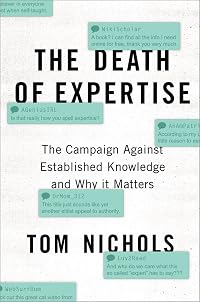
The Death of Expertise: The Campaign Against Established Knowledge and Why It Matters
by Tom Nichols
On This Page
Description
People are now exposed to more information than ever before, provided both by technology and by increasing access to every level of education. These societal gains, however, have also helped fuel a surge in narcissistic and misguided intellectual egalitarianism that has crippled informed debates on any number of issues. Today, everyone knows everything and all voices demand to be taken with equal seriousness, and any claim to the contrary is dismissed as undemocratic elitism. Tom Nichols show more shows this rejection of experts has occurred for many reasons, including the openness of the internet, the emergence of a customer satisfaction model in higher education, and the transformation of the news industry into a 24-hour entertainment machine. Paradoxically, the increasingly democratic dissemination of information, rather than producing an educated public, has instead created an army of ill-informed and angry citizens who denounce intellectual achievement. Nichols notes that when ordinary citizens believe that no one knows more than anyone else, democratic institutions themselves are in danger of falling either to populism or to technocracy-or in the worst case, a combination of both. show lessTags
Recommendations




Member Reviews
Democratic societies work by having responsible, informed citizens choosing political representatives whom we trust to take complicated decisions on our behalf. Those representatives take their decisions based on the best advice they can assemble from competent professional advisers — analysts, administrators, technicians — who are experts in the topic in question. At least that’s the theory…
According to Nichols (who is a self-confessed foreign-policy expert as well as being a celebrated Jeopardy contestant), this model is breaking down in the USA because of a growing distrust of specialist professional knowledge. Lay-people have an exaggerated sense of our own expertise (we can Google it, after all, so we know as much as they show more do, don’t we?) and a tendency to resent anyone who tells us that they know better. We’re all too ready to suspect conspiracies and ulterior motives, we like to think that our opinion is (at least) as valuable as the next person’s, and we rarely bother to read anything written by people with a different point of view from our own. Nichols talks a lot about stupid, wilfully ignorant people, but he also makes the point — which I found rather more interesting — that this kind of thinking is also prevalent among people who are educated, experienced professionals in one field but dangerously willing to assume knowledge in other fields where they have no proper training and experience.
Nichols reminds us that expertise is gained through an education that challenges us to step outside our comfort zone and defend our ideas in serious logical argument, and through a long process of gaining practical experience and making mistakes. Things which he argues are no longer easily available to most Americans, because of the way the education system has turned into a commercial service-industry where the customer is always right.
There’s probably nothing new about any of these effects — I can remember a fellow-delegate at an important scientific conference forty years ago lecturing me over lunch about what he saw as the strong evidence for biblical-style creation. But they seem to have been accelerated by the effect of the internet, which allows stupid ideas and misinformation to spread around the world faster than ever before, and by developments in the way that news media work, serving us with the news they know their customers want to read, rather than the news they think it’s important for informed citizens to be aware of.
Obviously a lot of what Nichols says can be dismissed as the gloom-and-doom of an older, conservative academic, who sees the world changing around him, or as the reaction of a mainstream Republican to the rise of Trumpery. I’ve been reading British versions of the same kind of thinking since the Brexit referendum (apart from the fact that British commentators have the additional advantage of being able to blame America, which always goes down well…). I found a lot of what Nichols said quite patronising — for example, he is dismissive of the independence of mind of the current generation of students in the US, an assumption that is belied by the current protests against the Israeli actions in Gaza; and he implies that only stupid people could possibly vote for Trump, which clearly can’t be true: in real life a large proportion of the people who voted for him must have been decent, intelligent people who somehow allowed themselves to be convinced that the alternative was worse. But he does make some good points, although he unfortunately doesn’t come up with a solution to the problem… show less
According to Nichols (who is a self-confessed foreign-policy expert as well as being a celebrated Jeopardy contestant), this model is breaking down in the USA because of a growing distrust of specialist professional knowledge. Lay-people have an exaggerated sense of our own expertise (we can Google it, after all, so we know as much as they show more do, don’t we?) and a tendency to resent anyone who tells us that they know better. We’re all too ready to suspect conspiracies and ulterior motives, we like to think that our opinion is (at least) as valuable as the next person’s, and we rarely bother to read anything written by people with a different point of view from our own. Nichols talks a lot about stupid, wilfully ignorant people, but he also makes the point — which I found rather more interesting — that this kind of thinking is also prevalent among people who are educated, experienced professionals in one field but dangerously willing to assume knowledge in other fields where they have no proper training and experience.
Nichols reminds us that expertise is gained through an education that challenges us to step outside our comfort zone and defend our ideas in serious logical argument, and through a long process of gaining practical experience and making mistakes. Things which he argues are no longer easily available to most Americans, because of the way the education system has turned into a commercial service-industry where the customer is always right.
There’s probably nothing new about any of these effects — I can remember a fellow-delegate at an important scientific conference forty years ago lecturing me over lunch about what he saw as the strong evidence for biblical-style creation. But they seem to have been accelerated by the effect of the internet, which allows stupid ideas and misinformation to spread around the world faster than ever before, and by developments in the way that news media work, serving us with the news they know their customers want to read, rather than the news they think it’s important for informed citizens to be aware of.
Obviously a lot of what Nichols says can be dismissed as the gloom-and-doom of an older, conservative academic, who sees the world changing around him, or as the reaction of a mainstream Republican to the rise of Trumpery. I’ve been reading British versions of the same kind of thinking since the Brexit referendum (apart from the fact that British commentators have the additional advantage of being able to blame America, which always goes down well…). I found a lot of what Nichols said quite patronising — for example, he is dismissive of the independence of mind of the current generation of students in the US, an assumption that is belied by the current protests against the Israeli actions in Gaza; and he implies that only stupid people could possibly vote for Trump, which clearly can’t be true: in real life a large proportion of the people who voted for him must have been decent, intelligent people who somehow allowed themselves to be convinced that the alternative was worse. But he does make some good points, although he unfortunately doesn’t come up with a solution to the problem… show less
The author observes that "The foundational knowledge of the average American is now so low that it has crashed through the floor of "uninformed," passed "misinformed" on the way down, and is now plummeting to "aggressively wrong." Interestingly, the American penchant to disregard expertise is baked into our national psychology. Alexis de Tocqueville noted the same tendency in 1835, and with the rise of the Internet, with which everyone can give the air of authority to ignorant viewpoints, has only made it worse. Ignorance, Nichols notes, has become "hip."
This is the inevitable result of a stew of influences: the belief that democracy means that one opinion, based on nothing but preconceived and unreflective assumptions, is as good as show more the conclusion from someone who has spent years studying the question; the tendency of education today to cater to adolescent narcissism that takes "correction as an insult", paired with a reliance on student evaluations to reward teachers.
I didn't agree with every part of his argument: He is too dismissive of students who "explode over imagined slights." Since he is never likely to have been the target of such rhetoric, his tolerance of "pranks" is probably higher than the minorities having their right to exist questioned and challenged. But he does write for the Federalist (a low quality internet tabloid), so perhaps this is to have been expected. In a sense, he is at times his own best evidence for the hard-headed insistence on adhering to bad ideas merely because, as he says, they agree with his values, and everyone will ignore evidence if it allows them to retain their presumptions.
For that reason, while the individual pieces of his argument are worth considering, they do not necessarily result in the world the author personally advocates. As we've seen in the Trump world, facts are irrelevant in pursuing the political ends advocated by the Federalist. It's just odd to see someone committed to the very kind of anti-intellectualism advanced by his publisher also writing a book to criticize it in other people. show less
This is the inevitable result of a stew of influences: the belief that democracy means that one opinion, based on nothing but preconceived and unreflective assumptions, is as good as show more the conclusion from someone who has spent years studying the question; the tendency of education today to cater to adolescent narcissism that takes "correction as an insult", paired with a reliance on student evaluations to reward teachers.
I didn't agree with every part of his argument: He is too dismissive of students who "explode over imagined slights." Since he is never likely to have been the target of such rhetoric, his tolerance of "pranks" is probably higher than the minorities having their right to exist questioned and challenged. But he does write for the Federalist (a low quality internet tabloid), so perhaps this is to have been expected. In a sense, he is at times his own best evidence for the hard-headed insistence on adhering to bad ideas merely because, as he says, they agree with his values, and everyone will ignore evidence if it allows them to retain their presumptions.
For that reason, while the individual pieces of his argument are worth considering, they do not necessarily result in the world the author personally advocates. As we've seen in the Trump world, facts are irrelevant in pursuing the political ends advocated by the Federalist. It's just odd to see someone committed to the very kind of anti-intellectualism advanced by his publisher also writing a book to criticize it in other people. show less
I think this book is so prescient and correct in so many ways, and really off track in others. We live in a world where people don't trust doctors to give medical advice, yet will take their plumber's recommendation that they take a horse de-worming pill to ward off infection from a deadly virus. As I was reading this book and listening to the mid 2010s examples of anti-expert-ism, I thought "oh, isn't that cute." Would that people were only as misinformed as they were 10 years ago!
I found the author's description of higher education to be very similar to my experiences, where students have a sense of entitlement about receiving a passing grade for merely showing up and "trying hard." While that is frustrating to me beyond belief show more (especially as an engineering professor), as I have only been a professor for 7 years, I cannot say for sure that it was any better or worse in the 60s / 70s / 80s / 90s. I do know that the corporatization of administration in higher ed is one of the problems, as many experts in education have already pointed out. The author did not blame the gaggle of $250,000/year deans and provosts with MBAs and EdDs, but students.
I disagree when the author scoffs at students wishing not to see racist Halloween costumes or swastikas in public. (Which has nothing to do with disrespect of expertise, that's just straight up calling out people for bigotry.) The author comes across as a typical entitled white man who doesn't like to have the younger generation calling out transphobic, racist, antisemitic, etc., bullsh*t from older folks who think it's OK just because they've never been held accountable or suffered consequences of being bigots before.
I also found it annoying and exhausting, but not surprising, to hear the author complain about getting 'splained things by non-experts, as if women don't deal with this all the time. I have had non-pilots tell me how to land an airplane (I'm a licensed pilot, so I know how to land an airplane and, furthermore, HAVE DONE IT HUNDREDS OF TIMES). I have had men tell me how quantum physics works (not that I'm an expert, but I know a lot more about it than my massage therapist, and I did take graduate classes on quantum mech and quantum optics while getting my PhD). I have had men explain to me how electricity works, as if I don't have three degrees in electrical engineering. Not that it justifies any 'splaining, but WELCOME TO HOW ALL WOMEN FEEL ALL THE TIME, WHITE GUY AUTHOR!
Without having the time or desire to look up every study cited by the author, I wondered about selection bias and lack of expertise of the author in some of the fields he cited. How many times is an extremely technical medical paper showing kind of a low stakes result (x has shown to be correlated with y, and we know that y leads to disease z) spun by the media to be X CAUSES Z! The author goes on about how scientists told people to stop eating eggs and that caused people to get fat. Which strikes me as disingenuous at best. I'm not sure what the initial study says, but wonder how much of the hype was caused by journalists and folks like him who don't know how to interpret scientific study results. And the fatphobia was unnecessary. Body size does not correlate with intelligence, nor is there a causal relationship between the two variables.
It's not news that the journalism field has been pretty much redefined and completely decimated as a serious profession over the past 20-30 years. When clickbait reigns supreme, and with the massive reduction in local newspapers and journals, news media organizations don't want to spend money on actual reporting. The author discusses this peripherally, and sort of blames the journalists. He doesn't blame the system that we have that has lead to this dearth of expertise in the journalism field. (Let's blame entitled millennials who cried their way to unearned college diplomas at small schools that shouldn't exist because they aren't ivy league instead!)
Finally, I was disturbed on how little flak the author gives to one of the HUGEST causes of the spread of misinformation: social media CEOs. What, so Facebook and Google get off the hook? They haven't lead to the proliferation of conspiracy theories, misinformation, anti-science, racism, and worse, through their algorithms? Nothing? No, the author says nothing about this at all. It's a shame, because this problem cannot be corrected until the root causes are identified.
I had read this book after just having completed Off the Edge, and I think the two books paired well together. Still, with all its flaws, I think it raises some important topics. I wish it held up to the expert level of scrutiny called for in the text itself. show less
I found the author's description of higher education to be very similar to my experiences, where students have a sense of entitlement about receiving a passing grade for merely showing up and "trying hard." While that is frustrating to me beyond belief show more (especially as an engineering professor), as I have only been a professor for 7 years, I cannot say for sure that it was any better or worse in the 60s / 70s / 80s / 90s. I do know that the corporatization of administration in higher ed is one of the problems, as many experts in education have already pointed out. The author did not blame the gaggle of $250,000/year deans and provosts with MBAs and EdDs, but students.
I disagree when the author scoffs at students wishing not to see racist Halloween costumes or swastikas in public. (Which has nothing to do with disrespect of expertise, that's just straight up calling out people for bigotry.) The author comes across as a typical entitled white man who doesn't like to have the younger generation calling out transphobic, racist, antisemitic, etc., bullsh*t from older folks who think it's OK just because they've never been held accountable or suffered consequences of being bigots before.
I also found it annoying and exhausting, but not surprising, to hear the author complain about getting 'splained things by non-experts, as if women don't deal with this all the time. I have had non-pilots tell me how to land an airplane (I'm a licensed pilot, so I know how to land an airplane and, furthermore, HAVE DONE IT HUNDREDS OF TIMES). I have had men tell me how quantum physics works (not that I'm an expert, but I know a lot more about it than my massage therapist, and I did take graduate classes on quantum mech and quantum optics while getting my PhD). I have had men explain to me how electricity works, as if I don't have three degrees in electrical engineering. Not that it justifies any 'splaining, but WELCOME TO HOW ALL WOMEN FEEL ALL THE TIME, WHITE GUY AUTHOR!
Without having the time or desire to look up every study cited by the author, I wondered about selection bias and lack of expertise of the author in some of the fields he cited. How many times is an extremely technical medical paper showing kind of a low stakes result (x has shown to be correlated with y, and we know that y leads to disease z) spun by the media to be X CAUSES Z! The author goes on about how scientists told people to stop eating eggs and that caused people to get fat. Which strikes me as disingenuous at best. I'm not sure what the initial study says, but wonder how much of the hype was caused by journalists and folks like him who don't know how to interpret scientific study results. And the fatphobia was unnecessary. Body size does not correlate with intelligence, nor is there a causal relationship between the two variables.
It's not news that the journalism field has been pretty much redefined and completely decimated as a serious profession over the past 20-30 years. When clickbait reigns supreme, and with the massive reduction in local newspapers and journals, news media organizations don't want to spend money on actual reporting. The author discusses this peripherally, and sort of blames the journalists. He doesn't blame the system that we have that has lead to this dearth of expertise in the journalism field. (Let's blame entitled millennials who cried their way to unearned college diplomas at small schools that shouldn't exist because they aren't ivy league instead!)
Finally, I was disturbed on how little flak the author gives to one of the HUGEST causes of the spread of misinformation: social media CEOs. What, so Facebook and Google get off the hook? They haven't lead to the proliferation of conspiracy theories, misinformation, anti-science, racism, and worse, through their algorithms? Nothing? No, the author says nothing about this at all. It's a shame, because this problem cannot be corrected until the root causes are identified.
I had read this book after just having completed Off the Edge, and I think the two books paired well together. Still, with all its flaws, I think it raises some important topics. I wish it held up to the expert level of scrutiny called for in the text itself. show less
As Nichols would be quick to point out, I was likely to enjoy this book about “the death of expertise” (more accurately, “the death of the acknowledgment of and respect for expertise”) due to the fact that it fits with my existing beliefs. Tom Nichols' book, based on his astonishingly prescient 2014 article in “The Federalist,” is a jeremiad on the loss of respect for the opinions of experts and for facts themselves. He discusses at length the issues of confirmation bias, anti-intellectualism, prioritization of feelings over facts at universities, the internet's creation of “instant experts,” the explosion of talk radio and cable news and growth of splinter “news” sources such as Alex Jones's “Infowars” to show more satisfy Americans' appetite for fantasy masquerading as fact, etc. He decries the tendency for the poorly informed to insist that their opinions, on everything from American foreign policy to childhood vaccinations, are as equally deserving of respect as those of experts in the various fields, and harkens back to a simpler time when “ordinary” citizens knew their place and listened respectfully to the wisdom of the well-credentialed. As you might expect, this aspect is where his book can become rather grating. He is quick to admit that “experts” do sometimes err, and points out that citizens have a duty to inform themselves (as best their often feeble abilities will allow), but reminds readers that experts' opinions are far more likely to be correct than those of the less well-trained. And he's right, but that doesn't save his repeated complaints about the failure of ordinary folks to respect experts from becoming irritating. To a large extent I think this is a function of a short magazine article being stretched into a full-length book when what it would have been better served by expansion into a long magazine piece. Despite its repetitiveness, his criticisms of a culture in which the belligerently ignorant insist that their views be treated as just as valid as those of the well-informed who base their ideas on actual facts are indisputable and timely. Three and a half stars. show less
“These are dangerous times. Never have so many people had so much access to so much knowledge and yet have been so resistant to learning anything.”
This is a depressing, timely, and important book, although one that I fear will not be read by those who most need to read it. In this age of people diagnosing medical conditions through Google, getting their news from Facebook and deriding anyone who bothers to read a book as an egghead, it’s hard for experts to defend their expertise without being branded as “elitists”.
I agreed with most of the author’s arguments and spent a good chunk of the book shaking my head sadly in agreement. However, I bristled a bit when university students were presented as coddled and entitled. I show more don’t dispute that grade inflation is rampant, and that some students are entitled whiners who consider themselves customers rather than learners. I do dispute the idea that having to share a room with a stranger without knowing anything about them beforehand somehow builds character and is “better” than the modern approach, which could involve matching roommates based on their sleeping habits or their programs, and enabling them to meet on social media in advance of the school year. For an introvert especially, the thought of rooming with an unknown person is terrifying. Allowing roommates to meet beforehand gives them an opportunity to get to know each other, perhaps divvy up buying shared things for the room, and maybe even discuss some areas of potential conflict so that they can figure out a plan before the conflict arises.
Apart from this admittedly highly specific gripe (I speak from experience in terms of benefitting from roommate compatibility surveys), I would certainly recommend that everyone read it—and then go and read more about the wider world. That is one thing this book does well: remind the reader of how vital it is to be well informed about current affairs. Because if you disengage, you’re letting others do your thinking for you. show less
This is a depressing, timely, and important book, although one that I fear will not be read by those who most need to read it. In this age of people diagnosing medical conditions through Google, getting their news from Facebook and deriding anyone who bothers to read a book as an egghead, it’s hard for experts to defend their expertise without being branded as “elitists”.
I agreed with most of the author’s arguments and spent a good chunk of the book shaking my head sadly in agreement. However, I bristled a bit when university students were presented as coddled and entitled. I show more don’t dispute that grade inflation is rampant, and that some students are entitled whiners who consider themselves customers rather than learners. I do dispute the idea that having to share a room with a stranger without knowing anything about them beforehand somehow builds character and is “better” than the modern approach, which could involve matching roommates based on their sleeping habits or their programs, and enabling them to meet on social media in advance of the school year. For an introvert especially, the thought of rooming with an unknown person is terrifying. Allowing roommates to meet beforehand gives them an opportunity to get to know each other, perhaps divvy up buying shared things for the room, and maybe even discuss some areas of potential conflict so that they can figure out a plan before the conflict arises.
Apart from this admittedly highly specific gripe (I speak from experience in terms of benefitting from roommate compatibility surveys), I would certainly recommend that everyone read it—and then go and read more about the wider world. That is one thing this book does well: remind the reader of how vital it is to be well informed about current affairs. Because if you disengage, you’re letting others do your thinking for you. show less
The Death of Expertise is the best curmudgeonly, "get off my lawn" argument for returning to better norms I've ever read. The author makes his case as reasoned and articulate as possible but you can practically hear the resignation in his voice because it's as if he knows he's trying to stem an unstoppable tide.
There's plenty of understated humor in the book which helps to offset its pervasive pessimism. Take this quote for example, "Imagine what the 1920s would've sounded like if every crank in every small town had his own radio station. Maybe it's not that people are any dumber or any less willing to listen to experts than they were 100 years ago, it's just that we can hear them all now."
I think the death of expertise is mostly the show more result of timing. Given the rise of globalism and our increasing interconnectedness of the past half century, it's not that experts are making more wrong calls but rather their occasional stumbles are now affecting more people. And those same people, a much larger group than ever before, will only see the stumbles and not the greater number of correct decisions. It's human nature, really, but this time there's weight in numbers to swing the pendulum further the other way. show less
There's plenty of understated humor in the book which helps to offset its pervasive pessimism. Take this quote for example, "Imagine what the 1920s would've sounded like if every crank in every small town had his own radio station. Maybe it's not that people are any dumber or any less willing to listen to experts than they were 100 years ago, it's just that we can hear them all now."
I think the death of expertise is mostly the show more result of timing. Given the rise of globalism and our increasing interconnectedness of the past half century, it's not that experts are making more wrong calls but rather their occasional stumbles are now affecting more people. And those same people, a much larger group than ever before, will only see the stumbles and not the greater number of correct decisions. It's human nature, really, but this time there's weight in numbers to swing the pendulum further the other way. show less
Nichols book hits the mark dead on and hits it hard. So why am I tempted to say what is the good of it? And why do I think Nichols might grudgingly acknowledge this sentiment?
Maybe because Nichols struggles mightily down the home stretch when attempting to discover some reasons for optimism while his pessimism flows like honey in the promised land. Nichols clearly understands the catch-22 woven into the scenario of a professor writing a book on expertise: those who need to read Nichols' book most likely will not; those who already ascribe to the thesis offered up in the title, are much more likely to be found reading it and nodding along in affirmation.
Or put another way, a public intellectual expounding on expertise will be heard by show more his primary target audience--the one he wishes he could reach--as a braying, pompous ass. This outcome cannot be dodged no matter how gingerly Nichols proceeds. It will always sound like someone pulling rank--an elite looking down the barrel of a very long nose.
I share Nichols pessimism. I don't have a thought worth a dime about about how to right the train, because the issue is both educational and cultural and runs deep. Moreover, my metaphor is wrong: we are not dealing with a train that can be righted but a boat that has sailed. It seems to me fixing things is going to be a matter of just hanging on, biding time with a cold-war-like mentality to keep the Republic going until one wakes up one day to find the problem is no longer a problem, the wall toppled, our heirs interest having shifted to deal with other, more pressing problems.
I once told my son when he was young that there is no glory in ignorance. I know this because my son, now in his twenties, recently told me I said this. Nichols says this much more elegantly, making it clear that we too often get confused about who should be embarrassed when someone serves up something nonsensical or ignorant with perfect equanimity and confidence. Calling this out is sane. It is honest. One thing it is not is elitist, so long as we are sensible enough to have our own ravings called out by those who know better. show less
Maybe because Nichols struggles mightily down the home stretch when attempting to discover some reasons for optimism while his pessimism flows like honey in the promised land. Nichols clearly understands the catch-22 woven into the scenario of a professor writing a book on expertise: those who need to read Nichols' book most likely will not; those who already ascribe to the thesis offered up in the title, are much more likely to be found reading it and nodding along in affirmation.
Or put another way, a public intellectual expounding on expertise will be heard by show more his primary target audience--the one he wishes he could reach--as a braying, pompous ass. This outcome cannot be dodged no matter how gingerly Nichols proceeds. It will always sound like someone pulling rank--an elite looking down the barrel of a very long nose.
I share Nichols pessimism. I don't have a thought worth a dime about about how to right the train, because the issue is both educational and cultural and runs deep. Moreover, my metaphor is wrong: we are not dealing with a train that can be righted but a boat that has sailed. It seems to me fixing things is going to be a matter of just hanging on, biding time with a cold-war-like mentality to keep the Republic going until one wakes up one day to find the problem is no longer a problem, the wall toppled, our heirs interest having shifted to deal with other, more pressing problems.
I once told my son when he was young that there is no glory in ignorance. I know this because my son, now in his twenties, recently told me I said this. Nichols says this much more elegantly, making it clear that we too often get confused about who should be embarrassed when someone serves up something nonsensical or ignorant with perfect equanimity and confidence. Calling this out is sane. It is honest. One thing it is not is elitist, so long as we are sensible enough to have our own ravings called out by those who know better. show less
Members
- Recently Added By
Lists

Top Five Books of 2017
757 works; 231 members

ORCID Book list
27 works; 1 member

University Presses
155 works; 1 member

Books Read in 2023
5,638 works; 147 members
Author Information

3 Works 1,172 Members
Some Editions
Awards and Honors
Awards
Notable Lists
Series
Belongs to Publisher Series
Common Knowledge
- Canonical title
- The Death of Expertise: The Campaign Against Established Knowledge and Why It Matters
- Dedication
- For
Lynn Marie Nichols
and
Hope Virginia Nichols
Expert wife and peerless daughter - First words
- In the early 1990s, a small group of "AIDS denialists," including a University of California professor named Peter Duesberg, argued against virtually the entire medical establishment's consensus that the human immunodeficienc... (show all)y virus (HIV) was the cause of Acquired Immune Deficiency Syndrome.
- Last words
- (Click to show. Warning: May contain spoilers.)I could be wrong.
- Canonical DDC/MDS
- 001.0973
Classifications
- Genres
- Sociology, General Nonfiction, Nonfiction, Science & Nature
- DDC/MDS
- 001.0973 — Computer science, information & general works Computer science, knowledge & systems Knowledge and learning in general Standard subdivisions History, geographic treatment, biography North America United States
- LCC
- HM851 .N54 — Social sciences Sociology (General) Sociology Social change
- BISAC
Statistics
- Members
- 1,059
- Popularity
- 24,327
- Reviews
- 32
- Rating
- (3.79)
- Languages
- 6 — Chinese, English, Finnish, Italian, Japanese, Portuguese
- Media
- Paper, Audiobook, Ebook
- ISBNs
- 21
- ASINs
- 6