Noah Webster's Fighting Words
by Tracy Nelson Maurer
On This Page
Description
Describes the life and times of the man made famous for writing the first dictionary of the English language.Tags
Recommendations


Member Reviews
Noah Webster fought the American Revolution with his pen, as the author argues in this story:
In his opinion, America needed to break away from Great Britain in every way. Politics. Trade. Even in its ways of speaking and spelling.”
To that end, he published A Grammatical Institute of the English Language in 1783, changing some British spellings and showing American pronunciations. He followed this up in the next two years with American Grammar and the American Reader. He featured the works of Americans in his books, and looked for more ways to make “American” separate from “English.” Thus, for example, he promulgated such usages as “jail” instead of “gaol” (successfully) and “riter” instead of “writer” (not so show more much).
He asked the U.S. Congress to pass laws making speaking and spelling uniform throughout the states, but Congress refused. He then tried to effect change through a dictionary. In 1806 he wrote a small dictionary with 40,600 entries, including some unique American words, such as chowder and skunk. [His philosophy - “descriptionist” rather than “prescriptionist” to dictate correct word usage - is still being debated to this day.]
In 1828, he published his pièce de résistance, An American Dictionary of the English Language. The author writes:
“No one, not another author, or even a king or queen, has ever successfully changed the spellings of as many English words as Noah Webster did for the new nation.”
“Today,” the author concludes, “a dictionary named after him is still published in America - with new words in every edition.”
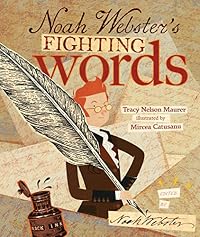
An Author’s Note explains the author’s interest in Noah Webster and the research she undertook to write the book. Romanian illustrator Mircea Catusanu also includes a note, reporting on how he “opted for a collage style that incorporates realistic elements including some period drawings of objects, created over one hundred years ago by anonymous artists, as well as excerpts from period books, newspapers, and Noah’s original handwritten letters.” He also reveals that he tried using “a lighter approach” in drawing his characters, “aiming for an unexpected and hopefully amusing effect.”
The book concludes with a timeline, list of sources, and selected bibliography.
Evaluation: The interesting text and lively, collage-style illustrations will provide children with insight into how language evolves, as well as teaching them that the American Revolution was carried out in more unorthodox ways than just through military clashes. This can lead to many insights on the ways in which words, images, and art of all kinds can influence the course of history. show less
In his opinion, America needed to break away from Great Britain in every way. Politics. Trade. Even in its ways of speaking and spelling.”
To that end, he published A Grammatical Institute of the English Language in 1783, changing some British spellings and showing American pronunciations. He followed this up in the next two years with American Grammar and the American Reader. He featured the works of Americans in his books, and looked for more ways to make “American” separate from “English.” Thus, for example, he promulgated such usages as “jail” instead of “gaol” (successfully) and “riter” instead of “writer” (not so show more much).
He asked the U.S. Congress to pass laws making speaking and spelling uniform throughout the states, but Congress refused. He then tried to effect change through a dictionary. In 1806 he wrote a small dictionary with 40,600 entries, including some unique American words, such as chowder and skunk. [His philosophy - “descriptionist” rather than “prescriptionist” to dictate correct word usage - is still being debated to this day.]
In 1828, he published his pièce de résistance, An American Dictionary of the English Language. The author writes:
“No one, not another author, or even a king or queen, has ever successfully changed the spellings of as many English words as Noah Webster did for the new nation.”
“Today,” the author concludes, “a dictionary named after him is still published in America - with new words in every edition.”
An Author’s Note explains the author’s interest in Noah Webster and the research she undertook to write the book. Romanian illustrator Mircea Catusanu also includes a note, reporting on how he “opted for a collage style that incorporates realistic elements including some period drawings of objects, created over one hundred years ago by anonymous artists, as well as excerpts from period books, newspapers, and Noah’s original handwritten letters.” He also reveals that he tried using “a lighter approach” in drawing his characters, “aiming for an unexpected and hopefully amusing effect.”
The book concludes with a timeline, list of sources, and selected bibliography.
Evaluation: The interesting text and lively, collage-style illustrations will provide children with insight into how language evolves, as well as teaching them that the American Revolution was carried out in more unorthodox ways than just through military clashes. This can lead to many insights on the ways in which words, images, and art of all kinds can influence the course of history. show less
This was one of the cutest books I’ve read in a while. Noah Webster’s Fighting Words gives us a short biography about Noah Webster, and he’s decided to make sure that the author gets it just right, so it features notes and edits by Noah Webster’s ghost.
Mostly, what this book focuses on is Webster’s passion for words, detailing his fight for making an “American” language that was separate from British English, and the career he made for himself in writing and editing. It’s easy to read and incredibly informative; certainly a must-have for an elementary teacher who delves into the American Revolution time period. The illustrations are fun and have a beautiful sepia-toned, old-timey feel to them that brought me right into show more atmosphere of the colonial time period for America. Plus, you get a bit of humor from Webster making his edits to the biography and giving side notes.
This book is delightful and I highly recommend it for those who want an approachable non-fiction book about an important figure in American history.
Also posted on Purple People Readers. show less
Mostly, what this book focuses on is Webster’s passion for words, detailing his fight for making an “American” language that was separate from British English, and the career he made for himself in writing and editing. It’s easy to read and incredibly informative; certainly a must-have for an elementary teacher who delves into the American Revolution time period. The illustrations are fun and have a beautiful sepia-toned, old-timey feel to them that brought me right into show more atmosphere of the colonial time period for America. Plus, you get a bit of humor from Webster making his edits to the biography and giving side notes.
This book is delightful and I highly recommend it for those who want an approachable non-fiction book about an important figure in American history.
Also posted on Purple People Readers. show less
Introducing young readers to real people in picture book biographies is a fabulous way for them to begin learning about those who shaped the world. It is also a wonderful method to introduce and encourage reading of non-fiction works to young readers.
Most Americans have used a Webster's Dictionary at one time or another but few have the slightest clue as to how a dictionary was compiled, when, and by whom. In Noah Webster's Fighting Words the story begins with America's path toward shaping American English as we know and define it.
The story reveals the feisty nature of Noah Webster and how he pushed hard to establish verbiage that was uniquely American in sound interpretation and spelling.
Illustrations that will surely capture the show more attention of the most reluctant reader add interest and direction to the text that is factual yet with a bit of tongue-in-cheek humor that keeps it lively and entertaining. This story gives a glimpse into an individual that was somewhat weird, hard to get along with, and contrary and yet who was a valuable contributor to American English language development.
The pages at the end of the book include author's note and illustrator's note as well as a fantastic timeline. This book would make a great addition to libraries everywhere and of every type.
DISCLOSURE: I received a complimentary copy from Lerner Books to facilitate this review. Opinions are my own and are freely given. show less
Most Americans have used a Webster's Dictionary at one time or another but few have the slightest clue as to how a dictionary was compiled, when, and by whom. In Noah Webster's Fighting Words the story begins with America's path toward shaping American English as we know and define it.
The story reveals the feisty nature of Noah Webster and how he pushed hard to establish verbiage that was uniquely American in sound interpretation and spelling.
Illustrations that will surely capture the show more attention of the most reluctant reader add interest and direction to the text that is factual yet with a bit of tongue-in-cheek humor that keeps it lively and entertaining. This story gives a glimpse into an individual that was somewhat weird, hard to get along with, and contrary and yet who was a valuable contributor to American English language development.
The pages at the end of the book include author's note and illustrator's note as well as a fantastic timeline. This book would make a great addition to libraries everywhere and of every type.
DISCLOSURE: I received a complimentary copy from Lerner Books to facilitate this review. Opinions are my own and are freely given. show less
This review is based on an ARC from NetGalley.
Aaaadorable. I love the illustrations, they're so lively and old-timey. I love that Noah Webster himself left editorial comments throughout, presumably to make sure Tracy Maurer got everything right. I especially love this bit:
As he once said, "I began life...full of confidence in my own opinions."
I also love that he was a descriptivist, not a prescriptivist. And I'm a huge fan of some of his spelling changes that didn't quite catch on, like riter and soop!
Aaaadorable. I love the illustrations, they're so lively and old-timey. I love that Noah Webster himself left editorial comments throughout, presumably to make sure Tracy Maurer got everything right. I especially love this bit:
As he once said, "I began life...full of confidence in my own opinions."
I also love that he was a descriptivist, not a prescriptivist. And I'm a huge fan of some of his spelling changes that didn't quite catch on, like riter and soop!
A little bit linguistic history, a little bit American Revolution history, and all around sassy telling of Noah Webster's work.
Adorable. Very interesting and great illustrations. If you have a fact loving, word loving, list loving child, this is a must.
Great to introduce the boys to another famous figure from the revolutionary era of American history. Especially one who was able to declare independence with his pen rather than a gun.
Members
- Recently Added By
Lists

Youth: Social Values
194 works; 1 member
Author Information

113 Works 1,037 Members
Awards and Honors
Common Knowledge
- People/Characters
- Noah Webster
- Important events
- American Revolution
Classifications
Statistics
- Members
- 63
- Popularity
- 490,939
- Reviews
- 10
- Rating
- (3.96)
- Languages
- English
- Media
- Paper, Ebook
- ISBNs
- 5
- ASINs
- 1