
Susan L. Roth
Author of Listen to the Wind: The Story of Dr. Greg & Three Cups of Tea
About the Author
Image credit: via author's website
Works by Susan L. Roth
Associated Works
Tagged
Common Knowledge
- Gender
- female
- Education
- Mills College (BA|art|1965)
Mills College (MA|printmaking, art history|1968) - Occupations
- author
illustrator - Short biography
- Born: New York City
Childhood: Madison, Wisconsin
Young adult: San Francisco Bay Area, California
Adult and Present: Washington, D.C.; Bethesda, Maryland; Baltimore, Maryland;
New York City
B.A.: 1965, Mills College, Oakland, California; Art
M.A.: 1968, Mills College, Oakland, California; Printmaking, Art History
Married, three children, three grandchildren
Author/Illustrator of 57 Books
Primary medium: Collage [from the official author page] - Nationality
- USA
- Birthplace
- New York, New York, USA
- Places of residence
- Madison, Wisconsin, USA
San Francisco Bay Area, California, USA
Washington, D.C., USA
Bethesda, Maryland, USA
Baltimore, Maryland, USA - Associated Place (for map)
- USA
Members
Reviews
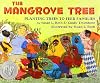
Here is a grand deed, as basic as a science-fair project, that had a profound application bringing health and economic bounty to a small coastal town, Hargigo, in Eritrea. Dr. Gordon Santo had a brainstorm: Why not plant mangrove trees in the waters off Hargigo? The leaves would feed the town’s hungry herds of sheep and goats and provide wood for fuel; the trees’ root system would attract fish (a food and revenue source); and the trees themselves would do what trees are so good show more at—converting carbon dioxide to oxygen. Roth’s artwork is a treat, cut-paper and fabric collages of intense, shimmering color on a ground of paper that is electric with thick veins of fiber (photos join glossary in backmatter). Roth and Trumbore’s cumulative verse goes about its merry way on the left page—“These are the shepherds / Who watch the goats / and watch the sheep / That eat the leaves”—while a narrative on the right takes readers on Santo’s journey. He has named the project Manzanar, after the internment camp where he was placed during World War II, because he wanted to turn that experience (where he first grew desert plants) into something good. Hitting home hard is the project’s simple practicality: no high-tech, no great infusions of capital or energy—in a word, motivating, in the best possible way. (Informational picture book. 6-9)
-Kirkus Review show less
-Kirkus Review show less
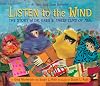
My book club will be reading Mortenson's Three Cups of Tea later this year, so this children's version of the story caught my eye. Even if the title hadn't (and the subtitle as it came up when I added this book was wrong, so I corrected it), the cover artwork would have.
Susan Roth has created stunning, colorful, three-dimensional, highly textural collages for this book's illustrations. The head scarves (made of fabric or textured papers) of the Pakistani girls and women look as though they show more are actually wrapped around the heads. Paper fingers are bent and look as though they are actually holding objects. Roth includes an informative artist's note at the end of the book, explaining her inspiration and how she created the collages and base papers.
The story, of Greg Mortensen's follow-though on a promise to build a school in a remote village after the people there helped him recover after a failed mountain climb in the area, is inspiring. A scrapbook with actual photographs of the villagers and the school at the end of the book shows children the story is true.
The artwork will encourage children to create their own collages, and the story will prompt them to consider ways in which one person's actions can make such a difference. I will definitely be purchasing this book for the curriculum collection of my university's library. show less
Susan Roth has created stunning, colorful, three-dimensional, highly textural collages for this book's illustrations. The head scarves (made of fabric or textured papers) of the Pakistani girls and women look as though they show more are actually wrapped around the heads. Paper fingers are bent and look as though they are actually holding objects. Roth includes an informative artist's note at the end of the book, explaining her inspiration and how she created the collages and base papers.
The story, of Greg Mortensen's follow-though on a promise to build a school in a remote village after the people there helped him recover after a failed mountain climb in the area, is inspiring. A scrapbook with actual photographs of the villagers and the school at the end of the book shows children the story is true.
The artwork will encourage children to create their own collages, and the story will prompt them to consider ways in which one person's actions can make such a difference. I will definitely be purchasing this book for the curriculum collection of my university's library. show less
I hated everything about this book! The illustrations, which were collages of scraps from the illustrator's studio, looked like they were just sloppily slapped together of, like she was on a deadline. The fact that the children on the cover are wearing hijabs, when it doesn't show any pictures of the actual children wearing them, shows me that she didn't look beyond stereotypes. As for the story, I think it's actually more about the author's messiah complex. Basically, he gets lost hiking in show more the mountains and comes across a village, where the villagers take care of him for about a year. When it's time for him to leave, he asks the old wise man of the village what he can do to give something back to them. The old man replies, "listen to the wind." The author somehow interprets this as the children of the village need a modern, Americanized school. Who knows what the old mountain man really meant??? They build a school for the children and apparently everything is happy ever after. And I love how he tells the story from the children's point of view, instead of his own! That way, we can definitely be sure whether the children and villagers really appreciated his "gift". To me, the book is really about a typical American who believes his way of life is so much better than other people's (more simple) way of life, so he takes it upon himself to assimilate them. The fact that it is written under the guise of a happy little children's book is even worse. would NEVER read this book to children, unless it was to teach them that just because you like your way of life, doesn't mean that is what everybody else wants and needs, too. I'm glad I have a strong intuition about fake, terrible people. Do a little googling about Greg Mortensen and you'll see what I mean. show less
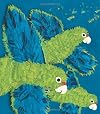
Parrots Over Puerto Rico, however, is an extraordinary exception. Using highly detailed collage art, and employing many textured and brightly colored materials, Susan L. Roth has created a book that accurately portrays the colors of the island and evokes the stunning beauty of the endangered parrots of Puerto Rico. Designed to be read "portrait style," the collages cover about 2/3 of each double-spread layout. Cindy Trumbore's narrative appears in a simple black font in the bottom third of show more the collage against a plain, complementary-colored background.
As stunning as it is, the artwork is not the only thing to love about Parrots over Puerto Rico. An astute teacher's dream, Parrots takes a holistic view of the parrots' rapid decline and slow slog back to viability in the wild. As the story of the American Bison is forever entwined with the story of American Westward expansion, the Puerto Rican's parrot story is entwined with that of the Tainos, the Spaniards, and the Americans, as well as that of invasive species, and natural disasters like Hurricane Hugo.
Existing for millions of years on the island of Puerto Rico, they once numbered in the hundreds of thousands, and by 1975, had dwindled to only 13.
"Above the treetops of Puerto Rico flies a flock or parrots as green as their island home. If you look up from the forest, and you are very lucky, you might catch the bright blue flashes of their flight feathers and hear their harsh call.
These are Puerto Rican parrots. They lived on this island for millions of years, and then they nearly vanished from the earth forever. This is their story."
An Afterword contains photographs and information on the Puerto Rican Parrot Recovery Program. Also included is a timeline of Important Dates in the History of Puerto Rico and Puerto Rican Parrots, and Author's Sources.
A video and more at http://shelf-employed.blogspot.com/2014/01/parrots-over-puerto-rico-review.html show less
As stunning as it is, the artwork is not the only thing to love about Parrots over Puerto Rico. An astute teacher's dream, Parrots takes a holistic view of the parrots' rapid decline and slow slog back to viability in the wild. As the story of the American Bison is forever entwined with the story of American Westward expansion, the Puerto Rican's parrot story is entwined with that of the Tainos, the Spaniards, and the Americans, as well as that of invasive species, and natural disasters like Hurricane Hugo.
Existing for millions of years on the island of Puerto Rico, they once numbered in the hundreds of thousands, and by 1975, had dwindled to only 13.
"Above the treetops of Puerto Rico flies a flock or parrots as green as their island home. If you look up from the forest, and you are very lucky, you might catch the bright blue flashes of their flight feathers and hear their harsh call.
These are Puerto Rican parrots. They lived on this island for millions of years, and then they nearly vanished from the earth forever. This is their story."
An Afterword contains photographs and information on the Puerto Rican Parrot Recovery Program. Also included is a timeline of Important Dates in the History of Puerto Rico and Puerto Rican Parrots, and Author's Sources.
A video and more at http://shelf-employed.blogspot.com/2014/01/parrots-over-puerto-rico-review.html show less
Lists
Youth: Zoology (1)
Awards


You May Also Like


Associated Authors
Statistics
- Works
- 37
- Also by
- 4
- Members
- 4,114
- Popularity
- #6,113
- Rating
- 4.0
- Reviews
- 211
- ISBNs
- 101
- Languages
- 2