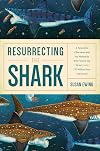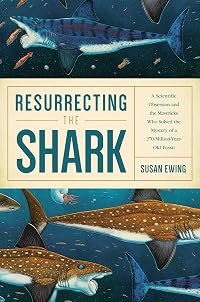
Resurrecting the Shark: A Scientific Obsession and the Mavericks Who Solved the Mystery of a 270-Million-Year-Old Fossil
by Susan Ewing
On This Page
Description
"In 1993 Alaskan artist and paleo-fish enthusiast, Ray Troll, stumbled upon the weirdest fossil he had ever seen in a museum-- a platter-sized spiral of tightly wound shark teeth, from the Helicoprion, a mysterious monster from deep time. In 2010 the undergraduate student, Jesse Pruitt, became seriously smitten with a Helicoprion fossil in a museum basement in Idaho. Together, they researched and were able, with others, to reanimate this awe-inspiring beast"--Tags
Recommendations





















Member Reviews
Where do buzz saws come from, daddy?
There’s nothing new under the sun, and all you have to do is observe evolution to see that. Nature has produced so many experiments and dead ends that 99.9% of species are extinct. Resurrecting the Shark is about a 300 million year old shark that thrived and died. We know it from its mouth, which housed a circular saw of ever larger teeth. The helicoprion was so specialized it probably did itself in, because it disappeared long before the great Permian Extinction. We know of it because its mouthful of teeth is uniquely spiral, making for absolutely stunning fossils, pictured in the book.
It turns out that sharks never stop growing; they grow until they die. So contrary to intuition, the smallest show more teeth on the helicoprion whorl are not the newest, but the oldest, and are in the front, not the back. (In modern sharks, the teeth work their way outwards and eventually fall out, with new ones constantly minted.) The whorl grew out from the back of the mouth, with the largest, sharpest teeth pushing the rest into its tight swirl. Even more bizarre is that all the teeth had one single root; they were actually crowns. And if that were not enough, it didn’t have any other teeth, just “pavement” teeth to grind against.
Ewing’s book is a delight of discovery. She profiles the players from the first discoveries in the 19th century, to the gathering point in Idaho (also not quite intuitive), where the most shark whorls have been found. The theories, the guesswork, and the deductions are all here, and you are there for the process and discoveries. Ewing’s style is to define terms right after their first use, which makes it easy to understand the technicalities and esoterica of paleontology.
It took a massive effort by team of extraordinarily knowledgeable and specialized scientists to pull this together, first individually, then at a marathon get-together. This mission impossible team had experts in mouth mechanics and even artists, making it a great machine to promulgate its findings. Their heart and soul producer was connected right back to the beginning of the discoveries. They figured out how the teeth fit in the body, how they processed prey and also avoided ripping the mouth apart or stabbing into the brain. Because sharks have cartilage instead of bone skeletons, we don’t have full bodies to examine, so there are still debates on gills and sex and what they preyed on. The current favorite is that it used the tooth whorl like a snail fork, extracting cephalopods from their shells. On 15-26 foot sharks, that’s a lot of feeding.
And finally, this being 2017, there will be an app for this, at google play, where you can make the color photos in the book come even more alive.
David Wineberg show less
There’s nothing new under the sun, and all you have to do is observe evolution to see that. Nature has produced so many experiments and dead ends that 99.9% of species are extinct. Resurrecting the Shark is about a 300 million year old shark that thrived and died. We know it from its mouth, which housed a circular saw of ever larger teeth. The helicoprion was so specialized it probably did itself in, because it disappeared long before the great Permian Extinction. We know of it because its mouthful of teeth is uniquely spiral, making for absolutely stunning fossils, pictured in the book.
It turns out that sharks never stop growing; they grow until they die. So contrary to intuition, the smallest show more teeth on the helicoprion whorl are not the newest, but the oldest, and are in the front, not the back. (In modern sharks, the teeth work their way outwards and eventually fall out, with new ones constantly minted.) The whorl grew out from the back of the mouth, with the largest, sharpest teeth pushing the rest into its tight swirl. Even more bizarre is that all the teeth had one single root; they were actually crowns. And if that were not enough, it didn’t have any other teeth, just “pavement” teeth to grind against.
Ewing’s book is a delight of discovery. She profiles the players from the first discoveries in the 19th century, to the gathering point in Idaho (also not quite intuitive), where the most shark whorls have been found. The theories, the guesswork, and the deductions are all here, and you are there for the process and discoveries. Ewing’s style is to define terms right after their first use, which makes it easy to understand the technicalities and esoterica of paleontology.
It took a massive effort by team of extraordinarily knowledgeable and specialized scientists to pull this together, first individually, then at a marathon get-together. This mission impossible team had experts in mouth mechanics and even artists, making it a great machine to promulgate its findings. Their heart and soul producer was connected right back to the beginning of the discoveries. They figured out how the teeth fit in the body, how they processed prey and also avoided ripping the mouth apart or stabbing into the brain. Because sharks have cartilage instead of bone skeletons, we don’t have full bodies to examine, so there are still debates on gills and sex and what they preyed on. The current favorite is that it used the tooth whorl like a snail fork, extracting cephalopods from their shells. On 15-26 foot sharks, that’s a lot of feeding.
And finally, this being 2017, there will be an app for this, at google play, where you can make the color photos in the book come even more alive.
David Wineberg show less
Helicoprion was an unusual looking Paleozoic shark-type creature, with a circular saw of teeth centered in its lower jaw—a feature unseen in the shark world before or since. For about ten million years this creature swam the shallow seas around the supercontinent Pangaea as the apex predator of its time. Susan Ewing describes the journey of discovery of this fascinating creature, from the first fossil finds to the revolutionary insights into the appearance and eating habits of Helicoprion and how the tooth whorl functioned.
This book was interesting, however all the scientific findings and information relating to Helicoprion was overwhelmed with excessive biographical detail of everybody (and their acquaintances) that had even vague show more connections with with the Helicoprion fossils. In addition, the narrative was somewhat disjointed with explanatory sections being inserted into the biography sections. The first half of the book was slow, with the story of Helicoprion picking up in the second half. This is where most of the science, fossil analysis and results are discussed, with the description of the scientists' mystery solving escapades positively enlivening.
The book includes many pretty colour illustrations, however these are all dumped at the end of the book with no reference to their relevant place in the text and no indication in the text that there is a useful diagram that fits in that spot. I don't know if this is applicable to the e-book only or also to the hardcover edition. References are supplied in the end notes in that horrible format so common these days.
In short: too much biography, too little science.
NOTE: The book states that there are four augmented reality models, viewable with the "Resurrecting the Shark" app, available on Google Play. However, this app is apparently not compatible with any of the android tablets/phones that various family members possess, at least one of which is brand new. show less
This book was interesting, however all the scientific findings and information relating to Helicoprion was overwhelmed with excessive biographical detail of everybody (and their acquaintances) that had even vague show more connections with with the Helicoprion fossils. In addition, the narrative was somewhat disjointed with explanatory sections being inserted into the biography sections. The first half of the book was slow, with the story of Helicoprion picking up in the second half. This is where most of the science, fossil analysis and results are discussed, with the description of the scientists' mystery solving escapades positively enlivening.
The book includes many pretty colour illustrations, however these are all dumped at the end of the book with no reference to their relevant place in the text and no indication in the text that there is a useful diagram that fits in that spot. I don't know if this is applicable to the e-book only or also to the hardcover edition. References are supplied in the end notes in that horrible format so common these days.
In short: too much biography, too little science.
NOTE: The book states that there are four augmented reality models, viewable with the "Resurrecting the Shark" app, available on Google Play. However, this app is apparently not compatible with any of the android tablets/phones that various family members possess, at least one of which is brand new. show less
A marvelously informative book with surprising humor about a highly specialized and esoteric subject- I enjoyed it immensely.
Ratings
Members
- Recently Added By
Lists

Science: Zoology
107 works; 1 member
Author Information
9+ Works 272 Members
Classifications
Statistics
- Members
- 49
- Popularity
- 614,881
- Reviews
- 3
- Rating
- (4.25)
- Languages
- English
- Media
- Paper, Ebook
- ISBNs
- 3
- ASINs
- 1