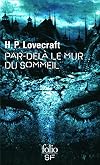
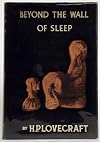
Beyond the Wall of Sleep [collection]
by H. P. Lovecraft
On This Page
Description
Beyond the Wall of Sleep" is a short story by American writer H. P. Lovecraft written in 1919 and first published in the amateur publication Pine Cones in October 1919. Inspiration Lovecraft said the story was inspired by an April 27, 1919 article in the New York Tribune. Reporting on the New York state police, the article cited a family named Slater or Slahter as representative of the backwards Catskills population. The nova mentioned at the end of Lovecraft's story is a real star, known as show more GK Persei; the quotation is from Garrett P. Serviss' Astronomy with the Naked Eye (1908). The title of the story may have been influenced by Ambrose Bierce's "Beyond the Wall"; Lovecraft was known to be reading Bierce in 1919. Jack London's 1906 novel Before Adam, which concerns the concept of hereditary memory, contains the passage, "Nor...did any of my human kind ever break through the wall of my sleep. show lessTags
Recommendations













Member Reviews
Author of the horrific, the Gothic and the fantastic, a man who lived his short life as a recluse in his hometown of Providence, Rhode Island until his premature death at age 47, Beyond the Wall of Sleep is H. P. Lovecraft’s (1890-1939) classic tale of a reality less visible than our everyday earthbound material existence.
A quote from the opening paragraph: “We may guess that in dreams life, matter, and vitality, as the earth knows such things, are not necessarily constant; and that time and space do not exist as our waking selves comprehend them. Sometimes I believe that this less material life is our truer life, and that our vain presence on the terraqueous globe is itself the secondary or merely virtual phenomenon.”
With this show more statement from our narrator, a young intern working at a mental hospital in the state of New York during the winter of 1900, we hear echoes of the shamanic worldview of many indigenous tribespeople and, more specifically, the dreamtime of the Australian Aborigines, that is, how the world of dreams is more enduring, more intense, more meaningful and, in terms of our vital spiritual life, more real than the ordinary world perceived by our senses.
However, this general philosophic reflection only sets the stage for the tale’s unfolding; specifically, how a 40-year old mountaineer from the rustic, wild Catskill Mountains by the name of Joe Slater is brought to the mental hospital after he brutally murdered a neighbor in a fit of insane rage.
Then, once at the hospital, Joe has his first episode of supercharged frenzy requiring four orderlies and a straitjacket. The narrator relates, “Slater raved for up to fifteen minutes, babbling in his backwoods dialect of great edifices of light, oceans of space, strange music and shadowy mountains and valleys. But most of all did he dwell upon some mysterious blazing entity that shook and laughed and mocked him.” Since Joe Slater could neither read nor write, nor was he ever acquainted with legends or fairy tales, the doctors remained baffled as to the basis or root cause of Joe’s visions, concluding the source to be nothing more definite than “abnormal dreams.”
Let’s pause here and explore an alternate explanation developed by psychiatrist Carl Jung. As a young doctor, Jung came in contact with a patient in a mental institution whose lack of education was similar to Joe Slater, a patient who suffered from paranoid-schizophrenia and reported seeing the sun’s dangling phallus whose motion caused wind to blow on earth.
As it turns out, this exact ‘phallus dangling from the sun’ imagery is part of the ancient Mithraic religion practiced by many Roman soldiers and having roots going back to very ancient Egypt. Jung concluded such a strikingly similar vision reported by his patient and incorporated into the ancient religion of Mithras arise from a common deep-seated psychic source we all share as humans, a source Jung termed the collective unconscious.
Within the collective unconscious there are certain primal images or motifs, for example, the image of the dangling phallus, and such primal images Jung termed archetypes. And each of these archetypal primal images have their shadow side, a shadow side that can be negative, destructive, and very, very threatening. Thus, employing this Jungian interpretation, the mysterious blazing entity that shook, laughed, and mocked Joe Slater, could be viewed as the shadow of a primal archetype from the collective unconscious.
Returning to the tale, the narrator goes on to relate how Joe Slater is not only a passive recipient of dream images, including the recurring image of some hideous, tormenting being, but when entering the dream world Joe becomes an active participant with an altered identity, that is, amazing as it might seem, Joe becomes himself a being of light. We read: “This thing had done Slater some hideous but unnamed wrong, which the maniac (if maniac he were) yearned to avenge. From the manner in which Slater alluded to their dealings, I judged that he and the luminous thing had met on equal terms; that in his dream existence the man was himself a luminous thing of the same race as his enemy. This impression was sustained by his frequent references to flying through space and burning all that impeded his progress.”
If this weird Lovecraft twist isn’t enough, the tale offers us much more: the narrator’s curiosity prompts him to ask himself if the light being inhabiting Joe Slater is perhaps attempting to directly communicate with him, the sensitive, perceptive, open-minded intern. Such curiosity prompts the narrator to unpack a long forgotten instrument he built back in his college days, a transmitting apparatus somewhat akin to a crude radio where he could, unbeknownst to the doctors or the authorities of his mental hospital, hook up to both Joe Slater’s head and his own head in order to possibly receive transmissions or some mysterious communications from the realm of light.
Of course, since the narrator will be conducting his experiments entirely in secret, he is very well aware he is crossing the line, that his hooking up his transmitting contraption to a mental patient’s head is highly unethical. But his curiosity is simply too strong for him to resist. One wonders if H .P. Lovecraft was making a statement about the moral and ethical integrity of people working with patients in mental hospitals, since, after all, when the author was three years old his own father entered a mental institution where he remained until his death five years later.
Anyway, the experiments are carried out. And the findings? I wouldn’t want to spoil by saying anything more specific, but I will note how the weirdness of this tale isn’t only ratcheted up one notch but, from this point forward we as readers are provided a triple dose of weirdness, that’s right, three more unexpected twists and bizarre turns in the unfolding of the tale’s mysterious and astonishing happening to keep any fan of fantastic Gothic horror in suspense right up until the last sentence.
Coda: I can personally relate to this Lovecraft tale since years ago I myself had a powerful dream were I encountered a luminous being. Fortunately, unlike Joe Slater, my luminous being was blazing with the energy of enlightenment and compassion. Thank goodness!
This tale is available on-line:
http://www.hplovecraft.com/writings/texts/fiction/bws.aspx show less
“White trash”, “a Catskill degenerate”, “a backwoods dullard”
How could his dreams reflect a “spark of genius” or be “things only a superior or even exceptional brain could conceive”?
An interne at a state psychopathic institution decides to find out, and he gets more than he expects! A strange story, as only H.P. can tell!
P.S. - “The Three Strangers” by Thomas Hardy is included ‘as a bonus gift’. I think it’s longer than the title story! Smh. But it's good, and if he read this, I can see where Quentin Tarantino may have lifted some ideas for "The Hateful Eight". I guess even the christening of a country shepherd's daughter can be wrought with mischief!
How could his dreams reflect a “spark of genius” or be “things only a superior or even exceptional brain could conceive”?
An interne at a state psychopathic institution decides to find out, and he gets more than he expects! A strange story, as only H.P. can tell!
P.S. - “The Three Strangers” by Thomas Hardy is included ‘as a bonus gift’. I think it’s longer than the title story! Smh. But it's good, and if he read this, I can see where Quentin Tarantino may have lifted some ideas for "The Hateful Eight". I guess even the christening of a country shepherd's daughter can be wrought with mischief!
Author of the horrific, the Gothic and the fantastic, a man who lived his short life as a recluse in his hometown of Providence, Rhode Island until his premature death at age 47, “Beyond the Wall of Sleep” is H. P. Lovecraft’s (1890-1939) classic tale of a reality less visible than our everyday earthbound material existence. A quote from the opening paragraph: “We may guess that in dreams life, matter, and vitality, as the earth knows such things, are not necessarily constant; and that time and space do not exist as our waking selves comprehend them. Sometimes I believe that this less material life is our truer life, and that our vain presence on the terraqueous globe is itself the secondary or merely virtual phenomenon.” With show more this statement from our narrator, a young intern working at a mental hospital in the state of New York during the winter of 1900, we hear echoes of the shamanic worldview of many indigenous tribespeople and, more specifically, the dreamtime of the Australian Aborigines, that is, how the world of dreams is more enduring, more intense, more meaningful and, in terms of our vital spiritual life, more real than the ordinary world perceived by our senses.
However, this general philosophic reflection only sets the stage for the tale’s unfolding; specifically, how a 40-year old mountaineer from the rustic, wild Catskill Mountains by the name of Joe Slater is brought to the mental hospital after he brutally murdered a neighbor in a fit of insane rage. Then, once at the hospital, Joe has his first episode of supercharged frenzy requiring four orderlies and a straitjacket. The narrator relates, “Slater raved for up to fifteen minutes, babbling in his backwoods dialect of great edifices of light, oceans of space, strange music and shadowy mountains and valleys. But most of all did he dwell upon some mysterious blazing entity that shook and laughed and mocked him.” Since Joe Slater could neither read nor write, nor was he ever acquainted with legends or fairy tales, the doctors remained baffled as to the basis or root cause of Joe’s visions, concluding the source to be nothing more definite than “abnormal dreams.”
Let’s pause here and explore an alternate explanation developed by psychiatrist Carl Jung. As a young doctor, Jung came in contact with a patient in a mental institution whose lack of education was similar to Joe Slater, a patient who suffered from paranoid-schizophrenia and reported seeing the sun’s dangling phallus whose motion caused wind to blow on earth. As it turns out, this exact ‘phallus dangling from the sun’ imagery is part of the ancient Mithraic religion practiced by many Roman soldiers and having roots going back to very ancient Egypt. Jung concluded such a strikingly similar vision reported by his patient and incorporated into the ancient religion of Mithras arise from a common deep-seated psychic source we all share as humans, a source Jung termed the collective unconscious.
Within the collective unconscious there are certain primal images or motifs, for example, the image of the dangling phallus, and such primal images Jung termed archetypes. And each of these archetypal primal images have their shadow side, a shadow side that can be negative, destructive, and very, very threatening. Thus, employing this Jungian interpretation, the mysterious blazing entity that shook, laughed, and mocked Joe Slater, could be viewed as the shadow of a primal archetype from the collective unconscious.
Returning to the tale, the narrator goes on to relate how Joe Slater is not only a passive recipient of dream images, including the recurring image of some hideous, tormenting being, but when entering the dream world Joe becomes an active participant with an altered identity, that is, amazing as it might seem, Joe becomes himself a being of light. We read: “This thing had done Slater some hideous but unnamed wrong, which the maniac (if maniac he were) yearned to avenge. From the manner in which Slater alluded to their dealings, I judged that he and the luminous thing had met on equal terms; that in his dream existence the man was himself a luminous thing of the same race as his enemy. This impression was sustained by his frequent references to flying through space and burning all that impeded his progress.”
If this weird Lovecraft twist isn’t enough, the tale offers us much more: the narrator’s curiosity prompts him to ask himself if the light being inhabiting Joe Slater is perhaps attempting to directly communicate with him, the sensitive, perceptive, open-minded intern. Such curiosity prompts the narrator to unpack a long forgotten instrument he built back in his college days, a transmitting apparatus somewhat akin to a crude radio where he could, unbeknownst to the doctors or the authorities of his mental hospital, hook up to both Joe Slater’s head and his own head in order to possibly receive transmissions or some mysterious communications from the realm of light.
Of course, since the narrator will be conducting his experiments entirely in secret, he is very well aware he is crossing the line, that his hooking up his transmitting contraption to a mental patient’s head is highly unethical. But his curiosity is simply too strong for him to resist. One wonders if H .P. Lovecraft was making a statement about the moral and ethical integrity of people working with patients in mental hospitals, since, after all, when the author was three years old his own father entered a mental institution where he remained until his death five years later.
Anyway, the experiments are carried out. And the findings? I wouldn’t want to spoil by saying anything more specific, but I will note how the weirdness of this tale isn’t only ratcheted up one notch but, from this point forward we as readers are provided a triple dose of weirdness, that’s right, three more unexpected twists and bizarre turns in the unfolding of the tale’s mysterious and astonishing happening to keep any fan of fantastic Gothic horror in suspense right up until the last sentence.
Coda: I can personally relate to this Lovecraft tale since years ago I myself had a powerful dream were I encountered a luminous being. Fortunately, unlike Joe Slater, my luminous being was blazing with the energy of enlightenment and compassion. Thank goodness!
This tale is available on-line:
http://www.hplovecraft.com/writings/texts/fiction/bws.aspx show less
I really enjoyed this as a concept. I thought the cosmic entity itself could have been more interesting but looking at the story more abstractly, it was pretty good.
Interesante relato de H. P. Lovecraft sobre los sueños, sus misterios y la realidad, pero algo racista. Lo recomiendo si les late este autor.
Let it be known that Lovecraft hates white trash hillbillies just as much as any other lesser race. (The man is an elitist jackass; there is no way around that.) I can't quite discern if this tale of telepathic dreaming is the first appearance of Old Gods, or if the dream beings are something else entirely.
(Moved 2015 review to the individual work Sept. 2017 to make room to review the collection under its own entry.)
(Moved 2015 review to the individual work Sept. 2017 to make room to review the collection under its own entry.)
Livre vraiment malsain
Members
- Recently Added By
Lists

Literature which inspired Pop songs
85 works; 9 members

Les 100 principaux titres de la science-fiction (1981)
126 works; 3 members
Author Information

1,905+ Works 73,536 Members
Howard Phillips Lovecraft, 1890 - 1937 H. P. Lovecraft was born on August 20, 1890 in Providence, Rhode Island. His mother was Sarah Susan Phillips Lovecraft and his father was Winfield Scott Lovecraft, a traveling salesman for Gorham & Co. Silversmtihs. Lovecraft was reciting poetry at the age of two and when he was three years old, his father show more suffered a mental breakdown and was admitted to Butler Hospital. He spent five years there before dying on July 19, 1898 of paresis, a form of neurosyphillis. During those five years, Lovecraft was told that his father was paralyzed and in a coma, which was not the case. His mother, two aunts and grandfather were now bringing up Lovecraft. He suffered from frequent illnesses as a boy, many of which were psychological. He began writing between the ages of six and seven and, at about the age of eight, he discovered science. He began to produce the hectographed journals, "The Scientific Gazette" (1899-1907) and "The Rhode Island Journal of Astronomy" (1903-07). His first appearance in print happened, in 1906, when he wrote a letter on an astronomical matter to The Providence Sunday Journal. A short time later, he began writing a monthly astronomy column for The Pawtuxet Valley Gleaner - a rural paper. He also wrote columns for The Providence Tribune (1906-08), The Providence Evening News (1914-18), The Asheville (N.C.) Gazette-News (1915). In 1904, his grandfather died and the family suffered severe financial difficulties, which forced him and his mother to move out of their Victorian home. Devastated by this, he apparently contemplated suicide. In 1908, before graduating from high school, he suffered a nervous breakdown. He didn't receive a diploma and failed to get into Brown University, both of which caused him great shame. Lovecraft was not heard from for five years, re-emerging because of a letter he wrote in protest to Fred Jackson's love story in The Argosy. His letter was published in 1913 and caused great controversy, which was noted by Edward F. Daas, President of the United Amateur Press Association (UAPA). Daas invited Lovecraft to join the UAPA, which he did in early 1914. He eventually became President and Official Editor of the UAPA and served briefly as President of the rival National Amateur Press Association (NAPA). He published thirteen issues of his own paper, The Conservative (1915-23) and contributed poetry and essays to other journals. He also wrote some fiction which titles include "The Beast in the Cave" (1905), "The Alchemist" (1908), "The Tomb" and "Dagon" (1917). In 1919, Lovecraft's mother was deteriorating, mentally and physically, and was admitted to Butler Hospital. On May 24, 1921, his mother died from a gall bladder operation. While attending an amateur journalism convention in Boston, Lovecraft met his future wife Sonia Haft Greene, a Russian Jew. They were married on March 3, 1924 and Lovecraft moved to her apartment in Brooklyn. Sonia had a shop on Fifth Avenue that went bankrupt. In 1925, Sonia went to Cleveland for a job and Lovecraft moved to a smaller apartment in the Red Hook district of Brooklyn. In 1926, he decided to move back to Providence. Lovecraft had his aunts bar his wife, Sonia, from going to Providence to start a business because he couldn't have the stigma of a tradeswoman wife. They were divorced in 1929. After his return to Providence, he wrote his greatest fiction, which included the titles "The Call of Cthulhu" (1926), "At the Mountains of Madness" (1931), and "The Shadow Out of Time" (1934-35). In 1932, his aunt, Mrs. Clark, died; and he moved in with his other aunt, Mrs. Gamwell, in 1933. Suffering from cancer of the intestine, Lovecraft was admitted to Jane Brown Memorial Hospital and on March 15, 1937 he died. (Bowker Author Biography) show less
Series
Belongs to Publisher Series
Présence du futur (16)
Gallimard, Folio SF (107)
Work Relationships
Is contained in
Common Knowledge
- Canonical title
- Beyond the Wall of Sleep [collection]
- Original title
- Beyond the wall of sleep
- Original publication date
- 1941
- First words*
- Je me suis souvent demandé si la majorité du genre humain prend jamais le temps de réfléchir à la signification, formidable parfois, des rêves et du monde obscur auquel ils appartiennent.
- Last words*
- (Click to show. Warning: May contain spoilers.)Tel son portrait maudit un an auparavant, Joseph Curwen n'était plus maintenant qu'une mince couche de fine poussière gris bleuâtre, éparpillée sur le sol.
- Original language*
- Anglais
*Some information comes from Common Knowledge in other languages. Click "Edit" for more information.
Classifications
Statistics
- Members
- 168
- Popularity
- 193,909
- Reviews
- 11
- Rating
- (3.75)
- Languages
- English, French, Hungarian, Turkish
- Media
- Paper, Ebook
- ISBNs
- 21
- ASINs
- 10