On This Page
Description
Helva had been born human, but only her brain had been saved and implanted into the titanium body of an intergalactic scout ship. But first she had to choose a human partner--male or female--to share her exhilarating escapades in space. Her life was to be rich and rewarding, resplendent with daring adventures and endless excitement, beyond the wildest dreams of mere mortals. Gifted with the voice of an angel and being virtually indestructible, Helva XH-834 anticipated a sublime immortality. show more Then one day she fell in love! show lessTags
Recommendations

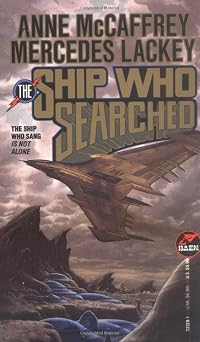








Member Recommendations
Member Reviews
3.5 stars. I was pleasantly gripped by the unique premise and dramatic plots in this episodic story. The only unfortunate bit of this book is how poorly it has aged with its language around the disabled humans who become brainships and the relationship Helva has with men. It's clearly a product of its generation of the free-love 60s and today serves as a good lesson in how far the underlying mindsets of the feminist movement have advanced. It's also hard to miss the differences in the style of the popular genre, which relies on a lot more dialogue than you see nowadays in best-selling sci-fi. I've only ever tried to read Pern by McCaffrey, and it didn't do it for me. Had no idea she wrote sci-fi as well and was very surprised by how show more much I enjoyed this. It's so good, I feel it deserves to be rewritten/retold with an updated take on Helva in which she isn't primarily obsessed with finding the right dude to ride inside her. This would make a great miniseries. show less
Alright dig this, in the far future the parents of malformed children are given a choice, put the baby down or let the government train it to be basically a brain inside a machine. A situation Marty McFly would probably describe as heavy. So here enters our protagonist, Helva, a “Shell Person” that gets to control a spaceship and explore the cosmos with a human companion of her choosing.
With our hero established, we follow Helva through various short stories as she completes missions for HQ, meets new species, and sings all the while. Helva is definitely a star with a very distinct personality that comes alive on the page. Our hero is certainly progressive for the time as both a woman and a disabled person and the book shows that show more though the lives of the disabled are different they are no less human. She has her own needs and goals that fit with her situation and she’s great fun to follow.
Without spoiling any of the short stories therein, the first bunch are all about grief; how to comfort others, how everyone gains catharses in different ways, and what happens when grief takes over your life. It’s not Tolstoy but it adds some depth to otherwise routine sci fi adventures.
In the latter half we meet some truly bizarre aliens and get a closer look at the shell-companion relationship. Overall the world is built well and the stories contain a few sci fi twists and turns.
Admittedly the book never truly grabbed me deeply, but it’s an entertaining adventure with some deeper themes. Definitely a good read for fans of old school science fiction or anyone who finds the human ship concept interesting. show less
With our hero established, we follow Helva through various short stories as she completes missions for HQ, meets new species, and sings all the while. Helva is definitely a star with a very distinct personality that comes alive on the page. Our hero is certainly progressive for the time as both a woman and a disabled person and the book shows that show more though the lives of the disabled are different they are no less human. She has her own needs and goals that fit with her situation and she’s great fun to follow.
Without spoiling any of the short stories therein, the first bunch are all about grief; how to comfort others, how everyone gains catharses in different ways, and what happens when grief takes over your life. It’s not Tolstoy but it adds some depth to otherwise routine sci fi adventures.
In the latter half we meet some truly bizarre aliens and get a closer look at the shell-companion relationship. Overall the world is built well and the stories contain a few sci fi twists and turns.
Admittedly the book never truly grabbed me deeply, but it’s an entertaining adventure with some deeper themes. Definitely a good read for fans of old school science fiction or anyone who finds the human ship concept interesting. show less
Worth reading in that the influence on subsequent works by many authors is clear. But be prepared for clanging, off key, obsolete cultural artifacts and references which in some ways make it feel more alien, almost exotic than it may have felt a half century ago, even if it was a newer set of ideas then. Lots of misogyny and obsolete notions of male and female roles. There is also at a glancing but surprisingly electric sexuality which for me really is the best part of the work, even if at times it can be dated and problematic as well. I appreciate that this ship’s sexuality is not lost, in spite of the way her intellect and personality are instantiated. There are some tired and two dimensional but some genuinely novel aliens, too. show more This isn’t anywhere near the level of Le Guin’s work of the same era, nor has it aged as gracefully , but it’s a worthy read with a kind of Star Trek Original Series plastic furniture / Spock singing folk songs charm. show less
3 and 1/2 stars. This has been on my to read list for a few decades. I probably should have read it back in the '80s when the 1960s scifi/fantasy misogyny wouldn't have bothered me so much.
The book is a series of vignettes. Some are better than others. Some are a little hard to follow because of the dated writing style. It's an interesting concept that doesn't really get into the moral decision of how Helva came to be wired into the mainframe of a ship and encased in a titanium tube. I liked the world-building in the first vignette. I found the story involving the actors extremely hard to follow - this section really dragged for me.
Happy to check this one off of my to-read list. Enjoyed it... I was entertained, but I won't continue show more with the series. show less
The book is a series of vignettes. Some are better than others. Some are a little hard to follow because of the dated writing style. It's an interesting concept that doesn't really get into the moral decision of how Helva came to be wired into the mainframe of a ship and encased in a titanium tube. I liked the world-building in the first vignette. I found the story involving the actors extremely hard to follow - this section really dragged for me.
Happy to check this one off of my to-read list. Enjoyed it... I was entertained, but I won't continue show more with the series. show less
I was surprised by how much I enjoyed this. I've read the first short story/ chapter a few times, and it always moved me but didn't make me feel the need to read further. But now I found a group discussing it... you can find that discussion in The Lady Vaults, Oct. 2019
Anyway, to address just three complaints of negative reviewers:
The plot is 'fragmented' because it's stitched-together short stories. Think of it as episodic and it's fine.
The love story at the end is *not* just about lust. Yes, it's about what it means to be fully human, but it's about love, and comparisons are made to love of beauty, of knowledge, of ideals.
Helva wants a companion, it's true. Yes, she tends to think of men as the most likely to be compatible. But it's show more made that her 'brawn' could be female, and that not all brainships like being close friends to their brawns, and that people are individuals, whether they are brain or brawn or citizen or service member or alien....
I really liked the over-arching theme of the value of the Arts in the future in which technology seems to rule. The Dylanist and the Shakespearean Troupe are important 'episodes' (not inserted randomly, as a fourth negative reviewer complains) that express McCaffrey's view that the Arts are part of what keeps us all human.
I have no idea why some ppl have trouble with the portrayal of disability. But I have seen that complaint only among ppl who did not finish the book, and I do admit that the first few pages are a bit hard to stomach as McCaffrey shows us what the world she's building does with infants with birth defects. Consider, though, that these stories were almost certainly written as a response to the thalidomide tragedy, and that at the time the first was written McCaffrey did not know that a new drug was to blame and likely feared a wider & more persistent problem. In any case, Helva's character and the others' interactions with her do get more nuanced as the story goes along. show less
Anyway, to address just three complaints of negative reviewers:
The plot is 'fragmented' because it's stitched-together short stories. Think of it as episodic and it's fine.
The love story at the end is *not* just about lust. Yes, it's about what it means to be fully human, but it's about love, and comparisons are made to love of beauty, of knowledge, of ideals.
Helva wants a companion, it's true. Yes, she tends to think of men as the most likely to be compatible. But it's show more made that her 'brawn' could be female, and that not all brainships like being close friends to their brawns, and that people are individuals, whether they are brain or brawn or citizen or service member or alien....
I really liked the over-arching theme of the value of the Arts in the future in which technology seems to rule. The Dylanist and the Shakespearean Troupe are important 'episodes' (not inserted randomly, as a fourth negative reviewer complains) that express McCaffrey's view that the Arts are part of what keeps us all human.
I have no idea why some ppl have trouble with the portrayal of disability. But I have seen that complaint only among ppl who did not finish the book, and I do admit that the first few pages are a bit hard to stomach as McCaffrey shows us what the world she's building does with infants with birth defects. Consider, though, that these stories were almost certainly written as a response to the thalidomide tragedy, and that at the time the first was written McCaffrey did not know that a new drug was to blame and likely feared a wider & more persistent problem. In any case, Helva's character and the others' interactions with her do get more nuanced as the story goes along. show less
3.5 stars. I was pleasantly gripped by the unique premise and dramatic plots in this episodic story. The only unfortunate bit of this book is how poorly it has aged with its language around the disabled humans who become brainships and the relationship Helva has with men. It's clearly a product of its generation of the free-love 60s and today serves as a good lesson in how far the underlying mindsets of the feminist movement have advanced. It's also hard to miss the differences in the style of the popular genre, which relies on a lot more dialogue than you see nowadays in best-selling sci-fi. I've only ever tried to read Pern by McCaffrey, and it didn't do it for me. Had no idea she wrote sci-fi as well and was very surprised by how show more much I enjoyed this. It's so good, I feel it deserves to be rewritten/retold with an updated take on Helva in which she isn't primarily obsessed with finding the right dude to ride inside her. This would make a great miniseries. show less
This was such typical Anne McCaffrey, that it made me smile. The ship who sang is about a BB ship, or a brain-brawn ship. Helva is severly misformed when she's born. Therefore, her growth is inhibited and placed in a so-called shell, sort of a machine that she can control with her mind. Eventually, her brain is connected to a spaceship. She carries out missions together with her human partner, the brawn.
The setup of this book is slightly strange: it consists of 6 chapters that feel like short stories, although they are not self-reliant enough to actually be short stories. Each story is mostly about Helva's relationship with her brawn (when she has one) or other people aboard, against the background of strange and fantastical worlds.
I show more rather like McCaffrey's writing stile, and although the stories are not brilliant, they are entertaining. Perhaps most importantly, Helva is a dear. I'm definitely going to search for the nect installments... show less
The setup of this book is slightly strange: it consists of 6 chapters that feel like short stories, although they are not self-reliant enough to actually be short stories. Each story is mostly about Helva's relationship with her brawn (when she has one) or other people aboard, against the background of strange and fantastical worlds.
I show more rather like McCaffrey's writing stile, and although the stories are not brilliant, they are entertaining. Perhaps most importantly, Helva is a dear. I'm definitely going to search for the nect installments... show less
Members
- Recently Added By
Lists

Favorite Science Fiction by Women Authors
737 works; 196 members

Best reading order of Anne McCaffrey's non-Pern sci-fi
43 works; 2 members

Jean's 12in12 SciFi List
5 works; 1 member

Space Colonization
100 works; 26 members

Favorite Childhood Books
1,646 works; 518 members

Female Protagonist
1,056 works; 57 members

Sentient ships
20 works; 3 members

Books Read in 2020
4,379 works; 123 members

Books That Made Us Cry
278 works; 145 members

Favorite Science Fiction
456 works; 218 members
Author Information

260+ Works 208,128 Members
Anne McCaffrey was born in Cambridge, Massachusetts on April 1, 1926. She received a degree in Slavonic languages from Radcliffe College. She worked in advertising for Helena Rubenstein from 1947 to 1952. Her first publication was a short story in Science Fiction Magazine, and her first novel, Restoree, was published in 1967. She is a well-known show more author of over 100 books, mostly science fiction, including the Dragonriders of Pern series, the Crystal Singer series, Acorna's Children series, The Twins of Petaybee series, and Barque Cats series. She won numerous awards including the Hugo Award for Best Novella for the short story Weyr Search in 1968 and the Nebula Award for Best Novella for Dragonrider in 1969. In 2006, she was inducted into the Science Fiction Hall of Fame. She has also written books under the pseudonym Jody Lynn. She died of a stroke on November 21, 2011 at the age of 85. (Bowker Author Biography) show less
Some Editions
Series


Belongs to Publisher Series
Work Relationships
Is contained in
Contains
Is expanded in
Was inspired by
Common Knowledge
- Canonical title
- The Ship Who Sang
- Original title
- The Ship Who Sang
- Original publication date
- 1969
- People/Characters
- Helva; Jennan; Niall Parollan
- Dedication
- To the memory of the Colonel, my father
GEORGE HERBERT MCCAFFREY
citizen, soldier, patriot
for whom the ship first sang - First words
- She was born a thing and as such would be condemned if she failed to pass the encephalograph test required of all newborn babies.
- Last words
- (Click to show. Warning: May contain spoilers.)He might as well have been singing.
- Original language
- English
Classifications
Statistics
- Members
- 3,596
- Popularity
- 4,535
- Reviews
- 41
- Rating
- (3.80)
- Languages
- 5 — Dutch, English, French, German, Polish
- Media
- Paper, Audiobook, Ebook
- ISBNs
- 23
- ASINs
- 27