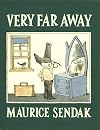
Very Far Away
by Maurice Sendak
On This Page
Description
Martin goes off to find someplace "very far away" and runs into a horse, a bird, and a cat who are all looking for their "ideal spot."Tags
Recommendations







Member Reviews
Very Far Away, first published in 1957, was the second book which Maurice Sendak both wrote and illustrated. It is the story of Martin, a little boy who decides to go very far away.
The book begins with Martin asking his mother a question, but she is too distracted with her new baby to hear him. So, he decides to go very far away. He packs a bag, and before long he runs into a horse and a sparrow. They too are longing for a place that is very far away. Then a cat enters the scene, and it turns out he knows of a place that is very far away. So they go to very far away, which turns out to be a small room with a table and two chairs. For awhile Martin and each of the animals get exactly what they want from very far away. Martin has someone show more to answer his questions, the sparrow is taken back to his previous life of civility and refinement, the horse is allowed to dream, and the cat can sing without complaint. But before long the four tire of each other and leave. Martin decides to go home, where maybe his mother is done washing the baby. If she isn't, he decides, he can simply sit on the step and count cars.
I have read almost all of Maurice Sendak's books, but this is my current favourite. It doesn't have the surreal weirdness of some of his more popular later books, like Where the Wild Things Are and In the Night Kitchen, but it is beautiful and poignant in its simplicity. Like many of Sendak's books you could take any single page on its own and admire it for its poetry and artwork. It also has a simple, but important message, which is simply that life offers no simple fixes. Every single day our lives are less than perfect and often it seems like running away is the best option. But very far away doesn't really exist for anyone. What seems like perfection is probably just a pretentious sparrow, an obnoxious cat, and a spacey horse. All anyone can really do is watch the cars go by and try to make the best of what they've got. show less
The book begins with Martin asking his mother a question, but she is too distracted with her new baby to hear him. So, he decides to go very far away. He packs a bag, and before long he runs into a horse and a sparrow. They too are longing for a place that is very far away. Then a cat enters the scene, and it turns out he knows of a place that is very far away. So they go to very far away, which turns out to be a small room with a table and two chairs. For awhile Martin and each of the animals get exactly what they want from very far away. Martin has someone show more to answer his questions, the sparrow is taken back to his previous life of civility and refinement, the horse is allowed to dream, and the cat can sing without complaint. But before long the four tire of each other and leave. Martin decides to go home, where maybe his mother is done washing the baby. If she isn't, he decides, he can simply sit on the step and count cars.
I have read almost all of Maurice Sendak's books, but this is my current favourite. It doesn't have the surreal weirdness of some of his more popular later books, like Where the Wild Things Are and In the Night Kitchen, but it is beautiful and poignant in its simplicity. Like many of Sendak's books you could take any single page on its own and admire it for its poetry and artwork. It also has a simple, but important message, which is simply that life offers no simple fixes. Every single day our lives are less than perfect and often it seems like running away is the best option. But very far away doesn't really exist for anyone. What seems like perfection is probably just a pretentious sparrow, an obnoxious cat, and a spacey horse. All anyone can really do is watch the cars go by and try to make the best of what they've got. show less
In my opinion this was a great book for young readers due to the illustrations that strengthen the development of the characters. Maurice Sendak's illustrations successfully depict the emotion of the characters. The characters travel through a wide range of emotions such as curiosity, longing, sorrow, frustration and worry. Such a wide range of emotions is expressed through the writing, and then strengthened by the illustrations. I also believe that young readers would really enjoy this book for being separated into 2 different "books," making young readers believe they are reading more advanced literature than they are, providing them with more reading confidence. The main message I got from this story is that running away from your show more problems is not the best solution. Martin did not get very much attention at home due to the new baby in the house, so his initial answer was to run away. The horse, sparrow, and cat he meets along the way have different issues they also believe will be solved if they run away as well. This solution does not work for any of them, and instead, they resort back to their old lives and solve their problems face-on. show less
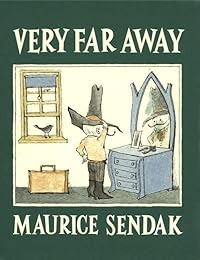
In this two-part picture book, Maurice Sendak, paints an original story about a little boy named Martin who decides to go "Very Far Away", where somebody will answer his questions because his mother is too busy washing the baby to listen to him. Then, in one of my favorite illustrations in the book, Martin packs his bags and dons a cowboy suit and a fake mustache - "so no one would recognize him" - and he went looking for very far away.
During his journey Martin meets a horse, a cat, and finally a bird, that join him on his quest to find very far away. They finally find "very far away", and that concludes the first half of the book. In the second half, Martin asks his new-found friends his questions, and they each indulge in their show more desires, and "they lived together very happily, for an hour and a half". The rest of the story concludes Martin's quest, and in a twist of humor and irony, he is on his way back home with a new set of questions for his mother. Excellent!
Themes: Running away, Exploration, Discovery, friendship. show less
During his journey Martin meets a horse, a cat, and finally a bird, that join him on his quest to find very far away. They finally find "very far away", and that concludes the first half of the book. In the second half, Martin asks his new-found friends his questions, and they each indulge in their show more desires, and "they lived together very happily, for an hour and a half". The rest of the story concludes Martin's quest, and in a twist of humor and irony, he is on his way back home with a new set of questions for his mother. Excellent!
Themes: Running away, Exploration, Discovery, friendship. show less
The story is quite wonderful and Mr. Sendak's illustrations are marvelous. A charm of a book.
Dreamy exploration of the individuality of memory and desire.
The book had an interesting concept and a moral that is up fro interpretation and discussion, which I liked.
Members
- Recently Added By
Author Information

171+ Works 67,828 Members
Maurice Sendak was born on June 10, 1928 in Brooklyn, New York. While in high school, he worked part time as an illustrator for All-American Comics adapting the Mutt and Jeff newspaper comic strip to a comic book format. His first professional illustrations were for a physics textbook, Atomics for the Millions, published in 1947. He later worked show more as a window-display director for F.A.O. Schwartz while attending night school at the Art Students League. In 1950, he illustrated his first children's book The Wonderful Farm by Marcel Aymé. He wrote his first children's book Kenny's Window in 1956 and went on to become a prolific author-illustrator. His works include Chicken Soup with Rice; In the Night Kitchen; Outside Over There; Higglety Pigglety Pop; The Sign on Rosie's Door; We Are All in the Dumps with Jack and Guy; Brundibar; Bumble Ardy; and My Brother's Book. He received numerous awards including the Caldecott medal for Where The Wild Things Are in 1964, the Hans Christian Andersen International Medal in 1970, the Laura Ingalls Wilder Award, and the National Medal of Arts in 1996. Characters from two of his books were the basis of an animated television special, Really Rosie, which first aired in 1975. He was also the set designer and lyricist for a subsequent off-Broadway musical of the same title. He was the lyricist, as well as the set and costume designer, for the original production of an opera based on Where The Wild Things Are in 1980. In addition, he has designed sets and costumes for performances of operas by Mozart, Prokofiev, and other classical composers. He died due to complications from a recent stroke on May 8, 2012 at the age of 83. (Bowker Author Biography) show less
Common Knowledge
- Original publication date
- 1957
- Dedication
- For Louise Halsey
who has lots of time for everybody - First words
- Martin asked his mother a question but she was busy washing the baby and didn't even hear him.
- Last words
- (Click to show. Warning: May contain spoilers.)Martin ran all the way home.
Classifications
Statistics
- Members
- 88
- Popularity
- 358,851
- Reviews
- 7
- Rating
- (3.75)
- Languages
- English
- Media
- Paper
- ISBNs
- 5
- ASINs
- 2