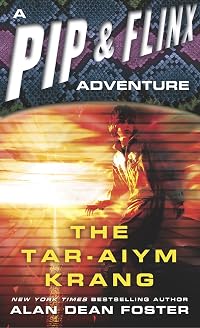
The Tar-Aiym Krang
by Alan Dean Foster
Pip and Flinx: publishing order (1), Humanx Commonwealth: timeline (549 AA: Pip and Flinx 2), Humanx Commonwealth Universe (Pip & Flinx — 4.02)
On This Page
Description
With two great golden clouds suspended around it, Moth was the only planet that appeared to have wings. It was a beautiful planet . . . and a trap for the unwary.Here was a wide-open world for any venture a man might scheme. The planet attracted unwary travelers, hardened space-sailors, and merchant buccaneers—a teeming, constantly shifting horde that provideda comfortable income for certain quick-witted fellows like Flinx and his pet mini-dragon, Pip. With his odd talents, the pickings show more were easy enough so that Flinx did not have to be dishonest . . . most of the time.
In fact, it hardly seemed dishonest at all to steal a starmap from a dead body that didn't really need it anymore. But Flinx forgot one crucial point. He should have wondered why the body was dead in the first place. show less
Tags
Recommendations


















Member Reviews
I'll give Foster this: the Space Foreigner in his book, Maxim Malaika, is an intelligent and knowledgeable character without whom the plot would have been infeasible. The expedition to retrieve the titular unpronounceable artifact would literally never have gotten off the ground. However, Malaika, smart as he is, is too dense to have noticed that a woman in his employ for six years is madly in love with him, enough so to eventually get in a really ineffective physical fight with another woman over him. And, like every other Fictional Foreigner, he is fluent in English but inexplicably given to dropping random native-language phrases -- heavy on the Swahili, light on the Russian, in this case -- into conversation. He also gets the show more unbelievably clichéd description: "Shockingly white teeth gleamed in the dusky face...." (Foster 48) Why shockingly? The man is insanely wealthy; does Foster think maybe he can't afford space toothpaste? And in what other part of the human body does Foster think teeth are ordinarily found gleaming? (Late in the book, he also gets this: "Malaika's eyebrows did flip-flops." O RLY?)
Malaika is also mercenary; possessed of terrible table manners (early in the book, he wipes his face on his ridiculously expensive sleeve); and given to casual sex with the whitest wimmins possible. Not only that, but his dialogue continually roars and booms in the lowest vocal register possible, like amplified James Earl Jones, in case we forgot from any of the early description that he's the Space Black Guy.
Women and the physical appearances thereof are also problematic. We have a classic crone archetype early in the book, but she's a prop to the protagonist, and he's already outgrown her care by the time the book starts. There's a Black-Widow archetype: rich, ruthless, gigolo-hiring, awful to her family, and one plastic surgery away from being Lady Cassandra from latter-day Doctor Who. (Indeed, when Malaika rings her up on the videophone thingy to taunt her about having foiled her cunning plan, he also disses her face, to her face.) Malaika's blonde is a Lynx; the protagonist defends (and defines) the Lynx to the pilot (and the reader) as not a prostitute per se, but something like the Firefly universe's Companions -- beautiful and charming women who have no interest in settling down, and who thus prefer to have serial relationships with fascinating, usually wealthy, men. (If you hadn't guessed it, there are no gays in this book, unless you really, really want to slash the Bran Tse-Mallory/Truzenzuzex pairing. I don't, because the latter is a sentient bug.)
However, Sissiph the Lynx is no Inara Serra. She is, rather, a spoiled brat who enjoys the fancy pretties Malaika buys her more than she enjoys Malaika (whom she, of course, calls "Maxy"); at the first sign of true difficulty, she turns all Anna Nicole Smith, and vows to ditch Malaika for an elderly googolplexionaire who will die soon and leave her to enjoy a "long, wealthy widowhood" (Foster 146). Also, it nearly goes without saying that she's dumber than a bag of hair extensions, including not knowing the difference between a reptile and a worm.
These objections aside -- and it takes me a fair bit of effort to push them there -- the book has two major faults remaining. One is common to hard SF: it revels in dense paragraphs that delightedly explain exactly how the author has figured every bit of l33t technology could work, especially with regard to spaceship battle, but not without the universe's history and sociology into the bargain -- shades of Heinlein there too, not just in the Women Problem and Stereotyped Space Foreigners Problem.
The other fault is the protagonist. Flinx is a Gary Stu of the highest order, being an empath with a Magic Pet and Tragic Past, and not only is he a Stu, he's the Wesley Crusher. He's just a kid, we're told repeatedly, but of course his presence and his alone is what makes the climax of the book possible, when not even the elder statesmen who showed up searching for the MacGuffin can bring about the necessary event. And when the book is over, he's got even greater Powers of Stu, as if the amazing archaeological relic the group found had only that as its entire point.
If I lay the snark on heavily here, it is because I liked this book a lot as a tween girl, identifying with the protagonist without having the conceptual framework necessary to figure out whether this novel could have worked with a girl of Flinx's age as the Mary Sue, or why all the named female characters were, in order of appearance, (a) old and ugly; (b) blonde, mercenary, petty, and dumb; (c) lovestruck, petty, and sneaky; (d) old, mean, vain, sex-obsessed, and the villain; and (e) sneaky, vengeful, and thoroughly pwned by the villain. It's like Disney fairytales in space, if you're casting female roles. Even the wealthy male characters haven't just possessed things; they've done things, seen things, gone places.
And that -- that's what isn't fair. Kindly, O writers, do not raise the hopes of the tween, only to lay the smackdown on the adult re-reader. show less
Malaika is also mercenary; possessed of terrible table manners (early in the book, he wipes his face on his ridiculously expensive sleeve); and given to casual sex with the whitest wimmins possible. Not only that, but his dialogue continually roars and booms in the lowest vocal register possible, like amplified James Earl Jones, in case we forgot from any of the early description that he's the Space Black Guy.
Women and the physical appearances thereof are also problematic. We have a classic crone archetype early in the book, but she's a prop to the protagonist, and he's already outgrown her care by the time the book starts. There's a Black-Widow archetype: rich, ruthless, gigolo-hiring, awful to her family, and one plastic surgery away from being Lady Cassandra from latter-day Doctor Who. (Indeed, when Malaika rings her up on the videophone thingy to taunt her about having foiled her cunning plan, he also disses her face, to her face.) Malaika's blonde is a Lynx; the protagonist defends (and defines) the Lynx to the pilot (and the reader) as not a prostitute per se, but something like the Firefly universe's Companions -- beautiful and charming women who have no interest in settling down, and who thus prefer to have serial relationships with fascinating, usually wealthy, men. (If you hadn't guessed it, there are no gays in this book, unless you really, really want to slash the Bran Tse-Mallory/Truzenzuzex pairing. I don't, because the latter is a sentient bug.)
However, Sissiph the Lynx is no Inara Serra. She is, rather, a spoiled brat who enjoys the fancy pretties Malaika buys her more than she enjoys Malaika (whom she, of course, calls "Maxy"); at the first sign of true difficulty, she turns all Anna Nicole Smith, and vows to ditch Malaika for an elderly googolplexionaire who will die soon and leave her to enjoy a "long, wealthy widowhood" (Foster 146). Also, it nearly goes without saying that she's dumber than a bag of hair extensions, including not knowing the difference between a reptile and a worm.
These objections aside -- and it takes me a fair bit of effort to push them there -- the book has two major faults remaining. One is common to hard SF: it revels in dense paragraphs that delightedly explain exactly how the author has figured every bit of l33t technology could work, especially with regard to spaceship battle, but not without the universe's history and sociology into the bargain -- shades of Heinlein there too, not just in the Women Problem and Stereotyped Space Foreigners Problem.
The other fault is the protagonist. Flinx is a Gary Stu of the highest order, being an empath with a Magic Pet and Tragic Past, and not only is he a Stu, he's the Wesley Crusher. He's just a kid, we're told repeatedly, but of course his presence and his alone is what makes the climax of the book possible, when not even the elder statesmen who showed up searching for the MacGuffin can bring about the necessary event. And when the book is over, he's got even greater Powers of Stu, as if the amazing archaeological relic the group found had only that as its entire point.
If I lay the snark on heavily here, it is because I liked this book a lot as a tween girl, identifying with the protagonist without having the conceptual framework necessary to figure out whether this novel could have worked with a girl of Flinx's age as the Mary Sue, or why all the named female characters were, in order of appearance, (a) old and ugly; (b) blonde, mercenary, petty, and dumb; (c) lovestruck, petty, and sneaky; (d) old, mean, vain, sex-obsessed, and the villain; and (e) sneaky, vengeful, and thoroughly pwned by the villain. It's like Disney fairytales in space, if you're casting female roles. Even the wealthy male characters haven't just possessed things; they've done things, seen things, gone places.
And that -- that's what isn't fair. Kindly, O writers, do not raise the hopes of the tween, only to lay the smackdown on the adult re-reader. show less
My second Pip and Flinx novel was the first written in the series but it takes place right after book five. Confusing? Not really. I'm just reading them chronologically, so Flinx is only 17 here and he sure knows how to get into trouble!
What's most fascinating is how polished and fascinating and fast this tale is compared to the other one I had just read. It's the entry novel into the universe and I can see immediately how Alan Dean Foster hoisted himself into the SF field with such gusto and why it was popular enough to support fifteen novels. I like this one better than book 5, easily.
In fact, as a straight adventure, it's speedy.
As a science fiction full of interesting worlds and even more interesting alien species, it rocks.
Is it show more a hardcore SF novel ranking up with the most ambitious and best of the genre? No. But as light fun with a kid with a mysteriously powerful and/or unknown level of empathic telepathy, flexible moral compass in some circumstances but not in the ways that are really important, or simply... fun with mini-dragons... it's a real delight and an easy read.
It helps when we get spaceships and space battles, intrigue, planetary mysteries and ancient dead civilizations, and baddies who you *know* are bad. (So you don't feel bad when they get ripped to shreds) :)
This is a pure adventure and it is what it is. Fun. Not deep, just well-crafted fun. It has aged very well and I don't see any issues for enjoying it in any foreseeable future. :)
I can see why the author was chosen to pick up most of the official novelizations for Star Wars. He has the sense of wonder down pat. :) show less
What's most fascinating is how polished and fascinating and fast this tale is compared to the other one I had just read. It's the entry novel into the universe and I can see immediately how Alan Dean Foster hoisted himself into the SF field with such gusto and why it was popular enough to support fifteen novels. I like this one better than book 5, easily.
In fact, as a straight adventure, it's speedy.
As a science fiction full of interesting worlds and even more interesting alien species, it rocks.
Is it show more a hardcore SF novel ranking up with the most ambitious and best of the genre? No. But as light fun with a kid with a mysteriously powerful and/or unknown level of empathic telepathy, flexible moral compass in some circumstances but not in the ways that are really important, or simply... fun with mini-dragons... it's a real delight and an easy read.
It helps when we get spaceships and space battles, intrigue, planetary mysteries and ancient dead civilizations, and baddies who you *know* are bad. (So you don't feel bad when they get ripped to shreds) :)
This is a pure adventure and it is what it is. Fun. Not deep, just well-crafted fun. It has aged very well and I don't see any issues for enjoying it in any foreseeable future. :)
I can see why the author was chosen to pick up most of the official novelizations for Star Wars. He has the sense of wonder down pat. :) show less
Oh hell yea! This book has the lot: space battles, space ships, good aliens, bad aliens, alien elder races, alien artefacts, space traders, space pirates, goodies, baddies, who-knows-whatsies, different tech-levels on different planets, different tech-levels on the same planet, an alliance between merchant-princes and the church, mysteries, enigmas, secrets, lies, withholding of information and it’s all set in the future in space! What’s not to like?
The enigma driving the plot is the krang. A fabled alien artifact that may be a weapon or may be a musical instrument but, as it’s named after the noise made by a metal guitarist thrashing out a power chord at the beginning of a 30 minute guitar solo that allows the lead singer to go show more backstage and avail himself of a sauna, a snack, some smack or some groupies, it has the potential to both wreak mass destruction or musical mayhem or both.
Elder races in science fiction are fantastic. I can never get over the idea that the story is set in the future, but the elder race have long since vanished. Does that mean that they are around now? That would make so much sense, especially when you consider that what mankind manufactures today that is really going to endure for millennia is most likely to be, say, a vast weapons system in a hollowed out mountain range rather than, to take a random example, a donkey sanctuary. Thousands of years from now, if alien archaeologists do come down to our planet and try and work out what we were like from our artefacts, they are probably going to conclude that we really, really liked drinking from styrofoam cups and that the barrels marked ‘toxic waste, biohazard, do not open’ make your face melt when you crack one of those suckers open even if you do come from Citrus Prime XII or wherever.
Given that mankind doesn’t really make an effort to get to know their fellow man even when they share the same time period, if not the same country, it’s good to see the humans in this book taking a stab at unravelling the mystery of a long-dead alien race. The humans are assisted by other aliens, but the krang and its makers are about as easy to understand as a public address tannoy system on a wet day.
The chase is the thing. It kicks off with a treasure map, that falls into the wrong hands, that turn out to be the right hands and very quickly the central character is drawn into events beyond his control and very out of his depth, even among those in the same treasure hunting party. As a street urchine he’s charmingly adrift, and knows it. But he’s a fast learner. The rest of the characters, merchant-princes, archaeologists and pursuing assorted henchmen are all excellent and, although this is a treasure hunt among the stars for an alien artefact, you never have that dreaded ‘oh wait a second, this is tosh’ moment.
From the start of the action on the trading world of Moth, to the finale on a lost world in a haunted stretch of interstellar space known as ‘the Blight’, it’s a breathless chase and one you yourself get caught up in. By the end of the book I was anxious to find out just what the bloody hell the krang was.
I loved the theory postulated at the start of the story that the krang is a weapon or a musical instrument or (pause for effect), both. Both? What? Are we expecting some sort of banjo with a rocket launcher gaffa-taped to it?
The result is worth waiting for and the chase across space is great fun. There are a lot of interesting ideas here; that even in the future you still get want, suffering and greed, that rather than some safe and sterile future, space travel offers a life more like that of an adventurer in the age of sail, that dormant abilities in the human mind can begin to show themselves and that this gives rise to fear and suspicion and that an alien superweapon is unlikely to be portable enough to strap to a banjo. show less
The enigma driving the plot is the krang. A fabled alien artifact that may be a weapon or may be a musical instrument but, as it’s named after the noise made by a metal guitarist thrashing out a power chord at the beginning of a 30 minute guitar solo that allows the lead singer to go show more backstage and avail himself of a sauna, a snack, some smack or some groupies, it has the potential to both wreak mass destruction or musical mayhem or both.
Elder races in science fiction are fantastic. I can never get over the idea that the story is set in the future, but the elder race have long since vanished. Does that mean that they are around now? That would make so much sense, especially when you consider that what mankind manufactures today that is really going to endure for millennia is most likely to be, say, a vast weapons system in a hollowed out mountain range rather than, to take a random example, a donkey sanctuary. Thousands of years from now, if alien archaeologists do come down to our planet and try and work out what we were like from our artefacts, they are probably going to conclude that we really, really liked drinking from styrofoam cups and that the barrels marked ‘toxic waste, biohazard, do not open’ make your face melt when you crack one of those suckers open even if you do come from Citrus Prime XII or wherever.
Given that mankind doesn’t really make an effort to get to know their fellow man even when they share the same time period, if not the same country, it’s good to see the humans in this book taking a stab at unravelling the mystery of a long-dead alien race. The humans are assisted by other aliens, but the krang and its makers are about as easy to understand as a public address tannoy system on a wet day.
The chase is the thing. It kicks off with a treasure map, that falls into the wrong hands, that turn out to be the right hands and very quickly the central character is drawn into events beyond his control and very out of his depth, even among those in the same treasure hunting party. As a street urchine he’s charmingly adrift, and knows it. But he’s a fast learner. The rest of the characters, merchant-princes, archaeologists and pursuing assorted henchmen are all excellent and, although this is a treasure hunt among the stars for an alien artefact, you never have that dreaded ‘oh wait a second, this is tosh’ moment.
From the start of the action on the trading world of Moth, to the finale on a lost world in a haunted stretch of interstellar space known as ‘the Blight’, it’s a breathless chase and one you yourself get caught up in. By the end of the book I was anxious to find out just what the bloody hell the krang was.
I loved the theory postulated at the start of the story that the krang is a weapon or a musical instrument or (pause for effect), both. Both? What? Are we expecting some sort of banjo with a rocket launcher gaffa-taped to it?
The result is worth waiting for and the chase across space is great fun. There are a lot of interesting ideas here; that even in the future you still get want, suffering and greed, that rather than some safe and sterile future, space travel offers a life more like that of an adventurer in the age of sail, that dormant abilities in the human mind can begin to show themselves and that this gives rise to fear and suspicion and that an alien superweapon is unlikely to be portable enough to strap to a banjo. show less
I struggled with getting through this slim 200 page book, and not just because I was busy, tired and distracted with various other goings on. Given how much I enjoyed his fantasy book Spellsinger earlier in the year, this was a disappointment. Whereas that book was highly entertaining, with prose that felt fresh and engaging, this book seemed clunky and at times dull. It is poorly written, and I would be tempted to say it seems to be aimed at more of a YA audience than an adult one (though that's no excuse). While a couple of the characters stood out, others were cardboard and one particularly found the infantilization of the female characters annoying.
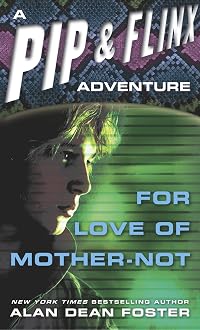
This is Alan Dean Foster's first novel and chronologically the second Pip and Flinx book. I found it ok, not as compelling as For Love of Mother Not which was written in the 80s (that book is an introduction to the character Flinx and his minidrag Pip.) This book, though having its good adventure parts, often drags in technobabble and is less prosaic than later works, more stiff in parts. Still its an entertaining read and I will read others in the series. Basically Flinx is a young man living on the planet Moth under the care if his foster mother called Mother Mastiff and he has psi-powers. He also has a pet mini dragon called Pip, a ferocious and loyal fighter. Flinx is approached by 2 strangers who request his services as a guide show more around the city. Really they are trying to find the mysterious artifact called the Krang, which was left behind by the belligerent race The Tar Aiym. Thus begins an adventure in space to find and decipher the mystery of the Krang. show less
Quite enjoyable for a first novel! There are many pieces of a busy universe here, and with several of them the reader gets too little to do anything with, but ultimately they add to the sense of the setting. The plot is a bit all over the place, and the finale seems to come and go much too quickly, but overall the book is enjoyable and has some interesting ideas.
Foster, Alan Dean. The Tar-Aiym Krang. 1972. Pip and Flinx No. 2 (Chronologically). Gateway, 2012.
The Tar-Aiym Krang is the second of the Pip and Flinx books chronologically but the first to be published. It sets up most of the dynamic for the series. Flinx is an orphan who has paranormal abilities that are enhanced by his pet miniature dragon Pip. He meets a human and a Thranx team who engage him to find a powerful alien artifact. There are, of course, some baddies who aim to spoil the party. It is a straight-up, fast-paced space adventure. Foster reveals early in his career what a good storyteller he is. 4 stars.
The Tar-Aiym Krang is the second of the Pip and Flinx books chronologically but the first to be published. It sets up most of the dynamic for the series. Flinx is an orphan who has paranormal abilities that are enhanced by his pet miniature dragon Pip. He meets a human and a Thranx team who engage him to find a powerful alien artifact. There are, of course, some baddies who aim to spoil the party. It is a straight-up, fast-paced space adventure. Foster reveals early in his career what a good storyteller he is. 4 stars.
Members
- Recently Added By
Lists

Books Read in 2013
1,630 works; 51 members
Author Information

363+ Works 74,097 Members
Bestselling science fiction writer Alan Dean Foster was born in New York City in 1946, but raised mainly in California. He received a B.A. in Political Science from UCLA in 1968, and a M.F.A. in 1969. Foster enjoys traveling because it gives him opportunities to meet new people and explore new places and cultures. This interest is carried over to show more his writing, but with a twist: the new places encountered in his books are likely to be on another planet, and the people may belong to an alien race. Foster began his career as an author when a letter he sent to Arkham Collection was purchased by the editor and published in the magazine in 1968. His first novel, The Tar-Aiym Krang, introduced the Humanx Commonwealth, a galactic alliance between humans and an insectlike race called Thranx. Several other novels, including the Icerigger trilogy, are also set in the world of the Commonwealth. The Tar-Aiym Krang also marked the first appearance of Flinx, a young man with paranormal abilities, who reappears in other books, including Orphan Star, For Love of Mother-Not, and Flinx in Flux. Foster has also written The Damned series and the Spellsinger series, which includes The Hour of the Gate, The Moment of the Magician, The Paths of the Perambulator, and Son of Spellsinger, among others. Other books include novelizations of science fiction movies and television shows such as Star Trek, The Black Hole, Starman, Star Wars, and the Alien movies. Splinter of the Mind's Eye, a bestselling novel based on the Star Wars movies, received the Galaxy Award in 1979. The book Cyber Way won the Southwest Book Award for Fiction in 1990. His novel Our Lady of the Machine won him the UPC Award (Spain) in 1993. He also won the Ignotus Award (Spain) in 1994 and the Stannik Award (Russia) in 2000. He is the recipient of the Faust, the IAMTW Lifetime achievement award. Alan Dean Foster's Star Wars: The Force Awakens, was a 2015 New York Times bestseller. (Bowker Author Biography) show less
Some Editions
Series

Pip and Flinx: publishing order
19 works (1)

Humanx Commonwealth: timeline
29 works (549 AA: Pip and Flinx 2)

Humanx Commonwealth Universe
1 works (Pip & Flinx — 4.02)
Belongs to Publisher Series
Work Relationships
Common Knowledge
- Canonical title*
- Das Tar-Aiym Krang
- Original title
- The Tar-Aiym Krang
- Original publication date
- 1972-03
- People/Characters
- Flinx; Malaika; Bran Tse-Mallory; Mother Mastiff; Rashalleila Nuaman; Pip the minidrag (show all 10); Truzenzuzex; Teleen auz Rudenuaman; The Tar-Aiym Krang; Baron Riidi WW
- Important places
- Moth, Humanx Commonwealth; the Blight
- Dedication
- To Larry Thor and John W. Campbell, jr., mentors
- First words
- The Flinx was an ethical thief in that he stole only from the crooked.
- Last words
- (Click to show. Warning: May contain spoilers.)Still, the whole universe was out there and it seemed a shame not to take a look at it.
Now that he could see. - Original language*
- Englisch
*Some information comes from Common Knowledge in other languages. Click "Edit" for more information.
Classifications
Statistics
- Members
- 1,406
- Popularity
- 16,886
- Reviews
- 24
- Rating
- (3.66)
- Languages
- 5 — English, German, Italian, Russian, Spanish
- Media
- Paper, Audiobook, Ebook
- ISBNs
- 21
- ASINs
- 17