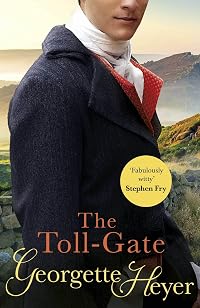
The Toll-Gate
by Georgette Heyer
On This Page
Description
The Queen of Regency Romance, bestselling author Georgette Heyer, enchants readers with what the New Yorker called "a witty cheerful extravaganza."His exploits were legendary...
Captain John Staple, back from the battlefront, is already bored with his quiet civilian life in the country. When he stumbles upon a mystery involving a disappearing toll-gate keeper, nothing could keep the adventure-loving captain from investigating.
But winning her will be his greatest yet...
The plot thickens show more when John encounters the enigmatic Lady Nell Stornaway and soon learns that rescuing her from her unsavory relatives makes even the most ferocious cavalry charge look like a particularly tame hand of loo. Between hiding his true identity from Nell and the arrival in the neighborhood of some distinctly shady characters, Captain Staple finds himself embarked on the adventure—and romance—of a lifetime.
Praise for The Toll-Gate:
"Spritely and good fun."—New York Herald Tribune
"Once again Georgette Heyer has directed her comic genius along the fictional highway of early nineteenth-century England, but this time...cleaves with refreshing persistence to the commoner levels of life."—Chicago Sunday Tribune
"Told in elegant prose with exceptionally humorous dialogue by the Queen of Regency romance."—Good Book Guide
. show less
Tags
Recommendations


















Member Reviews
This Regency romance by Georgette Heyer employs a great deal of “flash-patter” slang, which apparently actually originated in Derbyshire, a county in the East Midlands of England and the setting for this novel. [There is an interesting history of how flash patter arose in An Analytic Dictionary of the English Etymology: An Introduction by Anatoly Liberman.] Heyer provides no glossary for this slang, but it’s easy enough to get the gist of the dialogue. I also remembered some from the books by Lyndsay Faye set in 19th Century New York, where flash patter was the street argot of the era, especially because Faye did include a glossary with her books.
This story is also unusual in that the focus is on the hero rather than the heroine. show more Twenty-nine-year-old Captain John (called Jack) Staple is tall, handsome, genial, and honorable. He was a Captain in the Dragoon Guards, but now is mustered out and is at loose ends, and loathe to be bored by the strictures of formal society. He is also bored by women who have no spirit and no interests broader than advancing in society, and so he has remained unmarried. But that is all about to change.
Jack, riding off to visit his best friend, gets a bit lost, and ends up staying at a toll-gate house manned only by ten-year-old Ben Brean, acting for his father, who has gone missing. Ben is scared, and Jack agrees to stay and help out, as much for a lark as anything. But before long he is called to take a toll from 26-year-old local Nell Stornaway, clearly as independent as possible for a woman to be at that time, and with no care for propriety. They are both tall, but Jack is taller. It’s love at first sight.
So Jack decides to stay longer, and soon gets embroiled in “an excellent adventure” related to the disappearance of Ben’s father, that is not, however, without mortal peril for Jack. There are some fun side plots involving the humorous character of Jeremy Chirk, who is a highway robber but a good man, and who is in love with Nell’s former nursemaid Rose. There is also the delightful character of Nell’s grandfather, and the rather less savory characters of Nell's cousin Henry and his friend Coates. But they are all entertaining, each in his own way.
Jack devises a way to fix everything aright - that is, unless he is killed.
Evaluation: This book, like others I have read by Heyer, is very fun, and reminiscent of the “screwball comedy/romances” of old movies. My only quibble with this book is that Jack’s declaration of love for Nell was so swift I thought he was having another of his larks. Besides being heralded as the true source of "Regency Romances", Heyer should definitely receive notice for making "InstaLove" a plot feature as well. show less
This story is also unusual in that the focus is on the hero rather than the heroine. show more Twenty-nine-year-old Captain John (called Jack) Staple is tall, handsome, genial, and honorable. He was a Captain in the Dragoon Guards, but now is mustered out and is at loose ends, and loathe to be bored by the strictures of formal society. He is also bored by women who have no spirit and no interests broader than advancing in society, and so he has remained unmarried. But that is all about to change.
Jack, riding off to visit his best friend, gets a bit lost, and ends up staying at a toll-gate house manned only by ten-year-old Ben Brean, acting for his father, who has gone missing. Ben is scared, and Jack agrees to stay and help out, as much for a lark as anything. But before long he is called to take a toll from 26-year-old local Nell Stornaway, clearly as independent as possible for a woman to be at that time, and with no care for propriety. They are both tall, but Jack is taller. It’s love at first sight.
So Jack decides to stay longer, and soon gets embroiled in “an excellent adventure” related to the disappearance of Ben’s father, that is not, however, without mortal peril for Jack. There are some fun side plots involving the humorous character of Jeremy Chirk, who is a highway robber but a good man, and who is in love with Nell’s former nursemaid Rose. There is also the delightful character of Nell’s grandfather, and the rather less savory characters of Nell's cousin Henry and his friend Coates. But they are all entertaining, each in his own way.
Jack devises a way to fix everything aright - that is, unless he is killed.
Evaluation: This book, like others I have read by Heyer, is very fun, and reminiscent of the “screwball comedy/romances” of old movies. My only quibble with this book is that Jack’s declaration of love for Nell was so swift I thought he was having another of his larks. Besides being heralded as the true source of "Regency Romances", Heyer should definitely receive notice for making "InstaLove" a plot feature as well. show less
Audiobook
Such a delightful book. Heyer had me involved in this story right from the beginning. My one comment was that the romance aspect was rushed. I didn't believe their love declarations at all! But this book is strong on story, characterisation and adventure - the romance is very secondary to these other elements, so I pretty much ignored the romance issue.
Such a delightful book. Heyer had me involved in this story right from the beginning. My one comment was that the romance aspect was rushed. I didn't believe their love declarations at all! But this book is strong on story, characterisation and adventure - the romance is very secondary to these other elements, so I pretty much ignored the romance issue.
Captain John Staple, whose adventurous spirit and uncommon daring had earned him the sobriquet "Crazy Jack," returns to England shortly after seeing action at the battle of Waterloo, but finds the peace somewhat tiresome. Never one to hesitate when a mystery presents itself, Jack finds himself playing the role of toll-gate keeper when chance takes him to a remote part of Derbyshire... But what had become of the real gate-keeper, Ned Bream? What mischief had Mr. Henry Stornaway and his disreputable companion, Nat Coate, gotten up to? And most of all, how was Jack to protect the dashing and well-proportioned Miss Nell Stornaway, with whom he had fallen instantly in love?
An entertaining adventure-romance, The Toll-Gate is another of show more Georgette Heyer's light-hearted romps - well-written and most engrossing. Here the reader will encounter some familiar characters, from the good-hearted highwayman to the faithful family retainers. My only real complaint lies in the fact that Nell Stornaway, who makes a wonderful heroine, is under-utilized. I would have liked to see more of her... show less
An entertaining adventure-romance, The Toll-Gate is another of show more Georgette Heyer's light-hearted romps - well-written and most engrossing. Here the reader will encounter some familiar characters, from the good-hearted highwayman to the faithful family retainers. My only real complaint lies in the fact that Nell Stornaway, who makes a wonderful heroine, is under-utilized. I would have liked to see more of her... show less
At work we do the Guardian Crossword together at lunch and recently the answer to one clue was "toll gate" and that set two of us off reminiscing about this charming book. So, I've re-read it and found my memory not at fault. A lovely romance between two unfashionably large (but delightful) people set against a mystery, with lots of thieves' cant to enliven the dialog -and a lovelorn highwayman amongst the characters - makes for great fun (although an alarmingly high body count at the end is brushed off lightly to facilitate a happy ending!)
Georgette Heyer’s novel The Toll Gate is a little different from her typical Regencies. It is more of a mystery than a romance, and is told primarily from the point of view of the hero.
The hero, Captain John Staple, shares several characteristics with Hugo Darracott of The Unknown Ajax. Like Hugo, John is a former army officer who sold out after Napoleon’s defeat—though in John’s case, he sold out after Leipzig, and when Napoleon escaped from Elba and began the Hundred Days, he rejoined and thus (like Hugo) was present at Waterloo. Like Hugo, John is a large man, six-foot-four, with a gentle manner, a sense of humor, and a great deal of intelligence that he sometimes hides behind an intentionally bovine manner. And like Hugo, show more John prefers to travel cross-country on horseback rather than in a chaise with a servant and piles of baggage.
If you haven’t read this novel before, there is one thing you definitely should know before reading it. The first chapter seems not to fit. It is a large family dinner party where John’s cousin, the Earl of Saltash, has called his relations together to meet his fiancé. Thus the first few pages are full of characters that are hardly thought of again after John escapes the party in Chapter Two. The reason for this is that Heyer initially planned to develop the mystery to involve John’s status as his cousin’s heir presumptive. Instead she went in quite a different direction. So when you read it, don’t worry about keeping any of the characters straight except John, and enjoy the rest as vignettes of Regency life.
Captain Staple, traveling cross-country through Derbyshire to put as many miles as possible between himself and Lord Saltash’s country seat, is caught in rain and darkness and finds himself at an isolated toll gate attended only by a frightened boy. His dad, the boy explains reluctantly, went off saying he’d be back in an hour but hadn’t returned. John decides to stay the night, and look for the gatekeeper in the morning. And from there, finds himself in an adventure, which is much more to his taste than dancing attendance on Lord Saltash and his prospective in-laws.
There is a romance, but it is very lightly handled: quite sweet and satisfying, but not highly developed. There is quite a bit of thieves’ cant, but it is generally intelligible from context (and if it isn’t, provides a wonderful opportunity to delve into a cant dictionary, several of which are freely available online). There are entertaining secondary characters, as in every Heyer novel, including a highwayman and a Bow Street Runner. There are moments of comic relief, but they are not the focus.
Some have criticized Heyer for failing to excise or re-write the first chapter, which hangs unevenly and sets up the expectation of seeing some of the characters again, or at least of the relevance of their existence. But on re-reading, I find that there is very little that could be excised cleanly. John’s interactions with the various family members and guests reveal parts of his history and his own character which are important background for his later actions. So the chapter couldn’t just be chopped out without material loss. It would have to be rewritten, and I think that the labor involved wouldn’t be worth the return.
I give this novel four out of five stars, not for any grievous faults, but because it does not sparkle as some of Heyer’s other novels. I still would rank it higher than most Regency-set novels by other authors, for its wonderful language and well-drawn characters, but for me—and I realize that this is a subjective opinion, but I am the one writing a review—it isn’t a top-tier Heyer novel.
The Sourcebooks edition is lovely, the only possible criticism of it being that the cover photo is eighteenth-century rather than post-Waterloo, but I am happy to report that I did not find a single printing error, not even a scanno!
Note: I wrote this review for Austenprose, where it was publised 9 October 2011. show less
The hero, Captain John Staple, shares several characteristics with Hugo Darracott of The Unknown Ajax. Like Hugo, John is a former army officer who sold out after Napoleon’s defeat—though in John’s case, he sold out after Leipzig, and when Napoleon escaped from Elba and began the Hundred Days, he rejoined and thus (like Hugo) was present at Waterloo. Like Hugo, John is a large man, six-foot-four, with a gentle manner, a sense of humor, and a great deal of intelligence that he sometimes hides behind an intentionally bovine manner. And like Hugo, show more John prefers to travel cross-country on horseback rather than in a chaise with a servant and piles of baggage.
If you haven’t read this novel before, there is one thing you definitely should know before reading it. The first chapter seems not to fit. It is a large family dinner party where John’s cousin, the Earl of Saltash, has called his relations together to meet his fiancé. Thus the first few pages are full of characters that are hardly thought of again after John escapes the party in Chapter Two. The reason for this is that Heyer initially planned to develop the mystery to involve John’s status as his cousin’s heir presumptive. Instead she went in quite a different direction. So when you read it, don’t worry about keeping any of the characters straight except John, and enjoy the rest as vignettes of Regency life.
Captain Staple, traveling cross-country through Derbyshire to put as many miles as possible between himself and Lord Saltash’s country seat, is caught in rain and darkness and finds himself at an isolated toll gate attended only by a frightened boy. His dad, the boy explains reluctantly, went off saying he’d be back in an hour but hadn’t returned. John decides to stay the night, and look for the gatekeeper in the morning. And from there, finds himself in an adventure, which is much more to his taste than dancing attendance on Lord Saltash and his prospective in-laws.
There is a romance, but it is very lightly handled: quite sweet and satisfying, but not highly developed. There is quite a bit of thieves’ cant, but it is generally intelligible from context (and if it isn’t, provides a wonderful opportunity to delve into a cant dictionary, several of which are freely available online). There are entertaining secondary characters, as in every Heyer novel, including a highwayman and a Bow Street Runner. There are moments of comic relief, but they are not the focus.
Some have criticized Heyer for failing to excise or re-write the first chapter, which hangs unevenly and sets up the expectation of seeing some of the characters again, or at least of the relevance of their existence. But on re-reading, I find that there is very little that could be excised cleanly. John’s interactions with the various family members and guests reveal parts of his history and his own character which are important background for his later actions. So the chapter couldn’t just be chopped out without material loss. It would have to be rewritten, and I think that the labor involved wouldn’t be worth the return.
I give this novel four out of five stars, not for any grievous faults, but because it does not sparkle as some of Heyer’s other novels. I still would rank it higher than most Regency-set novels by other authors, for its wonderful language and well-drawn characters, but for me—and I realize that this is a subjective opinion, but I am the one writing a review—it isn’t a top-tier Heyer novel.
The Sourcebooks edition is lovely, the only possible criticism of it being that the cover photo is eighteenth-century rather than post-Waterloo, but I am happy to report that I did not find a single printing error, not even a scanno!
Note: I wrote this review for Austenprose, where it was publised 9 October 2011. show less
This is not necessarily what you think of when you pick up a Regency Romance. It starts conventionally enough, with an engagement party at the estate of the Earl of Saltash. But from there is rapidly becomes apparent that it's not the Earl that's the focus of the story, it's his dashing, devil-may-care cousin John Staples. He starts out to visit a friend, and ends up staying in a Toll-gate house. Ben's father (the gate keeper) has vanished and the boy is terrified. John - always out for adventure, or at least something out of the ordinary, is intrigued and hangs around for a while to get to the bottom of it. All sorts of characters turn up, the Squire's grandaughter, her maid, the groom, the landlord, the local highwayman, the works show more really. It's a real ensemble piece. There is a mystery to be got to the bottom of, as well as a romance to resolve. And it all does so in a most satisfactory way. Maybe a little bit too pat on the mystery, but the plot is involved enough for this not to be in the least bit predictable. The only gripe was the use of slang - a lot of which left me somewhat lost. I think I got the gist, but it didn't always make a great deal of sense at the first pass.
Re-read.
I think the previous review stands up. It's not a straightforward romance, it's a romance with a mystery entwined. It works rather well. show less
Re-read.
I think the previous review stands up. It's not a straightforward romance, it's a romance with a mystery entwined. It works rather well. show less
Captain John Staple leaves a very dull house party to go visit a friend for hunting. Taking a short cut his horse throws a shoe and then it begins to downpour. By now it is after dark and searching for a farmhouse to take shelter in he comes across a toll gate being manned by a very young, frightened boy. His dad is the gate keeper and he has disappeared. John decides to stay the night at the gate house and keep the boy company. In the morning, when she passes through the gate to go to church, John meets the Squire’s granddaughter, a strong and strong minded young woman who has been acting as squire since her grandfather had a stroke and he decides maybe he’ll stay a while and find out what is going on. This is one of Heyer’s most show more delightful historical stories with both romance and mystery. We have villains and swells and a highwayman (who isn’t a villain) and even a Bow Street Runner on special assignment. Pure escapism with laughs. show less
Members
- Recently Added By
Lists

Favorite Georgette Heyer Novels, Ranked
49 works; 29 members

Crime and Mysteries to Read
746 works; 31 members

Survey of Mysteries and Crime Fiction
96 works; 17 members

Books about characters you'd like to know
34 works; 15 members

unread and uncatalogued
48 works; 1 member

Books Read in 2022
5,166 works; 112 members
Author Information

125+ Works 78,055 Members
Georgette Heyer was born on August 16, 1902 at Wimbledon, London. She wrote The Black Moth as a story for her brother Boris. Her father, impressed with his daughter's imagination, suggested that she prepare it to be published, which it was by Constable in 1921. Having scored an instant success with The Black Moth at the age of nineteen under her show more own name, Georgette Heyer, she experimented with a pseudonym, Stella Martin, for her third book, published by Mills & Boon. She continued writing and in 1925 she married Ronald Rougier, a mining engineer. After reasonable but not spectacular sales from her first few books the instant success of These Old Shades in 1926 brought her a solid source of income which was very necessary at the time since the family relied to a large extent on the income from Georgette Heyer's writing. She wrote over fifty books during her lifetime and created the Regency England genre of romance novels. She died on July 4, 1974 at the age of 71. (Bowker Author Biography) show less
Some Editions
Series
Belongs to Publisher Series
rororo (979 & 2010)
Work Relationships
Common Knowledge
- Original title
- The Toll-Gate
- Original publication date
- 1954
- People/Characters
- Captain John Staple; Nell Stornaway; Sir Peter Stornaway; Henry Stornaway; Nathanial Coates; Ben Brean (show all 13); Jerry Chirk; Gabriel Stogumber; Wilfred Babbacombe; Rose Durward; Joe Lydd; Huby; Winkfield
- Important places
- Derbyshire, England, UK
- Important events
- Regency Era
- First words
- The sixth Earl of Saltash glanced round the immense dining-table, and was conscious of a glow of satisfaction.
- Last words
- (Click to show. Warning: May contain spoilers.)"...Now tell us, if you please, John, just how it all happened!"
- Original language
- English
- Canonical DDC/MDS
- 823.914
Classifications
- Genres
- Romance, Fiction and Literature, Historical Fiction, Mystery
- DDC/MDS
- 823.914 — Literature & rhetoric English & Old English literatures English fiction 1900- 1901-1999 1945-1999
- LCC
- PZ3 .H514 .T — Language and Literature Fiction and juvenile belles lettres Fiction and juvenile belles lettres Fiction in English
- BISAC
Statistics
- Members
- 1,470
- Popularity
- 15,852
- Reviews
- 39
- Rating
- (3.88)
- Languages
- English, German, Italian
- Media
- Paper, Audiobook, Ebook
- ISBNs
- 42
- UPCs
- 1
- ASINs
- 31