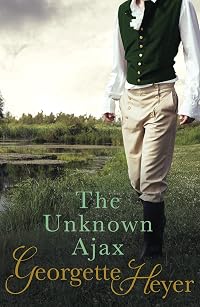
The Unknown Ajax
by Georgette Heyer
On This Page
Description
The Queen of Regency Romance, bestselling author Georgette Heyer, brings her trademark charm and wit to this pitch-perfect comedic romp.A past dispute . . .
When the irascible Lord Darracott's eldest son dies unexpectedly, the noble family must accept their estranged Yorkshire cousin as heir apparent. They are convinced he will prove to be a sadly vulgar person, but nothing could have prepared the beleaguered family for the arrival of Major Hugo Darracott . . .
A present deception . . .
His show more clever and beautiful cousin Anthea is sure there's more to the gentle giant than Hugo's innocent blue eyes and broad Yorkshire brogue would lead one to believe. But even she doesn't guess what he's capable of, until a family crisis arises and only Hugo can preserve the family's honor, leading everybody on a merry chase in the process . . .
Praise for The Unknown Ajax:
"Wonderful entertainment from first page to last."—Chicago Sunday Tribune
. show less
Tags
Recommendations











Member Reviews
Real Rating: 4.5* of five
The Publisher Says: A past dispute...
When the irascible Lord Darracott's eldest son dies unexpectedly, the noble family must accept their estranged Yorkshire cousin as heir apparent. They are convinced he will prove to be a sadly vulgar person, but nothing could have prepared the beleaguered family for the arrival of Major Hugo Darracott.
A present deception...
His clever and beautiful cousin Anthea is sure there's more to the gentle giant than Hugo's innocent blue eyes and broad Yorkshire brogue would lead one to believe. But even she doesn't guess what he's capable of, until a family crisis arises and only Hugo can preserve the family's honor, leading everybody on a merry chase in the process.
My Review: Here is show more a charming late (1959) work by Regency writer Miss Georgette Heyer (1902-1974), whom I shall not dismiss by calling her a "romance writer." There is very little of romance literature in this work; it is, rather, an historical novel with two characters whose marital future is in no real doubt from the get-go.
Spirited, determined Miss Anthea Darracott is to marry her newly introduced cousin Hugh Darracott, called Hugo. His, well, nigh-on-as-nasty-as-bastardy common birth to a Yorkshire mill lass appalls and disgusts their mutual grandfather. Sadly, Hugo's stint on the Peninsula in the Napoleonic Wars did not result in his convenient death. As he is alive and has sold out his commission, Lord Darracott must needs attend at last to the distasteful yet needful task of acknowledging the man as his heir. The law says Hugo's the heir by virtue of being born to a son, long dead, whose birth preceded the living son Matthew's birth. Not one soul among the Darracotts is happy about this, least of all Hugo.
Until he meets Anthea.
A spoiled Corinthian, a gaumless follower of the Beau, a stripling with dreams dashed and hopes thwarted; an Earl's daughter, a ninnyhammer, and a faded gentlewoman; a damned nasty old baron, a staff of hicks, and a starchy Calvinistic revenuer round out the dramatis personae. Miss Heyer's reliable clockwork plot moves the pieces into proper alignment for our surprisingly dark doings to eventuate as inevitably as sunrise and sunset, given the people she's placed in our path. In the end, all is sorted, and there is no one more pleased than a reader whose purpose in taking this trip was to restfully go down a well-loved and intimately known river of lovely words:
A quick resort to From Old Books will acquaint you with these and many more delicious underknown and woefully unused English-language words. Except "sackless hodgobbin," which appears here for the only time I can find in the entire online world. An academic published a paper on Heyer's impeccable research in Schwa, a linguistics journal, beginning on page 57. She confesses herself overmatched by this beautifully obvious, dolefully obscure phrase. Now, you whopstraws, go forth and discover the original citation for it!
Heyer presents us with a few beautiful drawing-room farces among her scenes, but possibly the funniest moments (to my mind) were between Vincent the Corinthian and Claud the gaumless's respective valets. Crimpleshaw and Polyphant (respectively) are engaged in a vicious, take-no-prisoners battle for dominance in the servants' hall. Hugo's arrival, valetless, ignites a major set-to in their long-running war. Crimpleshaw wins the first skirmish by using his secret formula for blacking to give Hugo's (excellent quality) boots a whole new level of gloss. Polyphant's riposte, an attempt to provide perfect neck-cloth tying, is rebuffed by Hugo; then, horror of horrors, the first true test of the line, provision of a valet to Hugo, goes to Crimpleshaw by dint of having a nephew in need of a position!
Intolerable. The insult must be answered!
And so it goes, a side-show that was beautifully woven in to the main narrative of Lord Darracott's humbling at the hands of his maligned, unloved, and insulted grandson Hugo, yet in a way that provokes no smallest scintilla of opprobrium in the sensitive reader's breast. It is a come-uppance and a liberation; it is not, for all that, a set-down or slight. It is the ideal ending to the story Miss Heyer chose to adorn her plot with.
Make no mistake: It is the same plot. The dresses are different and the hero is called something new, but it's a Heyer Regency. Read it or don't; those of us susceptible to her gorgeously bedizened orreries aren't going to be affected. Read it, say I, for the simple and genuine pleasure of following a master craftsperson as she sets the pieces of her construction before you prior to throwing a cloth over them and voilà off with the cloth to reveal a perfect Georgian manor house.
Come in, you great whopstraws, the door's letting in the cold of reality! Stop awhile by the fire. It will warm you in places you'd forgot were cold. show less
The Publisher Says: A past dispute...
When the irascible Lord Darracott's eldest son dies unexpectedly, the noble family must accept their estranged Yorkshire cousin as heir apparent. They are convinced he will prove to be a sadly vulgar person, but nothing could have prepared the beleaguered family for the arrival of Major Hugo Darracott.
A present deception...
His clever and beautiful cousin Anthea is sure there's more to the gentle giant than Hugo's innocent blue eyes and broad Yorkshire brogue would lead one to believe. But even she doesn't guess what he's capable of, until a family crisis arises and only Hugo can preserve the family's honor, leading everybody on a merry chase in the process.
My Review: Here is show more a charming late (1959) work by Regency writer Miss Georgette Heyer (1902-1974), whom I shall not dismiss by calling her a "romance writer." There is very little of romance literature in this work; it is, rather, an historical novel with two characters whose marital future is in no real doubt from the get-go.
Spirited, determined Miss Anthea Darracott is to marry her newly introduced cousin Hugh Darracott, called Hugo. His, well, nigh-on-as-nasty-as-bastardy common birth to a Yorkshire mill lass appalls and disgusts their mutual grandfather. Sadly, Hugo's stint on the Peninsula in the Napoleonic Wars did not result in his convenient death. As he is alive and has sold out his commission, Lord Darracott must needs attend at last to the distasteful yet needful task of acknowledging the man as his heir. The law says Hugo's the heir by virtue of being born to a son, long dead, whose birth preceded the living son Matthew's birth. Not one soul among the Darracotts is happy about this, least of all Hugo.
Until he meets Anthea.
A spoiled Corinthian, a gaumless follower of the Beau, a stripling with dreams dashed and hopes thwarted; an Earl's daughter, a ninnyhammer, and a faded gentlewoman; a damned nasty old baron, a staff of hicks, and a starchy Calvinistic revenuer round out the dramatis personae. Miss Heyer's reliable clockwork plot moves the pieces into proper alignment for our surprisingly dark doings to eventuate as inevitably as sunrise and sunset, given the people she's placed in our path. In the end, all is sorted, and there is no one more pleased than a reader whose purpose in taking this trip was to restfully go down a well-loved and intimately known river of lovely words:
- thatchgallows
- sackless hodgobbin
- whopstraw
- knaggy
- stiff-rumped
A quick resort to From Old Books will acquaint you with these and many more delicious underknown and woefully unused English-language words. Except "sackless hodgobbin," which appears here for the only time I can find in the entire online world. An academic published a paper on Heyer's impeccable research in Schwa, a linguistics journal, beginning on page 57. She confesses herself overmatched by this beautifully obvious, dolefully obscure phrase. Now, you whopstraws, go forth and discover the original citation for it!
Heyer presents us with a few beautiful drawing-room farces among her scenes, but possibly the funniest moments (to my mind) were between Vincent the Corinthian and Claud the gaumless's respective valets. Crimpleshaw and Polyphant (respectively) are engaged in a vicious, take-no-prisoners battle for dominance in the servants' hall. Hugo's arrival, valetless, ignites a major set-to in their long-running war. Crimpleshaw wins the first skirmish by using his secret formula for blacking to give Hugo's (excellent quality) boots a whole new level of gloss. Polyphant's riposte, an attempt to provide perfect neck-cloth tying, is rebuffed by Hugo; then, horror of horrors, the first true test of the line, provision of a valet to Hugo, goes to Crimpleshaw by dint of having a nephew in need of a position!
Intolerable. The insult must be answered!
And so it goes, a side-show that was beautifully woven in to the main narrative of Lord Darracott's humbling at the hands of his maligned, unloved, and insulted grandson Hugo, yet in a way that provokes no smallest scintilla of opprobrium in the sensitive reader's breast. It is a come-uppance and a liberation; it is not, for all that, a set-down or slight. It is the ideal ending to the story Miss Heyer chose to adorn her plot with.
Make no mistake: It is the same plot. The dresses are different and the hero is called something new, but it's a Heyer Regency. Read it or don't; those of us susceptible to her gorgeously bedizened orreries aren't going to be affected. Read it, say I, for the simple and genuine pleasure of following a master craftsperson as she sets the pieces of her construction before you prior to throwing a cloth over them and voilà off with the cloth to reveal a perfect Georgian manor house.
Come in, you great whopstraws, the door's letting in the cold of reality! Stop awhile by the fire. It will warm you in places you'd forgot were cold. show less
When the inheritance of Darrocott Place falls to an unknown and virtually disowned cousin, the eccentric Darracott family braces for the worst. Irascible Lord Darracott expects a country bumpkin to be cowed into submission, Vincent anticipates a rival to be vanquished, and Anthea resents a stranger whom she is pressured to marry. But when Hugo Darracott finally appears, he exceeds everyone's expectations at once.
As in The Quiet Gentleman, another Heyer novel about an undesired heir, the fraternal relationships in The Unknown Ajax are much more important than the protagonist's ostensible romance. Hugh juggles three self-absorbed cousins, a humorless uncle, and a fire-breathing grandfather, and he accomplishes the deed with charm and show more wit. (In contrast, his romance with Anthea is clever but secondary.) Hugo is the most developed and sympathetic Heyer hero that I can remember reading, and he's surrounded by a worthy secondary cast: the large Darracott family is initially bewildering in its internecine complexities, but they ultimately justify their existence in the plot. The Unknown Ajax is the best Heyer book I've read in a while. show less
As in The Quiet Gentleman, another Heyer novel about an undesired heir, the fraternal relationships in The Unknown Ajax are much more important than the protagonist's ostensible romance. Hugh juggles three self-absorbed cousins, a humorless uncle, and a fire-breathing grandfather, and he accomplishes the deed with charm and show more wit. (In contrast, his romance with Anthea is clever but secondary.) Hugo is the most developed and sympathetic Heyer hero that I can remember reading, and he's surrounded by a worthy secondary cast: the large Darracott family is initially bewildering in its internecine complexities, but they ultimately justify their existence in the plot. The Unknown Ajax is the best Heyer book I've read in a while. show less
This is how I like my light reading, delightful story of an unexpected heir, assumed by all to be a low born "weaver's brat" who is, of course, nothing of the sort, and who delights in stringing along his very out of countenance relations, and, in the end, proves to be the saving of them. Of course he, one of Miss Heyer's large and anything-but sleepy military heroes, gets the girl as well. Great fun but with an interesting underlying moral - bad laws are NOT meant to be broken...
Furious that his title and estates would now pass to his unacknowledged grandson, whose father he had disowned for daring to marry the daughter of a Yorkshire weaver, old Lord Darracott determined that his heir must be whipped into shape, enlisting the help of his reluctant, bullied family in the task. But neither he, his supercilious grandson Vincent, nor his spirited granddaughter Anthea, had counted on the "Unknown Ajax" and his lamentable propensity towards levity, and in the end, it was Cousin Hugo who whipped the Darracotts into shape...
The Unknown Ajax is the only Heyer novel, with which I am familiar, whose hero does not hail from an unassailable social position, and that fact alone gives the novel added interest. Cousin Hugo's show more masquerade affords Heyer the ideal chance to poke fun at the Darracott's snobbery, an opportunity she apparently relishes, setting up a few amusing misunderstandings whose resolution the reader will enjoy.
Anyone thinking that Heyer has converted - however briefly - to a more democratic frame of mind will be quelled (or reassured) by the fact that it is Lady Aurelia - the earl's daughter - whose understanding is strongest; but for all that, it is still refreshing to see such an unusual hero take the honors. And of course, the scenes in which Hugo baffles the zealous Exciseman, Lieutenant Ottershaw, are simply delightful! Heyer at her hilarious best! show less
The Unknown Ajax is the only Heyer novel, with which I am familiar, whose hero does not hail from an unassailable social position, and that fact alone gives the novel added interest. Cousin Hugo's show more masquerade affords Heyer the ideal chance to poke fun at the Darracott's snobbery, an opportunity she apparently relishes, setting up a few amusing misunderstandings whose resolution the reader will enjoy.
Anyone thinking that Heyer has converted - however briefly - to a more democratic frame of mind will be quelled (or reassured) by the fact that it is Lady Aurelia - the earl's daughter - whose understanding is strongest; but for all that, it is still refreshing to see such an unusual hero take the honors. And of course, the scenes in which Hugo baffles the zealous Exciseman, Lieutenant Ottershaw, are simply delightful! Heyer at her hilarious best! show less
This is a quiet romance, without explosive tension or conflict or whatever, and I like that. There's a lot of play with people's perceptions of others (the family's assumptions about hero Hugo and heroine's-little-brother Richmond particularly, but also condescending cousin Vincent's vision of himself as Too Cool to Give a Shit), self-presentation (all the fashion stuff amongst the gentlemen and their ambitious valets--unlike in so much romance, we hear almost nothing about women's fashion here), and people's actual character and desires. I found it an amusing and likeable story.
This may be one of my favorite Heyers - mostly because while there are pretty much the usual array of characters, none of them were intensely irritating. Hugo, the son of an unacceptable marriage, becomes heir to a peerage, much to his and his grandfather's mutual dismay. I believed his act for quite a while - I didn't catch his slips of the tongue as quickly as his cousin Anthea did. Of course, I wasn't being pressured to marry him, either. I loved the scenes between Hugo and Anthea, where he carefully doesn't quite admit what he's up to... The Corinthian cousin, the gentle (or cowardly, according to some of his relatives) cousin, the ill-handled high-strung youth, and the domineering patriarch of the family are among the males; the show more females include the sensible girl (Anthea), her addicted-to-drama mother, and the calm, majestic woman that married in to the family, and refuses to succumb to their expectations. All of them had at least one really good scene. Interesting discussions of smuggling and the long-term effects of breaking laws, even greedy and poorly-designed ones. And a lovely climactic - not scene, but series of scenes. I agree with another reviewer, it would make a magnificent play. Poor Ottershaw, he was really out of his depth here. A beautiful set of misdirections and twists. A lot of fun, and it makes me want to read some more Heyer. show less
When Lord Darracott sends for his heir, a previously unacknowledged grandson from his son's unfortunate liaison with a Yorkshire weaver's daughter, Lord Darracott and the rest of the family assume that the new heir will be a fairly rough article. With sly humor, Hugo Darracott lives up to their expectations, though he occasionally slips and forgets to speak in broad Yorkshire, or exhibits touches of a wry intelligence beneath his plodding good nature. In the end, he manages to not only win over his entire family, but to save them from a sticky situation, as well.
Heyer always elevates her genre, and this is far from being an exception to that rule. While it's obvious from the start that Hugo is having a bit of fun at his relatives' show more expense, the extent of his tomfoolery is revealed to the reader piece by piece -- and not through exposition, but through clues cleverly dropped into the dialogue or revealed through the actions of the various characters. There's a smuggling subplot that I found interesting, though some reviewers don't seem to have cared for it. My only criticism of this book was that I wanted more: more of the romance (which almost took a back seat in this book), and more of the story of what happened after the conclusion of the book! I was so wrapped up in the characters and their drama that I hated to see the book end. show less
Heyer always elevates her genre, and this is far from being an exception to that rule. While it's obvious from the start that Hugo is having a bit of fun at his relatives' show more expense, the extent of his tomfoolery is revealed to the reader piece by piece -- and not through exposition, but through clues cleverly dropped into the dialogue or revealed through the actions of the various characters. There's a smuggling subplot that I found interesting, though some reviewers don't seem to have cared for it. My only criticism of this book was that I wanted more: more of the romance (which almost took a back seat in this book), and more of the story of what happened after the conclusion of the book! I was so wrapped up in the characters and their drama that I hated to see the book end. show less
Members
- Recently Added By
Lists

Favorite Georgette Heyer Novels, Ranked
49 works; 29 members

Comedy of Manners
73 works; 1 member

Books Read in 2013
1,630 works; 51 members

1950s
340 works; 22 members

Books Read in 2019
4,052 works; 110 members

Books Read in 2023
5,547 works; 145 members
Author Information

125+ Works 78,066 Members
Georgette Heyer was born on August 16, 1902 at Wimbledon, London. She wrote The Black Moth as a story for her brother Boris. Her father, impressed with his daughter's imagination, suggested that she prepare it to be published, which it was by Constable in 1921. Having scored an instant success with The Black Moth at the age of nineteen under her show more own name, Georgette Heyer, she experimented with a pseudonym, Stella Martin, for her third book, published by Mills & Boon. She continued writing and in 1925 she married Ronald Rougier, a mining engineer. After reasonable but not spectacular sales from her first few books the instant success of These Old Shades in 1926 brought her a solid source of income which was very necessary at the time since the family relied to a large extent on the income from Georgette Heyer's writing. She wrote over fifty books during her lifetime and created the Regency England genre of romance novels. She died on July 4, 1974 at the age of 71. (Bowker Author Biography) show less
Some Editions
Series
Belongs to Publisher Series
rororo (1900)
Work Relationships
Common Knowledge
- Original title
- The Unknown Ajax
- Original publication date
- 1959
- People/Characters
- Major Hugo Darracott; Anthea Darracott; Richmond Darracott; Elvira Darracott; Matthew Darracott; Claud Darracott (show all 11); Ferring; John Joseph; Vincent Darracott; Lady Aurelia Darracott; Lord Darracott
- Important places
- England, UK
- Important events
- Regency Era
- First words
- Silence had reigned over the dining-room since his lordship, midway through the first course, had harshly commanded his widowed daughter-in-law to spare him anymore Steward's room gossip.
- Last words
- (Click to show. Warning: May contain spoilers.)'Don't be so daft!'
- Original language
- English
- Canonical DDC/MDS
- 823.914
Classifications
- Genres
- Romance, Fiction and Literature, Historical Fiction
- DDC/MDS
- 823.914 — Literature & rhetoric English & Old English literatures English fiction 1900- 1901-1999 1945-1999
- LCC
- PZ3 .H514 — Language and Literature Fiction and juvenile belles lettres Fiction and juvenile belles lettres Fiction in English
- BISAC
Statistics
- Members
- 1,639
- Popularity
- 13,735
- Reviews
- 61
- Rating
- (4.05)
- Languages
- English, German, Italian
- Media
- Paper, Audiobook, Ebook
- ISBNs
- 39
- UPCs
- 1
- ASINs
- 29