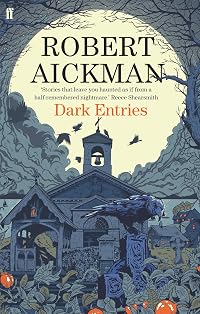
Dark Entries
by Robert Aickman
On This Page
Description
Robert Aickman (1914-1981) was the grandson of Richard Marsh, a leading Victorian novelist of the occult. Though his chief occupation in life was first as a conservationist of England's canals he eventually turned his talents to writing what he called 'strange stories.' Dark Entries (1964) was his first full collection, the debut in a body of work that would inspire Peter Straub to hail Aickman as 'this century's most profound writer of what we call horror stories.'Tags
Recommendations




















Member Reviews
My second collection of Aickman's "strange tales" (I've also enjoyed his novel The Model) and I'm now convinced of his genius for the uncanny. I love the way his precise, controlled sentences work to open up dense, foetid regions of the psyche. He's like a dapper surgeon ministering to our ugliest internal maladies. I loved all six of these, but the standout was The View, in which a mid-life civil servant and amateur painter boards a ferry in Liverpool (as I used to, and bound presumably for the Isle of Man) and finds himself on a version of Circe's island, time liquefying and the days accumulating blurrily like impasto — and all the fuckedupnesses of life, work, love, creation, and the basic question of what gives our days meaning show more somehow leach out of the gauzy, indeterminate atmosphere. But there are true ghost stories here, too: I think Aickman is the worthiest inheritor of M.R. James in his understanding that ghost stories are stories of place, of the semantic range of the word "haunt". Immaculately spooky and suggestive. show less
I believe this collection contains some of Aickman's earliest stories. That seems to show through--early style is often wonderful because it demonstrates in their purest form its author's strengths. Early style is also often uneven, inexperienced. In Aickman's cases, I think these stories are some of his best.
This is the third collection of Aickman's I've read, and it contains some clear highlights.
The School Friend: *****/*****
An insidious supernatural horror story about two friends and a haunting/possession/turning of some kind that exerts a curious power over the main characters. Aickman's touch is very light here--he doesn't try to explain just what is happening or what the compulsion is that's felt by his characters, and the result show more is all the more unsettling and effective for it.
Ringing the Changes: *****/*****
Effective horror doesn't come just from having a scary idea. In some ways, I think the mark of effective horror is how it does everything else aside from the horror--do the characters feel real? does the world feel real? is there more to the story than some scary ideas? What makes effective horror effective, in my view, is the sense of rupture it is capable of evoking--it's not just that something horrifying is happening, but that the horror emerge, exists within, and challenges a reality that we are somehow invested in. This story is a great illustration of this thesis, anyway. At its core is a textured, subtle portrait of a fragile relationship between a man and a much younger woman, and the tension in the story, though it seems to be supernatural, is a wonderful extension and expression of the dangers of the relationship itself. Rather than demystifying the story's horrors, this fact helps to bring them into reality.
Choice of Weapons: ****/*****
Underrated as far as Aickman stories go. I hadn't heard anything about this one prior to reading it (as opposed to Ringing the Changes, the School Friend, the Hospice, Pages From a Young Girl's Diary), but it ended up lingering with me quite a while. The story is about a young man who breaks off his engagement after becoming obsessed with a woman he catches glimpses of in a restaurant. This story is uncommonly literal and gothic and in its presentation--it reads more like a traditional horror story than a lot of Aickman's writing--but the queasy uncertainty and suggestions of something much deeper and more incomprehensible are there, and I appreciated it for the way it stands out amongst Aickman's stories.
The Waiting Room: **/*****
The weakest story in the collection, in my view. It's a perfectly serviceable ghost story, but not a very interesting one.
The View: ****/*****
Maybe the closest Aickman gets to writing a Mary Sue. His main character is a kind of artistic polymath--a composer, artist, writer, and more--wasting his delicate aesthetic sensibilities in a civil bureaucracy until he is rescued from his doldrums by a beautiful, enigmatic woman with an anachronistic manner who whisks him away to a sprawling country home and months of decadent leisure. Clearly this sounded like a dream to Aickman. But the story's about what it means to get what we want, only what we want, and whether that's not a rather terrifying thing, so the fact that the story is a kind of wish-fulfillment for Aickman is not necessarily a weakness.
Bind Your Hair: *****/*****
What a closer! Again, another story about horror as it emerges from the routine and normalcy of ordinary relationships. A woman spending a weekend with her new husband's family, who she finds friendly but frumpy and insipid, channels her sexual frustration into a walk into the mist, leading to the discovery that, as many horror stories have told us, the woods in the country are yet stranger than they seem. So many things work about this story. The strained, confusing relationship between the protagonist and her new husband (in particular, his inability to even consider having sex with her even after they've gotten married) feels both true to life and troubling. The townsfolk and their bizarre rituals are the cause of horror, but not necessarily danger. There is something almost welcoming and comforting in their treatment of the main character, and they don't seem to be accomplishing anything nefarious. The uncertain connection between the townsfolk and our protagonist's in-laws leads us to wonder whether the family and the strange, alien truths that the main character encounters are opposed to one another, or are in fact somehow the same thing. They are two sides of the same coin, in some unclear way. I think this might be my new story to recommend to Aickman newcomers. It's so strong, so compelling, and transitions you so nicely from what feels like a very grounded literary realism to the realms of something deeply strange. show less
This is the third collection of Aickman's I've read, and it contains some clear highlights.
The School Friend: *****/*****
An insidious supernatural horror story about two friends and a haunting/possession/turning of some kind that exerts a curious power over the main characters. Aickman's touch is very light here--he doesn't try to explain just what is happening or what the compulsion is that's felt by his characters, and the result show more is all the more unsettling and effective for it.
Ringing the Changes: *****/*****
Effective horror doesn't come just from having a scary idea. In some ways, I think the mark of effective horror is how it does everything else aside from the horror--do the characters feel real? does the world feel real? is there more to the story than some scary ideas? What makes effective horror effective, in my view, is the sense of rupture it is capable of evoking--it's not just that something horrifying is happening, but that the horror emerge, exists within, and challenges a reality that we are somehow invested in. This story is a great illustration of this thesis, anyway. At its core is a textured, subtle portrait of a fragile relationship between a man and a much younger woman, and the tension in the story, though it seems to be supernatural, is a wonderful extension and expression of the dangers of the relationship itself. Rather than demystifying the story's horrors, this fact helps to bring them into reality.
Choice of Weapons: ****/*****
Underrated as far as Aickman stories go. I hadn't heard anything about this one prior to reading it (as opposed to Ringing the Changes, the School Friend, the Hospice, Pages From a Young Girl's Diary), but it ended up lingering with me quite a while. The story is about a young man who breaks off his engagement after becoming obsessed with a woman he catches glimpses of in a restaurant. This story is uncommonly literal and gothic and in its presentation--it reads more like a traditional horror story than a lot of Aickman's writing--but the queasy uncertainty and suggestions of something much deeper and more incomprehensible are there, and I appreciated it for the way it stands out amongst Aickman's stories.
The Waiting Room: **/*****
The weakest story in the collection, in my view. It's a perfectly serviceable ghost story, but not a very interesting one.
The View: ****/*****
Maybe the closest Aickman gets to writing a Mary Sue. His main character is a kind of artistic polymath--a composer, artist, writer, and more--wasting his delicate aesthetic sensibilities in a civil bureaucracy until he is rescued from his doldrums by a beautiful, enigmatic woman with an anachronistic manner who whisks him away to a sprawling country home and months of decadent leisure. Clearly this sounded like a dream to Aickman. But the story's about what it means to get what we want, only what we want, and whether that's not a rather terrifying thing, so the fact that the story is a kind of wish-fulfillment for Aickman is not necessarily a weakness.
Bind Your Hair: *****/*****
What a closer! Again, another story about horror as it emerges from the routine and normalcy of ordinary relationships. A woman spending a weekend with her new husband's family, who she finds friendly but frumpy and insipid, channels her sexual frustration into a walk into the mist, leading to the discovery that, as many horror stories have told us, the woods in the country are yet stranger than they seem. So many things work about this story. The strained, confusing relationship between the protagonist and her new husband (in particular, his inability to even consider having sex with her even after they've gotten married) feels both true to life and troubling. The townsfolk and their bizarre rituals are the cause of horror, but not necessarily danger. There is something almost welcoming and comforting in their treatment of the main character, and they don't seem to be accomplishing anything nefarious. The uncertain connection between the townsfolk and our protagonist's in-laws leads us to wonder whether the family and the strange, alien truths that the main character encounters are opposed to one another, or are in fact somehow the same thing. They are two sides of the same coin, in some unclear way. I think this might be my new story to recommend to Aickman newcomers. It's so strong, so compelling, and transitions you so nicely from what feels like a very grounded literary realism to the realms of something deeply strange. show less
Robert Aickman was, quite simply put, a genius. He stood at the intersection of the gothic, the classic ghost story, cosmic horror, folk horror, and modern horror. His style was literary and verbose, but also eminently readable. "Ringing the Changes" is on par with Algernon Blackwood's "Ancient Sorceries" for one of the most atmospheric, terrifying stories I have ever read. The only conventional story in the bunch here is "The Waiting Room", but even that is above good.
Dark Entries is another stellar collection of "strange stories" by Robert Aickman, characterized by an enchroaching sense of uneasiness and brooding atmospheric detail. Here there are no neat and tidy conclusions, but rather there are frayed endings, loose ends, and stray threads that continue to wriggle unresolved. These are masterful tales that tend to linger restive in the reader's mind.
Perhaps Aickman's best book, and about half the length of the other Faber & Faber reprints—which may make it a wise place to start in on this author. I nominate "The View" and "The Waiting Room" as highlights, though the marvelous "Ringing the Changes" is a reprint perennial. Best by some distance is "The School Friend," so organically eerie and hauntingly unresolved that it would have been better placed as the final story, not the first.
This was a strange, but interesting collection!
I've been hearing from a number of other readers I trust that Robert Aickman's stories are fantastic. I was recently presented with the opportunity to pick up a few of his collections for free, and I jumped at the chance. Since Dark Entries won the September Monthly Read poll at the Literary Horror group on Goodreads, I started this one first.
These are NOT horror stories. Some of them hardly even seem to be stories at all...they're more like windows that look briefly on to some strange portion of someone's life and then they move on. There is no clear plot or point usually, but I found myself thinking deeply about every one of these tales, wondering if there were some hidden meaning that I show more wasn't getting. There was one seemingly clear ghost story here, "The Waiting Room." (I wonder if it was decided that there needed to be one clear, straightforward story included with this collection just to give the reader a break from all the thinking?)
I think my favorite story in this collection was the last one, "Bind Your Hair". I'm still thinking about it. I'm still thinking about "Ringing the Changes" as well. Don't ask me why, because I don't know...but it's still turning round in my noggin just the same.
I'm a horror loving gal...and I cut my teeth on the short stories of King, Straub, Etchison, Bradbury, Rasnic Tem, and other greats. I loved those tales with all my heart and I still do. I can't compare my Aickman experience to these other authors. That's not to say that I didn't like this collection, because I did. It's to say that these stories aren't even in the same league as those others. It's apples and oranges and both of them taste just fine to me.
Recommend for fans of weirdness.! show less
I've been hearing from a number of other readers I trust that Robert Aickman's stories are fantastic. I was recently presented with the opportunity to pick up a few of his collections for free, and I jumped at the chance. Since Dark Entries won the September Monthly Read poll at the Literary Horror group on Goodreads, I started this one first.
These are NOT horror stories. Some of them hardly even seem to be stories at all...they're more like windows that look briefly on to some strange portion of someone's life and then they move on. There is no clear plot or point usually, but I found myself thinking deeply about every one of these tales, wondering if there were some hidden meaning that I show more wasn't getting. There was one seemingly clear ghost story here, "The Waiting Room." (I wonder if it was decided that there needed to be one clear, straightforward story included with this collection just to give the reader a break from all the thinking?)
I think my favorite story in this collection was the last one, "Bind Your Hair". I'm still thinking about it. I'm still thinking about "Ringing the Changes" as well. Don't ask me why, because I don't know...but it's still turning round in my noggin just the same.
I'm a horror loving gal...and I cut my teeth on the short stories of King, Straub, Etchison, Bradbury, Rasnic Tem, and other greats. I loved those tales with all my heart and I still do. I can't compare my Aickman experience to these other authors. That's not to say that I didn't like this collection, because I did. It's to say that these stories aren't even in the same league as those others. It's apples and oranges and both of them taste just fine to me.
Recommend for fans of weirdness.! show less
Dark Entries by Robert Aickman
This collection contains six “Strange Tales”, as Aickman preferred to call his works of fiction. These are:
The School Friend
Ringing the Changes
Choice of Weapons
The Waiting Room
The View
Bind Your Hair
In addition there is an “Introduction” written by [[Richard T. Kelly]] and a “Robert Aickman Remembered” at the end of the book which was written by [[Ramsey Campbell]]. It appears to be the standard structure for the Faber & Faber editions of Aickman’s works: introduction by someone the publisher thinks is of note and a remembrance by someone who knew the man.
As is my wont, I read the Introduction after having read all the stories and the remembrance piece. It is not only one of the introductions show more that should not be read before reading the book, but it is an introduction that should be avoided unless you have read all Aickman’s works. It is full of spoilers for many of Aickman’s stories, not just the ones in this collection. I did not finish it as it will spoil many stories if one has not already read them.
Campbell’s remembrance was interesting. He met Aickman when he delivered the World Fantasy Award to Aickman in 1975 for his story, Pages from a Young Girl’s Journal (an excellent story that I commented upon in post #137 above) and subsequently entered into a regular correspondence and friendship after chaperoning Aickman when he was Guest of Honour at the British Fantasy Convention in 1976.
Having read the remembrance piece in Cold Hand in Mine by Jean Richardson, I can saw I am developing an image of the man in my mind. He was a man out of place and time according to comments: a man from a different age.
The stories are most intriguing. Each one holds its own memories for me. I am going to make some comments on each story so I will use the spoiler mask.
The School Friend
The first quote I underlined in this was:
“You’re an artist, Mel. You can’t expect to be a success at the same time.”
That was a passing comment in the story but I suspect it gave away some of Aickman’s views on his writing. Apparently his publisher wanted him to write more commercial pieces and was rebuked by Aickman who explained that this was his art.
Apart from the quirky quotes that I loved, this story took me back to my own childhood and reminded me of adventures I had with school friends.
Ringing the Changes is a chilling tale of strangeness but it contains many hints at Aickman’s views of marriage. It tells the story of a honeymoon couple visiting a seaside town in off-season and the strangeness that befalls them. There appear to be parallels between the couple’s relationship and that of Aickman and one of his female friends. I suspect the story is a warning to his friend that marriage to him could be detrimental to her.
Choice of Weapons
This is another story about a relationship between a man and a woman. As with all Aickman’s stories there are hidden depths of darkness and hints at the supernatural. Again, an excellent story that has the reader wondering what is happening but also includes prose and asides that make the reader think, or even laugh. His description of houses in an area is just such an aside: ”The houses seemed identical: withdrawn, but only as if ashamed of their unfashionableness.”
The Waiting Room is a comparatively straightforward ghost story and is very enjoyable for that. It also evokes the whole experience of travelling by train in a bygone age: the age when there were no mobile phones; steam was king; central heating in a railway station was unheard of; customer service was a term never heard of.
The View is a wonderful tale touching on love, ageing, madness, and the rat-race. This was a story that I thought I would abandon after the first couple of pages but which turned into a gem that I will return to again and again. Noted quotes include: ”She has no idea how plain she is and of course you can’t tell her,” observed a conspicuously unattractive woman of about forty-five to replica of herself.
Bind Your Hair is a strange tale of the rustic supernatural. I believe it is working with the urban/rural divide and uses the occasion of the visit of a recently engaged couple to the man’s parents to introduce the city girl to the hidden weirdness of country life.
This book reinforced my liking of Robert Aickman’s work and pushes me closer to reading his two autobiographies in an attempt to learn more about the man. show less
This collection contains six “Strange Tales”, as Aickman preferred to call his works of fiction. These are:
The School Friend
Ringing the Changes
Choice of Weapons
The Waiting Room
The View
Bind Your Hair
In addition there is an “Introduction” written by [[Richard T. Kelly]] and a “Robert Aickman Remembered” at the end of the book which was written by [[Ramsey Campbell]]. It appears to be the standard structure for the Faber & Faber editions of Aickman’s works: introduction by someone the publisher thinks is of note and a remembrance by someone who knew the man.
As is my wont, I read the Introduction after having read all the stories and the remembrance piece. It is not only one of the introductions show more that should not be read before reading the book, but it is an introduction that should be avoided unless you have read all Aickman’s works. It is full of spoilers for many of Aickman’s stories, not just the ones in this collection. I did not finish it as it will spoil many stories if one has not already read them.
Campbell’s remembrance was interesting. He met Aickman when he delivered the World Fantasy Award to Aickman in 1975 for his story, Pages from a Young Girl’s Journal (an excellent story that I commented upon in post #137 above) and subsequently entered into a regular correspondence and friendship after chaperoning Aickman when he was Guest of Honour at the British Fantasy Convention in 1976.
Having read the remembrance piece in Cold Hand in Mine by Jean Richardson, I can saw I am developing an image of the man in my mind. He was a man out of place and time according to comments: a man from a different age.
The stories are most intriguing. Each one holds its own memories for me. I am going to make some comments on each story so I will use the spoiler mask.
The School Friend
The first quote I underlined in this was:
“You’re an artist, Mel. You can’t expect to be a success at the same time.”
That was a passing comment in the story but I suspect it gave away some of Aickman’s views on his writing. Apparently his publisher wanted him to write more commercial pieces and was rebuked by Aickman who explained that this was his art.
Apart from the quirky quotes that I loved, this story took me back to my own childhood and reminded me of adventures I had with school friends.
Ringing the Changes is a chilling tale of strangeness but it contains many hints at Aickman’s views of marriage. It tells the story of a honeymoon couple visiting a seaside town in off-season and the strangeness that befalls them. There appear to be parallels between the couple’s relationship and that of Aickman and one of his female friends. I suspect the story is a warning to his friend that marriage to him could be detrimental to her.
Choice of Weapons
This is another story about a relationship between a man and a woman. As with all Aickman’s stories there are hidden depths of darkness and hints at the supernatural. Again, an excellent story that has the reader wondering what is happening but also includes prose and asides that make the reader think, or even laugh. His description of houses in an area is just such an aside: ”The houses seemed identical: withdrawn, but only as if ashamed of their unfashionableness.”
The Waiting Room is a comparatively straightforward ghost story and is very enjoyable for that. It also evokes the whole experience of travelling by train in a bygone age: the age when there were no mobile phones; steam was king; central heating in a railway station was unheard of; customer service was a term never heard of.
The View is a wonderful tale touching on love, ageing, madness, and the rat-race. This was a story that I thought I would abandon after the first couple of pages but which turned into a gem that I will return to again and again. Noted quotes include: ”She has no idea how plain she is and of course you can’t tell her,” observed a conspicuously unattractive woman of about forty-five to replica of herself.
Bind Your Hair is a strange tale of the rustic supernatural. I believe it is working with the urban/rural divide and uses the occasion of the visit of a recently engaged couple to the man’s parents to introduce the city girl to the hidden weirdness of country life.
This book reinforced my liking of Robert Aickman’s work and pushes me closer to reading his two autobiographies in an attempt to learn more about the man. show less
Members
- Recently Added By
Lists

Franklit
95 works; 1 member
Author Information

66+ Works 3,625 Members
Some Editions
Work Relationships
Contains
Common Knowledge
- Canonical title
- Dark Entries
- Alternate titles
- Dark Entries: Curious and Macabre Ghost Stories
- Original publication date
- 1964
- Dedication
- For
GEORGIA
Dauphine de Lyonness - First words
- It would be false modesty to deny that Sally Tessler and I were the bright girls of the school.
- Last words
- (Click to show. Warning: May contain spoilers.)'Don't be late,' she cried, and kissed her hand to them.
- Blurbers
- Newman, Kim; Gaiman, Neil
- Canonical DDC/MDS
- 823.914
- Canonical LCC
- PZ4.A288
Classifications
- Genres
- Fiction and Literature, Horror, General Fiction, Fantasy
- DDC/MDS
- 823.914 — Literature & rhetoric English & Old English literatures English fiction 1900- 1901-1999 1945-1999
- LCC
- PZ4 .A288 — Language and Literature Fiction and juvenile belles lettres Fiction and juvenile belles lettres Fiction in English
- BISAC
Statistics
- Members
- 362
- Popularity
- 87,498
- Reviews
- 12
- Rating
- (3.99)
- Languages
- English
- Media
- Paper, Ebook
- ISBNs
- 4
- ASINs
- 4