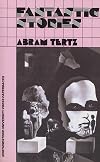
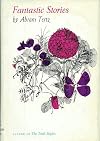
Fantastic Stories
by Andrei Sinyavsky
On This Page
Description
Abram Tertz is the pseudonym of Andrei Sinyavsky, the exile Soviet dissident writer whose works have been compared to fabulists like Kafka and Borges. Tertz's settings are exotic but familiar and as compelling as those of lunatics and mystics. This edition contains the nightmarish "Pkhentz," a story missing from the first English edition.Tags
Recommendations
















Member Recommendations
Member Reviews
I discovered Tertz some time ago as part of a class I was taking, and for a while was reading everything by or about him I could get my hands on. But these stories, the first ones I read, are still my favorites. Although the stories were written over a period of several years and apparently not conceived as a group, they are interrelated thematically and lend themselves well to being read together.
On some level all of the stories are concerned implicitly or explicitly with Soviet culture: "You and I" can be read as a terrifying parable about life under surveillance, and "Tenants" offers a humorous look at the residents of a communal housing building, while at the same time drawing on characters from Russian folklore. There are also show more numerous references to Russian literature, such as a tribute to Gogol in the form of a parody of a famous passage of "Dead Souls". But the stories are far more than satires, and while a knowledge of the cultural and political context is helpful for understanding some of the specific references, I read and enjoyed the stories without that background. Of Tertz's stories that I've read, these are probably the most accessible; by contrast, "The Trial Begins", for example, is much more directly concerned with life in the Soviet Union.
The "Fantastic Tales" are simply that: lively, unexpected, phantasmagoric stories -- the designation "arabesques" seems not inappropriate -- which somehow manage to remain light and even humorous in spite of their often violent or tragic subject matter. Yet they are also profoundly thought-provoking and poetic philosophical explorations of identity ("You and I"), alienation ("Pkhentz"), love and destiny ("The Icicle") and authorship ("Graphomaniacs"), among other things.
A few words on the translations, since I did some close work with one of the stories which necessitated consulting the original. Overall the translations are quite good. They read smoothly and are generally sensitive to the various layers of meaning in the text. Occasionally this results in emphasizing a reading which is mostly latent in the Russian (such as the sexual element in the sentence "I remembered the rule that one’s defenses are most easily penetrated from below…" in "You and I"), or in the omission of a sentence which comments on a verbal coincidence in Russian (that 'flour' (mUka) and 'torture' (mukA) differ only in stress, said by the plant-like being in "Pkhentz"). Although this sort of change is not unusual in translation, I encountered a few others which are more disturbing: for some reason the epigraph is omitted from "You and I", and the English translation has only five section breaks where the Russian has six, an omission which, in a story where the structure is fairly significant, is completely inexplicable.
In any case, the stories are highly worth reading, minor quibbles and all. Tertz tends not to be very widely known outside of Slavic departments, although I keep finding references to him in unexpected places. It's difficult to know what to compare his stories to. Kafka or Calvino, perhaps. He reminds me a bit of the Austrian writer Ilse Aichinger, and more than a little of his countryman Viktor Pelevin -- I've often wondered whether Tertz's writing was an influence on the latter, in fact, as his short stories, at least, show a similar mixture of the contemporary, fantastic, and philosophical. show less
On some level all of the stories are concerned implicitly or explicitly with Soviet culture: "You and I" can be read as a terrifying parable about life under surveillance, and "Tenants" offers a humorous look at the residents of a communal housing building, while at the same time drawing on characters from Russian folklore. There are also show more numerous references to Russian literature, such as a tribute to Gogol in the form of a parody of a famous passage of "Dead Souls". But the stories are far more than satires, and while a knowledge of the cultural and political context is helpful for understanding some of the specific references, I read and enjoyed the stories without that background. Of Tertz's stories that I've read, these are probably the most accessible; by contrast, "The Trial Begins", for example, is much more directly concerned with life in the Soviet Union.
The "Fantastic Tales" are simply that: lively, unexpected, phantasmagoric stories -- the designation "arabesques" seems not inappropriate -- which somehow manage to remain light and even humorous in spite of their often violent or tragic subject matter. Yet they are also profoundly thought-provoking and poetic philosophical explorations of identity ("You and I"), alienation ("Pkhentz"), love and destiny ("The Icicle") and authorship ("Graphomaniacs"), among other things.
A few words on the translations, since I did some close work with one of the stories which necessitated consulting the original. Overall the translations are quite good. They read smoothly and are generally sensitive to the various layers of meaning in the text. Occasionally this results in emphasizing a reading which is mostly latent in the Russian (such as the sexual element in the sentence "I remembered the rule that one’s defenses are most easily penetrated from below…" in "You and I"), or in the omission of a sentence which comments on a verbal coincidence in Russian (that 'flour' (mUka) and 'torture' (mukA) differ only in stress, said by the plant-like being in "Pkhentz"). Although this sort of change is not unusual in translation, I encountered a few others which are more disturbing: for some reason the epigraph is omitted from "You and I", and the English translation has only five section breaks where the Russian has six, an omission which, in a story where the structure is fairly significant, is completely inexplicable.
In any case, the stories are highly worth reading, minor quibbles and all. Tertz tends not to be very widely known outside of Slavic departments, although I keep finding references to him in unexpected places. It's difficult to know what to compare his stories to. Kafka or Calvino, perhaps. He reminds me a bit of the Austrian writer Ilse Aichinger, and more than a little of his countryman Viktor Pelevin -- I've often wondered whether Tertz's writing was an influence on the latter, in fact, as his short stories, at least, show a similar mixture of the contemporary, fantastic, and philosophical. show less
This was recommended to me as 'Soviet realism', but it isn't, really, it's not even realism at all.
Instead, this is one of the most psychedelic texts I have ever read. While the opening You and I still is relatively mild and 'only' concerns identity loss in a very playful manner and has you end up in confusion whether or not you are the writer, the reader or the protagonist, the following The icicle pulls all stops. A frightening initiation, clairvoyancy, access to earlier (and later) incarnations, awareness of elementals, being able to foresee the future, and an avalanche of other occult phenomena appear, all of them written down as if they are self-evident and accessible for everyone. Even a later incarnation of earth emerges. Yes, show more the background is the 'modern' Soviet state, and yes, the authorities do play a role here, but the atmosphere is whimsical throughout, the writing style on the verge of flippant. This continues in the consequent shorter stories, which are great fun to read, but miss the impact of The icicle. Surprising and worthwhile. show less
Instead, this is one of the most psychedelic texts I have ever read. While the opening You and I still is relatively mild and 'only' concerns identity loss in a very playful manner and has you end up in confusion whether or not you are the writer, the reader or the protagonist, the following The icicle pulls all stops. A frightening initiation, clairvoyancy, access to earlier (and later) incarnations, awareness of elementals, being able to foresee the future, and an avalanche of other occult phenomena appear, all of them written down as if they are self-evident and accessible for everyone. Even a later incarnation of earth emerges. Yes, show more the background is the 'modern' Soviet state, and yes, the authorities do play a role here, but the atmosphere is whimsical throughout, the writing style on the verge of flippant. This continues in the consequent shorter stories, which are great fun to read, but miss the impact of The icicle. Surprising and worthwhile. show less
In 1988 I stumbled upon this book at random at my university. I found unusual Soviet Union/Russian samizdat fiction, and this one was one of my major finds.The stories were drop-dead hilarious and just tour-de-forces of satire. I presented a book report at my college Soviet Lit class and actually generated a lot of interest in this writer among friends. (That same year, I also "discovered" Vladimir Voinovich's silly Moscow 2042, Nina Berberova's Tattered Cloak and M. Ageyev's Novel with Cocaine).
Of course, after then, the identity of Abram Tertz was disclosed as Andrei Sinyavsky, and some of his other works became available to the west (including the autobiographical Goodnight! A Novel, which was interesting though not halfway as good show more as Fantastic Stories).
A few random remarks: I can't remember whether Milan Kundera derived his "graphomania" concept from the story with this name in Fantastic Stories. At one point I knew the answer to this question (I was reading Kundera like mad).
Second, his self. v. authorial persona of Goodnight! A Novel certainly prefigures Phillip Roth's metafictional novels (not to mention Kundera's), not to mention The Breast.
So have you noticed that I have not told you anything about this story collection? Oops. I have totally forgotten what this book is about. I really need to reread . But rest assured that at the age of 21 I found it brilliant and inspiring, and you will too.
But rereading...and rediscovery, ahh, that is the pleasure. show less
Of course, after then, the identity of Abram Tertz was disclosed as Andrei Sinyavsky, and some of his other works became available to the west (including the autobiographical Goodnight! A Novel, which was interesting though not halfway as good show more as Fantastic Stories).
A few random remarks: I can't remember whether Milan Kundera derived his "graphomania" concept from the story with this name in Fantastic Stories. At one point I knew the answer to this question (I was reading Kundera like mad).
Second, his self. v. authorial persona of Goodnight! A Novel certainly prefigures Phillip Roth's metafictional novels (not to mention Kundera's), not to mention The Breast.
So have you noticed that I have not told you anything about this story collection? Oops. I have totally forgotten what this book is about. I really need to reread . But rest assured that at the age of 21 I found it brilliant and inspiring, and you will too.
But rereading...and rediscovery, ahh, that is the pleasure. show less
Ratings
Members
- Recently Added By
Lists

Russian Literature
187 works; 36 members

Best Fantasy Originally Published in a Language Other Than English
84 works; 26 members

Speculative Fiction from around the World
610 works; 18 members
Author Information

52+ Works 638 Members
Using the pseudonym Abram Terts, literary critic Andrei Sinyavsky wrote a number of satiric, often grotesque and surrealistic, prose works, including the short novel The Trial Begins (1960) and the essay "On Socialist Realism," a brilliant attack on the cliches of official Soviet literary dogma. In February 1966 he and writer Yuly Daniel were show more tried in a closed court. In spite of appeals by many writers in Russia and the West, they were sent to the labor camps for maligning the Soviet Union through "hostile" and "slanderous" writings published illegally abroad in the early 1960s. The trial marked the start of confrontations between the authorities and the nascent human-rights movement in the Soviet Union. After Sinyavsky's emigration to the West in 1973, he became a professor of Russian literature at the Sorbonne and continued to publish, both under his own name and the pseudonym. He was very active in emigre literary life, generally taking a liberal, democratic position and frequently finding himself a target of attacks by more-nationalist figures. Sinyavsky's newer writings include A Voice from the Chorus (1973), a hybrid text in which notes and letters from a penal camp are a vehicle for philosophical and literary meditations, and in which the author's own voice is joined by a multitude of voices of other inmates. His A Stroll with Pushkin (1975), a brilliant, joking discussion of Pushkin's art, provoked a storm of criticism both in the Soviet Union and abroad: Sinyavsky has been accused of blaspheming his nation's cultural icon. Little Jinx (1980) is a fantasy in which the personalities of both Sinyavsky and Terts are the objects of playful narrative manipulation. Sinyavsky's varied contributions make him one of the most important figures in contemporary Russian letters. His writings have now been reissued in Russia, where he has recently been awarded an honorary doctorate. (Bowker Author Biography) show less
Some Editions
Work Relationships
Is contained in
Contains
Common Knowledge
- Original publication date
- 1963
Classifications
- Genres
- Fiction and Literature, General Fiction, Fantasy
- DDC/MDS
- 813 — Literature & rhetoric American literature in English American fiction in English
- LCC
- PG3476 .S539 — Language and Literature Slavic languages and literatures. Baltic languages. Albanian language Slavic. Baltic. Albanian Russian literature Individual authors and works 1917-1960
- BISAC
Statistics
- Members
- 61
- Popularity
- 509,653
- Reviews
- 3
- Rating
- (4.00)
- Languages
- Dutch, English, Russian
- Media
- Paper
- ISBNs
- 2
- ASINs
- 2