On This Page
Description
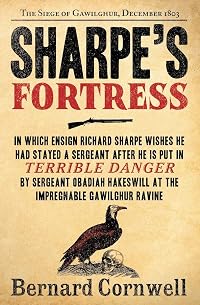
Critically acclaimed, perennial New York Times bestselling author Bernard Cornwell (Agincourt, The Fort, the Saxon Tales) makes real history come alive in his breathtaking historical fiction. Cornwell has brilliantly captured the fury, chaos, and excitement of battle as few writers have ever done-perhaps most vividly in his phenomenally popular novels following the illustrious military career of British Army officer Richard Sharpe during the late 18th and early 19th centuries. In Sharpe's show more Fortress, Ensign Sharpe's adventures in India reach a grand finale at the Siege of Gawilghur during the Maharatta War in December 1803, as Cornwell's hero uncovers a foul treason and seeks a righteous revenge. show lessTags
Recommendations








Member Reviews
While the Battle of Assaye (covered in Sharpe's Triumph) was a major defeat for the Mahratti forces of the confedration of western Indian kingdoms, Lt. Dodd, the renegade Englishman who has become Sharpe's personal target for revenge for the killing of Colonel McCandless, has retreated with his intact regiment, Dodd's Cobras, to the impregnable mountain fortress of Gawilghur. There, with the remnants of the Mahratti army, he plans to defeat the English army under Wellesley which must atttack and defeat Dodd if the English are to have any control and peace in the region. Confident of defending the fortress, Dodd intends to become Rajah of western India after destroying Wellesley's forces at Gawilghur.
Meanwhile, Sharpe--now Ensign Sharpe, show more having been promoted after saving Wellesley's life at Assaye--is miserable trying to fit in as an officer in a Scots regiment. He is also forced to coexist with his Nemesis, Sgt. Hakeswill, who has lost none of his enthusiasm to see Sharpe killed (preferably slowly and in great pain) and to steal the Sultan Tippoo's jewels which Hakeswill now knows Sharpe owns. Incapable by his malevolent nature of refraining from whatever evil comes to hand, Hakeswill, partnered by a degenerate officer, steals weapons and other military stores and sells them to the enemy. Sharpe discovers the treasonous scam by accident, and this provides Hakeswill an opportunity to kill Sharpe and steal his jewels.
Sharpe is captured by Hakeswill and turned over to the enemy, but Sharpe manages to escape. He rejoins the army as it prepares to assault Gawilghur. The rest, as they say, is history.
Oh yes, there is a love interest, but in this book, Sharpe is the object of a double whammy as he loses not one but two women!
Cornwell has few peers for this particular genere of historical action-adventure. The book is well researched; Cornwell provides an affterword of several pages explaining where he distorted history for the sake of the plot, and what the fortress looks like today.
You care about the characters--you worry about Sharpe and his friends, and curse his enemies.
Cornwell writes batttle scenes as well as Patrick O'Brain ever wrote the naval equivalent for the Aubrey/Maturin series; it would not be a surprise if Cornwell used O'Brian as an overall model. The one difference, I would say, is that O'Brian wrote memorable female characters who were integral to the series, whereas Cornwell's women are indifferently drawn and forgettable. Whether he emulated O'Brian or not, Cornwell's Sharpe series is outstanding in its own right. The climactic battle for Gawilghur is a real thriller--I could not put the book down until I finished, racing through the pages to the end.
Highly recommended. show less
Meanwhile, Sharpe--now Ensign Sharpe, show more having been promoted after saving Wellesley's life at Assaye--is miserable trying to fit in as an officer in a Scots regiment. He is also forced to coexist with his Nemesis, Sgt. Hakeswill, who has lost none of his enthusiasm to see Sharpe killed (preferably slowly and in great pain) and to steal the Sultan Tippoo's jewels which Hakeswill now knows Sharpe owns. Incapable by his malevolent nature of refraining from whatever evil comes to hand, Hakeswill, partnered by a degenerate officer, steals weapons and other military stores and sells them to the enemy. Sharpe discovers the treasonous scam by accident, and this provides Hakeswill an opportunity to kill Sharpe and steal his jewels.
Sharpe is captured by Hakeswill and turned over to the enemy, but Sharpe manages to escape. He rejoins the army as it prepares to assault Gawilghur. The rest, as they say, is history.
Oh yes, there is a love interest, but in this book, Sharpe is the object of a double whammy as he loses not one but two women!
Cornwell has few peers for this particular genere of historical action-adventure. The book is well researched; Cornwell provides an affterword of several pages explaining where he distorted history for the sake of the plot, and what the fortress looks like today.
You care about the characters--you worry about Sharpe and his friends, and curse his enemies.
Cornwell writes batttle scenes as well as Patrick O'Brain ever wrote the naval equivalent for the Aubrey/Maturin series; it would not be a surprise if Cornwell used O'Brian as an overall model. The one difference, I would say, is that O'Brian wrote memorable female characters who were integral to the series, whereas Cornwell's women are indifferently drawn and forgettable. Whether he emulated O'Brian or not, Cornwell's Sharpe series is outstanding in its own right. The climactic battle for Gawilghur is a real thriller--I could not put the book down until I finished, racing through the pages to the end.
Highly recommended. show less
I did not want to read about Colonialism, war, or English soldiers. I felt as though I was doing battle with the author all through this book. I thought I would abandon it, but would decide after reading just one more page. Twenty to fifty pages later, I was still reading. This happened several times until I passed the point of no return and could hardly put the book down. I confess to skimming a few portions of the enemy gloating and scheming, but when it came to Sharpe, I read every word. Cornwell has the gift of transporting you to the time and place you are reading about. The realism of the battles and life in those times is both horrifying and engrossing. Happy to have hung in there with this story.
Very little time has passed since the last of Sharpe's adventures, in which he saved Arthur Wellesley's life and the future Iron Duke made him an officer. As we start this new chapter in his life, Sharpe is getting a foul taste of just how hard it is to be an officer promoted "up from the ranks" in the British army of 1803. He's not of the gentry, so gets no respect from enlisted men or officers, and is coming to regret having tried so hard to get this leg up he's gotten.
But soon he's got bigger problems. Because both of his great enemies, the terrifying and capable British deserter Major Dodd, who is killing his way to becoming Lord of All India fighting for the Mahrathas, and the twitching, malevolent Sergeant Hakeswill, who has been show more trying for two novels now to get Sharpe killed out of sheer spite and hatred. The one has been chased, along with his army and allies, into India's great fortress in the sky, Gawilghur; the other has turned up among the British soldiers trying to solve the puzzle of how to take that impregnable place, destroy the Mahratha army there, and bring Dodd to justice. Oh, my.
The star of this novel is definitely the fortress itself, hence the title. Imagine George R.R. Martin's Eyrie, defended by thumping huge cannons and approachable only via a narrow ravine that is basically just a shooting gallery for said cannon. But before you can get to the ravine, you have to pound your way through an outer fort. While the fort's defenders shoot at you with thumping huge cannons.
Fortunately for Sharpe and his pals, the walls of these forts are old and ill-maintained. Also, the people in charge within are a cowardly princeling who just wants to be left alone to sport with his wives and concubines, and the enemy rajah's brother, who is quite a capable soldier, but whose faith in his men is so weak that he won't let that splendid attack dog, Dodd, do anything but kick his heels and take the occasional potshot with one of those newfangled rifle thingies. So the British are free to build their road right up to the perfect spot to hammer away at the walls with their cannon, and everybody has enough time on their hands to plot against each other. Because Hakeswill. And his buddy Captain Torrance, who already had it in for Sharpe because Sharpe's first act upon being assigned to help the Captain is to expose the Captain's treachery. D'oh!
And I haven't even talked about the treachery among the bad guys. Oh, is it delicious.
Bappoo's survivors, betrayed by Dodd, were trapped between two forces. They were stranded in a hell above emptiness, a slaughter in the high hills. There were screams as men tumbled to their deaths far beneath and still the fire kept coming. It kept coming until there was nothing left but quivering men crouching in terror on a road that was rank with the stench of blood, and then the redcoats moved forward with bayonets.
Yowza! Betrayal and the Ravine of Death!
Again, the tension of whether or not Sharpe is going to survive all of this is robbed of the modern reader who knows he's got a future with a rifle company in Europe, but Cornwell finds plenty of other ways to keep the reader eagerly turning pages. We don't know how Sharpe is going to get out of his own personal very difficult predicaments, just as we don't know (unless we peek at Wikipedia or something) how the hell the British are going to get through the Ravine of Death, or anything else, for that matter. Once again, Cornwell has done a skillful job of combining the exploits of real historical figures (Oh, Colonel Kenny!) with those of his semi-fictional villains (Dodd) and his own characters (Hakeswill, Major John Stokes, Sharpe himself) into something seamless and compulsively readable.
Most gratifying to me is the return of Major Stokes, whom you may recall from my last go-around in Sharpe's universe became quite a favorite of mine. Here he's put in charge of building the road that will allow the British to haul their cannons, shot, powder, and selves into attack range and of cobbling together some semblance of defenses for them as they haul. He doesn't get a lot of scenes, but he shines in all his nerdy glory in those he gets, and as one of Sharpe's few allies, quite well deserves to.
Also fun is Ahmed, an Arab boy whom Sharpe rescues from the precursor battle that opens the novel and who becomes Sharpe's fanatically loyal servant. Several major plot points revolve around this little hellion, whose command of the King's English improves somewhat over the course of the story but since he's learned it from Sharpe contains rather more "buggers" than a schoolmaster might like.
It continues to take almost all the willpower I have not to just plow through all of these Sharpe novels in one swoop. They're wonderfully written, utterly absorbing, thrilling, fun, bloody, character-driven, full of dashing heroics and madcap schemes -- everything I like in a novel. And they keep getting better, these books!
But I think if I did just go all Sharpe, all the time, I might end up doing something foolish when I was done. Like joining the army. Which would be pretty stupid. What would they do with a 42-year-old fat chick who can't even shoot straight, I ask you? show less
But soon he's got bigger problems. Because both of his great enemies, the terrifying and capable British deserter Major Dodd, who is killing his way to becoming Lord of All India fighting for the Mahrathas, and the twitching, malevolent Sergeant Hakeswill, who has been show more trying for two novels now to get Sharpe killed out of sheer spite and hatred. The one has been chased, along with his army and allies, into India's great fortress in the sky, Gawilghur; the other has turned up among the British soldiers trying to solve the puzzle of how to take that impregnable place, destroy the Mahratha army there, and bring Dodd to justice. Oh, my.
The star of this novel is definitely the fortress itself, hence the title. Imagine George R.R. Martin's Eyrie, defended by thumping huge cannons and approachable only via a narrow ravine that is basically just a shooting gallery for said cannon. But before you can get to the ravine, you have to pound your way through an outer fort. While the fort's defenders shoot at you with thumping huge cannons.
Fortunately for Sharpe and his pals, the walls of these forts are old and ill-maintained. Also, the people in charge within are a cowardly princeling who just wants to be left alone to sport with his wives and concubines, and the enemy rajah's brother, who is quite a capable soldier, but whose faith in his men is so weak that he won't let that splendid attack dog, Dodd, do anything but kick his heels and take the occasional potshot with one of those newfangled rifle thingies. So the British are free to build their road right up to the perfect spot to hammer away at the walls with their cannon, and everybody has enough time on their hands to plot against each other. Because Hakeswill. And his buddy Captain Torrance, who already had it in for Sharpe because Sharpe's first act upon being assigned to help the Captain is to expose the Captain's treachery. D'oh!
And I haven't even talked about the treachery among the bad guys. Oh, is it delicious.
Bappoo's survivors, betrayed by Dodd, were trapped between two forces. They were stranded in a hell above emptiness, a slaughter in the high hills. There were screams as men tumbled to their deaths far beneath and still the fire kept coming. It kept coming until there was nothing left but quivering men crouching in terror on a road that was rank with the stench of blood, and then the redcoats moved forward with bayonets.
Yowza! Betrayal and the Ravine of Death!
Again, the tension of whether or not Sharpe is going to survive all of this is robbed of the modern reader who knows he's got a future with a rifle company in Europe, but Cornwell finds plenty of other ways to keep the reader eagerly turning pages. We don't know how Sharpe is going to get out of his own personal very difficult predicaments, just as we don't know (unless we peek at Wikipedia or something) how the hell the British are going to get through the Ravine of Death, or anything else, for that matter. Once again, Cornwell has done a skillful job of combining the exploits of real historical figures (Oh, Colonel Kenny!) with those of his semi-fictional villains (Dodd) and his own characters (Hakeswill, Major John Stokes, Sharpe himself) into something seamless and compulsively readable.
Most gratifying to me is the return of Major Stokes, whom you may recall from my last go-around in Sharpe's universe became quite a favorite of mine. Here he's put in charge of building the road that will allow the British to haul their cannons, shot, powder, and selves into attack range and of cobbling together some semblance of defenses for them as they haul. He doesn't get a lot of scenes, but he shines in all his nerdy glory in those he gets, and as one of Sharpe's few allies, quite well deserves to.
Also fun is Ahmed, an Arab boy whom Sharpe rescues from the precursor battle that opens the novel and who becomes Sharpe's fanatically loyal servant. Several major plot points revolve around this little hellion, whose command of the King's English improves somewhat over the course of the story but since he's learned it from Sharpe contains rather more "buggers" than a schoolmaster might like.
It continues to take almost all the willpower I have not to just plow through all of these Sharpe novels in one swoop. They're wonderfully written, utterly absorbing, thrilling, fun, bloody, character-driven, full of dashing heroics and madcap schemes -- everything I like in a novel. And they keep getting better, these books!
But I think if I did just go all Sharpe, all the time, I might end up doing something foolish when I was done. Like joining the army. Which would be pretty stupid. What would they do with a 42-year-old fat chick who can't even shoot straight, I ask you? show less
I liked the PBS series & found the books very enjoyable, but as an audio book, it really shined. Cornwell's historical afterwords, which set straight any inaccuracies, are wonderful, too. But take my star rating with a grain of salt. I didn't find this book quite as good as the others I've read, just liked it in this format better.
The story suffered from quite a bit of repetition at times. For instance, the area they assaulted must have been described half a dozen times until it not only bored, but confused me. There were several other points & motivations that were hammered half to death, too.
Sharpe's actions & motivations didn't always ring true. He was too cavalier in some situations & too untrusting in others. Still, if I just went show more with it, the story was excellent. As usual, Cornwell made the time, situation, & landscape pop into a realistic whole that practically transported me. I can't wait to see if the library has the next one & plan to 'read' more of Cornwell's books like this. He has quite a few that I've heard great things about. show less
The story suffered from quite a bit of repetition at times. For instance, the area they assaulted must have been described half a dozen times until it not only bored, but confused me. There were several other points & motivations that were hammered half to death, too.
Sharpe's actions & motivations didn't always ring true. He was too cavalier in some situations & too untrusting in others. Still, if I just went show more with it, the story was excellent. As usual, Cornwell made the time, situation, & landscape pop into a realistic whole that practically transported me. I can't wait to see if the library has the next one & plan to 'read' more of Cornwell's books like this. He has quite a few that I've heard great things about. show less
Whoo! I think this is my favorite of the ones I’ve read thus far. I can’t imagine the amount of research Cornwell puts into his books—he even traveled to India to visit this fortress so that he could accurately describe the sheer cliffs, turns in narrow corridors, and the layout of the structure. Very impressive to be sure.
I do want to throttle Sharpe for making the same mistake he did the first 2 times he tried to kill Hakeswill… but Cornwell didn’t have much choice, since Hakeswille will be around well into the series. There are times I feel slightly sorry for the twitchy sergeant, such as when he mentions the fact that as a child, he was hanged. It was his small size that allowed him to survive the gallows. A horrible show more experience for any child to survive, and I’m sure that would mess with anybody’s personality… But yeah, the rest of the time he is just a nasty creature.
Torrance, though, he was great! He was just so… hedonistic, that it was funny. He’s one of those antagonists that you can’t help but to like. At least I couldn’t help it, anyway.
And another favorite new character: Ahmed. Little Ahmed is just adorable. Poor kid. At least he was able to repay Sharpe’s saving his life—which reminds me: the arena scene between Sharpe and the two strongmen is $%^& awesome! show less
I do want to throttle Sharpe for making the same mistake he did the first 2 times he tried to kill Hakeswill… but Cornwell didn’t have much choice, since Hakeswille will be around well into the series. There are times I feel slightly sorry for the twitchy sergeant, such as when he mentions the fact that as a child, he was hanged. It was his small size that allowed him to survive the gallows. A horrible show more experience for any child to survive, and I’m sure that would mess with anybody’s personality… But yeah, the rest of the time he is just a nasty creature.
Torrance, though, he was great! He was just so… hedonistic, that it was funny. He’s one of those antagonists that you can’t help but to like. At least I couldn’t help it, anyway.
And another favorite new character: Ahmed. Little Ahmed is just adorable. Poor kid. At least he was able to repay Sharpe’s saving his life—which reminds me: the arena scene between Sharpe and the two strongmen is $%^& awesome! show less
This review is written with a GPL 4.0 license and the rights contained therein shall supersede all TOS by any and all websites in regards to copying and sharing without proper authorization and permissions. Crossposted at WordPress, Blogspot, & Librarything by Bookstooge’s Exalted Permission
Title: Sharpe's Fortress
Series: Sharpe #3
Authors: Bernard Cornwell
Rating: 3.5 of 5 Stars
Genre: Historical Fiction
Pages: 274
Words: 114.5K
Synopsis:
From Wikipedia.org
In 1803, Arthur Wellesley's British and sepoy army is in pursuit of the Mahrattas in western India, having beaten them in the Battle of Assaye. Ensign Richard Sharpe, newly made an officer, is beginning to wish he had remained a sergeant, as most of his fellow officers look down upon him, show more including Captain Urquhart, his commanding officer. Urquhart suggests he sell his commission if he is not happy.
Manu Bappoo, the younger brother of the Rajah of Berar, decides to turn around and fight the British again, with his best unit, composed of Arab mercenaries, leading the charge, but he is again routed. During the fighting, Sharpe is impressed by the bravery of a teenage Arab boy, Ahmed, and saves his life when the boy is surrounded. Ahmed becomes his servant.
After the battle, Urquhart reassigns Sharpe to the 95th Rifles, an experimental unit, though the transfer cannot be completed while the war rages on. For the moment, Sharpe is sent to manage the baggage train, under the command of Captain Torrance. The army is short of many desperately needed supplies, and Sharpe soon discovers why. Lazy and deeply in debt, Torrance has been selling them to the merchant Naig, with the assistance of Sharpe's old nemesis, Sergeant Hakeswill. When Sharpe finds many of the stolen supplies in Naig's tent, Torrance has his associate hanged immediately to avoid being implicated. Jama, Naig's brother, is not pleased, so Torrance agrees to betray Sharpe into his hands. Hakeswill is only too glad to waylay Sharpe; besides their mutual hatred, he rightly suspects that Sharpe has a fortune in jewels looted from a dead enemy ruler.
Hakeswill ambushes Sharpe and takes him prisoner. He steals all of the jewels Sharpe has hidden on his person, then hands him over to Jama. Fortunately, Ahmed witnesses Sharpe's kidnapping and gets away. He finds Sharpe's friend, Syud Sevagee, who rescues him. Sharpe decides to let his enemies believe he is dead. Using this ruse, he catches captain Torrance alone and kills him in an act of summary justice.
The Mahrattas take refuge in Gawilghur, a seemingly impregnable fortress, perched high on cliffs above the Deccan Plain. Wellesley, despite his deep misgivings, has no choice but to attack anyway. Gawilghur is composed of an Outer Fort and an Inner Fort. While the Outer Fort is formidable, the Mahrattas expect the British to take it, though at heavy cost. However, the Inner Fort is so strong, they are confident it cannot fall. Once Wellesley's army has been bled dry trying to capture it, the Mahrattas plan to emerge and destroy the survivors.
When two of Hakeswill's henchmen are killed, Hakeswill realises Sharpe is responsible, so he deserts and finds service with the renegade Englishman William Dodd in Gawilghur. Who rules in Gawilghur, it is said, rules India, and Dodd intends for it to be him. When the Outer Fort falls, Dodd orders the gates of the Inner Fort be kept closed, trapping Manu Bappoo outside to be killed by the British. Dodd also murders Beny Singh, the weak commander of Gawilghur. However, Sharpe finds a way into the Inner Fort, a section of the wall which is weakly defended because it sits atop a steep cliff. The cliff, however, can be scaled. When Captain Morris, Sharpe's commanding officer, refuses to give him men, Sharpe beats him, then takes charge and leads a group of soldiers inside and opens the gates. He then finds and duels with Dodd, only to find that Dodd is by far the better swordsman. It is Dodd who gives Sharpe the scar on his right cheek. Ahmed appears unexpectedly and attacks Dodd. Dodd kills him easily, but a cavalryman shoots him in the shoulder, and then Sharpe is able to kill him.
Hakeswill tries to flee, disguised as a British soldier, but Sharpe finds him. Sharpe retrieves most of his jewels from him, then backs Hakeswill up until he falls into a pit filled with poisonous snakes.
My Thoughts:
This was a good adventure story. Without a side character who is religious and devout, Cornwell didn't seem to have a target for his religious vitriol and thus didn't use Sharpe as a mouthpiece. Hakeswill is still around, but he talks a LOT less, so his abuse of the phrase “Scripture says” was cut down to a palatable amount.
Speaking of Hakeswill. The book ends with Sharpe pushing him into a pit of poisonous snakes and then Sharpe just walks away without confirming that Hakeswill dies. How stupid is Sharpe? He's tried to feed Hakeswill to tigers AND have an elephant crush him but he never verifies. So I am fully expecting Hakeswill to survive and come back in the next book to cause problems yet again. Honestly, I'm surprised Sharpe just doesn't bring him up on charges for not saluting him and have him flogged to death. What's the point of being an Officer if he's still going to think and act like a soldier of the line?
I am not at all familiar with the history of Britain's conquering of India, as I'm more concerned with the American and British bit of history, so this has all been brand new stuff to me. I rather like it and am enjoying the story. There was talk about Sharpe being transferred to another company somewhere in this book and I think they were located back in England, so this might be the last of the Indian scenery. I guess I'll find out in the next book.
★★★✬☆ show less
Title: Sharpe's Fortress
Series: Sharpe #3
Authors: Bernard Cornwell
Rating: 3.5 of 5 Stars
Genre: Historical Fiction
Pages: 274
Words: 114.5K
Synopsis:
From Wikipedia.org
In 1803, Arthur Wellesley's British and sepoy army is in pursuit of the Mahrattas in western India, having beaten them in the Battle of Assaye. Ensign Richard Sharpe, newly made an officer, is beginning to wish he had remained a sergeant, as most of his fellow officers look down upon him, show more including Captain Urquhart, his commanding officer. Urquhart suggests he sell his commission if he is not happy.
Manu Bappoo, the younger brother of the Rajah of Berar, decides to turn around and fight the British again, with his best unit, composed of Arab mercenaries, leading the charge, but he is again routed. During the fighting, Sharpe is impressed by the bravery of a teenage Arab boy, Ahmed, and saves his life when the boy is surrounded. Ahmed becomes his servant.
After the battle, Urquhart reassigns Sharpe to the 95th Rifles, an experimental unit, though the transfer cannot be completed while the war rages on. For the moment, Sharpe is sent to manage the baggage train, under the command of Captain Torrance. The army is short of many desperately needed supplies, and Sharpe soon discovers why. Lazy and deeply in debt, Torrance has been selling them to the merchant Naig, with the assistance of Sharpe's old nemesis, Sergeant Hakeswill. When Sharpe finds many of the stolen supplies in Naig's tent, Torrance has his associate hanged immediately to avoid being implicated. Jama, Naig's brother, is not pleased, so Torrance agrees to betray Sharpe into his hands. Hakeswill is only too glad to waylay Sharpe; besides their mutual hatred, he rightly suspects that Sharpe has a fortune in jewels looted from a dead enemy ruler.
Hakeswill ambushes Sharpe and takes him prisoner. He steals all of the jewels Sharpe has hidden on his person, then hands him over to Jama. Fortunately, Ahmed witnesses Sharpe's kidnapping and gets away. He finds Sharpe's friend, Syud Sevagee, who rescues him. Sharpe decides to let his enemies believe he is dead. Using this ruse, he catches captain Torrance alone and kills him in an act of summary justice.
The Mahrattas take refuge in Gawilghur, a seemingly impregnable fortress, perched high on cliffs above the Deccan Plain. Wellesley, despite his deep misgivings, has no choice but to attack anyway. Gawilghur is composed of an Outer Fort and an Inner Fort. While the Outer Fort is formidable, the Mahrattas expect the British to take it, though at heavy cost. However, the Inner Fort is so strong, they are confident it cannot fall. Once Wellesley's army has been bled dry trying to capture it, the Mahrattas plan to emerge and destroy the survivors.
When two of Hakeswill's henchmen are killed, Hakeswill realises Sharpe is responsible, so he deserts and finds service with the renegade Englishman William Dodd in Gawilghur. Who rules in Gawilghur, it is said, rules India, and Dodd intends for it to be him. When the Outer Fort falls, Dodd orders the gates of the Inner Fort be kept closed, trapping Manu Bappoo outside to be killed by the British. Dodd also murders Beny Singh, the weak commander of Gawilghur. However, Sharpe finds a way into the Inner Fort, a section of the wall which is weakly defended because it sits atop a steep cliff. The cliff, however, can be scaled. When Captain Morris, Sharpe's commanding officer, refuses to give him men, Sharpe beats him, then takes charge and leads a group of soldiers inside and opens the gates. He then finds and duels with Dodd, only to find that Dodd is by far the better swordsman. It is Dodd who gives Sharpe the scar on his right cheek. Ahmed appears unexpectedly and attacks Dodd. Dodd kills him easily, but a cavalryman shoots him in the shoulder, and then Sharpe is able to kill him.
Hakeswill tries to flee, disguised as a British soldier, but Sharpe finds him. Sharpe retrieves most of his jewels from him, then backs Hakeswill up until he falls into a pit filled with poisonous snakes.
My Thoughts:
This was a good adventure story. Without a side character who is religious and devout, Cornwell didn't seem to have a target for his religious vitriol and thus didn't use Sharpe as a mouthpiece. Hakeswill is still around, but he talks a LOT less, so his abuse of the phrase “Scripture says” was cut down to a palatable amount.
Speaking of Hakeswill. The book ends with Sharpe pushing him into a pit of poisonous snakes and then Sharpe just walks away without confirming that Hakeswill dies. How stupid is Sharpe? He's tried to feed Hakeswill to tigers AND have an elephant crush him but he never verifies. So I am fully expecting Hakeswill to survive and come back in the next book to cause problems yet again. Honestly, I'm surprised Sharpe just doesn't bring him up on charges for not saluting him and have him flogged to death. What's the point of being an Officer if he's still going to think and act like a soldier of the line?
I am not at all familiar with the history of Britain's conquering of India, as I'm more concerned with the American and British bit of history, so this has all been brand new stuff to me. I rather like it and am enjoying the story. There was talk about Sharpe being transferred to another company somewhere in this book and I think they were located back in England, so this might be the last of the Indian scenery. I guess I'll find out in the next book.
★★★✬☆ show less
The three Sharpe's novels set in India are among my favorites. They're longer and Cornwell does more with them. More than anything, they provide background to the Sharpe's stories that occur in the Peninsula.
This is Sharpe's first experience as an officer, an ensign assigned to the well-trained 74th Regt. They don't need him, so he is detailed to logistical support duties which find him immediately assigned as an assistant to Captain Torrance, corrupt supply officer. Not surprisingly Torrance is in league with Sharpe's old nemesis Obadiah Hakeswill. Sharpe always finds a way to circumvent these "inside" problems and gets to participate on the impregnable fortress of Gawilghur.
Cornwell is so adept at telling battle stories on a level show more that is understandable. He tells us just enough to picture the battle as a big picture, as well as helping us understand the soldier's individual role in the battle. Yes the story is formulaic, but many of the characters-McCandless, Stokes, and Sharpe himself are quite endearing. It's kept me coming back for more. show less
This is Sharpe's first experience as an officer, an ensign assigned to the well-trained 74th Regt. They don't need him, so he is detailed to logistical support duties which find him immediately assigned as an assistant to Captain Torrance, corrupt supply officer. Not surprisingly Torrance is in league with Sharpe's old nemesis Obadiah Hakeswill. Sharpe always finds a way to circumvent these "inside" problems and gets to participate on the impregnable fortress of Gawilghur.
Cornwell is so adept at telling battle stories on a level show more that is understandable. He tells us just enough to picture the battle as a big picture, as well as helping us understand the soldier's individual role in the battle. Yes the story is formulaic, but many of the characters-McCandless, Stokes, and Sharpe himself are quite endearing. It's kept me coming back for more. show less
Members
- Recently Added By
Lists

Favourite Books
1,820 works; 309 members
Author Information

172+ Works 93,988 Members
Bernard Cornwell was born in London, England, on February 23, 1944, and came to the United States in 1980. He received a B.A. from the University of London in 1967. Cornwell served as producer of the British Broadcasting Corporation from 1969-1976. After this he was head of current affairs for BBC-TV in Belfast, Northern Ireland. In 1979 he became show more editor of television news for Thames Television of London. Since 1980 he has been a freelance writer. he lives with his wife on Cape Cod. Cornwell's Sharpe series, adventure stories about a British soldier set in the Peninsula War of 1808-1814, are built on the author's interest in the Duke of Wellington's army. Titles include Sharpe's Rifles, Sharpe's Revenge, Sharpe's Siege, Sharpe's Regiment, and Sharpe's Waterloo. The Last Kingdom series has ten books. Book ten, The Flame Bearer is on the bestsellers list. He has also written other works including Wildtrack, Killer's Wake, Sea Lord, Stormchild, Rebel, Copperhead, and Battle Flag. His title Death of Kings made The New York Times Best Seller List in 2012 and In 2014 his title The Pagan Lord made the list again. (Bowker Author Biography) show less
Series

Work Relationships
Is contained in
Sharpe's War Battle Collection (Sharpe's Battle, Sharpe's Havoc, Sharpe's Eagle, Sharpe's Trafalgar, Sharpe's Fortress, Sharpe's Triumph, Sharpe's Siege, Sharpe's Regiment, Sharpe's Waterloo) by Bernard Cornwell
Sharpe's War Battle Collection (Sharpe's Waterloo, Sharpe's Siege, Sharpe's Regiment, Sharpe's Company, Sharpe's Battle, Sharpe's Fury, Sharpe's Escape, Sharpe's Gold, Sharpe's Eagle, Sharpe's Havoc, Sharpe's Rifles, Sharpe's Prey, Sharpe's Trafalgar, Sharpe's Fortress, Sharpe's Triumph, Sharpe's Tiger) by Bernard Cornwell
Sharpe Series (Sharpe's Trafalgar; Sharpe's Tiger; Sharpe's Triumph; Sharpe's Fortress; Sharpe's Prey; Sharpe's Rifles; Sharpe's Havoc; Sharpe's Eagle; Sharpe's Gold; Sharpe's Escape; Sharpe's Battle; Sharpe's Company; Sharpe's Sword; Sharpe's Enemy) by Bernard Cornwell
Sharpe's War Collection (Sharpe's Battle, Sharpe's Eagle, Sharpe's Escape, Sharpe's Fortress, Sharpe's Fury, Sharpe's Gold, Sharpe's Havoc, Sharpe's Prey, Sharpe's Rifles, Sharpe's Tiger, Sharpe's Trafalgar, Sharpe's Triumph) by Bernard Cornwell
Sharpe's War Collection: Sharpe's Battle, Sharpe's Eagle, Sharpe's Escape, Sharpe's Fortress, Sharpe's Fury, Sharpe's Gold, Sharpe's Havoc, Sharpe's Prey by Bernard Cornwell
Common Knowledge
- Canonical title
- Sharpe's Fortress
- Original title
- Sharpe's Fortress
- Alternate titles
- Sharpe's Fortress: Richard Sharpe and the Siege of Gawilghur, December 1803
- Original publication date
- 1998-11-19
- People/Characters
- Richard Sharpe; Arthur Wellesley, 1st Duke of Wellington; Obadiah Hakeswill; Major William Dodd; Syud Sevajee
- Important places
- Gawilghur, Maharashtra, India; Argaon, Maharashtra, India; India
- Important events
- Second Anglo-Maratha War (1802 | 1805); Battle of Argaon (1803-11-28); Siege of Gawilghur (1803-12-15)
- Dedication
- Sharpe's Fortress is for Christine Clarke, with many thanks.
- First words
- Richard Sharpe wanted to be a good officer.
- Last words
- (Click to show. Warning: May contain spoilers.)It was the fastness in the sky, the stronghold that could not fall, and now it was Sharpe's fortress.
Classifications
Statistics
- Members
- 1,769
- Popularity
- 12,437
- Reviews
- 25
- Rating
- (4.01)
- Languages
- 8 — Czech, English, German, Hungarian, Italian, Polish, Portuguese, Spanish
- Media
- Paper, Audiobook, Ebook
- ISBNs
- 49
- ASINs
- 26