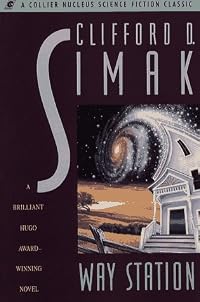
Way Station
by Clifford D. Simak
On This Page
Description
An ageless hermit runs a secret way station for alien visitors in the Wisconsin woods in this Hugo Award-winning science fiction classic Enoch Wallace is not like other humans. Living a secluded life in the backwoods of Wisconsin, he carries a nineteenth-century rifle and never seems to age-a fact that has recently caught the attention of prying government eyes. The truth is, Enoch is the last surviving veteran of the American Civil War and, for close to a century, he has operated a secret show more way station for aliens passing through on journeys to other stars. But the gifts of knowledge and immortality that his intergalactic guests have bestowed upon him are proving to be a nightmarish burden, for they have opened Enoch's eyes to humanity's impending destruction. Still, one final hope remains for the human race . . . though the cure could ultimately prove more terrible than the disease. Winner of the Hugo Award for Best Novel, Way Station is a magnificent example of the fine art of science fiction as practiced by a revered Grand Master. A cautionary tale that is at once ingenious, evocative, and compassionately human, it brilliantly supports the contention of the late, great Robert A. Heinlein that "to read science-fiction is to read Simak.". show lessTags
Recommendations























Member Reviews
Ahh 😌 I love the quietness of Simak's writing. He deals with big questions calmly, he's enchanting and optimistic, but tinged with sadness, opening majestic vistas while acknowledging the transitoriness of life and the inevitability of change. I think the sadness is in the limitedness of individual experience, the optimism in the potential of collective growth, and his magic is in seeking to reconcile us to both realities.
I don't think Simak is read much these days, but he had a long career in science fiction, publishing his first short story in 1931 and his last novel in 1986. He was the third author to be named a Grand Master by the Science Fiction Writers of America, and one of the first class of authors to receive the Lifetime Achievement Award from the Horror Writers Association.
He's often described as the genre's great pastoral writer; his stories are more likely to be set in the country than in futuristic cities or on spaceships. And Way Station, the 1964 Hugo winner for Best Novel, is a fine example.
The novel is set in the (then) present day in a particularly isolated corner of Wisconsin, where Enoch Wallace lives in the home his father built, show more keeping mostly to himself. With the exception of a daily walk and chats with the mailman, he doesn't even leave his house all that often.
The locals know that Enoch is a bit odd; they notice, for instance, that he doesn't ever seem to age much, seeming to be permanently stuck somewhere in his 30s. He is, in fact, a Civil War veteran, and owes his longevity to the fact that the house he rarely leaves is part of an interstellar travel network; his longevity is a gift from the aliens on whose behalf he manages this station. By traditional standards, it's a lonely existence, but Enoch is a smart and curious man, and his conversations with the travelers who come through his station are more than enough compensation for the lack of human relationships.
But a man and a house this strange can't go unnoticed by the outside world forever, and a federal stakeout of Enoch's home sets the story in motion.
Simak's style is calm and quiet, so much so that the novel feels less eventful than it is. It's a novel filled with awe, as Enoch marvels that he has been given this strange role in a universe that is so much larger than he ever might have imagined. Here's a sample of Simak's style, after one unexpected event:
"There was a quietness. As if the entire world had caught its breath and stood attentive and in awe, waiting for a sound that did not come, that would never come but would always be expected.
"And with the quietness came an abiding sense of peace that seemed to seep into the very fiber of one's being. It was no synthetic thing -- not as if someone had invoked a peace and peace then was alllowed to exist by sufferance. It was a present and an actual peace, the peace of mind that came with the calmness of a sunset after a long, hot day, or the sparkling, ghost-like shimmer of a springtime dawn. You felt it inside of you and all about you, and there was the feeling that it was not only here but that the peace extended on and out in all directions, to the farthest reaches of infinity, and that it had a depth which would enable it to endure until the final gasp of all enternity."
That style and those ideas are unusual in science fiction, which is not (he wildly overgeneralized) a genre given to calm contemplation and awesome majesty. Perhaps that's why Simak has fallen out of vogue. I haven't read much of his work myself; this book makes me want to read more. show less
He's often described as the genre's great pastoral writer; his stories are more likely to be set in the country than in futuristic cities or on spaceships. And Way Station, the 1964 Hugo winner for Best Novel, is a fine example.
The novel is set in the (then) present day in a particularly isolated corner of Wisconsin, where Enoch Wallace lives in the home his father built, show more keeping mostly to himself. With the exception of a daily walk and chats with the mailman, he doesn't even leave his house all that often.
The locals know that Enoch is a bit odd; they notice, for instance, that he doesn't ever seem to age much, seeming to be permanently stuck somewhere in his 30s. He is, in fact, a Civil War veteran, and owes his longevity to the fact that the house he rarely leaves is part of an interstellar travel network; his longevity is a gift from the aliens on whose behalf he manages this station. By traditional standards, it's a lonely existence, but Enoch is a smart and curious man, and his conversations with the travelers who come through his station are more than enough compensation for the lack of human relationships.
But a man and a house this strange can't go unnoticed by the outside world forever, and a federal stakeout of Enoch's home sets the story in motion.
Simak's style is calm and quiet, so much so that the novel feels less eventful than it is. It's a novel filled with awe, as Enoch marvels that he has been given this strange role in a universe that is so much larger than he ever might have imagined. Here's a sample of Simak's style, after one unexpected event:
"There was a quietness. As if the entire world had caught its breath and stood attentive and in awe, waiting for a sound that did not come, that would never come but would always be expected.
"And with the quietness came an abiding sense of peace that seemed to seep into the very fiber of one's being. It was no synthetic thing -- not as if someone had invoked a peace and peace then was alllowed to exist by sufferance. It was a present and an actual peace, the peace of mind that came with the calmness of a sunset after a long, hot day, or the sparkling, ghost-like shimmer of a springtime dawn. You felt it inside of you and all about you, and there was the feeling that it was not only here but that the peace extended on and out in all directions, to the farthest reaches of infinity, and that it had a depth which would enable it to endure until the final gasp of all enternity."
That style and those ideas are unusual in science fiction, which is not (he wildly overgeneralized) a genre given to calm contemplation and awesome majesty. Perhaps that's why Simak has fallen out of vogue. I haven't read much of his work myself; this book makes me want to read more. show less
A relatively short novel, [Way Station] encompasses the American Civil War at one end of its storyline and the Cold War at the other, pitting peaceful isolation against human brutality. Oh, and space aliens too. The splendid wise, pacific, almost loving sorts, not H. G. Wellsian warriors who neglect due diligence, violently try to subdue new territory, and discover that the new turf is not hospitable (to them).
Enoch Wallace returns from Civil War battlefields to his family's farm in a remote corner of Wisconsin. His parents die, but he stays put, working the fields alone. It's not a prosperous life, but he's content. Then a passing stranger solicits a bit of hospitality, is rewarded, and converses long and deep with Enoch. Eventually, show more this stranger, named Ulysses by Enoch, makes an unusual job offer, one that transforms his ancestral home, prolongs his life, and deepens his isolation. As the narrative begins, Wallace is about 125 years old and has but a single regular visitor, the postman. His daily routine turns on a long stroll around his property that ends at the mailbox, where he collects his considerable mail, the occasional parcel, and hears the news and gossip of the day. This routine naturally draws attention and makes people curious, then suspicious.
The rest is The Story, for Enoch is a stationmaster on an intergalactic thoroughfare. Attention is not good. How will it be dealt with? show less
Enoch Wallace returns from Civil War battlefields to his family's farm in a remote corner of Wisconsin. His parents die, but he stays put, working the fields alone. It's not a prosperous life, but he's content. Then a passing stranger solicits a bit of hospitality, is rewarded, and converses long and deep with Enoch. Eventually, show more this stranger, named Ulysses by Enoch, makes an unusual job offer, one that transforms his ancestral home, prolongs his life, and deepens his isolation. As the narrative begins, Wallace is about 125 years old and has but a single regular visitor, the postman. His daily routine turns on a long stroll around his property that ends at the mailbox, where he collects his considerable mail, the occasional parcel, and hears the news and gossip of the day. This routine naturally draws attention and makes people curious, then suspicious.
The rest is The Story, for Enoch is a stationmaster on an intergalactic thoroughfare. Attention is not good. How will it be dealt with? show less
I first read this in the late 1970s and loved it for a charming, pastoral delivery of a SF Contact novel. I just reread it for the first time since then and I'm again amazed at Simak's understated complexity. This really is a gently- and clearly-told rural fable of a man given extended life in the hills of Wisconsin to operate a cloaked interstellar transfer point; it is also a rumination on individual and species maturity and responsibility. The Cold War drama that lurks offstage in the original telling now can reflect the ideological crises in the US and world at large in 2021; are we mature enough taken singly or as a whole to survive, let alone participate in a star-spanning civilization?
Adding both great nuance and strength to this show more is the slowly-revealed crisis ongoing within that greater civilization; Ulysses, the ET contact, seems to wonder if they as a whole are mature enough to survive as a civilization. There is also a minor sub-plot involving some characters that appear to be Constructs of Enoch's and what occurs (in my interpretation) represents all the fancies and conceits one must let go of to move on. Kids can't keep believing in Santa Claus, Enoch has to release his creations, and mankind will have to give up some closely-held but ultimately fruitless passions as well: perhaps notions of race or socioeconomic superiority.
Read this, but read it more slowly that you might given the easy way it's told. This is Simak's best novel because it still carries that weight in its pages. show less
Adding both great nuance and strength to this show more is the slowly-revealed crisis ongoing within that greater civilization; Ulysses, the ET contact, seems to wonder if they as a whole are mature enough to survive as a civilization. There is also a minor sub-plot involving some characters that appear to be Constructs of Enoch's and what occurs (in my interpretation) represents all the fancies and conceits one must let go of to move on. Kids can't keep believing in Santa Claus, Enoch has to release his creations, and mankind will have to give up some closely-held but ultimately fruitless passions as well: perhaps notions of race or socioeconomic superiority.
Read this, but read it more slowly that you might given the easy way it's told. This is Simak's best novel because it still carries that weight in its pages. show less
While it tried to get philosophical, the tone from 60 years ago is really not that dark. Maybe it's the reality we're living in.
Simak telegraphed a couple of major plot points much too clearly, so the big reveals at the end weren't a surprise. In fact, I'd argue there wasn't any big surprise for the reader other than an unexpected visitor.
All that said, I enjoyed the book although it felt like a lighter read than what Simak may have aimed for. I did see why his style is sometimes called "pastoral sci-fi." I enjoyed that tone which carried throughout most of the book.
Simak telegraphed a couple of major plot points much too clearly, so the big reveals at the end weren't a surprise. In fact, I'd argue there wasn't any big surprise for the reader other than an unexpected visitor.
All that said, I enjoyed the book although it felt like a lighter read than what Simak may have aimed for. I did see why his style is sometimes called "pastoral sci-fi." I enjoyed that tone which carried throughout most of the book.
I decided I wanted to read all the Hugo winners and this one was available as an e-book from Libby. This is my first book from Simak, somehow I missed him over the past 45 years or so. It was kind of funny because for some reason I was thinking it was written by Arthur C Clarke, but the writing was obviously so much better it made me double check.
There's not a ton of action in this, but the idea is interesting and there are some interesting characters in it. As I mentioned, the writing is superior to many of the old school sci-fi writers. The characters are not just tools to move the story along and there's some deep introspection going on here.
I'll definitely be trying out some more books from Simak in the future.
There's not a ton of action in this, but the idea is interesting and there are some interesting characters in it. As I mentioned, the writing is superior to many of the old school sci-fi writers. The characters are not just tools to move the story along and there's some deep introspection going on here.
I'll definitely be trying out some more books from Simak in the future.
Four paragraphs:
"And there she sat, with the wild red and gold of the butterfly poised upon her finger, with the sense of alertness and expectancy and, perhaps, accomplishment shining on her face. She was alive, thought Enoch, as no other thing he knew had ever been alive. The butterfly spread its wings and floated off her finger and went fluttering, unconcerned, unfrightened, up across the wild grass and the goldenrod of the field."
"They would say he was a madman; that he had run them off at gunpoint. They might even say that he had kidnapped Lucy and was holding her against her will. They would stop at nothing to make him all the trouble that they could. He had no illusions about what they might do, for he knew the breed, vindictive show more in their smallness--little vicious insects of the human race."
"He sensed the crashing down of not only his own personal world, but all the hopes of Earth. With the station gone, Earth once more would be left in the backwaters of the galaxy, with no hope of help, no chance of recognition, no realization of what lay waiting in the galaxy. Standing alone and naked, the human race would go on in its same old path, fumbling its uncertain way toward a blind, mad future."
"It was something that was past all description--a mother's love, a father's pride, the adoration of a sweetheart, the closeness of a comrade, it was all of these and more. It made the farthest distance near and turned the complex simple and it swept away all fear and sorrow, for all of there being a certain feeling of deep sorrow in it, as if one might feel that never in his lifetime would he know an instant like this, and that in another instant he would lose it and never would be able to hunt it out again. But that was not the way it was, for this ascendant instant kept going on and on."
Four paragraphs to capture the beauty, the conflict, the despair and the peace contained in only 210 pages.
Set in 1960, published in 1963, Way Station represents its time perfectly. Simak was in love with the early ideas of science fiction: space travel; the miraculous devices; the potential of humanity; intergalactic language; the aliens of unusual being; the idea of intergalactic federation. He also saw the flip side: small-minded violence, suspicion, spying, power plays, nuclear war. His lead character is a man named Enoch Wallace, born in 1840 on a small Wisconsin farm. After fighting in the Civil War under Ulysses Grant, Enoch returns to the farm. Before long, he is alone in the house he grew up in, but his solitude does not last. A very unusual visitor comes one night with a proposal for him.
The language, while rather clear and simple, fittingly captures the the simple and elemental beauty of the rural Wisconsin landscape, and the ongoing wonder Wallace has for alien peoples and cultures. Simak did a marvelous job of developing the feel of a 120 year-old-man immersed in his head, both memories and his self-taught explorations. The time span was impressive and the historical snapshots integrated smoothly.
The narrative uses straightforward language to explore philosophical questions most of us have had, the moments we find hope for humanity, and those moments we despair. While that might sound like a slow read, parallel with these musings are Wallace's small-scale drama with a neighbor girl and her thoughtless family, and a large-scale drama with being spied upon by the CIA. They give focus to his musings and structure the conflict.
The first time through, I struggled a little withthe shadow-people. I was not sure how they fit in, except to perhaps show fallibility and isolation of Enoch. The second read, I'm wondering if they represent even more intimately the internal struggles of the philosophical issues Wallace is grappling with, as well as his social isolation .
This is a slow, evocative book that fully deserves to win the Hugo again. It isn't sexy according to modern tastes of action, multi-perspective narrative or violence. But that is exactly why I recommend it: to have a glimpse of the sci-fi age that struggled with the philosophical underpinnings of the glories of science and exploration, that made room for the big question--what it means to be human. It truly is a brilliant book to pose these questions as it does, with so many contrasts that lend meaning and perspective. Rural Wisconsin, outer space. A young deaf-mute woman and a man who communicates with aliens. A Civil-War era human immersing himself in learning and concepts that would stun modern physics and mathematicians. The lady-slipper plants hidden along a trail, and an alien-built house concealing an intergalactic way station.
Really a lovely book. Four and a half stars on a moonless night. Library-worthy.
Cross posted at http://clsiewert.wordpress.com/2013/01/05/way-station-by-clifford-d-simak-or-cla... show less
"And there she sat, with the wild red and gold of the butterfly poised upon her finger, with the sense of alertness and expectancy and, perhaps, accomplishment shining on her face. She was alive, thought Enoch, as no other thing he knew had ever been alive. The butterfly spread its wings and floated off her finger and went fluttering, unconcerned, unfrightened, up across the wild grass and the goldenrod of the field."
"They would say he was a madman; that he had run them off at gunpoint. They might even say that he had kidnapped Lucy and was holding her against her will. They would stop at nothing to make him all the trouble that they could. He had no illusions about what they might do, for he knew the breed, vindictive show more in their smallness--little vicious insects of the human race."
"He sensed the crashing down of not only his own personal world, but all the hopes of Earth. With the station gone, Earth once more would be left in the backwaters of the galaxy, with no hope of help, no chance of recognition, no realization of what lay waiting in the galaxy. Standing alone and naked, the human race would go on in its same old path, fumbling its uncertain way toward a blind, mad future."
"It was something that was past all description--a mother's love, a father's pride, the adoration of a sweetheart, the closeness of a comrade, it was all of these and more. It made the farthest distance near and turned the complex simple and it swept away all fear and sorrow, for all of there being a certain feeling of deep sorrow in it, as if one might feel that never in his lifetime would he know an instant like this, and that in another instant he would lose it and never would be able to hunt it out again. But that was not the way it was, for this ascendant instant kept going on and on."
Four paragraphs to capture the beauty, the conflict, the despair and the peace contained in only 210 pages.
Set in 1960, published in 1963, Way Station represents its time perfectly. Simak was in love with the early ideas of science fiction: space travel; the miraculous devices; the potential of humanity; intergalactic language; the aliens of unusual being; the idea of intergalactic federation. He also saw the flip side: small-minded violence, suspicion, spying, power plays, nuclear war. His lead character is a man named Enoch Wallace, born in 1840 on a small Wisconsin farm. After fighting in the Civil War under Ulysses Grant, Enoch returns to the farm. Before long, he is alone in the house he grew up in, but his solitude does not last. A very unusual visitor comes one night with a proposal for him.
The language, while rather clear and simple, fittingly captures the the simple and elemental beauty of the rural Wisconsin landscape, and the ongoing wonder Wallace has for alien peoples and cultures. Simak did a marvelous job of developing the feel of a 120 year-old-man immersed in his head, both memories and his self-taught explorations. The time span was impressive and the historical snapshots integrated smoothly.
The narrative uses straightforward language to explore philosophical questions most of us have had, the moments we find hope for humanity, and those moments we despair. While that might sound like a slow read, parallel with these musings are Wallace's small-scale drama with a neighbor girl and her thoughtless family, and a large-scale drama with being spied upon by the CIA. They give focus to his musings and structure the conflict.
The first time through, I struggled a little with
This is a slow, evocative book that fully deserves to win the Hugo again. It isn't sexy according to modern tastes of action, multi-perspective narrative or violence. But that is exactly why I recommend it: to have a glimpse of the sci-fi age that struggled with the philosophical underpinnings of the glories of science and exploration, that made room for the big question--what it means to be human. It truly is a brilliant book to pose these questions as it does, with so many contrasts that lend meaning and perspective. Rural Wisconsin, outer space. A young deaf-mute woman and a man who communicates with aliens. A Civil-War era human immersing himself in learning and concepts that would stun modern physics and mathematicians. The lady-slipper plants hidden along a trail, and an alien-built house concealing an intergalactic way station.
Really a lovely book. Four and a half stars on a moonless night. Library-worthy.
Cross posted at http://clsiewert.wordpress.com/2013/01/05/way-station-by-clifford-d-simak-or-cla... show less
Members
- Recently Added By
Lists

Best Science Fiction Novels
816 works; 430 members

Hugo Award Winning Novels
63 works; 23 members

Hugo Awards - Best Novel
69 works; 10 members
David Pringle's Science Fiction: The 100 Best Novels
101 works; 9 members

Books Read in 2019
4,052 works; 110 members

Books Read in 2020
4,379 works; 124 members

Books Read in 2022
5,164 works; 113 members

Books Read in 2012
815 works; 31 members

Books Read in 2024
4,623 works; 126 members

GraceCollection TBR/To Buy List
106 works; 1 member

Les 100 principaux titres de la science-fiction (1981)
126 works; 3 members

TBR - Older Books
92 works; 1 member
Favorite Science Fiction
452 works; 215 members

Books Read in 2026
1,667 works; 62 members

Speculative Fiction: The Classics
36 works; 5 members
Author Information

386+ Works 25,257 Members
Some Editions
Awards and Honors
Awards
Distinctions
Series
Belongs to Publisher Series
J'ai Lu, Science-Fiction (847)
Delta Pocket (9)
Goldmanns Zukunftsromane (Z 54)
Pan Books (X572)
Urania [Mondadori] (351)
J'ai lu (847)
Colecção Vampiro (200)
Work Relationships
Common Knowledge
- Canonical title
- Way Station
- Original title
- Way Station, 1963; Way Station
- Alternate titles
- Here Gather the Stars
- Original publication date
- 1963
- People/Characters
- Enoch Wallace; Ulysses (an alien); Claude Lewis; Lucy Fisher; Winslowe Grant; Mary (a shadow person) (show all 10); Erwin Hardwick; David Ramsome; Hank Fisher; Roy Fisher
- Important places
- Wisconsin, USA; Millville, Wisconsin, USA; Galactic Central; Earth, Orion-Cygnus Arm, Milky Way Galaxy; Orion-Cygnus Arm, Milky Way Galaxy
- First words
- The noise was ended now.
- Quotations
- Here lies one from a distant star, but the soil is not alien to him, for in death he belongs to the universe.
Somewhere, he thought, on the long backtrack of history, the human race had accepted an insanity for a principle and had persisted in it until today that insanity-turned-principle stood ready to wipe out, if not the race itse... (show all)lf, at least all of those things, both material and immaterial, that had been fashioned as symbols of humanity through many hard-won centuries.
Could it be, he wondered, that the goldenness was the Hazers' life force and that they wore it like a cloak, as a sort of over-all disguise? Did they wear that life force on the outside of them while all other creatures wore ... (show all)it on the inside?
...the Earth was now on galactic charts, a way station for many different peoples traveling star to star. An inn...a stopping place, a galactic crossroads.
...on the other side of the room stood the intricate mass of machinery, reaching well up into the open second storey, that wafted passengers through the space from star to star.
On the fireplace mantel and strewn on shelf and table were articles and artifacts that had no earthly origin and some no earthly names - the steady accumulation through the years of the gifts from friendly travelers. Some of... (show all) them were functional and others were to look at only...
...there was nothing that could touch it. Even should he be forced some day to remain within its walls, the station...would stand against all of mankind's watching, all of mankind's prying. They could not chip it and they c... (show all)ould not gouge it and they could not break it down. For it could survive anything except a thermonuclear explosion - and maybe even that.
It would be hard to shut the door... never to feel the sun or wind again, to never know the smell of the changing seasons as they came across the Earth...He needed sun and soil and wind to remain a man. (p.98-9) - Last words
- (Click to show. Warning: May contain spoilers.)He had said his last good bye.
- Original language
- English
- Canonical DDC/MDS
- 813.08762
Classifications
- Genres
- Science Fiction, Fiction and Literature
- DDC/MDS
- 813.08762 — Literature & rhetoric American literature in English American fiction in English By type Genre fiction Adventure fiction Speculative fiction Science fiction
- LCC
- PS3537 .I54 .W38 — Language and Literature American literature American literature Individual authors 1900-1960
- BISAC
Statistics
- Members
- 2,872
- Popularity
- 6,253
- Reviews
- 99
- Rating
- (3.92)
- Languages
- 14 — Bulgarian, Czech, Danish, Dutch, English, Estonian, Finnish, French, German, Italian, Portuguese, Russian, Spanish, Swedish
- Media
- Paper, Audiobook, Ebook
- ISBNs
- 38
- ASINs
- 47