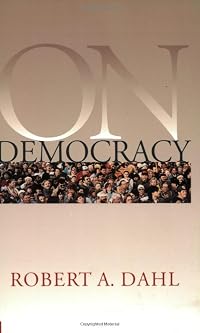
On Democracy
by Robert A. Dahl
On This Page
Description
Written by the preeminent democratic theorist of our time, this book explains the nature, value, and mechanics of democracy. In a new introduction to this Veritas edition, Ian Shapiro considers how Dahl would respond to the ongoing challenges democracy faces in the modern world. "Within the liberal democratic camp there is considerable controversy about exactly how to define democracy. Probably the most influential voice among contemporary political scientists in this debate has been that of show more Robert Dahl."-Marc Plattner, New York Times "An excellent introduction for novices, as well as a trusty handbook for experts and political science mavens."-Publishers Weekly show lessTags
Recommendations







Member Reviews
For the most part this was pretty much what you'd expect --- a definition of democracy, a defence of the idea, and a description of various practical implementations.
My main disappointment is that the various practical implementations are given so little space, after so much space is devoted to the (IMHO far less interesting) defence of democracy.
The most interesting idea I learned from the book is that representative democracy is a fairly new (late 1700s) idea that is apparently not obvious, and that was considered (perhaps justifiably) to be one of the greatest inventions of the age.
Along similar lines was that it took the US constitutional congress two months to come up with the idea of an elected president to run the executive (as show more opposed to the British equivalent of a monarch); for example one idea floated was that of an elected monarch (ie, I guess, president-for-life).
It could certainly be argued that mistakes were made in this regard. The unitary US presidency, defined as both the (non-political) head of state and the (intensely political) head of government, and, in practice, also the head of a political party, does not seem to provide a mechanism in the system for a person generally respected, mostly apolitical, but able to act in moments of crisis in ways generally considered to be in the nation's best interests (for a recent example, consider the King of Thailand). Dahl does not discuss this sort of issue, but I think he should have.
Also interesting was a binning of democratic political systems into four main groups:
* European : parliament + proportional representation
* UK : parliament + first pass the post
* US : president + first pass the post (he doesn't like this)
* South American: president + proportional representation (he thinks this is really bad)
This is the sort of political "science" I want to learn more about, and I wish he'd concentrated more on this sort of thing. show less
My main disappointment is that the various practical implementations are given so little space, after so much space is devoted to the (IMHO far less interesting) defence of democracy.
The most interesting idea I learned from the book is that representative democracy is a fairly new (late 1700s) idea that is apparently not obvious, and that was considered (perhaps justifiably) to be one of the greatest inventions of the age.
Along similar lines was that it took the US constitutional congress two months to come up with the idea of an elected president to run the executive (as show more opposed to the British equivalent of a monarch); for example one idea floated was that of an elected monarch (ie, I guess, president-for-life).
It could certainly be argued that mistakes were made in this regard. The unitary US presidency, defined as both the (non-political) head of state and the (intensely political) head of government, and, in practice, also the head of a political party, does not seem to provide a mechanism in the system for a person generally respected, mostly apolitical, but able to act in moments of crisis in ways generally considered to be in the nation's best interests (for a recent example, consider the King of Thailand). Dahl does not discuss this sort of issue, but I think he should have.
Also interesting was a binning of democratic political systems into four main groups:
* European : parliament + proportional representation
* UK : parliament + first pass the post
* US : president + first pass the post (he doesn't like this)
* South American: president + proportional representation (he thinks this is really bad)
This is the sort of political "science" I want to learn more about, and I wish he'd concentrated more on this sort of thing. show less
Really dry and hard to read in places, but the ideas Dahl talks about are incredibly useful for understanding what makes democracy function.
容易上手的入門書,篇幅不大,由於現今國民教育缺乏良好的民主相關教材,因此相當適合每個台灣公民研讀
Brief summary of democratic theory. Differences between the ideal and what we get in reality.
In Dahl's view, no government in the world has lived up to the Platonic ideal of Democracy, but some have made significant progress in both the number of democracies and the expansion of the electorate in the latter half of the 20th century. Talks about the legal and philosophical justifications of equality, of course given the fact that no two people are identical nor equal.
What factors constitute an actual democracy?
1) Elected officials
2) Free, fair, and frequent elections
3) Freedom of expression
4) Alternative sources of information
5) Associational autonomy
6) Inclusive citizenship
For our example, the United States, 2 may be modestly disputed show more owing to the massive financial requirements needed to conduct a successful political campaign, especially after the Citizens United case, and Factor 4 as well, owing to the monopolistic views of corporate media. Although there is progress on the latter, with alternative internet and media sources gaining traction against the old hegemonic TV stations.
By contrast, Putin's Russia is more non-democratic, with 2, 3, 4, and 5 under heavy restrictions.
A brief and informative summary of democracy studies. Although such statements may seem so obvious they are almost pablum to most Americans, they are still valuable concepts which earn much from further study. show less
In Dahl's view, no government in the world has lived up to the Platonic ideal of Democracy, but some have made significant progress in both the number of democracies and the expansion of the electorate in the latter half of the 20th century. Talks about the legal and philosophical justifications of equality, of course given the fact that no two people are identical nor equal.
What factors constitute an actual democracy?
1) Elected officials
2) Free, fair, and frequent elections
3) Freedom of expression
4) Alternative sources of information
5) Associational autonomy
6) Inclusive citizenship
For our example, the United States, 2 may be modestly disputed show more owing to the massive financial requirements needed to conduct a successful political campaign, especially after the Citizens United case, and Factor 4 as well, owing to the monopolistic views of corporate media. Although there is progress on the latter, with alternative internet and media sources gaining traction against the old hegemonic TV stations.
By contrast, Putin's Russia is more non-democratic, with 2, 3, 4, and 5 under heavy restrictions.
A brief and informative summary of democracy studies. Although such statements may seem so obvious they are almost pablum to most Americans, they are still valuable concepts which earn much from further study. show less
Dahl is at Yale at a top Ivy League Department. Issues of Democracy affect us all, this is a guy and a book to start one's learning.
Written by the preeminent democratic theorist of our time, this book explains the nature, value, and mechanics of democracy. In a new introduction to this Veritas edition, Ian Shapiro considers how Dahl would respond to the ongoing challenges democracy faces in the modern world.
“Within the liberal democratic camp there is considerable controversy about exactly how to define democracy. Probably the most influential voice among contemporary political scientists in this debate has been that of Robert Dahl.”—Marc Plattner, New York Times
“An excellent introduction for novices, as well as a trusty handbook for experts and political science mavens.”—Publishers Weekly
“Within the liberal democratic camp there is considerable controversy about exactly how to define democracy. Probably the most influential voice among contemporary political scientists in this debate has been that of Robert Dahl.”—Marc Plattner, New York Times
“An excellent introduction for novices, as well as a trusty handbook for experts and political science mavens.”—Publishers Weekly
Oct 2, 2022Dutch
Ratings
Members
- Recently Added By
Lists

Política - Clásicos
164 works; 2 members

Works Cited in The Life and Death of Democracy by John Keane
278 works; 1 member
Author Information

34+ Works 2,379 Members
Robert A. Dahl is Sterling Professor Emeritus of Political Science at Yale University and past president of the American Political Science Association.
Series
Belongs to Publisher Series
Common Knowledge
- Canonical title
- On Democracy
- Original title
- On Democracy
- Original publication date
- 1998
- Original language
- English
Classifications
- Genres
- Politics and Government, Nonfiction, Philosophy, General Nonfiction, History
- DDC/MDS
- 321.8 — Society, government, & culture Political science Systems of governments and states Democratic government [formerly : Republic]
- LCC
- JC423 .D2497 — Political Science Political theory Political theory. The state. Theories of the state Forms of the state
- BISAC
Statistics
- Members
- 468
- Popularity
- 64,961
- Reviews
- 6
- Rating
- (3.70)
- Languages
- 11 — Arabic, Chinese, Czech, English, French, Italian, Japanese, Portuguese, Romanian, Spanish, Turkish
- Media
- Paper, Audiobook, Ebook
- ISBNs
- 24
- ASINs
- 5