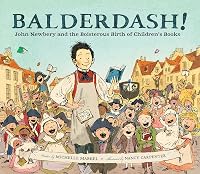
Balderdash! John Newbery and the Boisterous Birth of Children's Books
by Michelle Markel
On This Page
Description
A picture book chronicle of the life of children's book pioneer John Newbery describes how he imagined books filled with stories, science and games before becoming a celebrated author and publisher, changing the literary world forever.Tags
Recommendations






Member Reviews
As someone who has a great interest in the history of children's literature, and who has done some research into the earlier centuries of that history, I was quite excited to discover that there was a picture-book biography of John Newbery, the eighteenth-century British publisher who did so much to popularize books for the young, and for whom the Newbery Medal is named. Unfortunately, almost everything about the book - with the notable exception of Nancy Carpenter's expressive and amusing illustrations - was a disappointment to me. From the title on - no, Michelle Markel, Anglophone children's books did not have their birth with John Newbery or his contemporaries - I found myself irritated by the tone here, and by some of the author's show more underlying assumptions about early children's books and how they were received. In the end, I concluded that although the topic here was worthy, the book itself was sufficiently misleading to give a wholly incorrect impression of early English children's literature. Given that this is so, I simply cannot recommend it.
One of the classes I enjoyed most, during the course of completing my masters, was devoted to early English children's literature, stretching from the Puritan period through the late eighteenth century. When reading such works as James Janeway's 1671 A Token for Children: Being an Exact Account of the Conversion, Holy and Exemplary Lives, and Joyful Deaths of Several Young Children it is easy for the contemporary reader to conclude, as Markel does, that children were forced to read "religious texts that made them fear that death was near." What readers coming from such a perspective fail to understand about the historical and cultural context of such works, is that in a time when infant mortality was incredibly high, and most children would have experienced the loss of multiple siblings before reaching the age of ten, the idea of deceased youngsters finding a better life in the hereafter would have offered, not fear, but great comfort. This is but one example of how Markel misreads her subject, too enmeshed in her contemporary viewpoint to really understand the texts she has (one hopes?) read.
Markel's statement that there were no books for children in the early 18th-century isn't simply factually incorrect, it is self-contradictory, given her subsequent (misguided) statements about the nature of those earlier books. Her claim that the exciting books being produced in the period weren't shared with children is also a misreading. It ignores the fact that social mores about the appearance of children in public would have been different at that time than those we observe today, assuming that because children were not permitted in such institutions as lending libraries, the books sold there were not shared with young people. In point of fact, many works were written explicitly to be shared in the family circle, and were intended, if not solely for children, at least partially for them. Markel mentioned John Locke in her afterword, which I find ironic, given that it was his statement in his 1693 Some Thoughts Concerning Education about the suitability of The History of Reynard the Fox as children's literature that first inspired me to examine three centuries of children's retellings of that tale in my masters dissertation. Needless to say, quite a few versions of Reynard predate John Newbery and his influential Little Goody Two-Shoes, discussed by Markel in her text.
I recognize that my interests and training are not those of many other readers approaching this picture-book - something that can be seen by the almost universal praise heaped on Balderdash!: John Newbery and the Boisterous Birth of Children's Books by other online reviewers - but I feel they do give me the ability to pick out the subtle but persistent inaccuracies to be found therein. That so many, even in the world of children's literature studies, continue to believe some of the canards presented here is a cause of concern to me, but given that Markel explicitly set out to research the subject, I expected something a little more nuanced and accurate from her. I do think Newbery and his story are worth telling, so it is with regret that I say: This one is not recommended. show less
One of the classes I enjoyed most, during the course of completing my masters, was devoted to early English children's literature, stretching from the Puritan period through the late eighteenth century. When reading such works as James Janeway's 1671 A Token for Children: Being an Exact Account of the Conversion, Holy and Exemplary Lives, and Joyful Deaths of Several Young Children it is easy for the contemporary reader to conclude, as Markel does, that children were forced to read "religious texts that made them fear that death was near." What readers coming from such a perspective fail to understand about the historical and cultural context of such works, is that in a time when infant mortality was incredibly high, and most children would have experienced the loss of multiple siblings before reaching the age of ten, the idea of deceased youngsters finding a better life in the hereafter would have offered, not fear, but great comfort. This is but one example of how Markel misreads her subject, too enmeshed in her contemporary viewpoint to really understand the texts she has (one hopes?) read.
Markel's statement that there were no books for children in the early 18th-century isn't simply factually incorrect, it is self-contradictory, given her subsequent (misguided) statements about the nature of those earlier books. Her claim that the exciting books being produced in the period weren't shared with children is also a misreading. It ignores the fact that social mores about the appearance of children in public would have been different at that time than those we observe today, assuming that because children were not permitted in such institutions as lending libraries, the books sold there were not shared with young people. In point of fact, many works were written explicitly to be shared in the family circle, and were intended, if not solely for children, at least partially for them. Markel mentioned John Locke in her afterword, which I find ironic, given that it was his statement in his 1693 Some Thoughts Concerning Education about the suitability of The History of Reynard the Fox as children's literature that first inspired me to examine three centuries of children's retellings of that tale in my masters dissertation. Needless to say, quite a few versions of Reynard predate John Newbery and his influential Little Goody Two-Shoes, discussed by Markel in her text.
I recognize that my interests and training are not those of many other readers approaching this picture-book - something that can be seen by the almost universal praise heaped on Balderdash!: John Newbery and the Boisterous Birth of Children's Books by other online reviewers - but I feel they do give me the ability to pick out the subtle but persistent inaccuracies to be found therein. That so many, even in the world of children's literature studies, continue to believe some of the canards presented here is a cause of concern to me, but given that Markel explicitly set out to research the subject, I expected something a little more nuanced and accurate from her. I do think Newbery and his story are worth telling, so it is with regret that I say: This one is not recommended. show less
A fairly lively biography of one of the pioneers of children's literature should entertain children and adults.
John Newbery was a bookstore owner, publisher, and writer. He was quite the entrepreneur, i.e., including product placement for his health elixir in his books, pairing his books with toys to boost sales, cross-pollinating characters to create a shared universe – the sort of stuff we still see corporations doing today.
I wish the author had worked a few dates into the body of the story to better anchor the tale in history.
John Newbery was a bookstore owner, publisher, and writer. He was quite the entrepreneur, i.e., including product placement for his health elixir in his books, pairing his books with toys to boost sales, cross-pollinating characters to create a shared universe – the sort of stuff we still see corporations doing today.
I wish the author had worked a few dates into the body of the story to better anchor the tale in history.
Who knew kids could read without becoming feral monsters? Not adults, that's for sure.
I agree with one of the reviews I read that I would not take quite this tone if it were me writing this book. But the author does a good job introducing the topic and adding context to the Newbery Award. The illustrations are boisterous and charming.
In the 1700s, bookshops were full of delightful books - for adults. Books for children, such as they were, didn't contain entertaining stories, poems, or rhymes, but moralizing and rules. John Newbery worked for a printer, then became a publisher, and he published attractive and entertaining books for children (sometimes packaged with a toy ball or a pincushion). The ALA's award for "the most distinguished contribution to American literature for children" is named after him.
Back matter includes a biography, a bibliography, further reading, and selected articles. Illustrations (pen and ink, digital media) are at once old-fashioned and lively, with lots of fun details.
Back matter includes a biography, a bibliography, further reading, and selected articles. Illustrations (pen and ink, digital media) are at once old-fashioned and lively, with lots of fun details.
Balderdash! is a book that follows the life of John Newbery, and how he became one of the first people to create books specifically for children to enjoy. This is a fun book that taught me something I had not known, which is how children's literature specifically began to take off. It was interesting to see how scandalized people were at first but how popular the literature still was. This book would be a fun way to get children thinking about books and an assignment discussing kids' favorite books would pair quite well with this.
In the 18th century, literature abounded...but not for children. John Newbery was a British publisher who created books for children with rhymes, stories, and illustrations. This picture book telling of the story of the birth of children's books is quick-paced and exciting with boisterous illustrations.
Members
- Recently Added By
Lists

Book Review Roundup
254 works; 2 members

Picture books about books
110 works; 6 members
Author Information

20 Works 2,040 Members
All Editions
Awards and Honors
Awards
Distinctions
Notable Lists
Common Knowledge
- Canonical title
- Balderdash! John Newbery and the Boisterous Birth of Children's Books
- Original publication date
- 2017
- People/Characters
- John Newbery; Margery Meanwell (Goody Two-Shoes); Goody Two-Shoes (Margery Meanwell)
- Important places
- London, England, UK
- Dedication
- To every librarian who has assisted me on my projects, including those in Special Collections, for getting those tiny, wonderful antique books into my hands --M. M.
In memory of Vinnie Kralyevich--whose mind bubbled with ideas --N. C. - First words
- WELCOME!
THIS BOOK'S FOR YOU. - Last words
- (Click to show. Warning: May contain spoilers.)JOHN NEWBERY,
the father of children's literature.
Huzza! - Original language
- English
Classifications
- Genre
- Picture Books
- DDC/MDS
- 070.5092 — Computer science, information & general works News media, journalism & publishing Documentary media, educational media, news media; journalism; publishing Publishing Biography; History By Place Biography
- LCC
- Z325 .N53 .M37 — Bibliography, Library Science and Information Resources Book industries and trade Bookselling and publishing
- BISAC
Statistics
- Members
- 214
- Popularity
- 153,734
- Reviews
- 12
- Rating
- (4.06)
- Languages
- English
- Media
- Paper, Ebook
- ISBNs
- 6
- ASINs
- 1