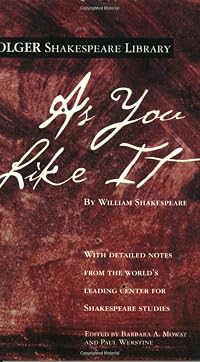
As You Like It
by William Shakespeare
On This Page
Description
As You Like It is truly one of Shakespeare's greatest romantic comedies. The heroine, Rosalind has grown up in the court of her usurping uncle Duke Frederick, her father, the rightful duke, having been exiled by his younger brother. Rosalind falls in love with Orlando, but Orlando is forced to flee when he is persecuted by his older brother Oliver. Soon Rosalind is also banished from the court by her uncle. Switching genders she assumes the identity of Ganymede and with her cousin Celia in show more tow goes in search of her father. Finding him and his friends in the Forest of Arden the young girls join the exiles before finally being reunited with their lovers, a mellowed Oliver and an evil uncle who has found religion.. show less
Tags
Recommendations








Member Reviews
As You Like It is a complex contraption with a simple key to unlock it; or, if not to unlock it, to at least give the door a budge. The contraption is the almost impossibly intricate lattice of characters, arcs and themes that make up the play. The key is the play's most famous passage: "All the world's a stage, And all the men and women merely players; They have their exits and their entrances, And one man in his time plays many parts" (pg. 59).
Taken literally, it is very difficult to divine a purpose for the play. The conflicts which start the play (between the competing dukes, and also the two competing brothers Orlando and Oliver) are both later resolved off-stage, in a way that would be unsatisfying for a plot-driven (or even show more character-driven) production. The ending gets rather drawn out. And in between this beginning and end we follow a bewildering network of characters as they romp about the fantastical Forest of Arden.
But it is that interplay of characters which is the purpose of As You Like It. The play is a play of parallels and intersections; the Forest of Arden the stage, and its trees the sieve between which the characters must be filtered and altered. The characters are players, with their exits and entrances, and they all play many parts. Everyone here, it seems, has moments of cynicism and moments where they swoon; all of them are moving through this forest. The only characters who don't change are the two who, throughout the play and also at its end, are outcasts: Touchstone and Jaques. Both are, in their way, 'fools' to the other characters, who are at least willing to risk all for love. These two, in contrast, are not willing to play the game: the game of life, with all its parts and players and exits and entrances. Touchstone is even called out on this by Jaques – but then again, Jaques is no better: he weeps over the deer without knowing why. He can "moralize… into a thousand similes" (pg. 46), but he won't truly feel; he won't truly risk himself in this life.
This, perhaps, is the reason for the pastoral theme, which would otherwise be difficult to square. You have to go out from conventional life in the city in order to risk all in nature; you have to risk failure in order to find love. You have to play the game. The conventional use of a pastoral is to juxtapose the stolidity and artificiality of city life, or civilization in general, with the harmony and freedom of natural, country life. At first, Shakespeare seems to play this straight, with plenty of exuberant remarks by various characters about "this life more sweet", frolicking in the forest and finding "sermons in stones, and good in everything" (pg. 45). But, being Shakespeare, he can't help but be clever and dexterous: he inverts it, turns it upside down and inside out, explores its dimensions and sublimates themes, sometimes so quickly or discreetly or prolifically that your mind cannot keep up and doesn't even register that things are moving, like the frame-rate of a film reel. I've often thought that, in his comedies, perhaps Shakespeare was too clever for his own good. The audience can't always keep up, and the intricate latticework can only be fully appreciated by a madman or a genius.
Because Shakespeare does query the pastoral theme as much as he reinforces it. The city has its merits: Orlando states proudly that he is "inland bred, And know some nurture" (pg. 58). In this passage, he seeks to prove that he can treat with a duke as a man of civility, rather than as a rutting nature-dweller. Similarly, Shakespeare remarks how the exiled duke and his men seem content with their overthrow, and "fleet the time carelessly" in the forest "as they did in the golden world" (pg. 32). That is, they abandon the responsibilities of the city, of proper governance (and perhaps this can be further expanded to mean proper governance of their own desires). For Shakespeare, the characters can be seen as intruders on the Forest; in killing deer – the "native burghers" of this land – for food, Jaques considers them more usurpers than the duke who banished them (pg. 45).
These connections are, in truth, difficult to reason out with any certainty, and at times you can no more draw out a lucid, complete theme from As You Like It than you could reconstitute flour, sugar and eggs from a baked cake. Consider the following disconnected observations I made, which warrant mention but which I struggle to organise into a coherent, flowing review:
1) Jaques rhapsodizes about the spoiled sanctity of the forest but, as I mentioned earlier, calls out Touchstone for wanting to get "married under a bush like a beggar" rather than in a church (pg. 75). What does this mean for the topsy-turvy pastoral country/city theme? Touchstone, the jester, ends up agreeing (cynically) to marry in a church, but the 'true' lovers, Rosalind and Orlando, exchange vows in the forest (pg. 85).
2) Is the natural Forest of Arden the proving ground for ardent love? The unloved wife strays; it's a 'foolish' woman who "cannot make her fault her husband's occasion" (pg. 86). Kill love and you become the cuckold: "What shall he have that killed the deer? His leather skin and horns to wear" (pg. 87) – horns being a Tudor sign of a cuckold.
3) Adam warns Orlando that his brother is plotting against him and will "burn the lodging where you use to lie, And you within it" (pg. 48). Does this relate to the deer, mentioned above, being driven from its own habitat by interlopers?
4) Adam is a minor character who seems to be dismissed by most critics, but I wonder if he's not the most important character. An old servant torn between two brothers, does he not embody more than anyone the pastoral struggle between city and country? Adam, having already loved, doesn't need to risk going back into the Forest of Arden like the other characters do, and he suffers for it. He seems to be forgotten about in the play itself, and has no fate: but is he not perhaps the "old religious man" beneath a tree who resolves the conflicts offstage (pp91, 105)? Oliver claims to be the man beneath the tree in the first instance, but his recounting of the story is vague; perhaps when he speaks of "his brother, his elder brother" (pg. 91), it is in the Christian sense that all men are brothers and to mistreat one is to mistreat all?
5) Further to that previous point, is the Forest of Arden analogous to the Garden of Eden? Surely it's not a coincidence that the character's name is Adam, that (if he is indeed the 'old religious man') he dispenses wisdom from beneath a tree (the Tree of Life?) and has a serpent around his neck (pp90-91)? What are we to make of the speculation that Adam was played, in initial performances of the play, by Shakespeare himself? The playwright – the creator?
6) Shakespeare's mother's maiden name was Arden; is she analogous to Mother Nature? Does this have something to do with the cross-dressing dynamics of Rosalind in the play? Males (boy actors playing female characters in Tudor times) getting in touch with their female side? Men returning to the forest, the mother they first came from?
You begin to see, I hope, how prolifically connections of this sort can be made, and how frustrating it can be to identify them but struggle to apply them to the whole. The play itself doesn't codify them, which is why As You Like It doesn't rank as highly as Shakespeare's more accessible tragedies, or some of his more rigorously-constructed comedies and satires. I've written more than 1,500 words in this review, and scarcely even mentioned Rosalind and the gender dynamics and the other more commonly discussed aspects of the play. Perhaps, as I said earlier, Shakespeare is too clever for his own good and only a madman or a genius can appreciate the variety here. In modesty, of the two I'd have to lay a tentative claim to some madness.
The play is a strange thing to wrestle with. It is superficially frustrating and metaphysically thrilling. Perhaps the fantastical craziness is intended; the only hope in this crazy stage-world of many entrances and exits is ardency; to, as Rosalind resolves, "prove a busy actor in their play" (pg. 77). Perhaps this is why, daringly enough, she is the closest As You Like It has to a hero. The title of the play might well be an instruction, a stage direction from the playwright to the audience rather than the actors. We're carried along by the world-stage and struggle to make sense of it, even when we find connections and catch glimpses of its underlying sense, engineered by its madman-genius creator. What matters is that we take part, we play the game. What we catch along the way, or see slip by, is of secondary importance. The perception is the key; the awareness that the game is being played, that the play has started. You can engage or withdraw, as you like it. The play takes place in spring, and you can either perceive that season as following winter or preceding summer. show less
Taken literally, it is very difficult to divine a purpose for the play. The conflicts which start the play (between the competing dukes, and also the two competing brothers Orlando and Oliver) are both later resolved off-stage, in a way that would be unsatisfying for a plot-driven (or even show more character-driven) production. The ending gets rather drawn out. And in between this beginning and end we follow a bewildering network of characters as they romp about the fantastical Forest of Arden.
But it is that interplay of characters which is the purpose of As You Like It. The play is a play of parallels and intersections; the Forest of Arden the stage, and its trees the sieve between which the characters must be filtered and altered. The characters are players, with their exits and entrances, and they all play many parts. Everyone here, it seems, has moments of cynicism and moments where they swoon; all of them are moving through this forest. The only characters who don't change are the two who, throughout the play and also at its end, are outcasts: Touchstone and Jaques. Both are, in their way, 'fools' to the other characters, who are at least willing to risk all for love. These two, in contrast, are not willing to play the game: the game of life, with all its parts and players and exits and entrances. Touchstone is even called out on this by Jaques – but then again, Jaques is no better: he weeps over the deer without knowing why. He can "moralize… into a thousand similes" (pg. 46), but he won't truly feel; he won't truly risk himself in this life.
This, perhaps, is the reason for the pastoral theme, which would otherwise be difficult to square. You have to go out from conventional life in the city in order to risk all in nature; you have to risk failure in order to find love. You have to play the game. The conventional use of a pastoral is to juxtapose the stolidity and artificiality of city life, or civilization in general, with the harmony and freedom of natural, country life. At first, Shakespeare seems to play this straight, with plenty of exuberant remarks by various characters about "this life more sweet", frolicking in the forest and finding "sermons in stones, and good in everything" (pg. 45). But, being Shakespeare, he can't help but be clever and dexterous: he inverts it, turns it upside down and inside out, explores its dimensions and sublimates themes, sometimes so quickly or discreetly or prolifically that your mind cannot keep up and doesn't even register that things are moving, like the frame-rate of a film reel. I've often thought that, in his comedies, perhaps Shakespeare was too clever for his own good. The audience can't always keep up, and the intricate latticework can only be fully appreciated by a madman or a genius.
Because Shakespeare does query the pastoral theme as much as he reinforces it. The city has its merits: Orlando states proudly that he is "inland bred, And know some nurture" (pg. 58). In this passage, he seeks to prove that he can treat with a duke as a man of civility, rather than as a rutting nature-dweller. Similarly, Shakespeare remarks how the exiled duke and his men seem content with their overthrow, and "fleet the time carelessly" in the forest "as they did in the golden world" (pg. 32). That is, they abandon the responsibilities of the city, of proper governance (and perhaps this can be further expanded to mean proper governance of their own desires). For Shakespeare, the characters can be seen as intruders on the Forest; in killing deer – the "native burghers" of this land – for food, Jaques considers them more usurpers than the duke who banished them (pg. 45).
These connections are, in truth, difficult to reason out with any certainty, and at times you can no more draw out a lucid, complete theme from As You Like It than you could reconstitute flour, sugar and eggs from a baked cake. Consider the following disconnected observations I made, which warrant mention but which I struggle to organise into a coherent, flowing review:
1) Jaques rhapsodizes about the spoiled sanctity of the forest but, as I mentioned earlier, calls out Touchstone for wanting to get "married under a bush like a beggar" rather than in a church (pg. 75). What does this mean for the topsy-turvy pastoral country/city theme? Touchstone, the jester, ends up agreeing (cynically) to marry in a church, but the 'true' lovers, Rosalind and Orlando, exchange vows in the forest (pg. 85).
2) Is the natural Forest of Arden the proving ground for ardent love? The unloved wife strays; it's a 'foolish' woman who "cannot make her fault her husband's occasion" (pg. 86). Kill love and you become the cuckold: "What shall he have that killed the deer? His leather skin and horns to wear" (pg. 87) – horns being a Tudor sign of a cuckold.
3) Adam warns Orlando that his brother is plotting against him and will "burn the lodging where you use to lie, And you within it" (pg. 48). Does this relate to the deer, mentioned above, being driven from its own habitat by interlopers?
4) Adam is a minor character who seems to be dismissed by most critics, but I wonder if he's not the most important character. An old servant torn between two brothers, does he not embody more than anyone the pastoral struggle between city and country? Adam, having already loved, doesn't need to risk going back into the Forest of Arden like the other characters do, and he suffers for it. He seems to be forgotten about in the play itself, and has no fate: but is he not perhaps the "old religious man" beneath a tree who resolves the conflicts offstage (pp91, 105)? Oliver claims to be the man beneath the tree in the first instance, but his recounting of the story is vague; perhaps when he speaks of "his brother, his elder brother" (pg. 91), it is in the Christian sense that all men are brothers and to mistreat one is to mistreat all?
5) Further to that previous point, is the Forest of Arden analogous to the Garden of Eden? Surely it's not a coincidence that the character's name is Adam, that (if he is indeed the 'old religious man') he dispenses wisdom from beneath a tree (the Tree of Life?) and has a serpent around his neck (pp90-91)? What are we to make of the speculation that Adam was played, in initial performances of the play, by Shakespeare himself? The playwright – the creator?
6) Shakespeare's mother's maiden name was Arden; is she analogous to Mother Nature? Does this have something to do with the cross-dressing dynamics of Rosalind in the play? Males (boy actors playing female characters in Tudor times) getting in touch with their female side? Men returning to the forest, the mother they first came from?
You begin to see, I hope, how prolifically connections of this sort can be made, and how frustrating it can be to identify them but struggle to apply them to the whole. The play itself doesn't codify them, which is why As You Like It doesn't rank as highly as Shakespeare's more accessible tragedies, or some of his more rigorously-constructed comedies and satires. I've written more than 1,500 words in this review, and scarcely even mentioned Rosalind and the gender dynamics and the other more commonly discussed aspects of the play. Perhaps, as I said earlier, Shakespeare is too clever for his own good and only a madman or a genius can appreciate the variety here. In modesty, of the two I'd have to lay a tentative claim to some madness.
The play is a strange thing to wrestle with. It is superficially frustrating and metaphysically thrilling. Perhaps the fantastical craziness is intended; the only hope in this crazy stage-world of many entrances and exits is ardency; to, as Rosalind resolves, "prove a busy actor in their play" (pg. 77). Perhaps this is why, daringly enough, she is the closest As You Like It has to a hero. The title of the play might well be an instruction, a stage direction from the playwright to the audience rather than the actors. We're carried along by the world-stage and struggle to make sense of it, even when we find connections and catch glimpses of its underlying sense, engineered by its madman-genius creator. What matters is that we take part, we play the game. What we catch along the way, or see slip by, is of secondary importance. The perception is the key; the awareness that the game is being played, that the play has started. You can engage or withdraw, as you like it. The play takes place in spring, and you can either perceive that season as following winter or preceding summer. show less
Maybe my favorite Shakespeare comedy (excluding the problem plays). Light and breezy and fairytaleish, with stunning language and, in my opinion, the best love story in Shakespeare. Rosalind and Orlando match wits without wounding each other, and confuse identities without making you feel like the plot has tricked them into a match. The plot is absurd, of course, but the tone helps you to embrace it instead of disbelieve it, so when Jaques de Boys comes running in at the last to resolve everyone's problems in one speech, you laugh rather than groan.
As You Like It follows Rosalind, the daughter of a Duke, as she escapes persecution in her Uncle’s court with her cousin Celia. They take refuge in the forest, waiting for a time when Rosalind’s father gains power. Before leaving however, she has just enough time to fall in love with Orlando, who fortunately ends up in the same forest.
I loved this one; it reminded me so much of The Tempest. There are two brothers who, just like in The Tempest, are both Dukes. Their daughters are central to the plot, falling in love for the first time, just as Miranda does in The Tempest.
The play includes so many of Shakespeare’s finest elements. There are women pretending to be men, women falling in love with those “men” and men confiding show more their love to those “men” without knowing who they really are. Confused? Don’t be, it’s all good fun.
In one section a young man goes on and on about how he’s in love. He tells the older man who is his companion that there’s no way he could possibly understand, because he’s so old. I love how Shakespeare often pokes fun at the naïveté of the young. They believe no one has ever gone through what I’m going through right now.
The play also includes the famous “All the world’s a stage” passage. I love reading one of his plays for the first time and stumbling upon one of those wonderful lines. It’s always a treat. I read this just after finishing Othello and it complemented the tragedy so well. It provided the comedic balance, cross dressing, falling in love, and mistaken identities that I craved after reading such a downer.
“Do you not know I am a woman? When I think, I must speak.” show less
I loved this one; it reminded me so much of The Tempest. There are two brothers who, just like in The Tempest, are both Dukes. Their daughters are central to the plot, falling in love for the first time, just as Miranda does in The Tempest.
The play includes so many of Shakespeare’s finest elements. There are women pretending to be men, women falling in love with those “men” and men confiding show more their love to those “men” without knowing who they really are. Confused? Don’t be, it’s all good fun.
In one section a young man goes on and on about how he’s in love. He tells the older man who is his companion that there’s no way he could possibly understand, because he’s so old. I love how Shakespeare often pokes fun at the naïveté of the young. They believe no one has ever gone through what I’m going through right now.
The play also includes the famous “All the world’s a stage” passage. I love reading one of his plays for the first time and stumbling upon one of those wonderful lines. It’s always a treat. I read this just after finishing Othello and it complemented the tragedy so well. It provided the comedic balance, cross dressing, falling in love, and mistaken identities that I craved after reading such a downer.
“Do you not know I am a woman? When I think, I must speak.” show less
As You Like It quickly became one of my favorite Shakespeare plays. I loved the humor, the clever wordplay, and how playful the story is. The blend of romance, humor, and playful identity swaps made the whole story enjoyable. I could easily see myself rereading it sometime in the future.
"The more pity that fools may not speak wisely what wise men do foolishly"
"The more pity that fools may not speak wisely what wise men do foolishly"
A strange play, but a very lovable one.
Why strange, you ask? Let me catalog its oddities. Both of the villains undergo sudden changes of heart ... offstage. Both leading couples fall in love ... on their first meeting. In A Midsummer Night’s Dream, Shakespeare’s other comedy set primarily in a forest, such happenings are explained as the results of magic, the maneuverings of mischievous fairies. The only supernatural figure in As You Like It is Hymen, who, in one of the play’s oddest turns, appears at the end to explain everything and bless the four marriages. It’s unclear exactly why he is needed; Rosalind seems to have orchestrated everything perfectly up until then.
And why lovable? In a word: its heroine. Rosalind is the true show more gem of the piece, and is probably the closest Shakespeare came to writing a female role comparable Hamlet, although of course this is in a completely different genre.* She has more lines than any other woman in the canon, but it’s not sheer quantity that makes her material so winning. She’s charming in a quicksilver fashion, and it’s clear from her scenes with Orlando that she enjoys make-believe playacting. But lest you think she is a mere trickster, I must stress has wonderful moments of vulnerability, too.
As far as Shakespeare’s young swains go, Orlando comes off pretty well. He doesn’t threaten to rape the woman who loves him (a la Demetrius in A Midsummer Night’s Dream), he isn’t an opportunistic adventurer (as Bassanio is in The Merchant of Venice), and he doesn’t listen to slurs against his lady (unlike Claudio in Much Ado About Nothing). He writes awful poetry, it’s true, but in prose he is almost as witty as his beloved Rosalind, and I picture him as having an easy smile and laugh. Of the other characters, Jacques is the standout—a melancholic personality who cannot find a place in the play’s the happy ending.
I’ve watched two video versions of this play, each very different from the other. The 1978 BBC adaptation looks as if an enterprising child filmed it in his backyard using a camcorder, somehow enlisting the aid of some of Britain’s finest actors. Richard Pasco steals the show as an unkempt and bleary-eyed Jacques—I really didn’t understand the character until I watched his performance—while Helen Mirren makes a statuesque Rosalind and roguish Ganymede. I didn’t care for the more recent Kenneth Branagh film when I first saw it on account of its Japanese setting, but now that I’ve studied the play in an academic environment and noticed just how strongly the theme of usurpation figures in the plot, I understand what he was going for. And I like how he tries to smooth out the creases of this admittedly problematic play; for instance, he actually stages the lion attack, making Oliver’s reformation a bit more believable.
Read As You Like It and go on a holiday in a verdant wonderland. Ignore some of the oddities and focus on your guide, one of Shakespeare’s greatest heroines.
* Looking at Wikipedia’s chronology, I see that As You Like It and Hamlet may have been written back-to-back, so perhaps the similarity is not coincidental. Shakespeare must have had fabulous performers at his disposal during this period, considering the virtuosic parts he wrote for them! show less
Why strange, you ask? Let me catalog its oddities. Both of the villains undergo sudden changes of heart ... offstage. Both leading couples fall in love ... on their first meeting. In A Midsummer Night’s Dream, Shakespeare’s other comedy set primarily in a forest, such happenings are explained as the results of magic, the maneuverings of mischievous fairies. The only supernatural figure in As You Like It is Hymen, who, in one of the play’s oddest turns, appears at the end to explain everything and bless the four marriages. It’s unclear exactly why he is needed; Rosalind seems to have orchestrated everything perfectly up until then.
And why lovable? In a word: its heroine. Rosalind is the true show more gem of the piece, and is probably the closest Shakespeare came to writing a female role comparable Hamlet, although of course this is in a completely different genre.* She has more lines than any other woman in the canon, but it’s not sheer quantity that makes her material so winning. She’s charming in a quicksilver fashion, and it’s clear from her scenes with Orlando that she enjoys make-believe playacting. But lest you think she is a mere trickster, I must stress has wonderful moments of vulnerability, too.
As far as Shakespeare’s young swains go, Orlando comes off pretty well. He doesn’t threaten to rape the woman who loves him (a la Demetrius in A Midsummer Night’s Dream), he isn’t an opportunistic adventurer (as Bassanio is in The Merchant of Venice), and he doesn’t listen to slurs against his lady (unlike Claudio in Much Ado About Nothing). He writes awful poetry, it’s true, but in prose he is almost as witty as his beloved Rosalind, and I picture him as having an easy smile and laugh. Of the other characters, Jacques is the standout—a melancholic personality who cannot find a place in the play’s the happy ending.
I’ve watched two video versions of this play, each very different from the other. The 1978 BBC adaptation looks as if an enterprising child filmed it in his backyard using a camcorder, somehow enlisting the aid of some of Britain’s finest actors. Richard Pasco steals the show as an unkempt and bleary-eyed Jacques—I really didn’t understand the character until I watched his performance—while Helen Mirren makes a statuesque Rosalind and roguish Ganymede. I didn’t care for the more recent Kenneth Branagh film when I first saw it on account of its Japanese setting, but now that I’ve studied the play in an academic environment and noticed just how strongly the theme of usurpation figures in the plot, I understand what he was going for. And I like how he tries to smooth out the creases of this admittedly problematic play; for instance, he actually stages the lion attack, making Oliver’s reformation a bit more believable.
Read As You Like It and go on a holiday in a verdant wonderland. Ignore some of the oddities and focus on your guide, one of Shakespeare’s greatest heroines.
* Looking at Wikipedia’s chronology, I see that As You Like It and Hamlet may have been written back-to-back, so perhaps the similarity is not coincidental. Shakespeare must have had fabulous performers at his disposal during this period, considering the virtuosic parts he wrote for them! show less
As You Like It has long been admired as one of Shakespeare's most exuberant early comedies, complete with one of the Bard's funniest and toughest heroines, Rosalind. Based on Thomas Lodge's Elizabethan novel Rosalynde, As You Like It follows the discontented Orlando as he is exiled from the tyrannical French court of Duke Frederick. By chance Frederick also banishes Rosalind, daughter of the usurped Duke Senior. The play then moves to the Forest of Arden, where chaos and misrule ensue, as Rosalind cross dresses "all points like a man", disguised as the saucy Ganymede and encourages the naive Orlando to "woo me, woo me, for now I am in a holiday humour". Meanwhile her clown Touchstone causes hilarity and havoc amongst the exiled lords show more and the pastoral inhabitants of the forest. The play concludes with Rosalind's extraordinary "unmasking" Epilogue addressed to the audience, where she offers to "kiss as many of you as had beards that pleased me". As You Like It remains one of Shakespeare's most popular comedies, yet it is also appreciated by critics for its complex exploration of cross dressing and sexual politics, and its interest in relations between the country and the city. --Jerry Brotton show less
I've been made aware that modernists like to write fiction that is basically plot-free, where the point is to entertain with beautiful, glorious language, not to excite or inform. One modernist, John Barth, has argued that what he is doing is more reactionary than modern, that he was merely returning to what masters like Cervantes and Rabelais did.
Or, in this case, Shakespeare. He had already written one nearly meta-fictional play, Love's Labour Lost, where witty people did nothing but talk wittily about life. He revised and improved the idea for this play, where a group of people hide in the Forest of Arden and do little but discourse of love and life. I loved it all, but especially the typically plucky heroine and the two polar show more opposite clowns. show less
Or, in this case, Shakespeare. He had already written one nearly meta-fictional play, Love's Labour Lost, where witty people did nothing but talk wittily about life. He revised and improved the idea for this play, where a group of people hide in the Forest of Arden and do little but discourse of love and life. I loved it all, but especially the typically plucky heroine and the two polar show more opposite clowns. show less
Members
- Recently Added By
Lists

Favorite Shakespeare plays?
37 works; 45 members

Comedy of Manners
73 works; 1 member

Next Plays / 2025
352 works; 1 member

Plays I Saw / 2025
37 works; 1 member

My Play Collection
769 works; 3 members

Physical TBR List
68 works; 1 member

Recommended Reading : 600 Classics Reviewed, Editors of Salem Press, 2015
634 works; 6 members

'Books You Can't Live Without: The Top 100', The Guardian, 2007
156 works; 7 members

Books Read in 2023
5,638 works; 147 members
Essential/Recognized Stage Plays
115 works; 4 members

AP Lit
363 works; 6 members

Greatest Books, allegedly
484 works; 9 members
1:28 p.m.'s 350 Stage Plays Challenge
94 works; 3 members

My 100 Favorite Books of All Time
57 works; 2 members

Books Mentioned in The Wedding Planner's Daughter series
107 works; 2 members
Stage Plays/Screenplays/Dialogues/Anything Dialogue-Storytelling Related
81 works; 2 members

Favourite Love Stories
53 works; 1 member
Folio Society
831 works; 49 members
100 World Classics
99 works; 15 members
Plays I Like
230 works; 31 members

Merrill's English Texts
59 works; 2 members

Ambleside Books
459 works; 18 members

University literature
145 works; 5 members
Literature About Women and Girls
426 works; 40 members

Literary Works Read in College
316 works; 15 members
Books mentioned in The Diary of a Provincial Lady
59 works; 4 members

Authors from England
147 works; 4 members
Blue Pyramid 1,276 Best Books of All Time
1,248 works; 32 members
Early Modern (Shakesperean)
64 works; 2 members

Western World's Greatest Books - Project Gutenberg
295 works; 15 members

Books Read in 2016
4,666 works; 199 members
Favourite Books
1,820 works; 308 members

Works cited in Palimpsest: A History of the Written Word by Matthew Battles
79 works; 2 members
School Made Us Read It
380 works; 196 members
Author Information

6,179+ Works 444,377 Members
William Shakespeare, 1564 - 1616 Although there are many myths and mysteries surrounding William Shakespeare, a great deal is actually known about his life. He was born in Stratford-Upon-Avon, son of John Shakespeare, a prosperous merchant and local politician and Mary Arden, who had the wealth to send their oldest son to Stratford Grammar School. show more At 18, Shakespeare married Anne Hathaway, the 27-year-old daughter of a local farmer, and they had their first daughter six months later. He probably developed an interest in theatre by watching plays performed by traveling players in Stratford while still in his youth. Some time before 1592, he left his family to take up residence in London, where he began acting and writing plays and poetry. By 1594 Shakespeare had become a member and part owner of an acting company called The Lord Chamberlain's Men, where he soon became the company's principal playwright. His plays enjoyed great popularity and high critical acclaim in the newly built Globe Theatre. It was through his popularity that the troupe gained the attention of the new king, James I, who appointed them the King's Players in 1603. Before retiring to Stratford in 1613, after the Globe burned down, he wrote more than three dozen plays (that we are sure of) and more than 150 sonnets. He was celebrated by Ben Jonson, one of the leading playwrights of the day, as a writer who would be "not for an age, but for all time," a prediction that has proved to be true. Today, Shakespeare towers over all other English writers and has few rivals in any language. His genius and creativity continue to astound scholars, and his plays continue to delight audiences. Many have served as the basis for operas, ballets, musical compositions, and films. While Jonson and other writers labored over their plays, Shakespeare seems to have had the ability to turn out work of exceptionally high caliber at an amazing speed. At the height of his career, he wrote an average of two plays a year as well as dozens of poems, songs, and possibly even verses for tombstones and heraldic shields, all while he continued to act in the plays performed by the Lord Chamberlain's Men. This staggering output is even more impressive when one considers its variety. Except for the English history plays, he never wrote the same kind of play twice. He seems to have had a good deal of fun in trying his hand at every kind of play. Shakespeare wrote 154 sonnets, all published on 1609, most of which were dedicated to his patron Henry Wriothsley, The Earl of Southhampton. He also wrote 13 comedies, 13 histories, 6 tragedies, and 4 tragecomedies. He died at Stratford-upon-Avon April 23, 1616, and was buried two days later on the grounds of Holy Trinity Church in Stratford. His cause of death was unknown, but it is surmised that he knew he was dying. (Bowker Author Biography) show less
Some Editions
Awards and Honors
Notable Lists
Series
Belongs to Publisher Series
Work Relationships
Is contained in
Ein Sommernachtstraum / Der Kaufmann von Venedig / Viel Lärm um nichts / Wie es euch gefällt / Die lustigen Weiber von by William Shakespeare
The Annotated Shakespeare: The Comedies, Histories, Sonnets and Other Poems, Tragedies and Romances Complete by William Shakespeare (indirect)
Shakespeares Dramatische Werke neunter Band: Was ihr wollt, Wie es euch gefällt, Ende gut,alles gut, Maß für Maß by William Shakespeare
Is retold in
Has the adaptation
Is abridged in
Was inspired by
Inspired
Is a study of
Has as a study
Has as a supplement
Has as a commentary on the text
Has as a student's study guide
Common Knowledge
- Canonical title
- As You Like It
- Original title
- As You Like It
- Alternate titles*
- Orlando en Rosalinde : (As you like it) : landspel [vert. A.S. Kok, 1860] (As you like it); Elk wat wils [vert. L.A.J. Burgersdijk, 1886-1888]; Shakespeare's Naar het u lijkt : (As you like it) [vert. Jacq. van Looy, 1915] (As you like it)
- Original publication date
- 1599
- People/Characters
- Rosalind; Celia; Orlando; Duke Frederick; Amiens; Jaques (show all 19); Le Beau; Charles; Oliver; Adam; Dennis; Touchstone; Sir Oliver Martext; Corin; Silvius; William; Phebe; Audrey; Hymen
- Important places
- Forest of Arden; France
- Related movies
- As You Like It (2006 | IMDb | Kenneth Branagh); As You Like It (1936 | IMDb | Paul Czinner); As You Like It (1978 | IMDb | Basil Coleman); As You Like It (1992 | IMDb)
- First words
- As I remember, Adam, it was upon this fashion bequeathed me by will but poor a thousand crowns, and, as thou sayest, charged my brother, on his blessing, to breed me well: and there begins my sadness.
- Quotations
- All the world's a stage,
And all the men and women merely players.
They have their exits and their entrances;
And one man in his time plays many parts...
The little foolery that wise men have makes a great show. - Last words
- (Click to show. Warning: May contain spoilers.)If I were a woman I would kiss as many of you as had beards that pleased me, complexions that liked me and breaths that I defied not: and, I am sure, as many as have good beards or good faces or sweet breaths will, for my kind offer, when I make curtsy, bid me farewell.
- Publisher's editor
- Harrison, G. B. (Penguin Popular Classics); Oliver, H. J. (New Penguin Shakespeare); Lever, J. W. (New Swan Shakespeare)
- Original language*
- Engels
- Disambiguation notice
- This work is for the complete As You Like It only. Do not combine this work with abridgements, adaptations or "simplifications" (such as "Shakespeare Made Easy"), Cliffs Notes or similar study guides, or anything else ... (show all)that does not contain the full text. Do not include any video recordings. Additionally, do not combine this with other plays.
*Some information comes from Common Knowledge in other languages. Click "Edit" for more information.
Classifications
Statistics
- Members
- 8,727
- Popularity
- 1,258
- Reviews
- 77
- Rating
- (3.77)
- Languages
- 23 — Arabic, Catalan, Chinese, Czech, Danish, Dutch, English, Esperanto, Finnish, French, German, Greek, Hebrew, Hungarian, Italian, Japanese, Norwegian (Bokmål), Polish, Portuguese, Russian, Spanish, Swedish, Turkish
- Media
- Paper, Audiobook, Ebook
- ISBNs
- 438
- UPCs
- 6
- ASINs
- 227