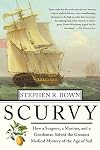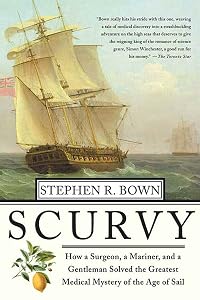
Scurvy: How a Surgeon, a Mariner, and a Gentlemen Solved the Greatest Medical Mystery of the Age of Sail
by Stephen R. Bown 
On This Page
Description
A lively recounting of how three determined individuals overcame the constraints of 18th century thinking to solve the greatest medical mystery of their era. The cure for scurvy ranks among the greatest of military successes, yet its impact on history has mostly been ignored. Stephen Bown, in this engaging and often gripping book, searches back to the earliest recorded appearance of scurvy in the 16th century, to the 18th century, when the disease was at its gum-shred, bone-snapping worst, show more to the early 19th century, when the preventative was finally put into service. Bown introduces us, among others, to James Lind, navy surgeon and medical detective, whose research on the disease spawned the implementation of the cure; Captain James Cook, who successfully avoided scurvy on his epic voyages; and Gilbert Blane, whose social status and charisma won over the British Navy and saved England. Scurvy is a medical detective story for the ages, a fascinating and often maddening examination of how a preventative for scurvy, the "scourge of the seas", was found, ignored, and finally implemented to the great benefit of all seafaring nations. show lessTags
Recommendations



































Member Reviews
Scurvy is the story of how dozens of smart, highly motivated people tried, for hundreds of years, to solve a medical mystery. That solving it took hundreds of years, even though thousands of lives and the viability of Europe’s oceangoing navies hung on a solution, suggests the difficulty of the problem. That the solution is now well-known, and can be summarized in terms simple enough for a child to grasp, suggests the difficulty of recounting the story for modern audiences. After only a chapter or two, the urge to shout “Fresh citrus juice, you fools!” back across the centuries is nearly overwhelming.
This is where Scurvy falls short. It narrates the story in novelistic detail, with an excellent sense of pace, and well-rounded show more portraits of the three figures mentioned in the subtitle. It shows the non-specialist reader everything about the history of scurvy-prevention research . . . except a comprehensive picture of the social and intellectual landscape within which that research took place. Bown’s narrative, good as it is, never brings alive a world where nobody knew which facts about scurvy and its mitigation were crucial, and which were irrelevant “noise.” It never sketches the conceptual framework – ideas about health, disease, medicine, nutrition, and cooking – into which 17th- and 18th-century researchers attempted to fit those facts. Instead, present-day knowledge (the solution was so simple!) subtly colors Bown’s analysis of their work.
His heroes’ struggles to find an answer thus, almost inevitably, come across as hopelessly clumsy and maddeningly pig-headed. They cling to “solutions” that we know to be useless, and, after stumbling on clues that we know to be vital, toss them aside and move blindly on. Bown never scolds them outright for these “failings,” but his tone of frustration and disapproval is palpable. Scurvy never breaks free of its present-day viewpoint, or explores the problem as it would have been seen by those who tried so hard, for so long, to solve it. Yet, understanding the past requires that we do just that. show less
This is where Scurvy falls short. It narrates the story in novelistic detail, with an excellent sense of pace, and well-rounded show more portraits of the three figures mentioned in the subtitle. It shows the non-specialist reader everything about the history of scurvy-prevention research . . . except a comprehensive picture of the social and intellectual landscape within which that research took place. Bown’s narrative, good as it is, never brings alive a world where nobody knew which facts about scurvy and its mitigation were crucial, and which were irrelevant “noise.” It never sketches the conceptual framework – ideas about health, disease, medicine, nutrition, and cooking – into which 17th- and 18th-century researchers attempted to fit those facts. Instead, present-day knowledge (the solution was so simple!) subtly colors Bown’s analysis of their work.
His heroes’ struggles to find an answer thus, almost inevitably, come across as hopelessly clumsy and maddeningly pig-headed. They cling to “solutions” that we know to be useless, and, after stumbling on clues that we know to be vital, toss them aside and move blindly on. Bown never scolds them outright for these “failings,” but his tone of frustration and disapproval is palpable. Scurvy never breaks free of its present-day viewpoint, or explores the problem as it would have been seen by those who tried so hard, for so long, to solve it. Yet, understanding the past requires that we do just that. show less
"Scurvy" is gruesomely informative but a fantastic read!
Ascorbic acid or Vitamin C, is like glue for tissues and without it the body quite literally fall apart. It is horrifying. Teeth and nails fall out, muscles deteriorate, skin becomes blotched and fragile, and even wounds can reopen. More sailors died to scurvy than all the shipwrecks combined. Ch. 3 covers Lord Anson's 4-yr voyage, the worst medical disaster at sea. The 18th c. was peak Age of Sail and scurvy was worse than ever. The first major study was made by Dr. James Lind of Haslar Naval Hospital. Lind, unlike many other physicians, was apprenticed to a ship’s surgeon and saw scurvy first hand. Through experimentation, he recognized the critical consumption of certain show more produce. While he couldn't pinpoint the vitamin itself, positing that scurvy resulted from an “alkaline imbalance,” he knew that sailors needed fresher provisions, not malt or "meat slush." His attempt was a juice called “rob.” It could be stored, but in hindsight, the process quickly defeated the vitamin's potency. But Lind doesn't quite have the clout to convince the Admiralty. David MacBride, another scurvy theorist, proposes wort of malt as a preventative instead. An experiment was proposed for the harrowing voyages of the Endeavor, flagship of Capt. James Cook. The wort was hardly useful, but thankfully Cook was sharp enough to anchor anywhere for fresh supplies. I don't care for Cook, but he never lost a man to scurvy. However this isn't what the Royal Society's John Pringle wanted to hear, and the record was purposefully distorted. Enter Gilbert Blane, gentleman and personal physician to Admiral Sir George Rodney. On his own expense he distributed the info and bombarded the Admiralty. In 1795 lemon juice became a daily ration.
Of course, had the Brits known the preventative for scurvy a lot sooner, the American Revolution might've ended differently! show less
Ascorbic acid or Vitamin C, is like glue for tissues and without it the body quite literally fall apart. It is horrifying. Teeth and nails fall out, muscles deteriorate, skin becomes blotched and fragile, and even wounds can reopen. More sailors died to scurvy than all the shipwrecks combined. Ch. 3 covers Lord Anson's 4-yr voyage, the worst medical disaster at sea. The 18th c. was peak Age of Sail and scurvy was worse than ever. The first major study was made by Dr. James Lind of Haslar Naval Hospital. Lind, unlike many other physicians, was apprenticed to a ship’s surgeon and saw scurvy first hand. Through experimentation, he recognized the critical consumption of certain show more produce. While he couldn't pinpoint the vitamin itself, positing that scurvy resulted from an “alkaline imbalance,” he knew that sailors needed fresher provisions, not malt or "meat slush." His attempt was a juice called “rob.” It could be stored, but in hindsight, the process quickly defeated the vitamin's potency. But Lind doesn't quite have the clout to convince the Admiralty. David MacBride, another scurvy theorist, proposes wort of malt as a preventative instead. An experiment was proposed for the harrowing voyages of the Endeavor, flagship of Capt. James Cook. The wort was hardly useful, but thankfully Cook was sharp enough to anchor anywhere for fresh supplies. I don't care for Cook, but he never lost a man to scurvy. However this isn't what the Royal Society's John Pringle wanted to hear, and the record was purposefully distorted. Enter Gilbert Blane, gentleman and personal physician to Admiral Sir George Rodney. On his own expense he distributed the info and bombarded the Admiralty. In 1795 lemon juice became a daily ration.
Of course, had the Brits known the preventative for scurvy a lot sooner, the American Revolution might've ended differently! show less
We hear about the dreaded disease scurvy in pirate lore. But what caused it? Why did it wreak such havoc in the annals of exploration? And how was a cure finally discovered, and by whom?
Author Stephen Bown serves up an interesting survey of the problem of scurvy at sea over the centuries from the dawn of the Age of Sail, and three men in particular who made remarkable strides to identify and solve this vexing seafaring challenge that killed hundreds of thousands of sailors up until the mid-19th century.
The first, James Lind, a medical doctor from Scotland, conducted the world's first scientific study of scurvy on a ship called the Salisbury in 1747, where he served as ship's surgeon. Lind discovered that the juice from lemons and show more oranges were successful in restoring to health men with symptoms of scurvy on long ocean voyages. However, for a multitude of reasons, persuading the Royal Navy to act on his findings proved futile--due in large part to resource constraints and social and hierarchical pressures.
The second, famed English Captain James Cook, was tasked with experimenting with a cure for scurvy on his renowned expedition on the Endeavour to the south Pacific from 1768-1771. Famously, he lost no man to the dreaded disease. It was known that poor diet was the cause of the disease, but they had not figured out that it was a deficiency of vitamin C.
The third, Gilbert Blane, an English physician of high social standing, took Lind's and Cook's evidence and won audience and favor with the Lord of the Admiralty, finally persuading the Royal Navy to provision ships with enough ascorbic acid from lemons and oranges to virtually eradicate the malady.
I really enjoyed this book. I am delving deeper into characters and stories from the Age of Sail, which made it satisfying to see names appear in this book that I've been reading about elsewhere. Any well-written tale about the history of discovery is beguiling to me--a window of understanding towards men and women whose innovations within the confines and context of their times and were able to change the course of world events.
Bown writes this book in the "romance of science" style, made famous in large part by scientific biographer Richard Holmes, which can be explored in his book "This Long Pursuit", in which he shares his journey in developing this biographic style since the 1960s. show less
Author Stephen Bown serves up an interesting survey of the problem of scurvy at sea over the centuries from the dawn of the Age of Sail, and three men in particular who made remarkable strides to identify and solve this vexing seafaring challenge that killed hundreds of thousands of sailors up until the mid-19th century.
The first, James Lind, a medical doctor from Scotland, conducted the world's first scientific study of scurvy on a ship called the Salisbury in 1747, where he served as ship's surgeon. Lind discovered that the juice from lemons and show more oranges were successful in restoring to health men with symptoms of scurvy on long ocean voyages. However, for a multitude of reasons, persuading the Royal Navy to act on his findings proved futile--due in large part to resource constraints and social and hierarchical pressures.
The second, famed English Captain James Cook, was tasked with experimenting with a cure for scurvy on his renowned expedition on the Endeavour to the south Pacific from 1768-1771. Famously, he lost no man to the dreaded disease. It was known that poor diet was the cause of the disease, but they had not figured out that it was a deficiency of vitamin C.
The third, Gilbert Blane, an English physician of high social standing, took Lind's and Cook's evidence and won audience and favor with the Lord of the Admiralty, finally persuading the Royal Navy to provision ships with enough ascorbic acid from lemons and oranges to virtually eradicate the malady.
I really enjoyed this book. I am delving deeper into characters and stories from the Age of Sail, which made it satisfying to see names appear in this book that I've been reading about elsewhere. Any well-written tale about the history of discovery is beguiling to me--a window of understanding towards men and women whose innovations within the confines and context of their times and were able to change the course of world events.
Bown writes this book in the "romance of science" style, made famous in large part by scientific biographer Richard Holmes, which can be explored in his book "This Long Pursuit", in which he shares his journey in developing this biographic style since the 1960s. show less
I thought I knew about scurvy - it was a disease of sailors caused by vitamin C deficiency. This book showed me how ignorant I was. I had no understanding of how severe scurvy could be, how widespread it was, that it still exists on a large scale.
Bown's book is particularly enlightening about the effects of politics and economics on medical treatment and research in Britain. If I hadn't already appreciated the scientific method, I would now. The failure to find an effective treatment for scurvy was directly due to the lack of an experimental outlook. There were vast quantities of data available, but it was rarely recorded and not analyzed.
The author's writing style is engaging and the topic fascinating. The book is tightly focused, show more with no digressions, addressing scurvy in the exclusive context of the British navy. Worth owning. show less
Bown's book is particularly enlightening about the effects of politics and economics on medical treatment and research in Britain. If I hadn't already appreciated the scientific method, I would now. The failure to find an effective treatment for scurvy was directly due to the lack of an experimental outlook. There were vast quantities of data available, but it was rarely recorded and not analyzed.
The author's writing style is engaging and the topic fascinating. The book is tightly focused, show more with no digressions, addressing scurvy in the exclusive context of the British navy. Worth owning. show less
I found this book fascinating, even though I'm not particularly interested in any of the subjects it might be listed under. First off, I had no idea how large a role scurvy played in the world before it could be prevented. The suffering of all those on board, including officers, was unbelievable, and the death toll staggering. This of course meant that ships had to set off with huge crews, just so there were enough staggering survivors to do the necessary work by the end of the voyage. The impact on the economy and other elements of society is hard to overstate - long ocean voyages were just not practical without some huge payoff.
The discussion of how the problem was solved was less compelling, for me. Even here, however, we see clearly show more how human foibles and fashions influence what we might think of as basic science. The efficacy of lemon juice was discovered, but discounted because the discoverer insisted on creating a lemon syrup by heating the juice, thereby destroying the vitamin C. Perhaps it was my frustration with this setback which made the remaining discussion less satisfying to me.
All in all, however, an amazing book. I highly recommend it. show less
The discussion of how the problem was solved was less compelling, for me. Even here, however, we see clearly show more how human foibles and fashions influence what we might think of as basic science. The efficacy of lemon juice was discovered, but discounted because the discoverer insisted on creating a lemon syrup by heating the juice, thereby destroying the vitamin C. Perhaps it was my frustration with this setback which made the remaining discussion less satisfying to me.
All in all, however, an amazing book. I highly recommend it. show less
Every disease seems to have its book these days; Stephen Bown's Scurvy: How a Surgeon, a Mariner, and a Gentleman Solved the Greatest Medical Mystery in the Age of Sail (St. Martin's, 2004) at least treats one of the more interesting of the bunch.
Bown has written a fairly good account of scurvy's impact on the English navy during the age of exploration through the Napoleonic wars and the long and circuitous effort to discover its cause and effective treatment options. Unfortunately he does little in a comparative way; discussing how scurvy affected other maritime nations during the time period and how non-English authorities went about trying to conquer it might have improved the book's scope nicely.
That said, the discussion of English show more attempts to figure out a cure for scurvy is decent. What surprised me - as it seems to have surprised Bown and others - is how many times the cure (ascorbic acid) was discovered, written about, and then promptly forgotten again, leading to the deaths of countless sailors as dozens of different ineffective methods were tried. Bown also offers biographical sketches of James Lind, James Cook and Gilbert Blane (his surgeon, seaman and gentleman), the three men perhaps most responsible - even if slightly indirectly - for the eventual end of scurvy as a serious threat to British naval might.
Aside from some noticeable repetitions, my major problem with Scurvy is the lack of citations. Bown throws this in his reader's face, writing in the "Note on Sources" "Because this is intended as a popular rather than scholarly book, I have elected not to include footnotes in the text." How insulting to assume that any reader - "scholar" or no - couldn't benefit from the inclusion of citations.
http://philobiblos.blogspot.com/2007/09/book-review-scurvy.html show less
Bown has written a fairly good account of scurvy's impact on the English navy during the age of exploration through the Napoleonic wars and the long and circuitous effort to discover its cause and effective treatment options. Unfortunately he does little in a comparative way; discussing how scurvy affected other maritime nations during the time period and how non-English authorities went about trying to conquer it might have improved the book's scope nicely.
That said, the discussion of English show more attempts to figure out a cure for scurvy is decent. What surprised me - as it seems to have surprised Bown and others - is how many times the cure (ascorbic acid) was discovered, written about, and then promptly forgotten again, leading to the deaths of countless sailors as dozens of different ineffective methods were tried. Bown also offers biographical sketches of James Lind, James Cook and Gilbert Blane (his surgeon, seaman and gentleman), the three men perhaps most responsible - even if slightly indirectly - for the eventual end of scurvy as a serious threat to British naval might.
Aside from some noticeable repetitions, my major problem with Scurvy is the lack of citations. Bown throws this in his reader's face, writing in the "Note on Sources" "Because this is intended as a popular rather than scholarly book, I have elected not to include footnotes in the text." How insulting to assume that any reader - "scholar" or no - couldn't benefit from the inclusion of citations.
http://philobiblos.blogspot.com/2007/09/book-review-scurvy.html show less
A clear and easy to read history of one of the most serious disease brought about by the age of exploration. Caused by a vitamin C deficiency, the ravages of scurvy decimated any ship away from land for more than a month or two. As ocean travel became more common, and military maneuvers necessitated longer and longer voyages, British scientists where under great pressure to come up with a cure. Unfortunately, this was before the era of double-blind studies or verifiable results. Many physicians who had never been to sea or even seen a man afflicted by scurvy attempted to offer cures based entirely upon medical theory. Not surprisingly many died as a result of political and ego-driven non-solutions.
This is a fascinating history of a show more deficiency disease that played a huge roll in Western European history. show less
This is a fascinating history of a show more deficiency disease that played a huge roll in Western European history. show less
Members
- Recently Added By
Lists

Best Medical Nonfiction
79 works; 29 members

Best History Books about Epidemics
27 works; 24 members
Author Information

24 Works 1,789 Members
Stephen R. Bown is the author of ten books on the history of exploration, science and ideas. His works have been published in many territories and translated into nine languages. He has won the BC Book Prize, the Alberta Book Award and the William Mills Prize for Polar Books, and his book Island of the Blue Foxes, for shortlisted for the RBC show more Taylor Prize. Born in Ottawa, he now live near Banff in the Canadian Rockies. show less
Stephen R. Bown is a LibraryThing Author, an author who lists their personal library on LibraryThing.
Common Knowledge
- Original publication date
- 2003
- People/Characters
- James Lind; Isobel Dickie Lind; Anthony Addington; Charles Bisset; John Pringle; David McBride (show all 10); George Anson, 1st Baron Anson (1697 to 1762); Captain James Cook, RN, FRS; Gilbert Blane; Admiral Sir George Rodney
Classifications
- Genres
- Nonfiction, History, General Nonfiction, Science & Nature
- DDC/MDS
- 616.394009 — Applied science & technology Medicine & health Diseases, Allergies, Skin Conditions Diseases of the digestive system Dietetic diseases
- LCC
- RC627 .S36 .B694 — Medicine Internal medicine Internal medicine Specialties of internal medicine Metabolic diseases
- BISAC
Statistics
- Members
- 424
- Popularity
- 72,756
- Reviews
- 16
- Rating
- (3.72)
- Languages
- Dutch, English, Spanish
- Media
- Paper, Audiobook, Ebook
- ISBNs
- 18
- ASINs
- 5