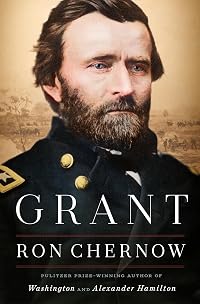
Grant
by Ron Chernow
On This Page
Description
The #1 New York Times bestseller and New York Times Book Review 10 Best Books of 2017“Eminently readable but thick with import . . . Grant hits like a Mack truck of knowledge.” —Ta-Nehisi Coates, The Atlantic
Pulitzer Prize winner Ron Chernow returns with a sweeping and dramatic portrait of one of our most compelling generals and presidents, Ulysses S. Grant.
Ulysses S. Grant's life has typically been misunderstood. All too often he is caricatured as a chronic loser and an show more inept businessman, or as the triumphant but brutal Union general of the Civil War. But these stereotypes don't come close to capturing him, as Chernow shows in his masterful biography, the first to provide a complete understanding of the general and president whose fortunes rose and fell with dizzying speed and frequency.
Before the Civil War, Grant was flailing. His business ventures had ended dismally, and despite distinguished service in the Mexican War he ended up resigning from the army in disgrace amid recurring accusations of drunkenness. But in war, Grant began to realize his remarkable potential, soaring through the ranks of the Union army, prevailing at the battle of Shiloh and in the Vicksburg campaign, and ultimately defeating the legendary Confederate general Robert E. Lee. Along the way, Grant endeared himself to President Lincoln and became his most trusted general and the strategic genius of the war effort. Grant’s military fame translated into a two-term presidency, but one plagued by corruption scandals involving his closest staff members.
More important, he sought freedom and justice for black Americans, working to crush the Ku Klux Klan and earning the admiration of Frederick Douglass, who called him “the vigilant, firm, impartial, and wise protector of my race.” After his presidency, he was again brought low by a dashing young swindler on Wall Street, only to resuscitate his image by working with Mark Twain to publish his memoirs, which are recognized as a masterpiece of the genre.
With lucidity, breadth, and meticulousness, Chernow finds the threads that bind these disparate stories together, shedding new light on the man whom Walt Whitman described as “nothing heroic... and yet the greatest hero.” Chernow’s probing portrait of Grant's lifelong struggle with alcoholism transforms our understanding of the man at the deepest level. This is America's greatest biographer, bringing movingly to life one of our finest but most underappreciated presidents. The definitive biography, Grant is a grand synthesis of painstaking research and literary brilliance that makes sense of all sides of Grant's life, explaining how this simple Midwesterner could at once be so ordinary and so extraordinary.
Named one of the best books of the year by Goodreads • Amazon • The New York Times • Newsday • BookPage • Barnes and Noble • Wall Street Journal. show less
Tags
Recommendations







Member Reviews
One of those books that is so exhaustive that it walks on the edge of (and occasionally topples over into) exhausting, it might have benefited from being split into two volumes much the same way Grant's auto-biography was split in two (by Mark Twain, apparently!)
The first half, or so, concluding with the end of the civil war, is a rousing war story, full of details and triumphant flourishes and finishes.
The second half, dealing with Grant's presidency is considerably less happy. It has a few more apologies than may be strictly necessary, but the real grimness is the parallels with today proving that the hideousness of racial relations and its interaction with politics and power hasn't changed nearly so much as one might have hoped.
On show more the other hand, reading about the sheer number of men and women murdered in the south in the 1870s reminds that things are better and the arc does bend toward progress. So slowly. So so slowly, though. show less
The first half, or so, concluding with the end of the civil war, is a rousing war story, full of details and triumphant flourishes and finishes.
The second half, dealing with Grant's presidency is considerably less happy. It has a few more apologies than may be strictly necessary, but the real grimness is the parallels with today proving that the hideousness of racial relations and its interaction with politics and power hasn't changed nearly so much as one might have hoped.
On show more the other hand, reading about the sheer number of men and women murdered in the south in the 1870s reminds that things are better and the arc does bend toward progress. So slowly. So so slowly, though. show less
[Grant] by [[Ron Chernow]]
I did it. I've been reading this for what feels like forever and I finally finished!
Chernow's exhaustive biography of Grant that just came out this year was an amazing reading experience. It's long - 960 pages of text, 1104 total - but surprisingly readable. Chernow works systematically through Grant's life: his childhood, days at West Point, experience in the Mexican War, a brief and unsuccessful foray in civilian life, extensive coverage of the Civil War, his 2 terms as President, and his civilian life and travels, and brutal fight with cancer as he wrote his autobiography at his end of life.
Throughout the book, Chernow explores Grant's struggle with alcohol and his naivety as far as trusting people with show more money and positions who he shouldn't have. His relationship with Lincoln is front and center in the book and also with one of his most trusted Generals, Sherman. The Civil War period is fascinating and his shift to being a strong supporter of black rights during the war and especially during Reconstruction was admirable and somewhat outside of his time.
I came away with a deep understanding of Grant as a leader and a man. I found him to be an admirable, intelligent, and courageous person. I had always pictured him as the Civil War hero who was elected to the Presidency sort of by default, based on his military reputation. But I actually think he was the best possible choice for the country as it embarked on Reconstruction. Though it didn't work the way Grant had hoped, his intentions were good and he was up against almost insurmountable odds.
Though it was a huge time commitment, I'm so glad I read this and highly recommend it to anyone interested in American history.
Original publication date: 2017
Author’s nationality: American
Original language: English
Length:1104 pages
Rating: 5 stars
Format/Where I acquired the book: library kindle
Why I read this: interested in the topic/like the author show less
I did it. I've been reading this for what feels like forever and I finally finished!
Chernow's exhaustive biography of Grant that just came out this year was an amazing reading experience. It's long - 960 pages of text, 1104 total - but surprisingly readable. Chernow works systematically through Grant's life: his childhood, days at West Point, experience in the Mexican War, a brief and unsuccessful foray in civilian life, extensive coverage of the Civil War, his 2 terms as President, and his civilian life and travels, and brutal fight with cancer as he wrote his autobiography at his end of life.
Throughout the book, Chernow explores Grant's struggle with alcohol and his naivety as far as trusting people with show more money and positions who he shouldn't have. His relationship with Lincoln is front and center in the book and also with one of his most trusted Generals, Sherman. The Civil War period is fascinating and his shift to being a strong supporter of black rights during the war and especially during Reconstruction was admirable and somewhat outside of his time.
I came away with a deep understanding of Grant as a leader and a man. I found him to be an admirable, intelligent, and courageous person. I had always pictured him as the Civil War hero who was elected to the Presidency sort of by default, based on his military reputation. But I actually think he was the best possible choice for the country as it embarked on Reconstruction. Though it didn't work the way Grant had hoped, his intentions were good and he was up against almost insurmountable odds.
Though it was a huge time commitment, I'm so glad I read this and highly recommend it to anyone interested in American history.
Original publication date: 2017
Author’s nationality: American
Original language: English
Length:1104 pages
Rating: 5 stars
Format/Where I acquired the book: library kindle
Why I read this: interested in the topic/like the author show less
I learned so much about Grant and his period in history through reading Chernow’s thorough and sympathetic biography of the man. I realized that I was short-changed in my high school history classes, which glossed over the Reconstruction era. I was shocked to learn of the atrocities inflicted on former slaves and ashamed to learn how most Northerners turned their back on them after winning the war. We had a real chance to improve race relations in this country then and we blew it. We’re living with the consequences still. I knew Grant was a war hero. I did not realize that he tried, perhaps not hard enough, but he did try to integrate African Americans into free society
This Memorial Day is appropriate to celebrate one of our nation’s forgotten saviors. Although Lincoln is often credited with guiding the nation’s rebirth by preserving the Union, none of this would have happened without Ulysses S. Grant’s leadership. Still, Grant is often denigrated as an inept drunk and a butcher of soldiers. This view simply was not shared among his contemporaries who viewed his grace in Confederate surrender at Appomattox Courthouse as foundational in national reconciliation. Chernow’s well-written, admiring biography seeks to correct this oversight.
In a bitter reaction to Northern victory, generations of Southern historians have tried to play up Confederate military expertise and put down Grant’s skill. show more Grant had struggles with alcohol early in his life, yes, but he admiringly avoided alcohol for most of his later life so that he prove more useful. Grant’s victories, such as those at Chattanooga and Vicksburg, required expertise that made him one of the world’s all-time greatest generals. His memoirs, written on his death-bed, only reaffirm this view as Grant’s ingenuity shines through.
I would have liked for Chernow to put in a chapter on Grant’s legacy. How can this successful two-term US President be so forgotten in contemporary culture? That explanatory narrative deserves to see the light of day, and I would have liked to have Chernow write it. Overall, this biography is extremely well-researched, well-argued, and well-executed, but that glaring omission stands as a weakness.
As Chernow and contemporary Walt Whitman acknowledge, America’s greatness can be seen in the ascent of plain but brilliant individuals like Abraham Lincoln and Ulysses S. Grant to the highest places. These stories must not be forgotten or revised in light of face-saving by future generations. Lincoln and Grant together freed the black slave. They saved the Union and preserved the hope of democracy for the world. Chernow does a good job of making this case and persuading the reader of Grant’s nobility. show less
In a bitter reaction to Northern victory, generations of Southern historians have tried to play up Confederate military expertise and put down Grant’s skill. show more Grant had struggles with alcohol early in his life, yes, but he admiringly avoided alcohol for most of his later life so that he prove more useful. Grant’s victories, such as those at Chattanooga and Vicksburg, required expertise that made him one of the world’s all-time greatest generals. His memoirs, written on his death-bed, only reaffirm this view as Grant’s ingenuity shines through.
I would have liked for Chernow to put in a chapter on Grant’s legacy. How can this successful two-term US President be so forgotten in contemporary culture? That explanatory narrative deserves to see the light of day, and I would have liked to have Chernow write it. Overall, this biography is extremely well-researched, well-argued, and well-executed, but that glaring omission stands as a weakness.
As Chernow and contemporary Walt Whitman acknowledge, America’s greatness can be seen in the ascent of plain but brilliant individuals like Abraham Lincoln and Ulysses S. Grant to the highest places. These stories must not be forgotten or revised in light of face-saving by future generations. Lincoln and Grant together freed the black slave. They saved the Union and preserved the hope of democracy for the world. Chernow does a good job of making this case and persuading the reader of Grant’s nobility. show less
Chernow’s book follows closely on the heels of a similarly weighty biography by Ronald C. White. The question is, why do we need two new books of this depth? The answer is: both have the goal of "rehabilitating" Grant's reputation from its historical downward slide, but each has a slightly different emphasis. Chernow’s book is more thorough [in the audio version, 38 compact discs unabridged versus 22] and is less complimentary to Grant. Nevertheless, it seems clear Chernow would agree with White that Grant’s diminished reputation is not commensurate with his great achievements for the nation, nor with the magnanimity of Grant’s character.
White is less focused on explaining why Grant’s reputation has receded over time, and more show more on setting forth a new way to evaluate him. Chernow not only provides more historical context for Grant's life, but frequently interjects theories as to the reasons why Grant's reputation became (unfairly) tarnished. “Pernicious stereotypes,” Chernow argues, “grossly impede our understanding of the man.”
In the main, Chernow notes three factors. Notably, all three of them were loudly bruited by those who were either hurt personally by Grant’s decisions, or who objected to his policies.
The most salient was the accusation, endured throughout his life, that Grant was a drunken sot. Apparently, in his younger days, he did have a problem with drinking, but largely overcame it in later years (an accomplishment Chernow compliments often). Nevertheless, whenever anyone was opposed to Grant, the accusations resurfaced. In particular, during the Civil War, when Grant undertook an effort to remove incompetent political appointees from positions of military power, there were quite a few such detractors.
Secondly, when Grant was president, there were a number of scandals in his administration. Chernow observes:
“It is sadly ironic that Grant’s presidency became synonymous with corruption, since he himself was impeccably honest. . . The mystery of Grant’s presidency is how this upright man tolerated some of the arrant rascals collected around him."
Not only could he not see the “swampiness” of those around him, but he also believed those in his inner circle who were attacked were innocent dupes, “showing the sympathy for human frailty was his tragic undoing.”
There are a number of theories about Grant’s naivety. For one thing, because of his own fundamental decency, he too often expected that others would act as he would. In addition, because he was acutely aware of the unfairness and lack of veracity of the accusations made about him over the years, he was inclined to give those around him the benefit of the doubt.
Chernow writes:
“The world of politics was filled with duplicitous people and Grant was poorly equipped to spot them, remaining an easy victim for crooked men. . . . Again and again he was stunned by scandals because he could not imagine subordinates guilty of such sleazy behavior.”
But Chernow wants us to be aware, not only of Grant’s better cabinet picks, but of Grant’s many accomplishments as president in spite of the distracting scandals. He points out that as a president coping with the aftermath of the Civil War, Grant “wrestled with herculean challenges,” from restoring a sense of one nation to the North and the South, to integrating four million blacks into the society as new citizens.
It was this last achievement that contributes to the third reason Grant’s reputation suffered: the period of Reconstruction after the Civil War. As Chernow indicates, for years the Reconstruction Era was excoriated, viewed as a "catastrophic error, a period of corrupt carpetbag politicians and illiterate black legislators, presided over by the draconian rule of U.S. Grant." It is only quite recently that historians, led by Eric Foner, have recast that time as "a noble experiment in equal justice for black citizens in which they made remarkable strides in voting, holding office, owning land, creating small businesses and churches, and achieving literacy.”
In addition, what is not often revealed, especially in history books for schools, is the shocking and inhumane violence employed by many whites throughout the South. Unable to countenance the freedom of their former slaves, white Southerners tried to suppress blacks in every way they could, with many joining the newly formed Ku Klux Klan to ensure that blacks stayed “in their places.”
This quasi-military organization and its offshoots throughout the South attempted, as Grant said himself:
". . . by force and terror . . . to deprive colored citizens of the right to bear arms and of the right to a free ballot, to suppress schools in which colored children were taught, and to reduce the colored people to a condition closely akin to that of slavery.’”
The Klan in essence launched a new civil war by clandestine means. Grant, to his lasting credit, took up this new battle as unrelentingly as he did the fight to save the Union. Chernow writes: “Klan violence was unquestionably the worst outbreak of domestic terrorism in American history and Grant dealt with it aggressively, using all the instruments at his disposal.”
Chernow astutely observes that the incidents in the South:
“. . . showed the fundamental weakness of a political revolution that had relied heavily on force applied by outsiders in Washington - something that couldn’t be maintained indefinitely.”
Those in power in the South (many of whom had been Confederates during the Civil War) resisted efforts by Grant to ensure civil equality and to rein in the violence of the Klan. And unfortunately, there arose “a certain moral fatigue” in the North, where racism remained widespread in spite of an opposition to the institution of slavery.
Chernow does not flinch in recounting horrifying incidents of beatings, rape and murder in the South, especially around the time of elections, with Grant responding vigorously at first, but then retreating in the final stages of his administration. Grant later confessed that pulling back was a mistake, but he was bowing to pressure from party bosses, who in turn were bowing to pressure from their constituents. But Grant knew the situation for blacks in the South was indefensible. In 1875, he predicted that the northern retreat from Reconstruction would lead to Democrats recapturing power in the South: "It requires no prophet to foresee that the national government will soon be at a great disadvantage and that the results of the war of the rebellion will have been in a large measure lost….”
Chernow emphasizes:
“This wasn’t a minor statement: the victorious Union general of the Civil War was saying that terror tactics perpetrated by southern whites had nullified the outcome of the rebellion. All those hundreds of thousands dead, the millions maimed and wounded, the mourning of widows and orphans - all that suffering, all that tumult, on some level, had been for naught. Slavery had been abolished, but it had been replaced by a caste-ridden form of second-class citizenship for southern blacks, and that counted as a national shame.”
After Grant’s presidency ended, Reconstruction ended as well. Northern troops were withdrawn from the South. “Jim Crow” laws taking rights away from blacks were enacted in one state of the South after another. The Klan was given free rein to exercise police power over blacks without fear of reprisal. Schools and other public services for blacks were defunded. History textbooks used in southern schools were designed to teach white superiority and black backwardness, so that children imbibed these ideas from the earliest age. These practices persisted until the Civil Rights movement of the 1960's.
Furthermore, Southerners, producing the greatest volume not only of textbooks and histories but also pictures, statuary, and movies, purposefully structured a mix of information laden with emotional impact that reinforced the view they chose to promulgate of the Civil War and its aftermath. These commemorative patterns came to inform the dominant narratives of American history, and thus kept alive the misunderstandings about Reconstruction. They have also become embedded in the subconscious of the American mind, helping to legitimate discriminatory political policies and practices over the years. And they have contributed to a negative impression about the accomplishments of Grant.
As for Grant, he didn't stop caring about the fate of freed blacks, but he was no longer in a position to act directly on the matter. Thus he left politics aside for a while and went off on a tour around the world, to widespread acclaim abroad.
After two years, out of money, Grant and his family returned. Grant died on July 23, 1885, after losing his final battle, this time against cancer.
The book ends with William Tecumseh Sherman (Grant's lifelong friend) and Mark Twain (the editor and publisher of Grant's memoirs) at a bar after the funeral: drinking, smoking, and trying to make sense of Grant's life. But it was Frederick Douglass, speaking at a memorial service in Washington, D.C. that same August, who may have summed up best who Grant was and what he meant to the country:
“He was a man too great to be envious of the fame of others; too just to detract from the merits of the most brilliant of his companions in arms; too enlightened to be influenced by popular prejudice; too humane to despise the humblest. In him the Negro found a protector, the Indian a friend, a vanquished foe a brother, an imperiled nation a savior.”
Discussion: Chernow’s thorough coverage of Grant’s life especially excels during the period of the Civil War, when Chernow takes us on a riveting tour of the most important battles. He reveals Grant’s devotion to the idea of Union, his implacable calmness in adversity, his indomitable will, his rarely failing instincts, his courage under fire, and his unwillingness to back down. He also shows Grant's less admirable qualities, especially his fixation on loyalty during his presidency, but doesn't believe they should detract from his achievements.
Chernow concludes that “Grant deserves an honored place in American history, second only to Lincoln, for what he did for the freed slaves. He got the big issues right during his presidency, even if he bungled many of the small ones. . . . In the words of Frederick Douglass [in 1890], ‘that sturdy old Roman, Benjamin Butler, made the negro a contraband, Abraham Lincoln made him a freeman, and Gen. Ulysses S. Grant made him a citizen.’”
Evaluation: As with his other books, Chernow does an excellent job of providing a deeply researched portrayal of an important figure in American history. Chernow’s detailed exposure of the horror of the Reconstruction Era in the South, not only for blacks but for whites who dared sympathize with them, will be eye-opening for readers not familiar with the outstanding scholarship of Eric Foner. And truly, it is a history about which Americans should be aware.
This excellent history is highly recommended.
Rating: 4.5/5
A Few Notes on the Audio Production:
The narrator, Mark Bramhall, had strong competition for finding Grant’s “voice” because of the excellent job done by Arthur Morey in the Grant biography by Ronald C. White. Bramhall too managed to master all the different voices he presented, such as those of Lincoln, Sherman, and even Julia Grant. After a time I could pick out the person by the voice, even before Bramhall identified the speaker. show less
White is less focused on explaining why Grant’s reputation has receded over time, and more show more on setting forth a new way to evaluate him. Chernow not only provides more historical context for Grant's life, but frequently interjects theories as to the reasons why Grant's reputation became (unfairly) tarnished. “Pernicious stereotypes,” Chernow argues, “grossly impede our understanding of the man.”
In the main, Chernow notes three factors. Notably, all three of them were loudly bruited by those who were either hurt personally by Grant’s decisions, or who objected to his policies.
The most salient was the accusation, endured throughout his life, that Grant was a drunken sot. Apparently, in his younger days, he did have a problem with drinking, but largely overcame it in later years (an accomplishment Chernow compliments often). Nevertheless, whenever anyone was opposed to Grant, the accusations resurfaced. In particular, during the Civil War, when Grant undertook an effort to remove incompetent political appointees from positions of military power, there were quite a few such detractors.
Secondly, when Grant was president, there were a number of scandals in his administration. Chernow observes:
“It is sadly ironic that Grant’s presidency became synonymous with corruption, since he himself was impeccably honest. . . The mystery of Grant’s presidency is how this upright man tolerated some of the arrant rascals collected around him."
Not only could he not see the “swampiness” of those around him, but he also believed those in his inner circle who were attacked were innocent dupes, “showing the sympathy for human frailty was his tragic undoing.”
There are a number of theories about Grant’s naivety. For one thing, because of his own fundamental decency, he too often expected that others would act as he would. In addition, because he was acutely aware of the unfairness and lack of veracity of the accusations made about him over the years, he was inclined to give those around him the benefit of the doubt.
Chernow writes:
“The world of politics was filled with duplicitous people and Grant was poorly equipped to spot them, remaining an easy victim for crooked men. . . . Again and again he was stunned by scandals because he could not imagine subordinates guilty of such sleazy behavior.”
But Chernow wants us to be aware, not only of Grant’s better cabinet picks, but of Grant’s many accomplishments as president in spite of the distracting scandals. He points out that as a president coping with the aftermath of the Civil War, Grant “wrestled with herculean challenges,” from restoring a sense of one nation to the North and the South, to integrating four million blacks into the society as new citizens.
It was this last achievement that contributes to the third reason Grant’s reputation suffered: the period of Reconstruction after the Civil War. As Chernow indicates, for years the Reconstruction Era was excoriated, viewed as a "catastrophic error, a period of corrupt carpetbag politicians and illiterate black legislators, presided over by the draconian rule of U.S. Grant." It is only quite recently that historians, led by Eric Foner, have recast that time as "a noble experiment in equal justice for black citizens in which they made remarkable strides in voting, holding office, owning land, creating small businesses and churches, and achieving literacy.”
In addition, what is not often revealed, especially in history books for schools, is the shocking and inhumane violence employed by many whites throughout the South. Unable to countenance the freedom of their former slaves, white Southerners tried to suppress blacks in every way they could, with many joining the newly formed Ku Klux Klan to ensure that blacks stayed “in their places.”
This quasi-military organization and its offshoots throughout the South attempted, as Grant said himself:
". . . by force and terror . . . to deprive colored citizens of the right to bear arms and of the right to a free ballot, to suppress schools in which colored children were taught, and to reduce the colored people to a condition closely akin to that of slavery.’”
The Klan in essence launched a new civil war by clandestine means. Grant, to his lasting credit, took up this new battle as unrelentingly as he did the fight to save the Union. Chernow writes: “Klan violence was unquestionably the worst outbreak of domestic terrorism in American history and Grant dealt with it aggressively, using all the instruments at his disposal.”
Chernow astutely observes that the incidents in the South:
“. . . showed the fundamental weakness of a political revolution that had relied heavily on force applied by outsiders in Washington - something that couldn’t be maintained indefinitely.”
Those in power in the South (many of whom had been Confederates during the Civil War) resisted efforts by Grant to ensure civil equality and to rein in the violence of the Klan. And unfortunately, there arose “a certain moral fatigue” in the North, where racism remained widespread in spite of an opposition to the institution of slavery.
Chernow does not flinch in recounting horrifying incidents of beatings, rape and murder in the South, especially around the time of elections, with Grant responding vigorously at first, but then retreating in the final stages of his administration. Grant later confessed that pulling back was a mistake, but he was bowing to pressure from party bosses, who in turn were bowing to pressure from their constituents. But Grant knew the situation for blacks in the South was indefensible. In 1875, he predicted that the northern retreat from Reconstruction would lead to Democrats recapturing power in the South: "It requires no prophet to foresee that the national government will soon be at a great disadvantage and that the results of the war of the rebellion will have been in a large measure lost….”
Chernow emphasizes:
“This wasn’t a minor statement: the victorious Union general of the Civil War was saying that terror tactics perpetrated by southern whites had nullified the outcome of the rebellion. All those hundreds of thousands dead, the millions maimed and wounded, the mourning of widows and orphans - all that suffering, all that tumult, on some level, had been for naught. Slavery had been abolished, but it had been replaced by a caste-ridden form of second-class citizenship for southern blacks, and that counted as a national shame.”
After Grant’s presidency ended, Reconstruction ended as well. Northern troops were withdrawn from the South. “Jim Crow” laws taking rights away from blacks were enacted in one state of the South after another. The Klan was given free rein to exercise police power over blacks without fear of reprisal. Schools and other public services for blacks were defunded. History textbooks used in southern schools were designed to teach white superiority and black backwardness, so that children imbibed these ideas from the earliest age. These practices persisted until the Civil Rights movement of the 1960's.
Furthermore, Southerners, producing the greatest volume not only of textbooks and histories but also pictures, statuary, and movies, purposefully structured a mix of information laden with emotional impact that reinforced the view they chose to promulgate of the Civil War and its aftermath. These commemorative patterns came to inform the dominant narratives of American history, and thus kept alive the misunderstandings about Reconstruction. They have also become embedded in the subconscious of the American mind, helping to legitimate discriminatory political policies and practices over the years. And they have contributed to a negative impression about the accomplishments of Grant.
As for Grant, he didn't stop caring about the fate of freed blacks, but he was no longer in a position to act directly on the matter. Thus he left politics aside for a while and went off on a tour around the world, to widespread acclaim abroad.
After two years, out of money, Grant and his family returned. Grant died on July 23, 1885, after losing his final battle, this time against cancer.
The book ends with William Tecumseh Sherman (Grant's lifelong friend) and Mark Twain (the editor and publisher of Grant's memoirs) at a bar after the funeral: drinking, smoking, and trying to make sense of Grant's life. But it was Frederick Douglass, speaking at a memorial service in Washington, D.C. that same August, who may have summed up best who Grant was and what he meant to the country:
“He was a man too great to be envious of the fame of others; too just to detract from the merits of the most brilliant of his companions in arms; too enlightened to be influenced by popular prejudice; too humane to despise the humblest. In him the Negro found a protector, the Indian a friend, a vanquished foe a brother, an imperiled nation a savior.”
Discussion: Chernow’s thorough coverage of Grant’s life especially excels during the period of the Civil War, when Chernow takes us on a riveting tour of the most important battles. He reveals Grant’s devotion to the idea of Union, his implacable calmness in adversity, his indomitable will, his rarely failing instincts, his courage under fire, and his unwillingness to back down. He also shows Grant's less admirable qualities, especially his fixation on loyalty during his presidency, but doesn't believe they should detract from his achievements.
Chernow concludes that “Grant deserves an honored place in American history, second only to Lincoln, for what he did for the freed slaves. He got the big issues right during his presidency, even if he bungled many of the small ones. . . . In the words of Frederick Douglass [in 1890], ‘that sturdy old Roman, Benjamin Butler, made the negro a contraband, Abraham Lincoln made him a freeman, and Gen. Ulysses S. Grant made him a citizen.’”
Evaluation: As with his other books, Chernow does an excellent job of providing a deeply researched portrayal of an important figure in American history. Chernow’s detailed exposure of the horror of the Reconstruction Era in the South, not only for blacks but for whites who dared sympathize with them, will be eye-opening for readers not familiar with the outstanding scholarship of Eric Foner. And truly, it is a history about which Americans should be aware.
This excellent history is highly recommended.
Rating: 4.5/5
A Few Notes on the Audio Production:
The narrator, Mark Bramhall, had strong competition for finding Grant’s “voice” because of the excellent job done by Arthur Morey in the Grant biography by Ronald C. White. Bramhall too managed to master all the different voices he presented, such as those of Lincoln, Sherman, and even Julia Grant. After a time I could pick out the person by the voice, even before Bramhall identified the speaker. show less
Summary: A biography on the life of Ulysses S. Grant from his Ohio childhood, his years of failure in business, his rise during the Civil War, his presidency, and later years, including the completion of his memoirs as a dying man.
Many people know the work of Ron Chernow from his great biography, Alexander Hamilton, which served as the basis of the Broadway play, or his biography, Washington: A Life. Chernow has done it again in this biography of Grant, which will likely raise Grant in the rankings of presidents, and establishes Chernow as one of the premier presidential biographers. I honestly can't say enough good about this book. It is rare to come to the end of 960 pages and wish there were more. I have his Washington: A Life on my show more TBR pile and will move it up!
Chernow gives us a Grant caught between the ambitions and expectations of father, father-in-law, and socially ambitious wife. It is little wonder in some ways that he struggled with drinking, which Chernow explores throughout the book. Grant quietly resigned from the Army in the early 1850's likely because of drinking problems on a backwater post in the Pacific northwest. He was a failure at farming a plot of land provided by his father-in-law, and unhappy running a store owned by his father under his younger brother in Galena, Illinois, and continued to struggle with drink. One heroic aspect of Grant's life was his gradual mastery of this problem during the Civil War (with occasional lapses) and in his presidency (where he remained sober) and later life. The vigilance of his aide, John Rawlins, and wife Julia certainly helped, but Grant's own eventual mastery is evidence of the resolute nature of this man.
Chernow explores the complicated nature of this man, who seems a bundle of contradictions. He could keenly recognize the opportunities of a battlefield situation and the outlines of grand strategy that led to victory after victory culminating in Appomattox and yet could not assess the character of his closest associates, who often betrayed his trust, in war, in his cabinet, and at the end of his life, when he was bankrupted by Ponzi-schemer Ferdinand Ward.
He could seem like someone with low energy and little drive until a crisis, where he would remain calm, and give decisive direction. He was the first general Lincoln found who would take the fight to the enemy and ruthlessly prosecute it to the end, gaining the reputation of being "Unconditional Surrender" Grant. Then he grants magnanimous peace terms to General Lee and his troops, for which many gave him their undying respect. In later life, touring Europe, he at once dazzled people with his grasp of military history and strategic concepts, showing far more brilliance than people credited, and yet he had no desire for reviewing troops, having seen more than enough of this in his time.
His presidency as well was a bundle of contradictions. His administration was a mix of men of integrity, and corrupt friends, who tainted his reputation as their corruption became evident. Most noteworthy, and a theme of Chernow's was his vigorous efforts both during the Johnson administration, and in his presidency, to protect and extend Reconstruction, including Black voting rights and office holders, while healing the rift with the South that led Frederick Douglass to write this in summary of his career: "In him the Negro found a protector, the Indian a friend, a vanquished foe a brother, an imperiled nation a savior." John Singleton Mosby, a Confederate general wrote on learning of his death: "I felt I had lost my best friend."
In addition to Reconstruction, his skill in avoiding war with Great Britain over the Alabama, turning it into an occasion to cement the alliance with Great Britain we enjoy to this day, his management of the nation's finances in paying down war debt, and his fostering of economic growth outshine the corruption of his associates, who he defended at first, but then dealt with when evidence was clear that they had betrayed his, and the public's trust. His administration was probably better than the taint of scandal that has come down to us. As Chernow notes, he loved his friends too well rather than wisely.
He was a man of few words, except when unbending with close friends. His orders and his speeches were models of clarity and concision. Yet this same man, dying of cancer of the throat accomplished the stupendous feat of writing the 336,000 words in his final years, finishing them just before he died. Many critics consider the Memoirs the one of the greatest works of this genre, described by Chernow as written in a "clear, supple style." Apart from minor changes of punctuation and grammar, he needed little editing. Writing this work, motivated in significant part to provide for his family after the financial debacle with Ferdinand Ward left him nearly penniless, was perhaps the most courageous act of his life, as he struggled on in great pain and increasing weakness. He finished the work on July 16, and died a week later on July 23, 1885 at age 63.
All this, and so much more, you will find in Chernow's Grant. Chernow, while cognizant of Grant's faults, doesn't bury Grant's greatness in his failings. He proposes that there is far more to this General and President than we have credited. And as a writer, he celebrates another writer, whose Memoirs are going on my reading list! show less
Many people know the work of Ron Chernow from his great biography, Alexander Hamilton, which served as the basis of the Broadway play, or his biography, Washington: A Life. Chernow has done it again in this biography of Grant, which will likely raise Grant in the rankings of presidents, and establishes Chernow as one of the premier presidential biographers. I honestly can't say enough good about this book. It is rare to come to the end of 960 pages and wish there were more. I have his Washington: A Life on my show more TBR pile and will move it up!
Chernow gives us a Grant caught between the ambitions and expectations of father, father-in-law, and socially ambitious wife. It is little wonder in some ways that he struggled with drinking, which Chernow explores throughout the book. Grant quietly resigned from the Army in the early 1850's likely because of drinking problems on a backwater post in the Pacific northwest. He was a failure at farming a plot of land provided by his father-in-law, and unhappy running a store owned by his father under his younger brother in Galena, Illinois, and continued to struggle with drink. One heroic aspect of Grant's life was his gradual mastery of this problem during the Civil War (with occasional lapses) and in his presidency (where he remained sober) and later life. The vigilance of his aide, John Rawlins, and wife Julia certainly helped, but Grant's own eventual mastery is evidence of the resolute nature of this man.
Chernow explores the complicated nature of this man, who seems a bundle of contradictions. He could keenly recognize the opportunities of a battlefield situation and the outlines of grand strategy that led to victory after victory culminating in Appomattox and yet could not assess the character of his closest associates, who often betrayed his trust, in war, in his cabinet, and at the end of his life, when he was bankrupted by Ponzi-schemer Ferdinand Ward.
He could seem like someone with low energy and little drive until a crisis, where he would remain calm, and give decisive direction. He was the first general Lincoln found who would take the fight to the enemy and ruthlessly prosecute it to the end, gaining the reputation of being "Unconditional Surrender" Grant. Then he grants magnanimous peace terms to General Lee and his troops, for which many gave him their undying respect. In later life, touring Europe, he at once dazzled people with his grasp of military history and strategic concepts, showing far more brilliance than people credited, and yet he had no desire for reviewing troops, having seen more than enough of this in his time.
His presidency as well was a bundle of contradictions. His administration was a mix of men of integrity, and corrupt friends, who tainted his reputation as their corruption became evident. Most noteworthy, and a theme of Chernow's was his vigorous efforts both during the Johnson administration, and in his presidency, to protect and extend Reconstruction, including Black voting rights and office holders, while healing the rift with the South that led Frederick Douglass to write this in summary of his career: "In him the Negro found a protector, the Indian a friend, a vanquished foe a brother, an imperiled nation a savior." John Singleton Mosby, a Confederate general wrote on learning of his death: "I felt I had lost my best friend."
In addition to Reconstruction, his skill in avoiding war with Great Britain over the Alabama, turning it into an occasion to cement the alliance with Great Britain we enjoy to this day, his management of the nation's finances in paying down war debt, and his fostering of economic growth outshine the corruption of his associates, who he defended at first, but then dealt with when evidence was clear that they had betrayed his, and the public's trust. His administration was probably better than the taint of scandal that has come down to us. As Chernow notes, he loved his friends too well rather than wisely.
He was a man of few words, except when unbending with close friends. His orders and his speeches were models of clarity and concision. Yet this same man, dying of cancer of the throat accomplished the stupendous feat of writing the 336,000 words in his final years, finishing them just before he died. Many critics consider the Memoirs the one of the greatest works of this genre, described by Chernow as written in a "clear, supple style." Apart from minor changes of punctuation and grammar, he needed little editing. Writing this work, motivated in significant part to provide for his family after the financial debacle with Ferdinand Ward left him nearly penniless, was perhaps the most courageous act of his life, as he struggled on in great pain and increasing weakness. He finished the work on July 16, and died a week later on July 23, 1885 at age 63.
All this, and so much more, you will find in Chernow's Grant. Chernow, while cognizant of Grant's faults, doesn't bury Grant's greatness in his failings. He proposes that there is far more to this General and President than we have credited. And as a writer, he celebrates another writer, whose Memoirs are going on my reading list! show less
Ron Chernow is the acclaimed biographer of two of the most fabled founding fathers of America - George Washington and Alexander Hamilton, as well as an historian of bankers and their dynasties in the early part of the 20th century. With Grant the author is taking on something else entirely. A famous name, to be sure, but one whose achievements are not so well known and who still raises passions for what he did, or was perceived to have done.
Chernow has produced a magnificent book, destined to be the gold standard, if not the last word, in general histories of this man.
Chernow approaches Grant’s life in a traditional way, starting with his birth, ending with his death and following him in a strictly chronological way in between. He show more rarely digresses to discuss the context of Grant’s actions, keeping the focus very tightly on what he did, where he went and why. This is a stroke of genius because we get to know Grant very intimately and begin to experience the ups and downs of his life with him and become very sympathetic to his way of thinking and acting.
Grant emerged from a not very spectacular start to become the military architect of the Union victory in the American Civil War where other, at the time, starrier names had failed. He was magnanimous in victory, refusing to punish or humiliate Confederate forces and often personally ensuring that troops were fed, clothed and allowed to return home with dignity. Less well known is his personal commitment to the abolition of slavery, never losing sight of this as the real goal of the war. As the conflict progressed and more and more freed slaves were appearing in Union territory Grant was quick to recruit black soldiers and to employ freed slaves to help with the war effort.
As President, Grant was the key driver of Reconstruction and the integration of freed slaves into American life resulting in many black appointments and electoral victories to political posts across the country. The four million freed slaves became the backbone of the electoral support for Grant’s Republican Party.
After his second term in office Grant spent two years travelling the world, initially on holiday, but increasingly as a semi-official ambassador helping to settle international disputes and spread American soft power.
Grant introduced many innovations into American politics, the Presidency and national governance, all covered by Chernow. In many respects Grant is the key figure in the transition from the Founding Fathers’ view of the role of the President and the modern Presidency we see today.
Chernow’s book is very long, but very readable. His narrative approach, his language, his focus on character and the rollercoaster life that was Grant make this more like a thriller than a dry biography.
Very highly recommended, especially for those who think that dead white presidents are all beyond the pale. show less
Chernow has produced a magnificent book, destined to be the gold standard, if not the last word, in general histories of this man.
Chernow approaches Grant’s life in a traditional way, starting with his birth, ending with his death and following him in a strictly chronological way in between. He show more rarely digresses to discuss the context of Grant’s actions, keeping the focus very tightly on what he did, where he went and why. This is a stroke of genius because we get to know Grant very intimately and begin to experience the ups and downs of his life with him and become very sympathetic to his way of thinking and acting.
Grant emerged from a not very spectacular start to become the military architect of the Union victory in the American Civil War where other, at the time, starrier names had failed. He was magnanimous in victory, refusing to punish or humiliate Confederate forces and often personally ensuring that troops were fed, clothed and allowed to return home with dignity. Less well known is his personal commitment to the abolition of slavery, never losing sight of this as the real goal of the war. As the conflict progressed and more and more freed slaves were appearing in Union territory Grant was quick to recruit black soldiers and to employ freed slaves to help with the war effort.
As President, Grant was the key driver of Reconstruction and the integration of freed slaves into American life resulting in many black appointments and electoral victories to political posts across the country. The four million freed slaves became the backbone of the electoral support for Grant’s Republican Party.
After his second term in office Grant spent two years travelling the world, initially on holiday, but increasingly as a semi-official ambassador helping to settle international disputes and spread American soft power.
Grant introduced many innovations into American politics, the Presidency and national governance, all covered by Chernow. In many respects Grant is the key figure in the transition from the Founding Fathers’ view of the role of the President and the modern Presidency we see today.
Chernow’s book is very long, but very readable. His narrative approach, his language, his focus on character and the rollercoaster life that was Grant make this more like a thriller than a dry biography.
Very highly recommended, especially for those who think that dead white presidents are all beyond the pale. show less
Members
- Recently Added By
Published Reviews
ThingScore 100
For all its scholarly and literary strengths, this book’s greatest service is to remind us of Grant’s significant achievements at the end of the war and after, which have too long been overlooked and are too important today to be left in the dark.
added by waitingtoderail
Lists

Presidents and First Ladies
25 works; 6 members

Best Biographies, Autobiographies and Memoirs
465 works; 160 members

Top Five Books of 2018
802 works; 265 members

Top Five Books of 2020
982 works; 350 members

Top Five Books of 2021
604 works; 181 members

Presidential Books
15 works; 2 members

Books recommended by Barack Obama
295 works; 29 members

2018 Notable Books for Adults
26 works; 4 members
The Hive Recommends
62 works; 2 members

2018 Best Foreign Affairs Books
24 works; 1 member

Books Read in 2020
4,379 works; 124 members
Barack Obama's Favorite Books of 2017
12 works; 1 member

In Our Time books
4,934 works; 2 members
Author Information

20+ Works 22,766 Members
Educated at Yale and Cambridge University in England, Ron Chernow is a biographer who specializes in hard-hitting exposes on historical business figures. Among Chernow's early accomplishments was his unmasking of corruption in Chinatown for New York magazine in 1973. In the book The House of Morgan, winner of the National Book Award in 1990, show more Chernow outlines the extraordinary path of J.P. Morgan's empire and its influence on the American banking industry. Chernow is also the author of Titan: The Life of John D. Rockefeller, which chronicles the life and times of the richest man in the United States in the early 1900s. His other work includes The Warburgs, The Death of a Banker, Alexander Hamilton, Washington: A Life, and Grant. Chernow is regular guest on the National Public Radio programs Fresh Air with Terry Gross and All Things Considered. (Bowker Author Biography) show less
Awards and Honors
Awards
Distinctions
Notable Lists
Work Relationships
Common Knowledge
- Original publication date
- 2017-10-10
- People/Characters
- Ulysses S. Grant; William Tecumseh Sherman; Abraham Lincoln; Andrew Johnson; Philip Sheridan; Edwin Stanton (show all 19); Charles Sumner; Julia Grant; Amos Akerman; Hamilton Fish; Frederick Douglass; Robert E. Lee; Henry W. Halleck; John Rawlins; Adam Badeau; Elihu B. Washburne; Orville Babcock; Benjamin Bristow; Roscoe Conkling
- Important places
- Vicksburg, Mississippi, USA; Petersburg, Virginia, USA; Fort Donelson, Tennessee, USA; Galena, Illinois, USA; Missouri, USA; Mexico (show all 7); Washington, D.C., USA
- Important events
- American Civil War
- Related movies
- Grant (2020 | IMDb)
- Dedication
- To my loyal readers, who have soldiered on through my lengthy sagas
- First words
- (Introduction) Even as other civil war generals rushed to publish their memoirs, flaunting their conquests and cashing in on their celebrity, Ulysses S. Grant refused to trumpet his accomplishments in print.
On April 27, 1822, Ulysses S. Grant was born in Point Pleasant, Ohio, tucked away in the rural southwestern corner of the state near Cincinnati. - Last words
- (Click to show. Warning: May contain spoilers.)But he knew that no hint of that existed in the narrative, that it had been too sore a point with Grant, who, in his quiet, inscrutable way, carried his private thoughts on the subject to the grave.
- Original language
- English US
Classifications
- Genres
- History, Biography & Memoir, General Nonfiction, Nonfiction
- DDC/MDS
- 973.8 — History & geography History of North America United States The Gilded Age, Reconstruction, Spanish American War (1865-1901)
- LCC
- E672 .C47 — History of the United States United States Late nineteenth century, 1865-1900 Grant's administrations, 1869-1877
- BISAC
Statistics
- Members
- 3,064
- Popularity
- 5,794
- Reviews
- 73
- Rating
- (4.49)
- Languages
- English
- Media
- Paper, Audiobook, Ebook
- ISBNs
- 15
- ASINs
- 4