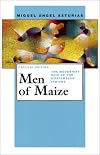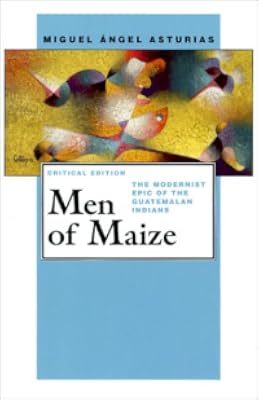
Men of Maize: The Modernist Epic of the Guatemalan Indians
by Miguel Ángel Asturias
On This Page
Description
"Deep in the mountain forests of Guatemala, a community of indigenous Mayans-the "men of maize"-serves as stewards to sacred corn crops. When outsiders encroach on their territory and threaten to abuse the fertile land, they enter a bloody struggle to protect their way of life. This 75th anniversary edition of Nobel Prize Winner Miguel Ángel Asturias's epic tale of the collision of capitalist exploitation and indigenous wisdom features a new introduction and a foreword by Pulitzer Prize show more winner Héctor Tobar"-- show lessTags
Recommendations


























Member Reviews
Noi abbiamo scoperto ciò che sta succedendo in Amazzonia ben che vada nel 1988, anno dell'assassinio di Chico Mendes, se non che Uomini di mais è del 1949.
Asturias è in primo luogo un poeta, e densamente poetico è il linguaggio di questo splendido romanzo, peraltre tradotto in modo pregevole, e poetici, pur nella loro crudezza, sono gli avvenimenti che vedono lo scontro tra gli Uuomini di mais, vale a dire gli indios secondo la tradizione del Popol Vuh, e coloro che disboscano la foresta col fuoco, per coltivare un mais che da alimento si trasforma in sciagura per la maledizione dell'avidità.
Un romanzo magico, oltre che poetico, che fa impallidire con la sua forza magica i vari Castaneda, Coelho, eccetera eccetera.
Da leggere come show more una rivelazione. show less
Asturias è in primo luogo un poeta, e densamente poetico è il linguaggio di questo splendido romanzo, peraltre tradotto in modo pregevole, e poetici, pur nella loro crudezza, sono gli avvenimenti che vedono lo scontro tra gli Uuomini di mais, vale a dire gli indios secondo la tradizione del Popol Vuh, e coloro che disboscano la foresta col fuoco, per coltivare un mais che da alimento si trasforma in sciagura per la maledizione dell'avidità.
Un romanzo magico, oltre che poetico, che fa impallidire con la sua forza magica i vari Castaneda, Coelho, eccetera eccetera.
Da leggere come show more una rivelazione. show less
Exceptional dream-like novel that tells a story across generations in Guatemala. Each chapter documents one character in the linked story, from stories of the Spanish colonial power to the natives. The actions and consequences of history are charted from one character to another; stories from one generation become legends or myths in the next, and the belief systems are intertwined with a history that is brilliantly told. Asturias weaves mythology into fiction to create a story that resonates today with environmental issues, despite being written in the 1940s. Brilliantly paced.
Me gustó mucho. En su tema y su trato de lo mítico, me recordó mucho a Cien años de soledad, aunque Márquez es más accesible que Asturias. Al principio pensé que era una especie de libro de cuentos, pero la forma en la que todas las historias se entrelazan después es sorprendente y magistral, con muchísima naturalidad. Muy recomendado, aunque se necesita tenerle bastante paciencia.
I can't fairly rate this, so I won't try. I'm not going to try reviewing it in Spanish either, even though I read it in that language. Or, you know, tried to. This novel is written in very idiosyncratic language, full of archaisms and (I assume) indigenous words. At the back of my Kindle edition was a glossary taking up 6% of the book (i.e. 26 pages), which gives me the impression that the language isn't easy for the majority of native Spanish speakers, either. Unfortunately, there are no actual links to the glossary from where these words appear in the text, making it a massive ordeal to check them – and if I had, it'd have taken me way longer to read this than two months, I can tell you. It seems that Amazon's pulled the book from show more sale since I bought it two years ago (although not from my library, evidently). I really hope they pulled it to fix this.
I am really not sure how this vibrantly non-standard Spanish was translated into English, but I guess I'd like to see. My university library theoretically has an English translation of this, and I went looking for it when I was about one-tenth of the way through this and realising I just could not understand it. Evidently the uni lost it because it wasn't on the shelf. So, I struggled through… and while I guess my Spanish got some good practice, I can barely tell you anything about this book that isn't in the Wikipedia summary of it. I can tell you about some of the language use, I guess…? Like once it used the verb "parlar" and I went on a great bout of research to discover what this word was doing in Castilian (the answer: it's a borrowing from Occitan, but in Castilian refers specifically to speaking indiscreetly, or in an otherwise mischievous manner. but it's very uncommon). I don't really remember quién parlaba o porqué, though. You see? I didn't absorb much of anything.
So… while this seems like a very interesting book to me… I did not gain anything by actually reading it and I really wish the English edition hadn't been out of print for decades. If I ever get my hands on one… show less
I am really not sure how this vibrantly non-standard Spanish was translated into English, but I guess I'd like to see. My university library theoretically has an English translation of this, and I went looking for it when I was about one-tenth of the way through this and realising I just could not understand it. Evidently the uni lost it because it wasn't on the shelf. So, I struggled through… and while I guess my Spanish got some good practice, I can barely tell you anything about this book that isn't in the Wikipedia summary of it. I can tell you about some of the language use, I guess…? Like once it used the verb "parlar" and I went on a great bout of research to discover what this word was doing in Castilian (the answer: it's a borrowing from Occitan, but in Castilian refers specifically to speaking indiscreetly, or in an otherwise mischievous manner. but it's very uncommon). I don't really remember quién parlaba o porqué, though. You see? I didn't absorb much of anything.
So… while this seems like a very interesting book to me… I did not gain anything by actually reading it and I really wish the English edition hadn't been out of print for decades. If I ever get my hands on one… show less
A novel by Guatemalan Nobel Prize in Literature winner Miguel Ángel Asturias. Written in Spanish. It exposes the devastating effects capitalism and international companies had on the lives of Guatemalan maize growers, having a profound effect on their customs, ancestral beliefs and cultural identity.
Hombres de maíz constituye una incisiva denuncia de los devastadores efectos que el capitalismo y las grandes empresas internacionales tuvieron en las costumbres, creencias ancestrales, despersonalización e inseguridad de los campesinos guatemaltecos.
Apr 4, 2014Spanish
¿Quién se atrevería a fijar con alfileres de academia el sortilegio que suscita esta escritura prodigiosa? Luis Alberto Crespo.
Sep 16, 2010Spanish
Members
- Recently Added By
Lists

Harold Bloom - The Western Canon: D. The Chaotic Age
833 works; 24 members

Las 100 Mejores Novelas en Castellano del Siglo XX
105 works; 13 members
Author Information

155+ Works 3,183 Members
Novelist, playwright, poet, translator, and diplomat, Miguel Asturias received the Nobel Prize for Literature in 1967 for what was considered highly colored writing rooted in national individuality and Indian tradition. His first novel, El Senor Presidente, a fictional account of the period of violence and human degradation under the Guatemalan show more dictator Estrada Cabrera, was completed in 1932 but not published until 1946 for political reasons. It was pioneering in its use of surrealistic structures and Indian myth as integrated parts of the novel's structure. Mulata (1963) uses a Guatemalan version of the legend of Faust as a point of departure for Asturias's inventive use of Indian myth. In 1966, Asturias received the Lenin Peace Prize for writings that expose American intervention against the Guatemalan people. Following the 1954 uprising, Asturias was deprived of his citizenship by the new government and lived in exile for eight years. After the election of President Julio Cesar Mendez Montenegro in 1967, he was restored to his country's diplomatic services as ambassador to Paris and continued to publish. (Bowker Author Biography) show less
Some Editions
Awards and Honors
Series
Belongs to Publisher Series
Work Relationships
Is contained in
Common Knowledge
- Canonical title
- Men of Maize: The Modernist Epic of the Guatemalan Indians
- Original title
- Hombres de maíz
- Original publication date
- 1949
- Original language
- Spanish
Classifications
Statistics
- Members
- 468
- Popularity
- 65,145
- Reviews
- 8
- Rating
- (4.36)
- Languages
- 10 — Danish, Dutch, English, French, Italian, Portuguese, Serbian, Spanish, Swedish, Welsh
- Media
- Paper, Ebook
- ISBNs
- 35
- ASINs
- 11