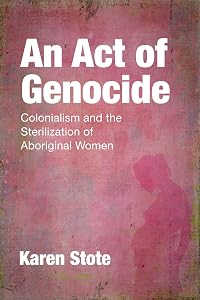
An Act of Genocide: Colonialism and the Sterilization of Aboriginal Women
by Karen Stote
On This Page
Description
Examines long-buried archival evidence documenting the forced sterilization of aboriginal women in Canada, linking this evidence to colonialism, the oppression of women, and the denial of indigenous sovereignty. Asserts that it should be understood as an act of genocide, and explores the ways Canada has avoided the charge.Tags
Member Reviews
Despite the book’s small size (200 pages, including notes, index, etc.), Karen Stote’s “An Act of Genocide: Colonialism and the Sterilization of Aboriginal Women” is a devastating indictment of both capitalism and the Canadian state. I must admit, due to the overwhelming amount of information in this book, it is difficult to accurately review it, as I don’t think I can do justice to this book with a simple review.
The book begins with a brief introduction as to how the coercive sterilization of Aboriginal women, and to a far lesser extent men, served colonialism in Canada. “Aboriginal peoples,” the author writes, “have been strategically and systematically targeted for assimilation into Canadian society. The control of show more women’s reproductive capacities by the Canadian state has been central to this end.” Between 1928-73, “at least three thousand people were sterilized” in Alberta and British Columbia alone, “under the direction of a provincially mandated Eugenics Board.” In these provinces “Aboriginal peoples were those to whom legislation was most applied as compared to their numerical significance in the general population.”
In chapter one, “Eugenics, Feminism and the Woman Question,” the author examines the history of eugenics and how eugenics, racism, and the subjugation of women serve capitalist interests, as well as the centrality of women to, and the role of early feminists in perpetuating, these ideologies.
Racism is inherent to exploitative societies. “The basic purpose of a racist ideology is to deny the humanity of those who are being oppressed, to blame individuals for their miserable conditions and to divert attention away from those who are doing the oppressing. In the case of the burgeoning industrial capitalist state, the poor living conditions of the masses needed to be explained as due to individual failures. Eugenic ideology served this purpose.”
Also, “Under the capitalist patriarchal mode of production, the reproductive capacities of women have been subverted, exploited and controlled in particular and specific ways to ensure its [capitalism’s] proper functioning.”
According to eugenics theory, “women, as bearers of the next generation, were seen as responsible for ‘reproducing the race’ both in a biological sense and in their role as reformers and child raisers.” Thus “Eugenicists sought to actively encourage the reproduction of some women while at the same time seeking to ensure their cooperation in efforts to curb the reproduction of others through their support for measures like marriage regulation, institutionalization and sterilization.”
A marriage of convenience was consequently born. “Many eugenicists were prepared to support certain rights for some women to the extent that these would help buttress the political and economic enterprise of nation building based on an inherently racist notion of who belonged,” while “some feminists adopted eugenic ideology to strengthen their arguments for social reform…A ‘eugenic feminism’ was developed by these women who were involved in shaping North America in the late nineteenth and early twentieth centuries.”
This ‘eugenic feminism’ served the interests of capitalism and the Canadian state, by arguing for “‘freedom’ only for those who demonstrated ‘fitness’ to use this ‘freedom’ appropriately, that is, within the confines of the existing relations of production…The eugenic feminism advocated by reformers like [Nellie] McClung, [Emily] Murphy or [Irene] Parlby did not become the dominant discourse on the rights of women in the early twentieth century because it held the possibility for emancipation from relations of oppression and economic dependency. This feminism was given prominence because it reinforced these very relations. It met the requirements of the mode of production by further assimilating women into socially desired roles, and by providing space for some to perpetuate oppressive relations on others.”
Chapter two, “Indian Policy and Aboriginal Women,” examines how the subjugation and control of Aboriginal women was imperative for colonization to be successful and for capitalism to become the dominant mode of production.
“Prior to European contact, Aboriginal women enjoyed a status drastically different from that held by women in Western European societies of the same time period.” In many Aboriginal societies, “Women were responsible for meeting many of the needs of their communities, and even though there was a division of labour, this did not imply inferiority. Rather, men and women enjoyed the right of access to food, tools and other means of survival by their simple fact of existence. Aboriginal women were also central decision makers affecting social life and they enjoyed greater freedom in their sexual life than did European women.”
These and other egalitarian “Indigenous forms of life existed in fundamental opposition to the relations required for colonization, or the imposition of Western capitalism.” Colonialists thus “proceeded to distort and undermine the roles of Aboriginal women.” If Aboriginal women “had no connection to their means of subsistence and were oppressed by Aboriginal men, then the colonial relations that were being imposed could more easily be justified as acts of goodwill, or simply another variation of what was already in existence,” thereby opening up Aboriginal lands for exploitation.
Colonization and the imposition of capitalist relations necessitated Aboriginal peoples being “reduced to a marginal class within the capitalist mode of production.” Assimilation, allowing for the “termination of the legal line of descendants able to claim rights to the land and resources on which Canada depends for its existence,” was and continues to be a method to turn Aboriginal peoples “into menial wage labourers” and for gaining access to their lands and resources. The logical consequence of assimilation is that it “also becomes increasingly difficult for Aboriginal peoples to practice their own ways. Therefore, assimilation is a twofold process involving the imposition of a particular way of life at the expense and with the destruction of the former. Another manner by which assimilation is carried out is by stripping Aboriginal women of the ability to control their reproduction and denying them the opportunity to raise their children in ways that are in keeping with their ways of life. Colonial policy has attacked the ability of Aboriginal women to reproduce, and short of eliminating this ability altogether, has sought to curb it, or confine it within socially accepted forms conducive to capitalist relations.”
Chapter 3, “Sterilization, Birth Control and Abusive Abortions,” documents the history of the use of sterilizations, birth control (even before it was publicly available), and abortions in limiting the capacity of ‘undesirables’, namely Aboriginal women, to reproduce.
Since both Alberta and British Columbia had enacted “legislation mandating compulsory sterilization,” these provinces are discussed heavily in this chapter.
Interesting bits of information from this chapter…
“In Alberta, the Sexual Sterilization Act was in effect from 1928-73,” with a Eugenics Board overseeing the sterilization of 4739 people, of whom a disproportionate number were Aboriginal women. When opposition to the Act gained momentum and its repeal became likely, “the rate at which Aboriginal peoples were sterilized underwent a terrific increase,” almost as if Alberta, knowing the end was near (at least officially), made one last ditch effort to sterilize as many Aboriginal people as possible.
In 1937, the Department of Indian Affairs did express some concern about the Eugenics Board in Alberta, but only to ensure that it avoided “a charge that bears resemblance to genocide, despite the term not being prominent in international discourse at the time.”
British Columbia “was the second province to enact a Sexual Sterilization Act, in effect from 1933 o 1973. This act permitted the provincial Eugenics Board to sterilize any inmate of a provincial institution deemed ‘hereditarily unfit,’ specifically any inmate of an industrial school or industrial home school [i.e. Residential Schools] for girls.”
Contraceptives were also prescribed or coercively implanted (IUDs) to Aboriginal women before becoming legally available to all Canadians. Before “the legalization of birth control for contraceptive purposes, it was considered viable to promote their use in Indigenous communities and these were prescribed with the express intent of limiting the number of births within the group.”
Chapter four, “Settling the Past,” documents the many legal challenges that led to the repeal of the Sexual Sterilization Acts in B.C. and Alberta, as well as the unwillingness of past and present federal and provincial governments to acknowledge any wrongdoing.
Finally, chapter five, “Canada, Genocide and Aboriginal Peoples,” examines the applicability of the word ‘genocide’ to Aboriginal people in Canada, and how Canada has made it almost impossible for Aboriginal people to charge past and present federal and provincial governments in Canada with genocide.
The chapter begins with an analysis of ‘genocide’ as understood by the man who coined the term, Raphael Lemkin. According to Lemkin, ‘genocide’ is much broader than direct killing: “Generally speaking, genocide does not necessarily mean the immediate destruction of a nation, except when accomplished by mass killings of all members of a nation. It is intended rather to signify a coordinated plan of different actions aiming at the destruction of essential foundations of the life of national groups, with the aim of annihilating the groups themselves. Genocide is directed against the national group as an entity, and the actions involved are directed against individuals, not in their individual capacity, but as members of the national group.”
Thus, as the author of the book summarizes, “genocide is not simply a singular event directed against individuals, but a process by which the ability of a group to exist is undermined through acts directed against members of a group because of their common group status.”
Despite Lemkin’s much broader definition of genocide, Canada, the U.S., and Britain succeeded in watering down the UN’s Genocide Convention to refer only the physical extermination of human groups. Instead these same states have emphasized human rights, with serious consequences for Aboriginal people. As Ronald Niezen writes (cited in the book): “The promotion of exclusively individual human rights has dangerous implications because many nation-states have vested interests in controlling and usurping collective rights (including the collective human rights) of Indigenous peoples. Individual human rights are insufficient to protect collective treaty rights. Emphasizing exclusively individual human rights leaves states with an opening to interfere in group identity, to provide only those cultural choices that weaken both Indigenous societies and the distinct collective (principally treaty) rights that are part of their relationship, as sovereign entities, with states. To do otherwise than to recognize Indigenous rights to self-determination is to invite the continued repression and marginalization of Indigenous societies.”
Interesting is how the refusal of past and present Canadian governments to enact legislation making it possible for someone in Canada to be charged with genocide, the only other avenue being the charge of ‘murder’, corresponds with Canada’s role as an imperialist country. Lester B. Pearson, the ‘founder of Canadian peacekeeping’, in his position as Foreign Affairs Minister, stated rather bluntly that Canada, “In approving this [Genocide] Convention…will be proclaiming throughout the world that genocide is considered by us to be a monstrous crime. We will be doing something to make it more difficult for ANY OTHER COUNTRY [emphasis added] to commit that crime.”
Also interesting are the parallels the author draws between Canada’s efforts to circumscribe the definition of genocide with those of the Nazi leadership at Nuremberg. “The fact that Canada, by refusing to acknowledge certain elements of the [Genocide] Convention, sough to excuse itself from international law does not change the fact that genocide accurately describes many of its policies concerning Aboriginal people. One should also consider that the primary defense advanced by the Nazi leadership at Nuremberg was that Germany had never accepted the international laws they were accused of violating. Instead, they argued the policies they carried out were legal under German law. The allied powers represented on the tribunal, including Canada, flatly rejected this argument. The wriggling of the Canadian government in this instance bears an uncomfortable resemblance to that of the Third Reich.”
This review in no way does justice to this book. I’d highly recommend this book, especially to Canadians. show less
The book begins with a brief introduction as to how the coercive sterilization of Aboriginal women, and to a far lesser extent men, served colonialism in Canada. “Aboriginal peoples,” the author writes, “have been strategically and systematically targeted for assimilation into Canadian society. The control of show more women’s reproductive capacities by the Canadian state has been central to this end.” Between 1928-73, “at least three thousand people were sterilized” in Alberta and British Columbia alone, “under the direction of a provincially mandated Eugenics Board.” In these provinces “Aboriginal peoples were those to whom legislation was most applied as compared to their numerical significance in the general population.”
In chapter one, “Eugenics, Feminism and the Woman Question,” the author examines the history of eugenics and how eugenics, racism, and the subjugation of women serve capitalist interests, as well as the centrality of women to, and the role of early feminists in perpetuating, these ideologies.
Racism is inherent to exploitative societies. “The basic purpose of a racist ideology is to deny the humanity of those who are being oppressed, to blame individuals for their miserable conditions and to divert attention away from those who are doing the oppressing. In the case of the burgeoning industrial capitalist state, the poor living conditions of the masses needed to be explained as due to individual failures. Eugenic ideology served this purpose.”
Also, “Under the capitalist patriarchal mode of production, the reproductive capacities of women have been subverted, exploited and controlled in particular and specific ways to ensure its [capitalism’s] proper functioning.”
According to eugenics theory, “women, as bearers of the next generation, were seen as responsible for ‘reproducing the race’ both in a biological sense and in their role as reformers and child raisers.” Thus “Eugenicists sought to actively encourage the reproduction of some women while at the same time seeking to ensure their cooperation in efforts to curb the reproduction of others through their support for measures like marriage regulation, institutionalization and sterilization.”
A marriage of convenience was consequently born. “Many eugenicists were prepared to support certain rights for some women to the extent that these would help buttress the political and economic enterprise of nation building based on an inherently racist notion of who belonged,” while “some feminists adopted eugenic ideology to strengthen their arguments for social reform…A ‘eugenic feminism’ was developed by these women who were involved in shaping North America in the late nineteenth and early twentieth centuries.”
This ‘eugenic feminism’ served the interests of capitalism and the Canadian state, by arguing for “‘freedom’ only for those who demonstrated ‘fitness’ to use this ‘freedom’ appropriately, that is, within the confines of the existing relations of production…The eugenic feminism advocated by reformers like [Nellie] McClung, [Emily] Murphy or [Irene] Parlby did not become the dominant discourse on the rights of women in the early twentieth century because it held the possibility for emancipation from relations of oppression and economic dependency. This feminism was given prominence because it reinforced these very relations. It met the requirements of the mode of production by further assimilating women into socially desired roles, and by providing space for some to perpetuate oppressive relations on others.”
Chapter two, “Indian Policy and Aboriginal Women,” examines how the subjugation and control of Aboriginal women was imperative for colonization to be successful and for capitalism to become the dominant mode of production.
“Prior to European contact, Aboriginal women enjoyed a status drastically different from that held by women in Western European societies of the same time period.” In many Aboriginal societies, “Women were responsible for meeting many of the needs of their communities, and even though there was a division of labour, this did not imply inferiority. Rather, men and women enjoyed the right of access to food, tools and other means of survival by their simple fact of existence. Aboriginal women were also central decision makers affecting social life and they enjoyed greater freedom in their sexual life than did European women.”
These and other egalitarian “Indigenous forms of life existed in fundamental opposition to the relations required for colonization, or the imposition of Western capitalism.” Colonialists thus “proceeded to distort and undermine the roles of Aboriginal women.” If Aboriginal women “had no connection to their means of subsistence and were oppressed by Aboriginal men, then the colonial relations that were being imposed could more easily be justified as acts of goodwill, or simply another variation of what was already in existence,” thereby opening up Aboriginal lands for exploitation.
Colonization and the imposition of capitalist relations necessitated Aboriginal peoples being “reduced to a marginal class within the capitalist mode of production.” Assimilation, allowing for the “termination of the legal line of descendants able to claim rights to the land and resources on which Canada depends for its existence,” was and continues to be a method to turn Aboriginal peoples “into menial wage labourers” and for gaining access to their lands and resources. The logical consequence of assimilation is that it “also becomes increasingly difficult for Aboriginal peoples to practice their own ways. Therefore, assimilation is a twofold process involving the imposition of a particular way of life at the expense and with the destruction of the former. Another manner by which assimilation is carried out is by stripping Aboriginal women of the ability to control their reproduction and denying them the opportunity to raise their children in ways that are in keeping with their ways of life. Colonial policy has attacked the ability of Aboriginal women to reproduce, and short of eliminating this ability altogether, has sought to curb it, or confine it within socially accepted forms conducive to capitalist relations.”
Chapter 3, “Sterilization, Birth Control and Abusive Abortions,” documents the history of the use of sterilizations, birth control (even before it was publicly available), and abortions in limiting the capacity of ‘undesirables’, namely Aboriginal women, to reproduce.
Since both Alberta and British Columbia had enacted “legislation mandating compulsory sterilization,” these provinces are discussed heavily in this chapter.
Interesting bits of information from this chapter…
“In Alberta, the Sexual Sterilization Act was in effect from 1928-73,” with a Eugenics Board overseeing the sterilization of 4739 people, of whom a disproportionate number were Aboriginal women. When opposition to the Act gained momentum and its repeal became likely, “the rate at which Aboriginal peoples were sterilized underwent a terrific increase,” almost as if Alberta, knowing the end was near (at least officially), made one last ditch effort to sterilize as many Aboriginal people as possible.
In 1937, the Department of Indian Affairs did express some concern about the Eugenics Board in Alberta, but only to ensure that it avoided “a charge that bears resemblance to genocide, despite the term not being prominent in international discourse at the time.”
British Columbia “was the second province to enact a Sexual Sterilization Act, in effect from 1933 o 1973. This act permitted the provincial Eugenics Board to sterilize any inmate of a provincial institution deemed ‘hereditarily unfit,’ specifically any inmate of an industrial school or industrial home school [i.e. Residential Schools] for girls.”
Contraceptives were also prescribed or coercively implanted (IUDs) to Aboriginal women before becoming legally available to all Canadians. Before “the legalization of birth control for contraceptive purposes, it was considered viable to promote their use in Indigenous communities and these were prescribed with the express intent of limiting the number of births within the group.”
Chapter four, “Settling the Past,” documents the many legal challenges that led to the repeal of the Sexual Sterilization Acts in B.C. and Alberta, as well as the unwillingness of past and present federal and provincial governments to acknowledge any wrongdoing.
Finally, chapter five, “Canada, Genocide and Aboriginal Peoples,” examines the applicability of the word ‘genocide’ to Aboriginal people in Canada, and how Canada has made it almost impossible for Aboriginal people to charge past and present federal and provincial governments in Canada with genocide.
The chapter begins with an analysis of ‘genocide’ as understood by the man who coined the term, Raphael Lemkin. According to Lemkin, ‘genocide’ is much broader than direct killing: “Generally speaking, genocide does not necessarily mean the immediate destruction of a nation, except when accomplished by mass killings of all members of a nation. It is intended rather to signify a coordinated plan of different actions aiming at the destruction of essential foundations of the life of national groups, with the aim of annihilating the groups themselves. Genocide is directed against the national group as an entity, and the actions involved are directed against individuals, not in their individual capacity, but as members of the national group.”
Thus, as the author of the book summarizes, “genocide is not simply a singular event directed against individuals, but a process by which the ability of a group to exist is undermined through acts directed against members of a group because of their common group status.”
Despite Lemkin’s much broader definition of genocide, Canada, the U.S., and Britain succeeded in watering down the UN’s Genocide Convention to refer only the physical extermination of human groups. Instead these same states have emphasized human rights, with serious consequences for Aboriginal people. As Ronald Niezen writes (cited in the book): “The promotion of exclusively individual human rights has dangerous implications because many nation-states have vested interests in controlling and usurping collective rights (including the collective human rights) of Indigenous peoples. Individual human rights are insufficient to protect collective treaty rights. Emphasizing exclusively individual human rights leaves states with an opening to interfere in group identity, to provide only those cultural choices that weaken both Indigenous societies and the distinct collective (principally treaty) rights that are part of their relationship, as sovereign entities, with states. To do otherwise than to recognize Indigenous rights to self-determination is to invite the continued repression and marginalization of Indigenous societies.”
Interesting is how the refusal of past and present Canadian governments to enact legislation making it possible for someone in Canada to be charged with genocide, the only other avenue being the charge of ‘murder’, corresponds with Canada’s role as an imperialist country. Lester B. Pearson, the ‘founder of Canadian peacekeeping’, in his position as Foreign Affairs Minister, stated rather bluntly that Canada, “In approving this [Genocide] Convention…will be proclaiming throughout the world that genocide is considered by us to be a monstrous crime. We will be doing something to make it more difficult for ANY OTHER COUNTRY [emphasis added] to commit that crime.”
Also interesting are the parallels the author draws between Canada’s efforts to circumscribe the definition of genocide with those of the Nazi leadership at Nuremberg. “The fact that Canada, by refusing to acknowledge certain elements of the [Genocide] Convention, sough to excuse itself from international law does not change the fact that genocide accurately describes many of its policies concerning Aboriginal people. One should also consider that the primary defense advanced by the Nazi leadership at Nuremberg was that Germany had never accepted the international laws they were accused of violating. Instead, they argued the policies they carried out were legal under German law. The allied powers represented on the tribunal, including Canada, flatly rejected this argument. The wriggling of the Canadian government in this instance bears an uncomfortable resemblance to that of the Third Reich.”
This review in no way does justice to this book. I’d highly recommend this book, especially to Canadians. show less
Members
- Recently Added By
Lists

The (So-Called) Canada Pill
150 works; 1 member
Author Information
3 Works 21 Members
Classifications
- Genres
- Nonfiction, Sexuality and Gender Studies
- DDC/MDS
- 363.9 — Society, government, & culture Social problems and social services Public Safety - Police, Crime Investigation Population problems
- LCC
- HQ767.7 .S76 — Social sciences The family. Marriage, Women and Sexuality The Family. Marriage. Women The family. Marriage. Home Family size
- BISAC
Statistics
- Members
- 19
- Popularity
- 1,333,029
- Reviews
- 1
- Rating
- (5.00)
- Languages
- English
- Media
- Paper, Ebook
- ISBNs
- 2
- ASINs
- 1