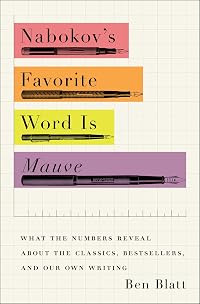
Nabokov's Favourite Word Is Mauve: the Literary Quirks and Oddities of our Most-Loved Authors
by Ben Blatt
On This Page
Description
In Nabokov's Favorite Word Is Mauve, statistician and journalist Ben Blatt brings big data to the literary canon, exploring the wealth of fun findings that remain hidden in the works of the world's greatest writers. He assembles a database of thousands of books and hundreds of millions of words, and starts asking the questions that have intrigued curious word nerds and book lovers for generations: What are our favorite authors' favorite words? Do men and women write differently? Are show more bestsellers getting dumber over time? Which bestselling writer uses the most clichés? What makes a great opening sentence? How can we judge a book by its cover? And which writerly advice is worth following or ignoring? Blatt draws upon existing analysis techniques and invents some of his own. All of his investigations and experiments are original, conducted himself, and no math knowledge is needed to understand the results. Blatt breaks his findings down into lucid, humorous language and clear and compelling visuals. This eye-opening book will provide you with a new appreciation for your favorite authors and a fresh perspective on your own writing, illuminating both the patterns that hold great prose together and the brilliant flourishes that make it unforgettable. show lessTags
Recommendations


Member Recommendations
Member Reviews
This is not exactly the book I was expecting it to be. I sort of thought it would be a quick read full of fun facts about various books and authors, and it is, but it's, you know, full of math and statistics.
I hate math, but not nearly as much as I hate statistics.
This book is cover to cover statistics, and uses foul words like median and average; it even includes a formula.
But like any good writer, Blatt had me glued to the pages anyway, because 1.) he didn't get bogged down defining the data sets (he put those in the notes), 2.) he made all the information easy to understand, 3.) he always reminded the reader that correlation is NOT causation and maintained an admirable objectivity, even when he admitted his biases, and 4.) the show more information he pulled out was fascinating. So many of the chapters had MT (who was patient about being read to) and I debating for hours about Blatt's results, often with him saying "yeah, but is he accounting for ..." and me breaking in with "oh! wait! here he goes on to address that..."
I've learned oodles from this book. For example, while I knew I used too many exclamation points (a fact validated by the math), I apparently also use too many -ly adverbs. I never knew avoiding them is considered a 'rule' to good writing. Ditto with qualifiers: quite, rather, somewhat, etc. That's going to be a harder habit to break than the exclamation points, as I often depend on those to soften statements I make that I worry can be taken badly. (I'm keeping that last adverb, dammit.)
Chapter 2 looks at identifying gender through writing, and it was interesting and a little depressing. There's a lot of information here that might get stuck in some people's craw, but Blatt maintains a very respectful, objective voice throughout - he's just the messenger of the data, even when he doesn't think it's as meaningful as others might; he's quick to point out that the results have as much to do with the content's subject as they do with author style. The only part that bothered me was that this level of sophisticated analysis is being used for user profiling and targeted marketing. Of course it is.
Chapter 3 talks about using common words to identify authorship and it's a step beyond fascinating. I could not stop reading this chapter - the results are awe inspiring.
The whole book is just a rich mine of information about what the best sellers and award winners have in common, how fan fiction quantitatively differs from published fiction and even how US writing differs from UK writing. And yes, there's a whole section on the favorite and fallback words of famous authors. (Teaser: 2 of Agatha Christie's favourites are inquest and alibi. I know; you're shocked.)
This is a book on statistics, but it uses books as its data sets, and Blatt writes well, so that makes it not only o.k., but cool. It should appeal to math lovers and book lovers. Math loving bibliophiles might find heaven between the covers. show less
I hate math, but not nearly as much as I hate statistics.
This book is cover to cover statistics, and uses foul words like median and average; it even includes a formula.
But like any good writer, Blatt had me glued to the pages anyway, because 1.) he didn't get bogged down defining the data sets (he put those in the notes), 2.) he made all the information easy to understand, 3.) he always reminded the reader that correlation is NOT causation and maintained an admirable objectivity, even when he admitted his biases, and 4.) the show more information he pulled out was fascinating. So many of the chapters had MT (who was patient about being read to) and I debating for hours about Blatt's results, often with him saying "yeah, but is he accounting for ..." and me breaking in with "oh! wait! here he goes on to address that..."
I've learned oodles from this book. For example, while I knew I used too many exclamation points (a fact validated by the math), I apparently also use too many -ly adverbs. I never knew avoiding them is considered a 'rule' to good writing. Ditto with qualifiers: quite, rather, somewhat, etc. That's going to be a harder habit to break than the exclamation points, as I often depend on those to soften statements I make that I worry can be taken badly. (I'm keeping that last adverb, dammit.)
Chapter 2 looks at identifying gender through writing, and it was interesting and a little depressing. There's a lot of information here that might get stuck in some people's craw, but Blatt maintains a very respectful, objective voice throughout - he's just the messenger of the data, even when he doesn't think it's as meaningful as others might; he's quick to point out that the results have as much to do with the content's subject as they do with author style. The only part that bothered me was that this level of sophisticated analysis is being used for user profiling and targeted marketing. Of course it is.
Chapter 3 talks about using common words to identify authorship and it's a step beyond fascinating. I could not stop reading this chapter - the results are awe inspiring.
The whole book is just a rich mine of information about what the best sellers and award winners have in common, how fan fiction quantitatively differs from published fiction and even how US writing differs from UK writing. And yes, there's a whole section on the favorite and fallback words of famous authors. (Teaser: 2 of Agatha Christie's favourites are inquest and alibi. I know; you're shocked.)
This is a book on statistics, but it uses books as its data sets, and Blatt writes well, so that makes it not only o.k., but cool. It should appeal to math lovers and book lovers. Math loving bibliophiles might find heaven between the covers. show less
If you read enough (and if you're reading this, you probably do), books become fascinating independent of the stories they tell. Blatt takes a math-y approach to this, quantitating a number of variables to answer different literary questions, such as the percentage of co-written books actually written by the more famous author, the difference between "literary" and genre fiction and the difference in word choice over time. There's some mission creep as chapters also reflect on how male versus female authors write the different genders and what that means, and also an introduction about who really wrote the Federalist Papers. It's mostly just fun -- can you deduce from an unbiased statistical approach that Nabakov was obsessed with show more colors, probably because he was a synesthete? -- and pretty light on the math. I'm pretty opposed to frequentist statistics, but it was still pretty bizarre to me to not have a p-value, or really any numbers at all, in a statistics book. Nonetheless, reading about reading is always extra fun and I enjoyed it quite a bit. show less
As someone with a background in linguistics and an interest in data science, I really wanted to like this book more than I did. The data that Blatt chose to look at is interesting, but he has an unfortunate habit of drawing grand conclusions about gender, nationality, and authorship based on limited data sets as well as not clearly separating causation from correlation.
I did enjoy chapter 3 ("Searching for Fingerprints"), but I think it's telling that that chapter is devoted to a methodology developed by other researchers (statisticians Frederick Mosteller and David Wallace).
Ultimately this book is weak from both a humanities perspective and a data perspective.
I did enjoy chapter 3 ("Searching for Fingerprints"), but I think it's telling that that chapter is devoted to a methodology developed by other researchers (statisticians Frederick Mosteller and David Wallace).
Ultimately this book is weak from both a humanities perspective and a data perspective.
This was a fun book about books and statistics. The author digs into what the words chosen by authors can tell us about the writing process, gender, the success of the novel, and our own stereotypes. Bookworm will likely love this book - many classics are discussed and authorial mysteries revealed, and yes, Blatt displays why mauve is Nabokov's favorite word. Fun reading!
Ben Blatt uses statistics to find patterns in the way that writers use words in their novels -- everything from bestsellers to literary award winners to Harry Potter fanfiction -- in an attempt to answer, or at least address, a number of different questions: Can computer analyses help resolve questions of disputed authorship? (Answer: a pretty firm yes, at least when you've got a limited number of authors to pick from.) Do authors who insist good writing involves eschewing adverbs follow their own advice, and are novels with fewer adverbs in fact more successful? Do women use some words more often than men, and vice versa? Are great first sentences more likely to be long or short? And so forth and so on.
I think a lot of the conclusions show more here need to be taken with a good-sized grain of salt, especially when they edge into the realm of writing advice. It's not at all difficult to see ways in which the data under consideration can be kind of ratty, or the algorithms lacking in nuance. But, to his credit, Blatt does make a point of acknowledging the limitations of what this kind of analysis tells us.
Really, mostly I think he's just having fun playing around with this stuff and thinking up questions to investigate. Which is fair enough, and it's interesting to see what he and his algorithms come up with. But maybe only mildly interesting. I have to say, I did find the book as a whole less engaging than I expected to, partly, perhaps, because there really is a limit to how much insight one can actually get out of this sort of thing, and partly because Blatt's own prose, while clear enough, isn't going to win any of those literary awards itself. show less
I think a lot of the conclusions show more here need to be taken with a good-sized grain of salt, especially when they edge into the realm of writing advice. It's not at all difficult to see ways in which the data under consideration can be kind of ratty, or the algorithms lacking in nuance. But, to his credit, Blatt does make a point of acknowledging the limitations of what this kind of analysis tells us.
Really, mostly I think he's just having fun playing around with this stuff and thinking up questions to investigate. Which is fair enough, and it's interesting to see what he and his algorithms come up with. But maybe only mildly interesting. I have to say, I did find the book as a whole less engaging than I expected to, partly, perhaps, because there really is a limit to how much insight one can actually get out of this sort of thing, and partly because Blatt's own prose, while clear enough, isn't going to win any of those literary awards itself. show less
Math and literature don't mix. Or so we thought in high school. Or in college. Or five minutes ago. Ben Blatt proves differently in “Nabokov's Favorite Word Is Mauve: What the Numbers Reveal about the Classics, Bestsellers, and Our Own Writing.”
Now that most books have been digitalized it has become a fairly easy process to study word usage over the centuries. This is how lexicographers now determine when individual words first appeared in print. Blatt applies the same techniques to literature and comes up with a number of fascinating discoveries.
Adverbs: The novels generally considered to rank among the best tend to have fewer adverbs than lesser books.
Exclamation points: James Joyce, often considered one of the best novelists, show more used lots of exclamation points. Ernest Hemingway and William Faulkner, also highly regarded, used very few.
Suddenly: Elmore Leonard said writers should never use the word suddenly. He didn't, at least after he included that as one of his rules of writing. Early in his career, however, he used that word frequently.
Cliches: Some writers employ numerous clichés in their work (James Patterson, for example) and others use few (Jane Austen), but all writers have their favorites. Tom Clancy: "by a whisker." Faulkner: "sooner or later." Donna Tartt: "too good to be true." Patterson: "believe it or not." Austen: "with all my heart."
As for Vladimir Nabokov and the color mauve, it seems that the author of “Lolita” tended to think and write in color, and of the many colors represented in his work, mauve was his favorite. Ray Bradbury, on the other hand, was inspired by the spice rack and by tastes in general. Words like spearmint, nutmeg, lemon, onion and vanilla show up frequently in his stories. But his favorite flavor was cinnamon.
Often a reader's response to Blatt's findings will be an insolent "so what?" He can make a big deal about very little. Still this is an informative book that reveals how each writer's style is his own, right down to individual word choices and even punctuation choices. If you are a writer thinking about writing a new series of books using a pseudonym, forget about it. Ben Blatt, or someone like him, will track you down.
It's all in the numbers. show less
Now that most books have been digitalized it has become a fairly easy process to study word usage over the centuries. This is how lexicographers now determine when individual words first appeared in print. Blatt applies the same techniques to literature and comes up with a number of fascinating discoveries.
Adverbs: The novels generally considered to rank among the best tend to have fewer adverbs than lesser books.
Exclamation points: James Joyce, often considered one of the best novelists, show more used lots of exclamation points. Ernest Hemingway and William Faulkner, also highly regarded, used very few.
Suddenly: Elmore Leonard said writers should never use the word suddenly. He didn't, at least after he included that as one of his rules of writing. Early in his career, however, he used that word frequently.
Cliches: Some writers employ numerous clichés in their work (James Patterson, for example) and others use few (Jane Austen), but all writers have their favorites. Tom Clancy: "by a whisker." Faulkner: "sooner or later." Donna Tartt: "too good to be true." Patterson: "believe it or not." Austen: "with all my heart."
As for Vladimir Nabokov and the color mauve, it seems that the author of “Lolita” tended to think and write in color, and of the many colors represented in his work, mauve was his favorite. Ray Bradbury, on the other hand, was inspired by the spice rack and by tastes in general. Words like spearmint, nutmeg, lemon, onion and vanilla show up frequently in his stories. But his favorite flavor was cinnamon.
Often a reader's response to Blatt's findings will be an insolent "so what?" He can make a big deal about very little. Still this is an informative book that reveals how each writer's style is his own, right down to individual word choices and even punctuation choices. If you are a writer thinking about writing a new series of books using a pseudonym, forget about it. Ben Blatt, or someone like him, will track you down.
It's all in the numbers. show less
It is a simple premise -- use modern statistical techniques to data mine for patterns in classic and modern literature. The method is applied over and over, but Ben Blatt's writing style keeps a potentially dull subject from getting too dry. Instead, he poses several fascinating questions and provides evidence to address those questions.
Blatt draws short of drawing much in the way of conclusions from his research, but as he takes pains to point out, his method gives evidence and not proof. The reader can make their own conclusions. And if you're like me, you'll want to take his method out for a spin yourself.
Blatt draws short of drawing much in the way of conclusions from his research, but as he takes pains to point out, his method gives evidence and not proof. The reader can make their own conclusions. And if you're like me, you'll want to take his method out for a spin yourself.
Members
- Recently Added By
Lists

Top Five Books of 2017
757 works; 231 members
Author Information

2 Works 409 Members
Ben Blatt is a staff writer at Slate and a Harvard graduate whose sports anlytics studies have been picked up by the Wall Street Journal, the New York Times, Deadspin, and others.
Awards and Honors
Distinctions
Notable Lists
Common Knowledge
- Canonical title
- Nabokov's Favourite Word Is Mauve: the Literary Quirks and Oddities of our Most-Loved Authors
- Original publication date
- 2017-03-14
- Dedication
- For my mother, Faith Minard.
And for my friends at 44 Bow Street. - First words
- Alexander Hamilton, James Madison, or John Jay?
For more than 150 years, historians argued over the authorship of 12 essays in The Federalist Papers, founding documents in the American march toward democracy... (show all). -Introduction
In literary lore, one of the best stories of all time is a mere six words. "For sale: baby shoes, never worn." It's the ultimate example of less is more, and you'll find it attributed to Ernest Hemingway. -Chapter 1, Use Spar... (show all)ingly - Last words
- (Click to show. Warning: May contain spoilers.)Through the union of writing and math there is so much to learn about the books we love and the writers we admire. And by looking at the patterns, we can appreciate that beautiful moment where the pattern breaks, and where a brilliant new idea bursts into the world.
- Blurbers
- Ellenberg, Jordan; Christian, Brian; Morris, Carl N.
- Original language
- English
- Canonical DDC/MDS
- 809
- Canonical LCC
- PN165.B55
Classifications
Statistics
- Members
- 345
- Popularity
- 91,392
- Reviews
- 21
- Rating
- (3.76)
- Languages
- English
- Media
- Paper, Audiobook, Ebook
- ISBNs
- 10
- ASINs
- 3