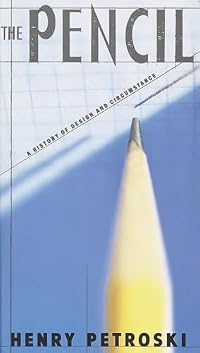
The Pencil: A History of Design and Circumstance
by Henry Petroski
On This Page
Description
Henry Petroski traces the origins of the pencil back to ancient Greece and Rome, writes factually and charmingly about its development over the centuries and around the world, and shows what the pencil can teach us about engineering and technology today.Tags
Recommendations























Member Reviews
Petroski takes the history of an everyday tool as a case-study in what engineers actually do in the real world. Some artisan in the sixteenth century noticed the useful properties of Borrowdale graphite and various other people, in multiple steps and by analogy with existing writing tools, found a convenient way to hold thin sticks of this natural material in protective wooden sleeves. Later advances in the design were driven by numerous factors including geopolitical restrictions on the supply of the raw materials (cedar and pure graphite), exhaustion of natural resources, shifts from cottage-industry to industrial manufacture, foreign competition, and much more. The people involved in the story of the pencil (Petroski treats them as show more engineers because of the way they were working, but of course few of them would have been qualified engineers in the modern sense of the term) were never on some ideal trajectory towards the perfect pencil, they were solving specific, local problems to enable them to produce something that was good enough to sell for more than what it cost to make. In the ideal case, marginally better or marginally cheaper than what the competitors were making.
It’s an interesting idea, and it brings out some useful insights into the way technology works, and quite a few interesting little anecdotes as well — I enjoyed learning about Henry David Thoreau’s day-job in his father’s pencil firm, for instance — but I didn’t enjoy this as much as I have some of Petroski‘s more recent books about engineering. He makes it all a little bit too slow and ponderous here, and he seems to be far too convinced that American-style free market capitalism is the way to solve all the world’s problems. show less
It’s an interesting idea, and it brings out some useful insights into the way technology works, and quite a few interesting little anecdotes as well — I enjoyed learning about Henry David Thoreau’s day-job in his father’s pencil firm, for instance — but I didn’t enjoy this as much as I have some of Petroski‘s more recent books about engineering. He makes it all a little bit too slow and ponderous here, and he seems to be far too convinced that American-style free market capitalism is the way to solve all the world’s problems. show less
I’m quite convinced that Henry Petroski could write about the engineering or manufacturing of anything and it would an order of magnitude better than expected. He’s authored books about bookshelves, the toothpick, and engineering projects that I would have expected to be ho-hum or dryasdust, but he always surprises me. In The Pencil, he takes on the titular subject and discusses not only the history of the object, but the mindset, engineering, and technology involved in crafting such a simple tool.
The Romans started with a tool known as a penicillum, or a pencil brush, but true pencils with lead/graphite cores are not documented in history until 1565 when an illustration shows up in a book on fossils by Konrad Gesner. Before the show more classic yellow #2 came into existence in 1890, there were all types of pencil designs. A massive graphite deposit discovered in Seathwaite, England lead to an acceleration in pencil design. Cheap pencils were just thick shards of graphite sharpened and wrapped with string, but by the early 1600s, wood casings were the norm.
All this begs the question: how does one actually make a pencil? Most processes are essentially the same. Take a piece of wood that is the general size and shape you want your finished product to be, cut a rut into which the writing substance can be fitted, then glue a wood cap on it to seal it together. You can then trim, re-shape, and paint the pencil to your liking after that. The process has been relatively unchanged since the Renaissance. Pencil variability and personal likes and dislikes come from the type of wood used, the shape of the pencil, and the quality of the graphite core.
It could be argued that Petroski’s history of the pencil could stand a bit of trimming, but all the engineering, biographical, and historical tangents were a lot of fun for me. If you want a straight history of the pencil, then you can just read the Wikipedia article and be done with it, but for a truly immersive and fully contextual account of the pencil and its place in history, read this one. It’s a bit hefty, but if you stick with it, you’ll get a lot out of it. He makes the reader slightly more aware of the little things, and I began to wonder about the manufacture of many other tiny quotidian objects in my life. That, I think, is the mark of a good author. A very interesting read. show less
The Romans started with a tool known as a penicillum, or a pencil brush, but true pencils with lead/graphite cores are not documented in history until 1565 when an illustration shows up in a book on fossils by Konrad Gesner. Before the show more classic yellow #2 came into existence in 1890, there were all types of pencil designs. A massive graphite deposit discovered in Seathwaite, England lead to an acceleration in pencil design. Cheap pencils were just thick shards of graphite sharpened and wrapped with string, but by the early 1600s, wood casings were the norm.
All this begs the question: how does one actually make a pencil? Most processes are essentially the same. Take a piece of wood that is the general size and shape you want your finished product to be, cut a rut into which the writing substance can be fitted, then glue a wood cap on it to seal it together. You can then trim, re-shape, and paint the pencil to your liking after that. The process has been relatively unchanged since the Renaissance. Pencil variability and personal likes and dislikes come from the type of wood used, the shape of the pencil, and the quality of the graphite core.
It could be argued that Petroski’s history of the pencil could stand a bit of trimming, but all the engineering, biographical, and historical tangents were a lot of fun for me. If you want a straight history of the pencil, then you can just read the Wikipedia article and be done with it, but for a truly immersive and fully contextual account of the pencil and its place in history, read this one. It’s a bit hefty, but if you stick with it, you’ll get a lot out of it. He makes the reader slightly more aware of the little things, and I began to wonder about the manufacture of many other tiny quotidian objects in my life. That, I think, is the mark of a good author. A very interesting read. show less
The pencil is such a simple piece of technology that it is often ignored. No one gives it a second thought to lose a pencil or throw one away. In fact, it’s the only piece of property that we lend to perfect strangers with little or no expectations of it being returned. The pencil is just everyday debris, a technology so common that we don’t even think of it as technology. And yet a tremendous amount of engineering, imagination, and hard work of thousands of people has gone into the simple, humble wood case pencil. Such a simple technology that has played such an important role in art and science, in everyday writing, and in every students learning experience deserves more credit then we give it.
Henry Petroski has taken on the show more challenge to track down and retell the history of the pencil in all its wonderful minutia. Starting from its murky origin through its industrialization to its place in our modern society (of the early 1990’s) the pencil has had an incredibly complex history and mix of economics and creativity that is inherit to any engineering endeavor. For Petroski the history of the pencil is a perfect metaphor for what he calls the engineering method. He makes a pretty convincing argument for treating the practice of engineering in the same manner that we treat the scientific method. It doesn’t take Petroski much arguing to convince the reader that engineering is so pervasive in our everyday lives, that it warrants more study of how engineers perform their jobs and make the things we simply can’t live without. However, since much of engineering is tied up in drawings and diagrams of designs and solutions, that there simply aren’t enough eloquent engineers to explain the process to the public in the same ways as popularizers of science.
Luckily, Petroski is an eloquent historian, whose enthusiasm for his subjects is infectious. Now full disclosure here, I’m something of a wood case enthusiast, so I need little selling on the arcane history of the pencil. For most folks it’s a bit of harder sale, which is understandable of course. But Petroski does such a good job of making the history relatable and easy to read that it feels more like reading a general history rather than a dry history of some dull everyday object. It’s not a page turner by any means, but I think there is enough information and enough exploration of the engineering methodology to keep anyone interested until the end. Then again I could be completely blinded by love of the pencil that this could all be completely terrible and not worth reading. So yeah, I thought it was great, not sure if everyone else will.
*1st draft of this review written with a General’s Layout (Extra Black) No.555 B-core pencil show less
Henry Petroski has taken on the show more challenge to track down and retell the history of the pencil in all its wonderful minutia. Starting from its murky origin through its industrialization to its place in our modern society (of the early 1990’s) the pencil has had an incredibly complex history and mix of economics and creativity that is inherit to any engineering endeavor. For Petroski the history of the pencil is a perfect metaphor for what he calls the engineering method. He makes a pretty convincing argument for treating the practice of engineering in the same manner that we treat the scientific method. It doesn’t take Petroski much arguing to convince the reader that engineering is so pervasive in our everyday lives, that it warrants more study of how engineers perform their jobs and make the things we simply can’t live without. However, since much of engineering is tied up in drawings and diagrams of designs and solutions, that there simply aren’t enough eloquent engineers to explain the process to the public in the same ways as popularizers of science.
Luckily, Petroski is an eloquent historian, whose enthusiasm for his subjects is infectious. Now full disclosure here, I’m something of a wood case enthusiast, so I need little selling on the arcane history of the pencil. For most folks it’s a bit of harder sale, which is understandable of course. But Petroski does such a good job of making the history relatable and easy to read that it feels more like reading a general history rather than a dry history of some dull everyday object. It’s not a page turner by any means, but I think there is enough information and enough exploration of the engineering methodology to keep anyone interested until the end. Then again I could be completely blinded by love of the pencil that this could all be completely terrible and not worth reading. So yeah, I thought it was great, not sure if everyone else will.
*1st draft of this review written with a General’s Layout (Extra Black) No.555 B-core pencil show less
Not as interesting as his book on the book and bookshelf, but interesting nevertheless. A history of the pencil which shows that it was not near as ancient as I thought and that much more engineering has gone into the simple pencil than I thought. Still, the fact that we are basically still using a hundred years old design for our lowly pencil is instructive, even though we are in the age of the internet. I wish he would do an update on mechanical pencils and mass-produced Chinese dreck versus a good old pencil like Musgrave's, but, still, I enjoyed it, though many people would likely say it drags at times. I wish it had a hundred images.
I really tried to like this book. The topic sounded very interesting, and as a writer who still does write by hand, I figured it would be interesting. However, Petroski simply does not know how to write or make an engaging narrative. Every time you think he is going to get to the history of the pencil, he goes off on some generic tangent--whether it be how wonderful engineering (as a field) is, or where I finally dropped off, some stuff about storytellers. That the prose is dense and dry certainly does not help things neither. I have read a good number of microhistory books (histories of just one topic) that were pretty good. This is not one of them. Avoid this book. I am sure if you want to learn more about pencils and their history, show more there are better sources out there.
I just basically followed the Nancy Pearl Rule of 50 on this one. show less
I just basically followed the Nancy Pearl Rule of 50 on this one. show less
Every once in a while everyone should take a look around the room and think about how the stuff in it came to be there, and about the people who invented them. If, like me, you are in an office, one of the objects your eye will encounter will be the lowly pencil. So who invented it? Why is it yellow and hexagonal in cross section? What is the lead made out of? Lots of questions--enough to fill a book!
And this is the book that provides answers to all the questions, and more. It is a superbly written, well organized, and beautifully produced with lots of illustrations. It is a book about the history of a technology and the people who made it. Petroski brings it all to life.
This is a fascinating tale of the quest for a perfect tool--one show more that does it well, cheaply, and reliably. This process has taken several centuries so far, and will probably continue for several more and it is a perfect vehicle for learning how technological change actually takes place through the agency of innovative men. It shows off the best side of man the engineer, questing ever to improve his lot, and that of his fellow man. show less
And this is the book that provides answers to all the questions, and more. It is a superbly written, well organized, and beautifully produced with lots of illustrations. It is a book about the history of a technology and the people who made it. Petroski brings it all to life.
This is a fascinating tale of the quest for a perfect tool--one show more that does it well, cheaply, and reliably. This process has taken several centuries so far, and will probably continue for several more and it is a perfect vehicle for learning how technological change actually takes place through the agency of innovative men. It shows off the best side of man the engineer, questing ever to improve his lot, and that of his fellow man. show less
This line gets overused, but this book really does have (just about) everything you could ever want to know about pencils. For me it began to drag after a while, but your mileage will vary; I ended up taking it a few chapters at a time while I read other things, and that worked better.
Members
- Recently Added By
Author Information

24+ Works 9,741 Members
Henry Petroski is an American engineer with wide-ranging historical and sociocultural interests. He earned a Ph.D. in theoretical and applied mechanics from the University of Illinois at Urbana-Champaign in 1968, and became Aleksandar S. Vesic professor and chair of the Department of Civil and Environmental Engineering at Duke University. Petroski show more teaches traditional engineering subjects, as well as courses for nonengineering students, that place the field in a broad social context. One of the major themes that transcends his technical and nontechnical publications is the role of failure and its contribution to successful design. This is the central theme in his study To Engineer Is Human: The Role of Failure in Successful Design, which is accessible to both engineers and general readers. This theme is also incorporated into Petroski's The Pencil: A History of Design and Circumstance (1990), which relates the history of the pencil to broader sociocultural themes. The theme is expanded further, illustrating the relationship of engineering to our everyday life in The Evolution of Useful Things (1992). Petroski's most recent book, Design Paradigms: Case Histories of Error and Judgment in Engineering, is planned for publication in 1994. After that, he will begin a study of the complex interrelationships between engineering and culture. Widely recognized and supported by both the technical and humanities communities, Petroski's work has effectively conveyed the richness and essence of engineering in its societal context for the general reader. (Bowker Author Biography) show less
Common Knowledge
- Original publication date
- 1990
- Dedication
- To Karen
- First words
- Henry David Thoreau seemed to think of everything when he made a list of essential supplies for a twelve-day excursion into the Maine woods.
- Last words
- (Click to show. Warning: May contain spoilers.)When we know the story of the pencil in the nineteenth century, we know the inescapable business of technology: the Germam pencil might have dominated the world market at mid-century, but the ultimate triumph of the American pencil could serve as inspiration for the future.
Classifications
- Genres
- Nonfiction, History, Technology, General Nonfiction, Art & Design, Science & Nature
- DDC/MDS
- 674.88 — Applied Science & Technology Manufacturing Lumber processing, wood products, cork Wood-using technologies Minor products
- LCC
- TS1268 .P47 — Technology Manufacturing engineering. Mass production Manufactures Paper manufacture and trade
- BISAC
Statistics
- Members
- 826
- Popularity
- 33,174
- Reviews
- 17
- Rating
- (3.58)
- Languages
- English, German
- Media
- Paper, Ebook
- ISBNs
- 7
- ASINs
- 2