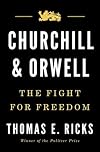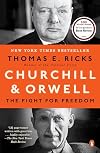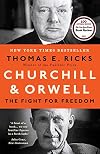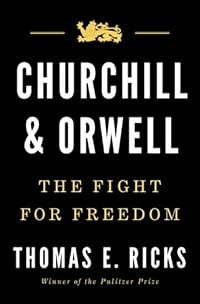
Churchill and Orwell: The Fight for Freedom
by Thomas E. Ricks
On This Page
Description
A New York Times bestseller!A New York Times Book Review Notable Book of 2017
A dual biography of Winston Churchill and George Orwell, who preserved democracy from the threats of authoritarianism, from the left and right alike.
Both George Orwell and Winston Churchill came close to death in the mid-1930's—Orwell shot in the neck in a trench line in the Spanish Civil War, and Churchill struck by a car in New York City. If they'd died then, history would scarcely remember them. At the time, show more Churchill was a politician on the outs, his loyalty to his class and party suspect. Orwell was a mildly successful novelist, to put it generously. No one would have predicted that by the end of the 20th century they would be considered two of the most important people in British history for having the vision and courage to campaign tirelessly, in words and in deeds, against the totalitarian threat from both the left and the right. In a crucial moment, they responded first by seeking the facts of the matter, seeing through the lies and obfuscations, and then they acted on their beliefs. Together, to an extent not sufficiently appreciated, they kept the West's compass set toward freedom as its due north.
It's not easy to recall now how lonely a position both men once occupied. By the late 1930's, democracy was discredited in many circles, and authoritarian rulers were everywhere in the ascent. There were some who decried the scourge of communism, but saw in Hitler and Mussolini "men we could do business with," if not in fact saviors. And there were others who saw the Nazi and fascist threat as malign, but tended to view communism as the path to salvation. Churchill and Orwell, on the other hand, had the foresight to see clearly that the issue was human freedom—that whatever its coloration, a government that denied its people basic freedoms was a totalitarian menace and had to be resisted.
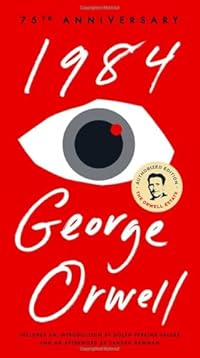
In the end, Churchill and Orwell proved their age's necessary men. The glorious climax of Churchill and Orwell is the work they both did in the decade of the 1940's to triumph over freedom's enemies. And though Churchill played the larger role in the defeat of Hitler and the Axis, Orwell's reckoning with the menace of authoritarian rule in Animal Farm and 1984 would define the stakes of the Cold War for its 50-year course, and continues to give inspiration to fighters for freedom to this day. Taken together, in Thomas E. Ricks's masterful hands, their lives are a beautiful testament to the power of moral conviction, and to the courage it can take to stay true to it, through thick and thin.
Churchill and Orwell is a perfect gift for the holidays!. show less
Tags
Recommendations







Member Reviews
"If liberty means anything at all, it means the right to tell people what they do not want to hear."
---George Orwell
This was an almost perfect read for me. It is concise and insightful and well written. It loses half a star because Ricks at times overstated his case. I loved the format which alternated chapters between these two very different men who have both left behind a legacy that is especially relevant in today's political climate. Ricks starts with a brief history of each man and then follows them into and through WWII. What is especially interesting is that Orwell kept a diary throughout his life, and so he commented on Churchill often. In fact:
"The last article George Orwell would ever complete and publish was a review of the show more second volume of Churchill's war memoirs, Their Finest Hour. He was appreciative of the politician, despite the vast difference in their political views:
"The political reminiscences which he has published from time to time have always been a great deal above average, in frankness as well as in literary quality. Churchill is among other things a journalist, with a real if not very discriminating feeling for literature, and he also has a restless, enquiring mind, interested in both concrete facts and in the analysis of motives, sometimes including his own motives. In general, Churchill's writings are more like those of a human being than of a public figure."
My favorite parts of the book were those that focused on Orwell, but then I have a thing for Orwell, and I have read a lot of his writing. Ricks does an excellent job of showing how Orwell'w writing grew with his life's experiences, and how Spain was a turning point for him:
"What he saw in the Spanish Civil War in 1937 would inform all his subsequent work. There is a direct line from the streets of Barcelona in 1937 to the torture chambers of 1984....Orwell, arriving home, had become the writer we know today from Animal Farm and 1984. Burma had made him an anti-imperialist, but it was his time in Spain that developed his political vision and with it the determination to criticize right and left with equal vigor. Before Spain, he had been a fairly conventional leftist, arguing that fascism and capitalism were essentially the same. Until this point, Orwell still clung to some of the views of the 1930s left. He would leave Spain resolved to oppose the abuse of power at both ends of the political spectrum."
The book is a mere 339 pages (with the last 60 of these being the notes and acknowledgements), but it packs a punch. Well worth your time if you are at all interested in the subject. Ricks has put together a unique and very interesting narrative that will pull you right into its pages. show less
---George Orwell
This was an almost perfect read for me. It is concise and insightful and well written. It loses half a star because Ricks at times overstated his case. I loved the format which alternated chapters between these two very different men who have both left behind a legacy that is especially relevant in today's political climate. Ricks starts with a brief history of each man and then follows them into and through WWII. What is especially interesting is that Orwell kept a diary throughout his life, and so he commented on Churchill often. In fact:
"The last article George Orwell would ever complete and publish was a review of the show more second volume of Churchill's war memoirs, Their Finest Hour. He was appreciative of the politician, despite the vast difference in their political views:
"The political reminiscences which he has published from time to time have always been a great deal above average, in frankness as well as in literary quality. Churchill is among other things a journalist, with a real if not very discriminating feeling for literature, and he also has a restless, enquiring mind, interested in both concrete facts and in the analysis of motives, sometimes including his own motives. In general, Churchill's writings are more like those of a human being than of a public figure."
My favorite parts of the book were those that focused on Orwell, but then I have a thing for Orwell, and I have read a lot of his writing. Ricks does an excellent job of showing how Orwell'w writing grew with his life's experiences, and how Spain was a turning point for him:
"What he saw in the Spanish Civil War in 1937 would inform all his subsequent work. There is a direct line from the streets of Barcelona in 1937 to the torture chambers of 1984....Orwell, arriving home, had become the writer we know today from Animal Farm and 1984. Burma had made him an anti-imperialist, but it was his time in Spain that developed his political vision and with it the determination to criticize right and left with equal vigor. Before Spain, he had been a fairly conventional leftist, arguing that fascism and capitalism were essentially the same. Until this point, Orwell still clung to some of the views of the 1930s left. He would leave Spain resolved to oppose the abuse of power at both ends of the political spectrum."
The book is a mere 339 pages (with the last 60 of these being the notes and acknowledgements), but it packs a punch. Well worth your time if you are at all interested in the subject. Ricks has put together a unique and very interesting narrative that will pull you right into its pages. show less
Well-written and informative, this dual biography is a good introduction to both of these influential 20th Century figures. It motivates me to want to want to go beyond the essays and read Homage to Catalonia and the late novels for which Orwell is best known. And to pick up a full-length biography of Churchill.
A combined biography of Churchill and Orwell that is well worth reading. Like the author, both men were war correspondents: both left a lasting impact. I always thought it was a shame that Churchill was re-elected in 1951, although he craved the job, he was too old to have the same influence. Ricks agrees. Just as it was a pity that Orwell didn't live long enough to appreciate the tremendous legacy he handed down.
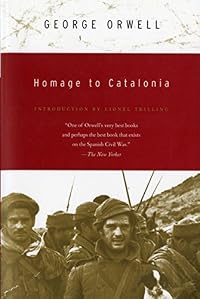
When the National Review, a conservative magazine, compiled a list of the most significant non-fiction books of the 20th century, Homage to Catalonia and The Collected Essays were in the top ten, Orwell being the only author to achieve the honour of having two books listed in the group. At the top of the list was Churchill's show more WWII memoirs. Ricks intentionally includes this significant information twice, at the beginning and again near the end.
Ricks, an American, is able to take an objective, cosmopolitan view of the two Britons, and writes with clarity and frankness - a style of which both his subjects would approve. Whether the reader is familiar with either man or not, it's an intensely interesting book and in fact difficult to put down. Highly recommended. show less
When the National Review, a conservative magazine, compiled a list of the most significant non-fiction books of the 20th century, Homage to Catalonia and The Collected Essays were in the top ten, Orwell being the only author to achieve the honour of having two books listed in the group. At the top of the list was Churchill's show more WWII memoirs. Ricks intentionally includes this significant information twice, at the beginning and again near the end.
Ricks, an American, is able to take an objective, cosmopolitan view of the two Britons, and writes with clarity and frankness - a style of which both his subjects would approve. Whether the reader is familiar with either man or not, it's an intensely interesting book and in fact difficult to put down. Highly recommended. show less
A fantastic dual biography that traces the disparate paths taken to a common anti-totalitarianism by these giants of the twentieth century, and also their reputations after death.
From the mid-1920s onward, aristocratic politician and writer Winston Churchill was a right-wing democratic capitalist. During the same period, little-known novelist and journalist George Orwell was a left-wing democratic socialist. Before, during, and after World War II, both Englishmen were convinced of the wrongs of Hitler's Nazism and Stalin's communism, and both fought them in their own ways through words and deeds.
For an earlier take on this topic, see The Two Winstons, the final episode of Simon Schama's great documentary, A History of Britain.
From the mid-1920s onward, aristocratic politician and writer Winston Churchill was a right-wing democratic capitalist. During the same period, little-known novelist and journalist George Orwell was a left-wing democratic socialist. Before, during, and after World War II, both Englishmen were convinced of the wrongs of Hitler's Nazism and Stalin's communism, and both fought them in their own ways through words and deeds.
For an earlier take on this topic, see The Two Winstons, the final episode of Simon Schama's great documentary, A History of Britain.
Writing a biography of two different people in the same book seems like a hard thing to do, but Thomas Ricks pulls it off in Churchill and Orwell:the Fight for Freedom. Both men were against totalitarianism and both were influential. While Churchill was more famous during his lifetime the legacy of Orwell's books may last longer. Both Churchill and Orwell almost died before their greatest accomplishments. Churchill was hit by a car while crossing a street in New York and spent weeks in the hospital with multiple broken bones. He looked to the right(which would have worked in England) and stepped in front of a car coming from the left. Orwell was shot through the neck while fighting in with the Republicans in the Spanish Civil War. The show more bullet missed his spine and his arteries by millimeters and he lived to write his greatest works.
Both men were persistent. Churchill encouraged England to fight when many of his Party wanted to surrender to the Nazis. Orwell, whose real name was Eric Blair, never gave up when his writing career when sales were few and publishers reluctant. Both fought for the freedom of the individual against totalitarianism. Both were ahead of their peers is seeing reality. show less
Both men were persistent. Churchill encouraged England to fight when many of his Party wanted to surrender to the Nazis. Orwell, whose real name was Eric Blair, never gave up when his writing career when sales were few and publishers reluctant. Both fought for the freedom of the individual against totalitarianism. Both were ahead of their peers is seeing reality. show less
Like many others, I found Thomas Ricks' paired biography of statesman Winston Churchill and author George Orwell to be an odd pairing, given that they apparently never met and had no direct connection. There were some parallels which Ricks tried to draw, but even without that, I enjoyed reading and hearing about each man, in his own sphere of influence. Churchill we all know as a statesman and Prime Minister of Great Britain during World War II, and Orwell as the author of "Animal Farm" and "1984". But Ricks goes beyond those points in his book, and points out how each man, in his own way, stood up to those who misused their power and oppressed others.
This an excellent joint biography of two of the most influential 20th-century figures. While certainly not exhaustive, this book provides an overview of the lives of both Winston Churchill and George Orwell, delving into each's careers as the themes of war, politics, and personal liberties are explored. This is a very timely book for those interested connecting current politics to history and I enjoyed the conclusion's connections of the book's themes to contemporary issues.
Members
- Recently Added By
Published Reviews
ThingScore 100
According to Ricks, both Winston Churchill and George Orwell lived through World War II and had a shared outlook on the war. "At a time not unlike today — when people were wondering whether democracy was sustainable, when a lot of people thought you needed authoritarian rule, either from the right or the left — Orwell and Churchill, from their very different perspectives, come together on show more a key point: We don't have to have authoritarian government." show less
added by danielx
both men’s “dominant priority, a commitment to human freedom, gave them common cause”. They didn’t need any personal interaction to be kindred spirits in the struggles against Hitler’s Nazism and Stalin’s Marxism-Leninism. “They responded with the same tools — their intellects, their confidence in their own judgements even when those judgements were rebuked by most of their show more contemporaries, and their extraordinary skill with words. And both steered by the core principles of liberal democracy: freedom of thought, speech, and association.” show less
added by danielx
Churchill and Orwell never met, Ricks writes separate biographies and then works hard to deliver a common theme. He succeeds because these two men made cases for individual freedom better than anyone in their century.
added by danielx
Lists

Dual Biographies
38 works; 1 member
Author Information

13+ Works 5,514 Members
Thomas E. Ricks lives outside Washington, D.C., with his wife and children. Pulitzer Prize-winning journalist Thomas E. Ricks was born in Massachusetts in 1955, and graduated from Yale University in 1977. Prior to becoming the Washington Post's Pentagon and military correspondent in 2000, he was a Wall Street Journal reporter for 17 years. He has show more written several books and other publications on defense matters, including Making the Corps, which won the Washington Monthly's Political Book of the Year award, the New York Times bestseller Fiasco: The American Military Adventure in Iraq, and The Gamble: General David Petraeus and the American Military Adventure in Iraq, 2006-2008. Ricks lectures frequently to the military and is a senior fellow at the Center for a New American Security. He is also a member of Harvard University's Senior Advisory Council on the Project on U.S. Civil-Military Relations, the Inter-University Seminar on Armed Forces and Society, and the International Institute for Strategic Studies. (Bowker Author Biography) show less
Some Editions
Awards and Honors
Common Knowledge
- Canonical title
- Churchill and Orwell: The Fight for Freedom
- Original publication date
- 2017
- People/Characters
- Winston Churchill; George Orwell; Randolph Churchill; Jennie Churchill; Violet Bonham Carter (as Violet Asquith); Clementine Hozier (show all 22); Oswald Mosley; Stanley Baldwin; Thomas Jones, CH; Neville Chamberlain; Adolf Hitler; Ernest Hemingway; Joseph P. Kennedy, Sr.; Franklin Delano Roosevelt; Harry Hopkins; Alan Brooke, 1st Viscount Alanbrooke; David Astor; Enoch Powell; Samuel Eliot Morison; John Stuart Mill; Winston Smith; Malcolm Muggeridge
- Important events
- World War II
- Dedication
- Dedicated to all those who seek to preserve our freedoms
- First words
- On December 13, 1931, a fifty-seven-year-old English politician, still a member of Parliament but quite unwelcome in his own party's government, stepped out of a taxi on New York's Fifth Avenue.
- Last words
- (Click to show. Warning: May contain spoilers.)He would no doubt have been a powerful critic of such things.
Classifications
- Genres
- History, Biography & Memoir, General Nonfiction, Nonfiction, Literature Studies and Criticism
- DDC/MDS
- 941.084092 — History & geography History of Europe British Isles Historical periods of British Isles 1837- Period of Victoria and House of Windsor 1936-1945
- LCC
- DA566.9 .C5 .R542 — History of Europe, Asia, Africa and Oceania Great Britain History of Great Britain England History By period Modern, 1485- 20th century
- BISAC
Statistics
- Members
- 661
- Popularity
- 43,344
- Reviews
- 18
- Rating
- (3.89)
- Languages
- Chinese, English, Portuguese (Portugal), Spanish
- Media
- Paper, Audiobook, Ebook
- ISBNs
- 20
- ASINs
- 3