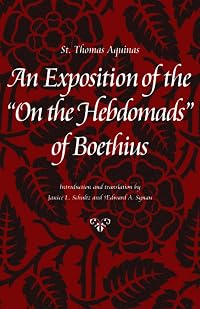
An Exposition of the On the Hebdomads of Boethius (Thomas Aquinas in Translation)
by Thomas Aquinas
On This Page
Description
The English translation itself, in facing-page format with the 1992 Leonine critical edition of Aquinas's Latin text, remains faithful to the text and at the same time clear and readable.Tags
Recommendations






Members
- Recently Added By
Author Information

2,199+ Works 27,964 Members
Thomas Aquinas, the most noted philosopher of the Middle Ages, was born near Naples, Italy, to the Count of Aquino and Theodora of Naples. As a young man he determined, in spite of family opposition to enter the new Order of Saint Dominic. He did so in 1244. Thomas Aquinas was a fairly radical Aristotelian. He rejected any form of special show more illumination from God in ordinary intellectual knowledge. He stated that the soul is the form of the body, the body having no form independent of that provided by the soul itself. He held that the intellect was sufficient to abstract the form of a natural object from its sensory representations and thus the intellect was sufficient in itself for natural knowledge without God's special illumination. He rejected the Averroist notion that natural reason might lead individuals correctly to conclusions that would turn out false when one takes revealed doctrine into account. Aquinas wrote more than sixty important works. The Summa Theologica is considered his greatest work. It is the doctrinal foundation for all teachings of the Roman Catholic Church. show less
Classifications
- Genres
- Philosophy, Nonfiction, Religion & Spirituality, Literature Studies and Criticism
- DDC/MDS
- 189 — Philosophy & psychology Ancient, medieval & eastern philosophy Medieval western philosophy
- LCC
- PA6231 .Q7 .T48 — Language and Literature Greek language and literature. Latin language and literature Roman literature Individual authors
- BISAC
Statistics
- Members
- 30
- Popularity
- 929,565
- Languages
- English, Latin
- Media
- Paper, Ebook
- ISBNs
- 4