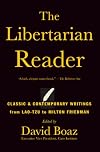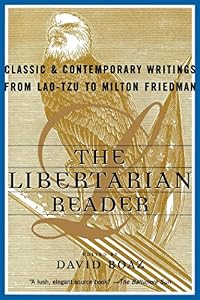
The Libertarian Reader: Classic and Contemporary Writings from Lao Tzu to Milton Friedman
by David Boaz (Editor)
On This Page
Description
The first collection of seminal writings on a movement that is rapidly changing the face of American politics, The Libertarian Reader links some of the most fertile minds of our time to a centuries-old commitment to freedom, self-determination, and opposition to intrusive government. A movement that today counts among its supporters Steve Forbes, Nat Hentoff, and P.J. O'Rourke, libertarianism joins a continuous thread of political reason running throughout history. In The Libertarian Reader, show more David Boaz has gathered the writers and works that represent the building blocks of libertarianism. These individuals have spoken out for the basic freedoms that have made possible the flowering of spiritual, moral, and economic life. For all independent thinkers, this unique sourcebook will stand as a classic reference for years to come, and a reminder that libertarianism is one of our oldest and most venerable American traditions. show lessTags
Recommendations














Member Reviews
I am not rating it low because it was a bad book. I am glad to have read through it because it gave me some exposure to ideas I do not often get exposed to. These days, it is very hard to tell apart conservatives, libertarians, classical liberals, and other labels. If you want to get a good sampling of what it is to be libertarian and what readings and authors helped to create and influence libertarianism, then this is a good primer to go. It contains a selection of short pieces by writers including but not limited to Friedman, Locke, Paine, von Mises, and Mencken. So, there are the authors you would expect, but there are also some you may not think of as libertarians right away. The book is organized by themes, which I think may help show more some readers find what they may be really interested in, say "individual rights" (part 3) or "free markets and voluntary order" (part 5). I would say this is a book to pick up, read a bit here, another bit there. It is not really a book to read cover to cover. Some of the essays can be a bit dry and the prose a bit thick. So, take it small doses, and as a reader, that was why I gave it the two stars. This is not a book that will take off when you get to it. But, with an open mind and going a little at a time, you may learn a thing or two. If you want exposure to the ideas, but you don't want to go find the full works of these authors and thinkers, this is the book for you. However, if you do feel encouraged to read more from these authors and thinkers, that can only be a good thing. I think this, along with similar books on other political ideas, belongs in every library, especially public libraries and then academic libraries. show less
A great introduction to Libertarian thinking
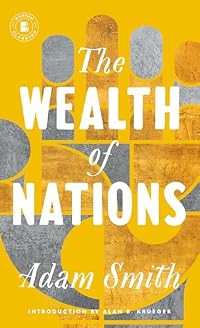
From Adam Smith to Friedman, dozens of writings present the cornerstones of libertarianism: Life, Liberty and Property. Also useful are the recommended readings
From Adam Smith to Friedman, dozens of writings present the cornerstones of libertarianism: Life, Liberty and Property. Also useful are the recommended readings
An assortment of pieces that examine the breadth of libertarian ideas. Essays on individualism, individual rights, free markets, spontaneous order, the future of libertarianism, and other subjects are included.
This is a voluminous reader of classic and contemporary writings on libertarian thought.
Tocqueville warned that democratic nations would have milder but more comprehensive repression. It would be degrade men without tormenting them (p. 21).
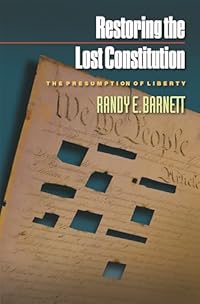
Fellow citizens! There is no matter in respect to which, the people of the North have allowed themselves to be so ruinously imposed upon, as that of the proslavery character of the Constitution. In that instrument I hold there is neither warrant, license, nor sanction of the hateful things; but, interpreted as it ought to be interpreted, the Constitution is a glorious liberty document. Read its preamble, consider its purposes. Is slavery among them? Is it at the gateway? Or is it in the temple? It is show more neither. Well I do not intend to argue this question on the present occasion, let me ask, if it be not somewhat singular that, if the Constitution were intended to be, By the framers in adopters, the slaveholding instrument, why neither slavery, slaveholding, North Layton anywhere be found in it. What would be thought of an instrument, drawn up, legally drawn up, for the purpose of an titling the city of Rochester to a track of land, in which no mention of land was made?
Now, take the Constitution according to explain reading, and I defied the presentation of a single proslavery clause in it. On the other hand it will be found to contain principles and purposes, entirely hostile to the existence of slavery (pp. 86-87). show less
Tocqueville warned that democratic nations would have milder but more comprehensive repression. It would be degrade men without tormenting them (p. 21).
Fellow citizens! There is no matter in respect to which, the people of the North have allowed themselves to be so ruinously imposed upon, as that of the proslavery character of the Constitution. In that instrument I hold there is neither warrant, license, nor sanction of the hateful things; but, interpreted as it ought to be interpreted, the Constitution is a glorious liberty document. Read its preamble, consider its purposes. Is slavery among them? Is it at the gateway? Or is it in the temple? It is show more neither. Well I do not intend to argue this question on the present occasion, let me ask, if it be not somewhat singular that, if the Constitution were intended to be, By the framers in adopters, the slaveholding instrument, why neither slavery, slaveholding, North Layton anywhere be found in it. What would be thought of an instrument, drawn up, legally drawn up, for the purpose of an titling the city of Rochester to a track of land, in which no mention of land was made?
Now, take the Constitution according to explain reading, and I defied the presentation of a single proslavery clause in it. On the other hand it will be found to contain principles and purposes, entirely hostile to the existence of slavery (pp. 86-87). show less
Ratings
Members
- Recently Added By
Author Information

David Boaz is Executive Vice President of the Cato Institute, described by Rolling Stone as "the hottest think-tank in Washington." He is the editor of The Libertarian Reader. His articles have appeared in The New York Times, The Wall Street Journal, The Washington Post, and the Los Angeles Times. He lives in Washington, D.C.
Some Editions
Classifications
- Genres
- Nonfiction, Politics and Government, General Nonfiction, Philosophy, Economics
- DDC/MDS
- 320.512 — Society, Government, and Culture Political science Types of Government Political ideologies Liberalism Traditional
- LCC
- JC585 .L3898 — Political Science Political theory Political theory. The state. Theories of the state Purpose, functions, and relations of the state
- BISAC
Statistics
- Members
- 437
- Popularity
- 70,004
- Reviews
- 4
- Rating
- (3.83)
- Languages
- English, Latvian
- Media
- Paper, Ebook
- ISBNs
- 7
- ASINs
- 3