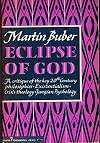
Eclipse of God: Studies in the Relation Between Religion and Philosophy
by Martin Buber
On This Page
Description
Biblical in origin, the expression "eclipse of God" refers to the Jewish concept of hester panim, the act of God concealing his face as a way of punishing his disobedient subjects. Though this idea is deeply troubling for many people, in this book Martin Buber uses the expression hopefully-for a hiding God is also a God who can be found.First published in 1952, Eclipse of God is a collection of nine essays concerning the relationship between religion and philosophy. The book features Buber's show more critique of the thematically interconnected-yet diverse-perspectives of Soren Kierkegaard, Hermann Cohen, C.G. Jung, Martin Heidegger, and other prominent modern thinkers. Buber deconstructs their philosophical conceptions of God and explains why religion needs philosophy to interpret what is authentic in spiritual encounters. He elucidates the religious implications of the I-Thou, or dialogical relationship, and explains how the exclusive focus on scientific knowledge in the modern world blocks the possibility of a personal relationship with God.Featuring a new introduction by Leora Batnitzky, Eclipse of God offers a glimpse into the mind of one of the modern world's greatest Jewish thinkers. show lessTags
Recommendations










































Member Reviews
critique of 20th c philosophies
Ratings
Members
- Recently Added By
Author Information

244+ Works 12,935 Members
Martin Buber was born in Vienna, the son of Solomon Buber, a scholar of Midrashic and medieval literature. Martin Buber studied at the universities of Vienna, Leipzig, Zurich, and Berlin, under Wilhelm Dilthey and Georg Simmel. As a young student, he joined the Zionist movement, advocating the renewal of Jewish culture as opposed to Theodor show more Herzl's political Zionism. At age 26 he became interested in Hasidic thought and translated the tales of Nahman of Bratslav. Hasidism had a profound impact on Buber's thought. He credited it as being the inspiration for his theories of spirituality, community, and dialogue. Buber is responsible for bringing Hasidism to the attention of young German intellectuals who previously had scorned it as the product of ignorant eastern European Jewish peasants. Buber also wrote about utopian socialism, education, Zionism, and respect for the Palestinian Arabs, and, with Franz Rosenzweig, he translated the Bible. He was appointed to a professorship at the University of Frankfurt in 1925, but, when the Nazis came to power, he received an appointment at the Hebrew University of Jerusalem. Buber died in 1965. (Bowker Author Biography) show less
Some Editions
Series
Belongs to Publisher Series
Common Knowledge
- Original title
- Gottesfinsternis
- Original publication date
- 1953
- First words
- I shall tell about two talks.
- Last words
- (Click to show. Warning: May contain spoilers.)His little "Abraxas" opus, which every unprejudiced reader will take to be not a poem as he says, but a confession, I have mentioned because here there is already proclaimed in all clarity the ambivalent Gnostic "God" who balances good and evil in Himself.
- Original language
- German
Classifications
- Genres
- Philosophy, Religion & Spirituality, Nonfiction
- DDC/MDS
- 201 — Religion The Bible & Christianity Religious mythology, general classes of religion, interreligious relations and attitudes, social theology
- LCC
- BL51 .B82 — Philosophy, Psychology and Religion Religions. Mythology. Rationalism Religions. Mythology. Rationalism Philosophy of religion. Psychology of religion. Religion
- BISAC
Statistics
- Members
- 409
- Popularity
- 75,540
- Reviews
- 1
- Rating
- (4.06)
- Languages
- 7 — Czech, Dutch, English, German, Italian, Portuguese, Spanish
- Media
- Paper, Ebook
- ISBNs
- 21
- ASINs
- 19