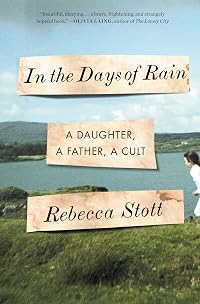
In the Days of Rain
by Rebecca Stott
On This Page
Description
"Rebecca Stott both adored and feared her father, Roger Stott, a high-ranking minister in the Brighton, England, branch of the Exclusive Brethren, a separatist fundamentalist Christian sect. A man of contradictions, he preached that the Brethren should shun the outside world, which was ruled by Satan, yet he kept a radio in the trunk of his car and read Shakespeare and Yeats. Years later, when the Stotts broke with the Brethren after a scandal involving the cult's leader, Roger became an show more actor and compulsive gambler who left the family penniless and ended up in jail....In the Days of Rain is Rebecca Stott's attempt to make sense of her childhood in the Exclusive Brethren, to understand her father's role in the cult and in the breaking apart of her family, and to come to be at peace with her relationship with a larger-than-life figure whose faults were matched by a passion for life, a thirst for knowledge, and a love of literature and beauty. A father-daughter story as well as a memoir of growing up in a closed-off community and then finding a way out of it, this is an inspiring and beautiful account of the bonds of family and the power of self-invention."--Jacket . show lessTags
Recommendations





Member Reviews
I received a copy of this memoir from the publisher via NetGalley. I requested it after reading a review in the Guardian and am glad I did so.
The author tells the story of her childhood growing up in the Exclusive Brethren church, where her father (and her grandfather) was a preacher and a priest. As a result of the increasingly extreme teachings of the leader of the worldwide Exclusive Brethren during the 1960s, the denomination became more or less a cult. Then, after scandalous sexual behaviour and alcoholism on the part of the leader, the church imploded and Rebecca's father took them out of the Brethren church altogether.
The memoir is written after the death of Rebecca's father. He has been unable to finish his planned memoir and show more Rebecca has felt obliged to take over the task. For the most part I found this an interesting read, and at times it was fascinating. The author manages to portray her father with affection, but without glossing over his (sometimes appalling) behaviour.
I learnt a lot about Brethren theology and the position of women in the church. It is astonishing to me that, even when more or less everything was forbidden, alcohol was still allowed. The author was very good at describing how confused and adrift she felt after the adults in her life turned away from what she had been told was absolute truth.
On the other hand, I was frustrated by the limits of what the memoir revealed. I really wanted to hear Rebecca's mother's side of the story and how what happened affected her siblings. What was the stepmother's story? What had her father truly believed? Had he never believed? If so, what about the "Mere Christianity" conversion experience? If he had once believed, was it merely in the specific teachings of the leader? Why did he never join another church, as Rebecca's mother did?
The section dealing with the downfall of the church leader was told partly in a transcript of a portion of a mad drunken speech and partly by witness statements. Although I had no sympathy for him or his behaviour, including the transcript seemed underhand in some way - it made me feel uneasy. The witness accounts about Mrs Ker, on the other hand were so sterile as to be unenlightening. What were the witnesses thinking? What was their plan?
My ARC has several typos etc, which I hope will be picked up. show less
The author tells the story of her childhood growing up in the Exclusive Brethren church, where her father (and her grandfather) was a preacher and a priest. As a result of the increasingly extreme teachings of the leader of the worldwide Exclusive Brethren during the 1960s, the denomination became more or less a cult. Then, after scandalous sexual behaviour and alcoholism on the part of the leader, the church imploded and Rebecca's father took them out of the Brethren church altogether.
The memoir is written after the death of Rebecca's father. He has been unable to finish his planned memoir and show more Rebecca has felt obliged to take over the task. For the most part I found this an interesting read, and at times it was fascinating. The author manages to portray her father with affection, but without glossing over his (sometimes appalling) behaviour.
I learnt a lot about Brethren theology and the position of women in the church. It is astonishing to me that, even when more or less everything was forbidden, alcohol was still allowed. The author was very good at describing how confused and adrift she felt after the adults in her life turned away from what she had been told was absolute truth.
On the other hand, I was frustrated by the limits of what the memoir revealed. I really wanted to hear Rebecca's mother's side of the story and how what happened affected her siblings. What was the stepmother's story? What had her father truly believed? Had he never believed? If so, what about the "Mere Christianity" conversion experience? If he had once believed, was it merely in the specific teachings of the leader? Why did he never join another church, as Rebecca's mother did?
The section dealing with the downfall of the church leader was told partly in a transcript of a portion of a mad drunken speech and partly by witness statements. Although I had no sympathy for him or his behaviour, including the transcript seemed underhand in some way - it made me feel uneasy. The witness accounts about Mrs Ker, on the other hand were so sterile as to be unenlightening. What were the witnesses thinking? What was their plan?
My ARC has several typos etc, which I hope will be picked up. show less
‘I was raised in a cult,’ I’d say, and then I’d recoil, embarrassed by the melodrama of the words I’d used. Were the Brethren a cult? I didn’t know. What was the difference between a sect and a cult? Was there a point on a spectrum where a sect became a cult? ‘We wore headscarves,’ I’d say. ‘We weren’t allowed to cut our hair. We weren’t allowed television, newspapers, radios, cinemas, holidays, pets, wristwatches.’ The list of prohibitions always seemed endless. I’d watch people’s eyes open wider. They’d look at me askance, then compete to ask questions, and I’d think, Oh no, not this again. ‘We weren’t allowed to talk to the other children at school,’ I’d say. ‘They told us that everyoneshow more
outside the Brethren was part of Satan’s army and they were all out to get us. They called them “worldly”, or “worldlies”. If you didn’t do exactly what they said, they’d expel you. Then your family wouldn’t be allowed to speak to you ever again. People committed suicide. People went mad. Yes, this was Brighton. Yes, this was Brighton in the sixties. Yes, during flower power. In the suburbs. During the sexual revolution. Yes. It’s hard to explain.’ ‘You were raised Plymouth Brethren?’ people would say. They would have heard about the Plymouth Brethren. Some might even have read Father and Son, Edmund Gosse’s beautiful memoir about growing up in a nineteenth-century Plymouth Brethren assembly. And I’d hear myself reply with a hint of superiority, ‘We weren’t Plymouth Brethren. We were Exclusive Brethren.’
This is, mainly but not wholly, due to the author's style, a very special book on life inside of and having left a cult. Rebecca Stott's father was high up in the hierarchy of this cult, and tells of it, her parents, their parents, her father's life with her, and of his dying, while packaging it all in a very exquisite and personal fashion.
If she would have written this in a less interesting style, I would not have thought much of it, but thanks to it, this book borders on getting a 4/5 grade.
She is not a martyr, nor a person who tries to state that the life she has lived is extremely noteworthy. To me, that's a relief. She can even laugh at herself, and ridicule the life she has led, but simultaneously put weight behind value and words, and thus, this tome is laudable.
At times, this book is nearly poetic in style.
My family hadn’t belonged to the Brethren, we’d been caught up in them. Caught up like a coat catching on thorns. Caught up in a scandal. Caught up in the arms of the Lord. Whichever way you phrased it, it meant you didn’t get to choose, and that there was no getting away.
There was one particular line I’d listen out for in my father’s preaching, a line that had especially beautiful rhythms. An important Brethren sister from the early Ireland days had once said, ‘Let us put away our playthings for the world is in flames’ – and that line, dark and poetic, had been passed down among Brethren over the years. My father loved it. He wouldn’t just use it once; he’d repeat it for effect. When I was six years old I watched him repeat it five times. I whispered each of the words along with him under my breath, anticipating where he was going to put the next stress, or the next long pause, keeping a close eye on my grandfather down in the front row opposite me to see, from his expression, if my father would get away with it.
It's often quite startling to read of how watched and brainwashed the cult members, called "Brethren", were.
Brethren were expected to live in detached houses as near to the local Meeting Room as possible, because detached houses minimised contact with worldly people, and proximity kept the local fellowship close and in sight.
Many ex-Brethren I’ve talked to describe the fifties as a golden age in Brethren life. It was only when Jim Taylor Junior took over as Man of God in 1959 that things went wrong. He ruined it all, they imply. He was an aberration, a monster. He made good people do unspeakable things. But even in the fifties, I can see, there were already serious prohibitions in place: No cinemas, theatres, circuses, music halls. No sports halls. No radios or television sets. Friendships with non-Brethren – tolerated but not encouraged. No trade unions. No sex before marriage. No trousers for women or short skirts. No fashionable clothes. No tabloid newspapers. No thrillers or modern novels. No short hair. Within five years the prohibition list would have grown to four or five times this length. Within ten years it would be at least twenty times as long.
The details do greatly paint the picture:
‘If you talked to a Christian from outside they’d use words that would jar with you,’ he said. ‘Brethren have a vocabulary and a way of talking about things that becomes the truth to you. It’s been worked out over many years. So if somebody else comes in and starts talking about Jesus in a way that’s off-key, it makes you feel ill at ease and out of place, so you’re actually quite grateful to get away from that worldly wedding and back amongst people who speak the same language as you.’ ‘What kind of off-key?’ I asked, though I knew exactly what he meant. People still seem off-key to me out here in the world, even though I’ve lived among non-Brethren more than five times longer than I lived among Brethren. It often feels as if the words I’ve learned to speak since then don’t stretch far enough, don’t describe the things I feel or imagine well enough. The things that crowd the dark, for instance, or flicker at the edges of my vision, have no name. ‘It wasn’t just phrases or ways of speaking,’ my father said. ‘It was ways of dressing and behaving as well. If an interloper got in, say a journalist passing himself off as a Brethren visitor, he’d break subtle rules and codes of conduct so that people would know he wasn’t a proper member of the Brethren immediately. There was a real tribal sensitivity. My father used to say that when he was driving to a Meeting in a strange town, he could spot the Brethren sisters walking along the road. He’d say it was the Spirit telling him, but I always used to think it was their hats.’
Also, it's interesting to read of Stott's hearing of voices from the time when she was a small child, which does not actually indicate mental issues, but is something that comes naturally with brainwashing and mantras:
I heard voices too as a child, sometimes when my head tipped to a particular angle, or when I was falling asleep or had just woken: loud, soft, haranguing, enticing, sometimes in English, sometimes in a language I did not recognise. They were very similar to the voices my father described, though he seems to have heard primarily Brethren mantras and scriptures. Eventually, of course, my father would recite those same words himself when he preached. Repetition of simplified mantras and maxims, social psychologists have proved, is one of the key methods of indoctrination; it affects the physiology of neurological pathways, particularly in teenagers, whose brains are still growing.13 It’s a powerful form of brainwashing. And of course my father’s exceptional IQ and photographic memory made it very hard to silence those voices once they got in his head. In the sixth form my father’s Brethren voices were telling him that Yeats and Shakespeare were a frivolous waste of time, that all the apparent vistas that were opening to him were carnal and corrupt, ‘the pleasures of sin for a season’. He veered from one way of seeing to the other. ‘One was graven on stone,’ he wrote, ‘the other rippled like water. One asserted, the other side sang and whispered, beguiled, suggested, asked questions, claimed nothing, resonated.’
Stott doesn't paint leaving the cult as something black-and-white; being taught to fear the Devil and to love God at *all* times is not something one can easily just shake off:
A decade later, a long-running story on The Archers finally prompted that conversation. Heavily pregnant Helen Archer had stabbed her controlling husband with a kitchen knife after years of isolation and mental abuse. She was arrested. The audience for the show grew by millions. There were chatrooms devoted to the storyline, and money was raised for support groups for victims of abuse. The whole country, including my daughters, then in their early twenties, seemed to be tuning in. But my daughters didn’t need me to do any explaining when the subject came up. ‘It’s called coercive control, Mum,’ Kez said. ‘They’ve passed a law about it.’ ‘Took them decades to listen to the campaigners, though,’ Hannah said, her eyes bright with anger. ‘Did you know that the law didn’t even recognise rape inside marriage until the nineteen-seventies? Un-bel-iev-ab-le.’ ‘I know,’ I said, trying to be positive. ‘But things are better for women now.’ ‘Mum, you’ve read The Handmaid’s Tale,’ Kez said. ‘You know we can’t ever take feminist progress for granted. They’ll take our freedom away again unless we protect it.’ ‘Look at what’s happening in Poland over abortion,’ said Hannah. ‘Thousands of women had to take to the streets to make the politicians scrap that Bill.’ I knew. I’d been teaching feminist theory and writing for years. I’d given my daughters copies of Margaret Atwood’s The Handmaid’s Tale as birthday presents during their teens. We’d groaned together about sexist adverts on the television, talked about equal pay and equal rights, and agreed about how important it was to stand up and make a noise when you thought something was unfair. Now they were bringing me articles to read and telling me about documentaries to watch by women of their generation. I was learning from them.
Stott goes into detail on how the leader of the cult, "JT Junior", abused his power by sexually abusing Brethren wives, but...
In a few weeks Brethren spin doctors had turned JT Junior from a lecherous alcoholic bully to a martyr, prepared to jeopardise his personal honour for the Lord’s Truth and to ensure a final necessary purge before the Rapture began. But then, just three months after Aberdeen, JT Junior died of an alcohol-related disease.
This is a wondrous description of leaving a cult:
Many people assume that leaving a cult like the Brethren must be exhilarating. ‘You had no TV or pop music or cinema,’ they say, ‘and then you did? It must have been amazing!’ But when you see interviews with people who have recently left cults, they describe feeling bewildered and frightened; their eyes dart around, searching for points of reference, metaphors that would get somewhere close to describing the feeling of being lost, not-at-home, without walls. No one, of course, shrugs off years of indoctrination in one go. Many escapees went back to the Brethren after a few weeks, not only because they missed their families – which would be reason enough – or because they didn’t have the skills to get work, but because the world frightened them. You can’t just refuse to believe that the world belongs to Satan if you’ve heard it repeated over and over since you were born. It’s under your skin. People also describe the difficulty of making choices – moral, financial, domestic, professional and emotional – because inside the Brethren there are virtually no choices to make.
Perhaps to conclude, this paragraph is great:
He took me to see a performance of Ibsen’s The Wild Duck at the National Theatre in London. I was sixteen. In the car, he explained Ibsen’s idea of the Life Lie with great care and attention. Life lies, he said, were the lies people told themselves to make life bearable. The Ekdal family in The Wild Duck, he explained – father, mother, teenage daughter, grandfather – were poor but happy. They keep going, he said, because they have delusions. The grandfather thinks he’s a great hunter. The father is convinced he’s on the verge of creating an invention that will make him famous and pay off all the family debts. The daughter thinks her father is a great man. These were their Life Lies. ‘So Ibsen,’ said my father, ‘sends in a visitor, Gregers, an old friend of the father’s. Gregers exposes all their Life Lies, and tells them a few more things they would rather not have known. Then Ibsen makes us watch what happens next. It’s not good, of course. But that’s the point: Ibsen isn’t sure we should make people see how deluded they are.’
Overall, this is akin to the recent "Jonestown" biography, but is far more poetic and existentialistic in nature. A good complement of sorts, even though this is mainly a personal book, and not a how-to-cult manual. show less
Rebecca Stott’s father had been wanting to write a memoir about his family life. For generations, his family had been members of a Christian sect that had steadily got more fundamentalist. He could only brush the surface of the past though as every time he ventured deeper into his memories the mental anguish meant that he could not carry on. When he was dying, he tried to persuade her to help him.
Rebecca had grown up in this Brethren sect too, with its draconian rules about what the members could and mostly couldn’t do, she was constrained in almost every activity that a normal child would have taken part in. They attended school but were not allowed to participate in any activities other than the learning. It was cruel too, with show more long term members being ‘denounced’ for the most arbitrary of reasons. The sect imploded to a certain extent after a sex scandal involving the American leader of the sect, JT Junior.
Her family dropped out too after this event, but because the cult had been so suffocating the family so much, they all struggled to re-connect with the normal world. The messages and culture that the cult had delivered had permeated her entire being. They began to rebuild their lives in their own way, she rebelled a little, had a child, dabbled in drugs and even managed to go to university, shoplifted and was afraid of the dark, but couldn’t even begin to tell people why this was.
The book is divided into rough thirds, “Before,” “During” and “Aftermath”, which were the piles of files and effects that she sorted through of her fathers at the time. It is pretty horrific reading at times, in particular about the levels of control that were exercised over the members, and the utter trust they had in the leaders of the cult. Just decompressing from the grip of the cult took a staggering amount of effort for them all. It is a deeply personal book, thankfully Stott writes with integrity and doesn’t try to blame anyone for her earlier life. Well worth reading for those that want a very different biography and to get some insight as to when does faith become a cult? show less
Rebecca had grown up in this Brethren sect too, with its draconian rules about what the members could and mostly couldn’t do, she was constrained in almost every activity that a normal child would have taken part in. They attended school but were not allowed to participate in any activities other than the learning. It was cruel too, with show more long term members being ‘denounced’ for the most arbitrary of reasons. The sect imploded to a certain extent after a sex scandal involving the American leader of the sect, JT Junior.
Her family dropped out too after this event, but because the cult had been so suffocating the family so much, they all struggled to re-connect with the normal world. The messages and culture that the cult had delivered had permeated her entire being. They began to rebuild their lives in their own way, she rebelled a little, had a child, dabbled in drugs and even managed to go to university, shoplifted and was afraid of the dark, but couldn’t even begin to tell people why this was.
The book is divided into rough thirds, “Before,” “During” and “Aftermath”, which were the piles of files and effects that she sorted through of her fathers at the time. It is pretty horrific reading at times, in particular about the levels of control that were exercised over the members, and the utter trust they had in the leaders of the cult. Just decompressing from the grip of the cult took a staggering amount of effort for them all. It is a deeply personal book, thankfully Stott writes with integrity and doesn’t try to blame anyone for her earlier life. Well worth reading for those that want a very different biography and to get some insight as to when does faith become a cult? show less
I would like to thank NetGalley for the opportunity to review a free advance copy of this book.
Author Rebecca Stott was raised in the separatist cult of the Exclusive Brethren from birth until a major schism saw her family finally withdraw. Stott was part of a third-generation Brethren family, and knew of no other way of life. She was forbidden all contact with outsiders and with worldly temptations such as reading novels, secular music, films; even eating in the company of outsiders was banned.
The Brethren evolved from being an isolationist Christian sect to something much darker and weirder, where members were hounded to suicide, families sundered and people withdrawn from for little or no reason. Withdrawal usually meant the loss of show more contact with all family members, and often one's livelihood.
Stott's father and grandfather were leading figures in the Brethren and played their part in these acts of intimidation and repression. After leaving the cult, her father had a crisis of faith which eventually did great damage to the family.
Stott's account of her ancestors initial involvement in the Brethren, and its gradual decline into a brutal cult is gripping and somewhat hair-raising. It is difficult to believe, as she intimates, that no doctor, teacher or other professional ever thought to intervene and ask what was going on with these people, rather than just look the other way.
The story of what happens after the family is finally extricated is both thoughtful and sad. Her own struggle to make sense of her life is ever-present, and one gets the sense that she will never entirely shake off the damage wrought by her formative years.
This book is a beautifully written account of a dark and secretive organisation, and the impact it had at a very personal level. It is moving, wise and compelling in equal measure. show less
Author Rebecca Stott was raised in the separatist cult of the Exclusive Brethren from birth until a major schism saw her family finally withdraw. Stott was part of a third-generation Brethren family, and knew of no other way of life. She was forbidden all contact with outsiders and with worldly temptations such as reading novels, secular music, films; even eating in the company of outsiders was banned.
The Brethren evolved from being an isolationist Christian sect to something much darker and weirder, where members were hounded to suicide, families sundered and people withdrawn from for little or no reason. Withdrawal usually meant the loss of show more contact with all family members, and often one's livelihood.
Stott's father and grandfather were leading figures in the Brethren and played their part in these acts of intimidation and repression. After leaving the cult, her father had a crisis of faith which eventually did great damage to the family.
Stott's account of her ancestors initial involvement in the Brethren, and its gradual decline into a brutal cult is gripping and somewhat hair-raising. It is difficult to believe, as she intimates, that no doctor, teacher or other professional ever thought to intervene and ask what was going on with these people, rather than just look the other way.
The story of what happens after the family is finally extricated is both thoughtful and sad. Her own struggle to make sense of her life is ever-present, and one gets the sense that she will never entirely shake off the damage wrought by her formative years.
This book is a beautifully written account of a dark and secretive organisation, and the impact it had at a very personal level. It is moving, wise and compelling in equal measure. show less
Rebecca Stott wrote this book because she promised her father (Roger) she would complete his memoirs after he died. She did much more than that: she made the book her own story as well.
Rebecca was born into a cult, the Exclusive Brethren. So was her father, who became a high-level official in the cult. There were strict rules about dress, and isolating from worldly things like television, radio and non-cult members. Women were not allowed to speak during services (called Meetings) and were expected to cover their heads and not cut their hair.
Rebecca's family left the Brethren when she was around10 years old. What I found particularly interesting was something other memoirs I've read didn't speak to -- the way a child, who'd been told show more one thing for her whole life was now expected to believe differently. Watching TV and listening to music was more of a scary undertaking than an entertaining one at first.
Roger knew he was dying and wanted to write his memoirs, but found himself unable to write about his years as a Brethren priest when he forced members to confess to impure deeds or thoughts and enforced isolation from family and friends until the person was "cleansed".
The book provides a look at living in a cult, leaving one, and an honest look at the father-daughter relationship, both the good and the more challenging aspects. show less
Rebecca was born into a cult, the Exclusive Brethren. So was her father, who became a high-level official in the cult. There were strict rules about dress, and isolating from worldly things like television, radio and non-cult members. Women were not allowed to speak during services (called Meetings) and were expected to cover their heads and not cut their hair.
Rebecca's family left the Brethren when she was around10 years old. What I found particularly interesting was something other memoirs I've read didn't speak to -- the way a child, who'd been told show more one thing for her whole life was now expected to believe differently. Watching TV and listening to music was more of a scary undertaking than an entertaining one at first.
Roger knew he was dying and wanted to write his memoirs, but found himself unable to write about his years as a Brethren priest when he forced members to confess to impure deeds or thoughts and enforced isolation from family and friends until the person was "cleansed".
The book provides a look at living in a cult, leaving one, and an honest look at the father-daughter relationship, both the good and the more challenging aspects. show less
Such an interesting view into a cult. A group of people were are not living off in the wilderness on their own, or acting in a manner that would bring attention.
Instead, they seemed to blend into their surroundings, almost intentionally becoming invisible to English society around them. In their minds, they were "separate." But they shared a common theme with so many cults - power-hungry and unaccountable leaders.
The isolation, shame, and abuse described in this book are truly heartbreaking.
Instead, they seemed to blend into their surroundings, almost intentionally becoming invisible to English society around them. In their minds, they were "separate." But they shared a common theme with so many cults - power-hungry and unaccountable leaders.
The isolation, shame, and abuse described in this book are truly heartbreaking.
Rebecca Stott was born into a cult. So was her father. He was a high ranking official in the church called the Exclusive Brethren. An End of Times cult, they felt they had to purify themselves so they would be bodily taken up when the Rapture occurred. The rules became more restrictive through the years; not only did they restrict all information sources to the Bible and their own publications, but they limited contact with outsiders to almost nothing. Women were to be seen and not heard. Then they started attacking their own members, trying to force confessions of sin from them; they removed the victim’s family members from the house and isolated them. Some committed suicide. Businesses and jobs were lost.
Growing up in this cult, show more Stott lived a life of fear, which seems to have been common among members. Fear that she could not live up to the strict standards of the cult- which of course she equated with the strict standards of God. But when things got too bad (the church leader, J.T. Junior, who was instituting all these rules, emerged as an alcoholic and blatant womanizer, going so far as to be fondling women’s breasts in front of others), her father broke with the church. He was the last member to have been allowed to go to college and had read ‘worldly’ books. Sadly, his education did not save him from folly; he became a chronic gambler and womanizer and left his wife trying to provide for the family.
The idea for the book began when her father, Roger, found out he was dying. He wanted help in finishing his autobiography, which he had started years before. Rebecca set out to record their talking sessions, and found that while he could talk about his early life, her father could not get past the years when he, as part of the Brethren, had led interrogations of members. Something in his mind could never get past what he had done, no matter how he tried to reconcile the person who had done that with the person who had sought to do the right thing.
One part of the book tells us about the Brethren movement itself; another about her family’s part in it. Then there is her father’s life; and then her own, as she sought to outgrow the philosophy she’d grown up with. While a lot of the writing is very good, it is in places disjointed, switching between her father’s life and hers. I found myself confused in places. I also found myself getting bored with the details of the Brethren’s history. While I feel this book is important to understanding how cults work and how people become coerced and dependent in them, I feel it could have used a lot more editing. 3.5 stars out of five. show less
Growing up in this cult, show more Stott lived a life of fear, which seems to have been common among members. Fear that she could not live up to the strict standards of the cult- which of course she equated with the strict standards of God. But when things got too bad (the church leader, J.T. Junior, who was instituting all these rules, emerged as an alcoholic and blatant womanizer, going so far as to be fondling women’s breasts in front of others), her father broke with the church. He was the last member to have been allowed to go to college and had read ‘worldly’ books. Sadly, his education did not save him from folly; he became a chronic gambler and womanizer and left his wife trying to provide for the family.
The idea for the book began when her father, Roger, found out he was dying. He wanted help in finishing his autobiography, which he had started years before. Rebecca set out to record their talking sessions, and found that while he could talk about his early life, her father could not get past the years when he, as part of the Brethren, had led interrogations of members. Something in his mind could never get past what he had done, no matter how he tried to reconcile the person who had done that with the person who had sought to do the right thing.
One part of the book tells us about the Brethren movement itself; another about her family’s part in it. Then there is her father’s life; and then her own, as she sought to outgrow the philosophy she’d grown up with. While a lot of the writing is very good, it is in places disjointed, switching between her father’s life and hers. I found myself confused in places. I also found myself getting bored with the details of the Brethren’s history. While I feel this book is important to understanding how cults work and how people become coerced and dependent in them, I feel it could have used a lot more editing. 3.5 stars out of five. show less
Members
- Recently Added By
Lists

Books Read in 2018
4,360 works; 110 members

Books Read in 2021
5,361 works; 114 members

Club Read's Recommended Nonfiction Written by Women
618 works; 30 members

Reading Glasses Podcast
410 works; 3 members

Top Five Books of 2025
954 works; 303 members
Author Information

19+ Works 3,368 Members
Rebecca Stott is an affiliated scholar in the Department of History and Philosophy of Science at Cambridge University.
Awards and Honors
Awards
Distinctions
The Guardian Book of the Day (2017-06-27)
Common Knowledge
- Canonical title
- In the Days of Rain
- First words
- My father did the six weeks of his dying - raging, reciting poetry, and finally pacified by morphine - in a remote eighteenth-century windmill on the East Anglian fens.
- Last words
- (Click to show. Warning: May contain spoilers.)Four days later the owl began its slow, ghostly flight down the riverbank towards him.
- Blurbers
- Laing, Olivia; Dunant, Sarah
Classifications
- Genres
- Nonfiction, Biography & Memoir, Religion & Spirituality, General Nonfiction
- DDC/MDS
- 289.9 — Religion Christian denominations Other denominations and sects Minor Christian Sects
- LCC
- BX8809 .S76 .S76 — Philosophy, Psychology and Religion Christian Denominations Christian Denominations Protestantism Other Protestant denominations Plymouth Brethren. Darbyites
- BISAC
Statistics
- Members
- 185
- Popularity
- 175,918
- Reviews
- 10
- Rating
- (3.62)
- Languages
- English
- Media
- Paper, Audiobook, Ebook
- ISBNs
- 15
- ASINs
- 5