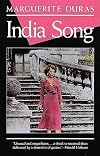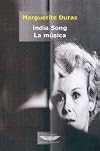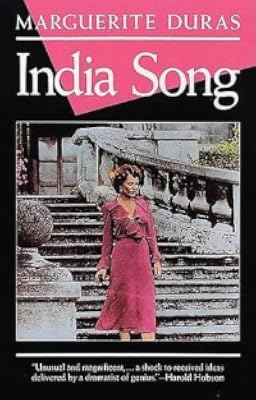
India Song
by Marguerite Duras
On This Page
Description
Marguerite Duras had already established herself as one of the major figures of postwar French literature when she launched an equally fascinating and unclassifiable career in cinema, translating her elliptical, experimental style to the screen through the unprecedented fusion of hypnotic, highly stylized imagery and radically disjunctive sound. Boldly reimagining the possibilities of dialogue, music, silence, and architectural space, the tantalizing, sphinxlike evocations of soul-deep show more female malaise India Song and Baxter, Vera Baxter embody Duras's singular multisensory approach, with each opening up new spaces for the expression of women's interior worlds -- show lessTags
Recommendations

















Member Reviews
Yes indeed, Marguerite Duras is a French literary Lars Von Trier, willingly dropping the reader into a state of doubt and unease. 'India Song' continues upon the story of [b:The Ravishing of Lol Stein|280|The Ravishing of Lol Stein|Marguerite Duras|https://d202m5krfqbpi5.cloudfront.net/books/1367749732s/280.jpg|378707] and is equally vague and disturbing.
In 'India Song', the story of Michael Richardson and Anne-Marie Stretter is elaborated upon. (Hey, at least Richardson is consistent in his choice of women. Stretter is a nutcase as well!). In true Duras style, nothing is really clear in this book. In fact, the story (if there is any to be told) is delivered by a variety of voices that have their own interests at heart. They are far show more from omniscient, trustworthy or consistent and this, of course, has its repercussions for the general experience of the book as well.
'India Song', in the end, is an intriguing little book/play, which succeeds in describing some very visceral scenes, but which is also very empty. There's nothing to describe, really. I'm out of words. show less
In 'India Song', the story of Michael Richardson and Anne-Marie Stretter is elaborated upon. (Hey, at least Richardson is consistent in his choice of women. Stretter is a nutcase as well!). In true Duras style, nothing is really clear in this book. In fact, the story (if there is any to be told) is delivered by a variety of voices that have their own interests at heart. They are far show more from omniscient, trustworthy or consistent and this, of course, has its repercussions for the general experience of the book as well.
'India Song', in the end, is an intriguing little book/play, which succeeds in describing some very visceral scenes, but which is also very empty. There's nothing to describe, really. I'm out of words. show less
slow-paced and dramatic.
Incontournable pour comprendre Duras. Tout est dans cet ouvrage, jusqu'au dégout, jusqu'à la haine. Duras a créé son univers, elle l'a sans cesse modelé, ciselé. C'est beau jusqu'à l'écoeurement..."Allongée sur un divan, mongue, très mince, presque maigre, il y a une femme habillée de noir. Très près d'elle, un homme également habillé de noir, assis.
VOIX UN (angoisse, très bas) : Anne-Marie Stretter..."
VOIX UN (angoisse, très bas) : Anne-Marie Stretter..."
French
Du pur Marguerite Duras. Des relations amoureuses compliquées, le microcosme des colons du sud asiatique. Moiteur, ennui, promiscuité. Une mise en scène pour la radio d’un scénario de film et de théâtre. On s’imagine très bien les images en noir et blanc en plan rapproché et leur lent défilement.
Le film que Marguerite Duras a tourné à partir de son roman et de sa pièce, et à la suite de cette création radiophonique qu’elle réalisa, ne correspond pas à celui que je me suis fait dans la tête à l’écoute de cette adaptation radiophonique mais je pense avoir éprouvé les mêmes sensations que celles que peuvent procurer le film.
Le film que Marguerite Duras a tourné à partir de son roman et de sa pièce, et à la suite de cette création radiophonique qu’elle réalisa, ne correspond pas à celui que je me suis fait dans la tête à l’écoute de cette adaptation radiophonique mais je pense avoir éprouvé les mêmes sensations que celles que peuvent procurer le film.
Jun 23, 2023French
Poetical tale of Anne-Marie Stretter, the wife of a French diplomat in India in the 1930s. At 18 she had married a French colonial administrator and went with him on posting to Savannakhet, Laos. There she met her second husband who took her away and for 17 years they lived in various locations in Asia. Now in Calcutta, she takes lovers to relieve the boredom in her life. Told in a highly visual style with little dialogue but a constant voice-over narrative by the different characters. (fonte: Imdb)
May 1, 2022Italian
Ratings
Members
- Recently Added By
Talk Discussions
Past Discussions
1914: Duras - India Song in Literary Centennials (January 2014)
Author Information

226+ Works 18,817 Members
Marguerite Duras was born in Gia-Dinh, Indochina on April 4, 1914. After attending school in Saigon, she moved to Paris, France to study law and political science. After graduation, she worked as a secretary in the French Ministry of the Colonies until 1941. During World War II, she joined the Resistance and published her first books. After the show more liberation, she became a member of the French Communist Party, and though she later resigned, she always described herself as a Marxist. Her first book, Les Impudents, was published in 1943. During her lifetime, she wrote more than 70 novels, plays, screenplays and adaptations. Her novels include The Sea Wall, The Lover, The Lover from Northern China, The War, and That's All. In 1959, she wrote her first film scenario, Hiroshima, Mon Amour, and has since been involved in a number of other films, including India Song, Baxter, Vera Baxter, Le Camion (The Truck), and The Lover. She died on March 4, 1996 at the age of 81. (Bowker Author Biography) show less
Work Relationships
Is contained in
Has as a student's study guide
Common Knowledge
- Original publication date
- 1973 (Original French) (Original French)
- Related movies
- India Song (1975 | IMDb | Marguerite Duras)
- Original language
- French
Classifications
Statistics
- Members
- 174
- Popularity
- 188,075
- Reviews
- 5
- Rating
- (3.13)
- Languages
- 10 — Dutch, English, Finnish, French, German, Italian, Portuguese, Romanian, Spanish, Swedish
- Media
- Paper, Ebook
- ISBNs
- 17
- UPCs
- 1
- ASINs
- 3